Investing in stocks can feel intimidating at first, especially for newcomers. But with thoughtful planning, patience, and a well-structured strategy, anyone can start building wealth and working toward financial independence. The key is to start small, keep learning, and stay disciplined as your knowledge and portfolio grow.
- Steps to Get Started for Beginners
- 1. Understand Your Financial Goals and Risk Tolerance
- 2. Determine Your Investing Style
- 3. Choose the Right Investment Account
- 4. Diversify Your Portfolio
- 5. Invest Regularly and Monitor (But Not Obsessively)
- 6. Account for Taxes and Fees
- DIY Investing vs Robo-Advisors: How to Choose
- The DIY Approach: Crafting Your Financial Future
- The Robo-Advisor Route: Streamlined Investing
- Minimum Amount to Open an Account
- The Costs to Invest in Stocks
- Types of Investment Costs
- Trading and Market Costs
- Strategies to Minimise Costs
- Choosing an Online Broker
- Practice First: Stock Market Simulators
- What to Look for in Beginner-Friendly Stocks
- Research and Expert Advice
- Investing in Stocks from Malaysia & Singapore
- Should You Invest in Stocks?
- Understanding the Risks
- Managing the Risks
- Frequently Asked Questions (FAQs)
[su_box title=”Key Steps on How to Start Investing in Stocks for Beginners” box_color=”#000877″ title_color=”#ffffff” radius=”6″]
- Set clear financial goals and understand your risk tolerance.
- Learn the differences between stocks, ETFs, mutual funds, and other assets.
- Pick an investing style: self-managed (DIY) or automated (robo-advisor).
- Choose a low-cost, regulated brokerage.
- Diversify your portfolio and invest regularly.
[/su_box]
Read also: What is the Stock Market and How It Works?
Steps to Get Started for Beginners

Stock investing is one of the most powerful tools for building long-term wealth. Here is a simplified, step-by-step guide to help beginners take those first steps with confidence.
1. Understand Your Financial Goals and Risk Tolerance
Begin by clarifying your objectives. Are you saving for retirement, building an emergency fund, or pursuing a shorter-term goal like a house down payment? Your timeline shapes how much risk you can take. A long-term goal such as retirement can tolerate more market volatility, while money you will need within a year or two belongs in safer, more liquid instruments — not stocks.
2. Determine Your Investing Style
Decide between active and passive investing. Active investors pick individual stocks and manage their own portfolios; passive investors favour low-cost index funds or ETFs for simplicity and broad diversification. If you are unsure, a low-cost robo-advisor can automate the whole process for you. For a deeper look at the mindset difference, see our guide on trading vs investing.
3. Choose the Right Investment Account
Select an account type that matches your plan. In the US these include taxable brokerage accounts, tax-advantaged retirement accounts such as IRAs and 401(k)s, and robo-advisor-managed accounts. In Malaysia and Singapore, most beginners use a standard cash brokerage account (local or international) — more on the MY/SG options further below.
4. Diversify Your Portfolio
Reduce risk by spreading your money across different stocks, sectors, and geographies. Diversification smooths out the impact of any single loser. A broad-market index fund or ETF is the simplest, most beginner-friendly way to own hundreds of companies in a single trade.
5. Invest Regularly and Monitor (But Not Obsessively)
Consistency beats timing. Investing a fixed amount every month — a strategy known as dollar-cost averaging — smooths out your entry price and removes emotion from the decision. Review your portfolio a few times a year to stay aligned with your goals, but avoid checking prices daily; short-term noise rarely matters to a long-term plan.
6. Account for Taxes and Fees
Fees and taxes quietly erode returns over decades. Favour low-cost index funds, use tax-advantaged accounts where available, and understand what your broker charges. For international investors, watch for foreign withholding taxes — the US withholds 30% on dividends paid to non-residents (see the MY/SG section below).
DIY Investing vs Robo-Advisors: How to Choose
Choosing how you will manage your money is as important as choosing what to buy. You can direct every trade yourself or hand the job to an automated robo-advisor. Here is a quick comparison:
| Feature | DIY Investing | Robo-Advisors |
|---|---|---|
| Control | High — you choose every holding. | Limited — algorithms build and rebalance for you. |
| Cost | Often lower (many $0-commission brokers), but costs your time. | A management fee (typically ~0.25%–0.50%/year), but hands-off. |
| Expertise required | Higher — you research and monitor holdings. | Low — the platform does the heavy lifting. |
| Customisation | Fully customisable portfolio. | Preset model portfolios based on your risk profile. |
| Best for | Hands-on investors who enjoy research. | Busy or brand-new investors who want simplicity. |
The DIY Approach: Crafting Your Financial Future
DIY investing appeals to those who value control and enjoy the details. By actively managing your portfolio you can tailor it precisely to your goals and keep costs low. The trade-off is time: you are responsible for research, monitoring, and rebalancing. It suits investors who are comfortable with their financial knowledge and want a hands-on role.
The Robo-Advisor Route: Streamlined Investing
Robo-advisors use algorithms to build and rebalance portfolios around your goals, risk tolerance, and time horizon. You give up control over individual picks but gain convenience and a low, predictable cost. Standardised models may not suit complex financial situations, but for most beginners a robo-advisor is an excellent, low-stress on-ramp to the market. In Malaysia and Singapore, popular robo-advisors include StashAway, Wahed, and Syfe.
Minimum Amount to Open an Account
Stock investing has never been more accessible. Most leading brokers have lowered or eliminated minimum deposit requirements, and many let you open an account with $0 and start investing with as little as $1 thanks to fractional shares.
Fractional shares let you buy a slice of a company rather than a whole share — so a stock trading at several hundred or even a few thousand dollars is still within reach on a modest budget. This is one of the biggest changes for beginners in the last few years: you no longer need thousands of dollars to build a diversified portfolio.
A few things to keep in mind: some mutual funds and ETFs still carry minimum investment amounts, and not every broker offers fractional trading on every security. The real goal is to pick a platform that fits your budget and goals, then start — even a small, regular contribution compounds meaningfully over time.
The Costs to Invest in Stocks
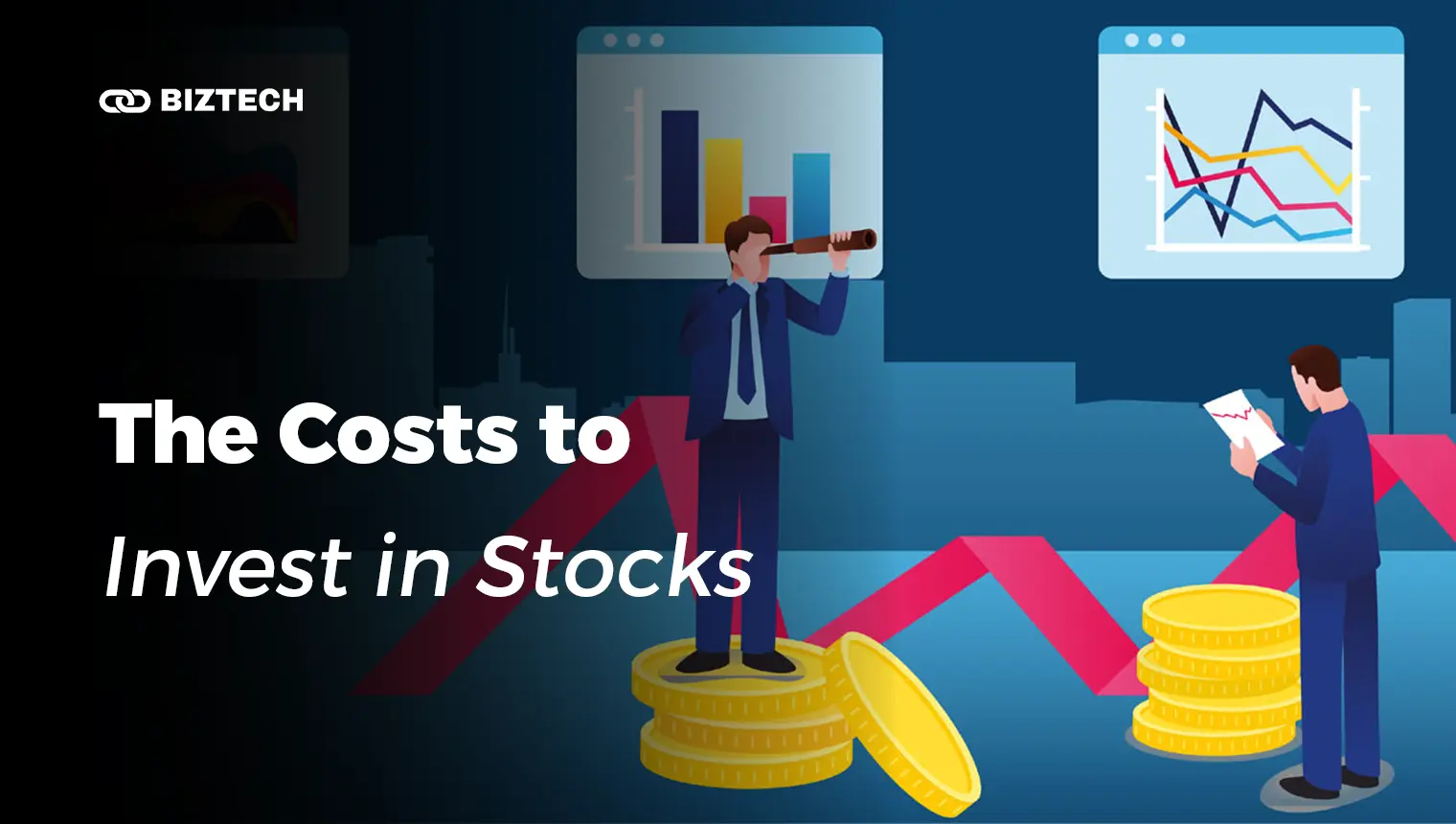
Understanding what you pay is essential to maximising returns. Even small fees compound into large sums over decades, so it pays to know the main categories of cost.
Types of Investment Costs
- Expense ratios: Annual management fees on mutual funds and ETFs, deducted automatically. Index funds are typically far cheaper (often under 0.10%) than actively managed funds.
- Brokerage commissions: Fees to buy or sell. Most major US brokers now charge $0 on US stocks and ETFs; some regional brokers still charge a small per-trade or percentage fee.
- Custodian and advisory fees: Charges for account maintenance or professional advice.
- Loads: Sales charges on some mutual funds, at purchase (front-end) or sale (back-end). Avoidable by choosing no-load funds.
- FX and withholding costs: When you buy foreign stocks you pay a currency-conversion spread, and dividends may be taxed at source.
Trading and Market Costs
- Bid-ask spread: The gap between buy and sell prices — an invisible cost that is wider on thinly traded stocks.
- Stamp duty and clearing fees: Levied on some exchanges (for example, Bursa Malaysia and SGX charge clearing and settlement fees).
- Regulatory fees: Small charges such as the US SEC/FINRA fees on sells.
Strategies to Minimise Costs
- Choose the right broker: A $0-commission broker or low-cost robo-advisor keeps more money working for you.
- Prefer passive funds: Low-fee index funds and ETFs usually beat higher-cost active funds over the long run.
- Trade less: Every trade has a cost (spread, and sometimes commission or tax). Patience is cheaper than activity.
- Mind the taxes: Use tax-advantaged accounts where available and hold for the long term.
Choosing an Online Broker
Picking the right online broker is a crucial early step. Your broker shapes your fees, the range of markets you can access, and the quality of the research and education available to you.
Key considerations when selecting a broker:
- Fees and features: Look for low or zero commissions, fractional shares, a good mobile app, solid research tools, and beginner education.
- Reputation and regulation: For US brokers, established names include Fidelity, Charles Schwab (which completed its acquisition of TD Ameritrade — and its thinkorswim platform — in 2024), Interactive Brokers, Robinhood, SoFi, and tastytrade. Verify regulatory coverage such as SIPC and FINRA in the US.
- Fit for your goals: Match the platform to how you plan to invest — a simple app like SoFi or Robinhood suits pure beginners, while Interactive Brokers suits those who want global market access.
- User experience and support: Intuitive navigation, clear funding and withdrawal processes, and responsive customer support all matter when you are learning.
Note: TD Ameritrade no longer exists as a standalone broker — its accounts and its popular thinkorswim platform are now part of Charles Schwab. If you are researching older guides, keep that in mind. For a deeper comparison, see our reviews of the best technical analysis tools and TradingView.
Practice First: Stock Market Simulators
Stock market simulators (also called paper-trading platforms) are excellent tools for beginners. They let you practise investing and test strategies in a risk-free environment that mirrors real market conditions — no real money at stake.
Popular simulators in 2026:
- Investopedia Stock Simulator: Browser-based, free, and the most beginner-friendly — gives you a virtual $100,000 portfolio with built-in educational content and no brokerage account required.
- thinkorswim paperMoney (by Charles Schwab): The most realistic full-featured simulator, with real-time data, advanced charting, and options tools on a simulated $100,000 balance.
- Webull Paper Trading: A free virtual account (up to $1 million) for practising order execution in live markets, available in the same app many MY/SG investors already use.
- TradeStation Simulator: Favoured by more active traders for its speed and realistic execution.
- Wall Street Survivor & MarketWatch Virtual Stock Exchange: Gamified, community-driven simulators that make learning the basics fun.
Simulators help you understand market dynamics and build confidence before committing real capital. When you do make the switch to real money, start small and scale up as your knowledge grows — live trading adds real emotions that no simulator can fully replicate.
What to Look for in Beginner-Friendly Stocks
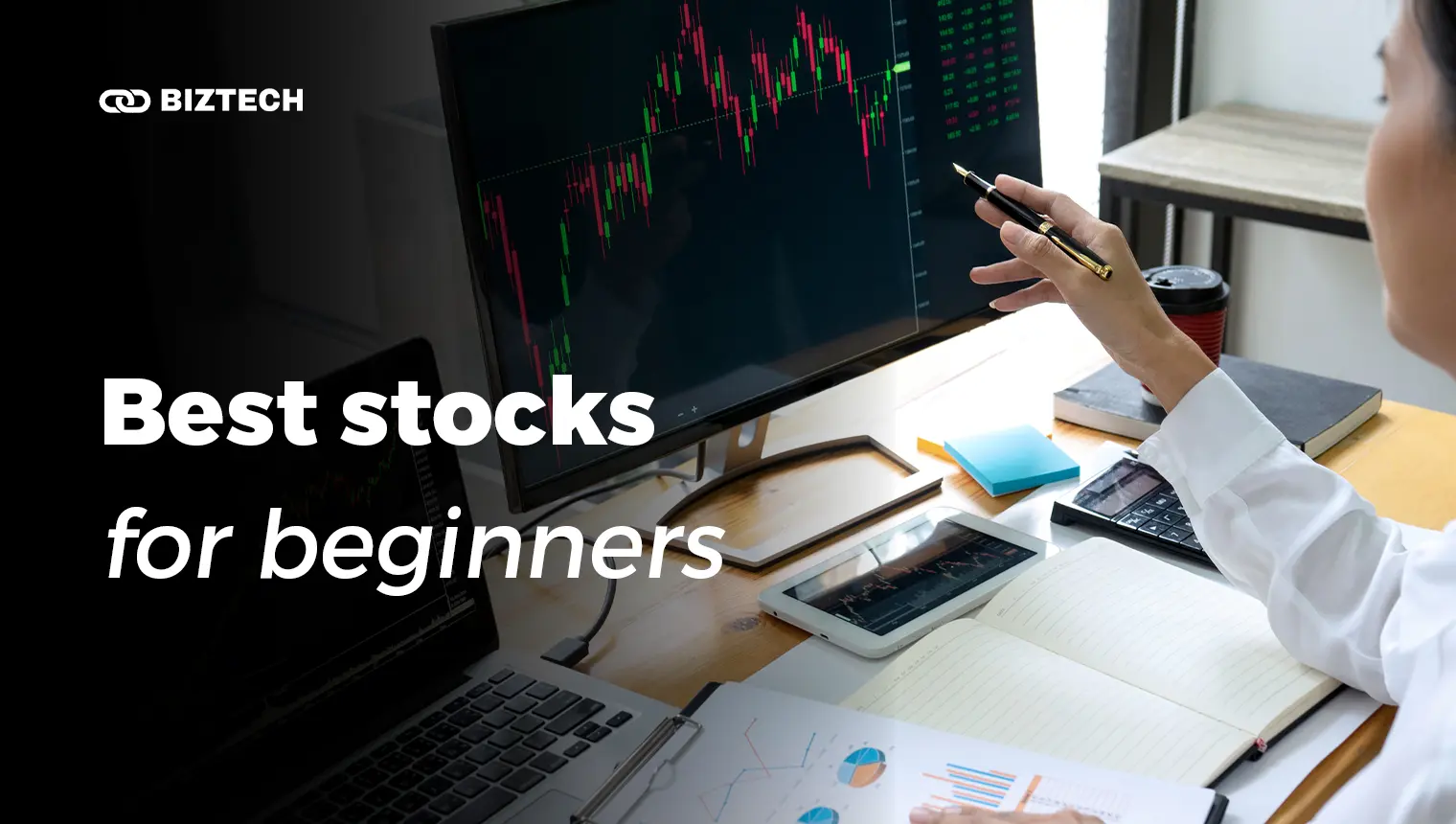
When you are starting out, favour companies with solid financial foundations, well-known brands, and business models you can actually understand. Avoid penny stocks, complex structures, and highly volatile equities — they carry a far higher risk of loss for beginners.
Rather than chasing a fixed list of tickers (which dates quickly), screen for these durable qualities:
- Consistent profitability: Positive net income in most of the past five years.
- Scale and stability: A large market capitalisation (often $50–100 billion or more) tends to mean lower volatility.
- A clear, understandable business: If you cannot explain how the company makes money, it may not be a beginner pick.
- A wide economic moat: Durable competitive advantages — brand, network effects, or scale.
Well-known large caps that many beginner guides cite — across technology (Apple, Microsoft, Broadcom, Qualcomm), consumer (Costco, Amazon), and healthcare (Intuitive Surgical) — tend to fit these criteria, but prices and fundamentals change, so always do your own current research. Honestly, the simplest beginner-friendly choice of all is not a single stock but a low-cost S&P 500 or total-market index fund, which gives you instant diversification across hundreds of companies. For ideas, see our roundups of the best long-term stocks and best stocks for beginners with little money.
Research and Expert Advice
Any specific company is only a starting point. Before you buy, study its financial health, competitive position, and growth prospects — and consider how it fits your overall portfolio. Reputable, free sources of company data include SEC EDGAR filings for US companies. When in doubt, a licensed financial adviser can tailor guidance to your goals and risk tolerance.
Investing in Stocks from Malaysia & Singapore
KayaToday readers are mostly in Malaysia and Singapore, so here is how the picture differs for you.
Where to trade. You have two broad choices: buy local shares on Bursa Malaysia or SGX, or buy US and global stocks through an international broker. For US stocks, the most popular beginner-friendly platforms in 2026 are moomoo and Webull (clean apps, low or zero commissions, fractional shares), with Interactive Brokers (IBKR) the value leader for lower per-share costs and the widest global market access. In Singapore, IBKR and Syfe Trade are also popular; in Malaysia, moomoo has been ranked among the best brokers for beginners. See our full guide to the best trading platforms in Malaysia.
Costs unique to MY/SG investors.
- US dividend withholding tax: The US withholds 30% on dividends paid to Malaysian and Singaporean investors. This mainly affects dividend stocks; it does not apply to capital gains.
- Currency conversion: Buying US stocks means converting MYR/SGD to USD, so watch the FX spread your broker charges.
- Capital gains: Malaysia and Singapore generally do not tax capital gains on listed shares for individual investors — a meaningful advantage over many other markets. (Malaysia introduced a capital gains tax on the disposal of unlisted shares from 2024, and a dividend tax on annual dividend income above RM100,000 from YA2025; confirm your situation with a tax professional.)
- Local trading fees: Bursa and SGX trades carry brokerage, clearing, and (in Malaysia) stamp duty plus SST. These are usually small but worth checking.
For most MY/SG beginners, a sensible starting point is a low-cost broker, a globally diversified ETF or two, and regular monthly contributions — keeping FX conversions and dividend withholding in mind.
Should You Invest in Stocks?

Stocks offer several compelling benefits that make them a cornerstone of long-term wealth building:
1. Wealth building: Historically, stocks have delivered higher long-run returns than most other asset classes. The S&P 500 has returned roughly 10% per year on average since 1928 (closer to about 7% after inflation) — though actual yearly returns vary enormously, and past performance never guarantees future results.
2. Dividend income: Many companies pay out part of their profits as dividends, giving you a steady income stream alongside potential price gains.
3. Diversification: Spreading money across industries and companies reduces the impact of any single loser.
4. Ownership rights: Buying a stock makes you a part-owner, often with voting rights on corporate decisions.
5. Inflation hedge: Over time, equities have tended to outpace inflation as companies raise prices and grow earnings.
6. Transparency and liquidity: Listed companies must disclose financials regularly, and shares can usually be bought or sold quickly during market hours.
Understanding the Risks
Stocks carry real risk alongside their potential rewards. Being aware of these risks is essential to making informed decisions.
1. Market risk: Broad downturns can cut the value of even good companies.
2. Company-specific risk: Poor management, weak financials, or operational failures can sink an individual stock.
3. Political and economic risk: Policy changes, recessions, or currency swings affect performance — especially relevant when investing across borders.
4. Liquidity risk: Thinly traded stocks can be hard to sell at a fair price when markets are volatile.
5. Concentration risk: Putting too much into one stock or sector amplifies losses if it underperforms.
Managing the Risks
- Diversify: Spread across companies, sectors, and regions — the single most effective risk control for beginners.
- Invest for the long term: A buy-and-hold approach smooths out short-term swings and lets compounding work.
- Only invest what you can leave alone: Keep an emergency fund in cash so you are never forced to sell in a downturn.
- Use low-cost funds: Index funds and ETFs deliver instant diversification at minimal cost.
Risk can never be eliminated entirely, but understanding your own risk tolerance and applying these principles goes a long way. A licensed financial adviser can offer guidance tailored to your circumstances.
Verified July 2026. Prices, fees, and tax rules change — always confirm the current details with your broker or a licensed professional before investing.
Frequently Asked Questions (FAQs)
Disclaimer: This article is provided by KayaToday for general educational purposes only and does not constitute financial, investment, or tax advice. Investing carries risk, including the potential loss of capital. Figures were verified in July 2026 and may change. Always do your own research and consult a licensed professional before making investment decisions.