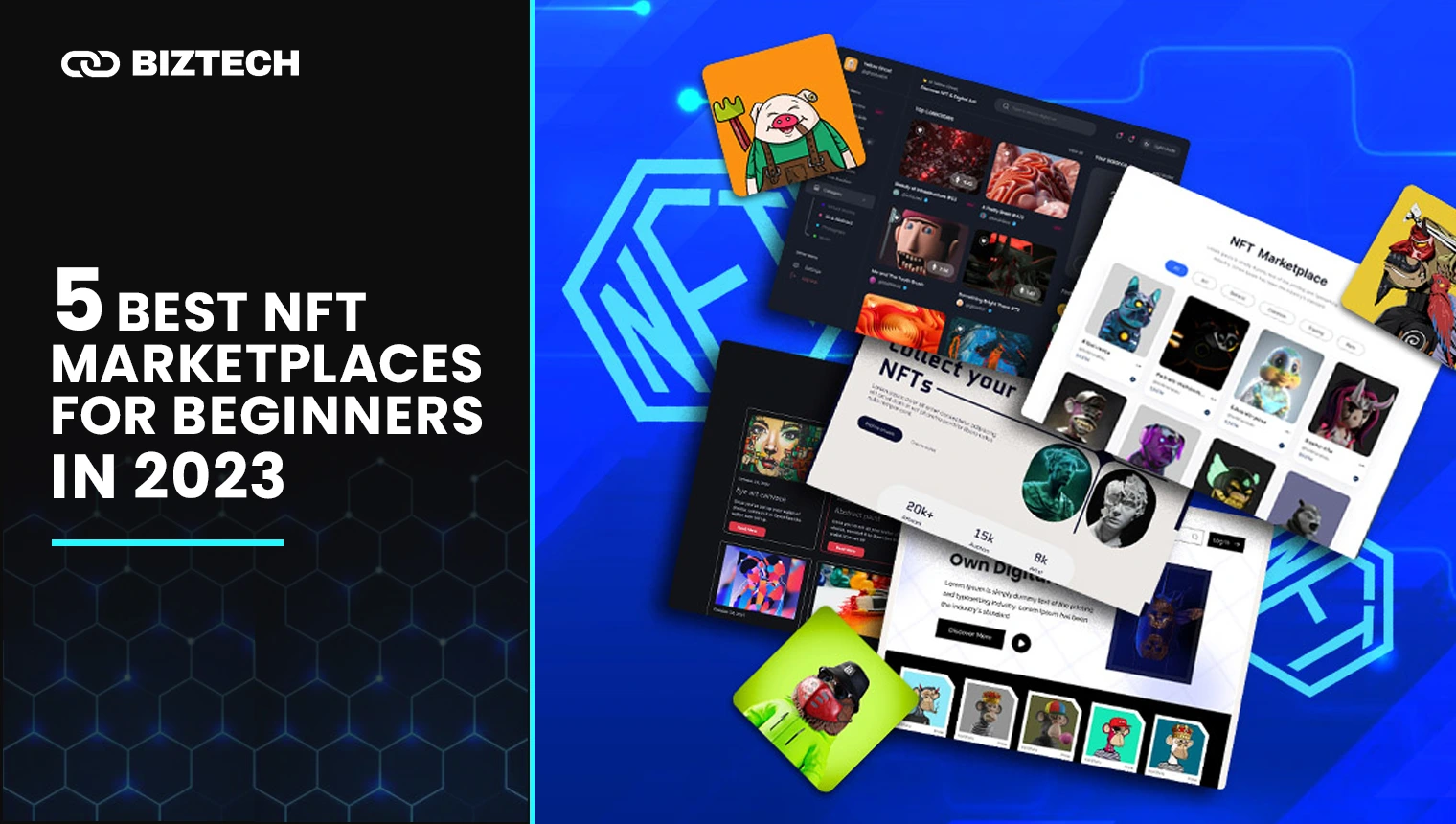
Non-fungible tokens (NFTs) redefined digital ownership, and after a brutal two-year downturn the market is finding its feet again. The global NFT market is estimated at roughly US$60 billion in 2026 (up from about US$43 billion in 2025), and first-half 2026 trading volume of around US$8.2 billion marked a ~156% rebound from 2025’s low. The recovery is selective rather than broad, though: gaming now drives roughly 38% of all NFT transaction volume, and Ethereum still settles the majority of NFT contracts. If you are just starting out, the marketplace you choose matters more than ever. Here is our fully updated guide for 2026 to the best NFT marketplaces for beginners, including which platforms have closed, which have consolidated, and how to buy safely from Malaysia and Singapore.
- What is an NFT?
- What is an NFT Marketplace?
- The NFT Marketplace Landscape Has Changed in 2026
- Best NFT Marketplaces for Beginners at a Glance (2026)
- How We Chose the Best NFT Marketplaces
- The 5 Best NFT Marketplaces for Beginners (2026)
- 1. OpenSea — Best All-Round for Beginners
- 2. Magic Eden — Best for Solana NFTs & Gaming
- 3. Rarible — Best for Creators & Multichain Collectors
- 4. Blur — Best for Active & Pro Traders
- 5. Mavis Market (Ronin) — Best for Web3 Gaming
- How to Choose the Right NFT Marketplace
- How to Buy NFTs Safely in Malaysia & Singapore
- Common Pitfalls & Staying Safe
- Conclusion
- Frequently Asked Questions
What is an NFT?
NFTs are unique digital assets tokenised on a blockchain, which records authenticity and ownership on a public ledger. Unlike cryptocurrencies such as Bitcoin or Ethereum, one NFT is not interchangeable with another. They can represent digital art, music, in-game items, event tickets, domain names, and increasingly tokenised real-world assets.
What is an NFT Marketplace?
An NFT marketplace is a platform where these tokens are minted (created), listed, bought, and sold. For beginners, the things that matter most are a clean interface, strong security, transparent fees, the blockchains and wallets it supports, and how deep its liquidity is for the kind of NFTs you want. A marketplace with lots of active buyers means you can actually sell later, not just buy.
The NFT Marketplace Landscape Has Changed in 2026
If you are following an older “best of 2024” list, be careful — several big names are gone or have pivoted:
- Binance NFT Marketplace has closed. Binance shut down its centralised NFT marketplace on 3 July 2026, migrating the experience into the self-custody Binance Wallet. Guides that still list it as a top pick are out of date.
- Nifty Gateway shut down in February 2026. One of the oldest curated-art platforms, it closed after facilitating over US$300 million in sales at the 2021 peak — a sign of how much the sector has contracted.
- Magic Eden refocused on Solana. In February 2026 it announced it would sunset support for Bitcoin Ordinals, Runes, and its EVM (Ethereum-compatible) NFT markets, because Solana accounted for 85%+ of its revenue.
- OpenSea rebuilt itself as “OS2” and confirmed a future SEA token (launch delayed indefinitely as of March 2026).
The lesson for beginners: pick platforms with real, current traction and a business model that survives a bear market — not whichever name you remember from the 2021 hype.
Best NFT Marketplaces for Beginners at a Glance (2026)
| Marketplace | Best for | Main chains | Marketplace fee | Native token |
|---|---|---|---|---|
| OpenSea (OS2) | All-round beginners | Ethereum, Polygon, Solana, Base & more | ~1% (2026) | SEA (planned) |
| Magic Eden | Solana NFTs & gaming | Solana (primary) | 0% listing + ~2% per sale | ME |
| Rarible | Creators & multichain | Ethereum, Polygon, RARI Chain & more | ~1% per side (0% via RARI perks) | RARI |
| Blur | Active / pro traders | Ethereum | 0% trading (gas applies) | BLUR |
| Mavis Market (Ronin) | Web3 gaming | Ronin | 2.5% per sale | RON / AXS |
Fees verified August 2026; marketplaces change pricing often, so confirm on the official site before you trade.
How We Chose the Best NFT Marketplaces
Our evaluation is based on these factors:
- User Experience: An intuitive, beginner-friendly design and simple wallet connection.
- Security & Track Record: A credible history, active audits, and features that protect newcomers from scams.
- Transaction Costs: Transparent fees for buying, selling, and minting — including any creator royalties.
- Liquidity & Selection: Enough active buyers and a wide range of collections so you can enter and exit positions.
- Chain & Wallet Support: Works with the blockchains and wallets a beginner is likely to use.
The 5 Best NFT Marketplaces for Beginners (2026)
1. OpenSea — Best All-Round for Beginners
- Overview: OpenSea remains the default starting point for most newcomers thanks to its huge selection, simple interface, and broad multi-chain support. Its 2026 “OS2” rebuild added faster browsing, cross-chain trading, and token swaps, and the platform still reports well over US$100 million in monthly volume across roughly 1.7 million NFTs sold each month.
- Unique Features:
- Multi-chain trading (Ethereum, Polygon, Solana, Base and more) in one interface.
- Built-in token swaps and a planned SEA token with a community-focused distribution.
- The deepest catalogue of collections for discovery.
- Fees:
- Marketplace fee: ~1% in 2026 (raised from 0.5% during the OS2 launch period).
- Creator royalties: Optional, set per collection.
✅ Pros:
- Easiest on-ramp for first-time buyers.
- Widest selection and multi-chain reach.
- Large, active user base means better liquidity.
❌ Cons:
- Fees rose in 2026 and the SEA token launch keeps slipping.
- Not the cheapest venue for high-volume flipping.
2. Magic Eden — Best for Solana NFTs & Gaming
- Overview: Magic Eden is the leading marketplace for Solana NFTs and Web3 gaming. After expanding to several chains, it deliberately refocused on Solana in 2026 (sunsetting Bitcoin Ordinals, Runes and EVM markets), where the fast, low-cost network makes it a great fit for beginners who want cheap mints. If you plan to collect Solana assets, pair it with a good Solana wallet like Phantom.
- Unique Features:
- Deep Solana liquidity plus a strong gaming and launchpad ecosystem.
- ME token (launched late 2024) with trader rewards and revenue sharing.
- Very low network fees on Solana for minting and trading.
- Fees:
- Listing fee: 0%.
- Marketplace fee: ~2% per sale, plus optional creator royalties.
✅ Pros:
- Best home for Solana collections and gaming NFTs.
- Cheap, fast transactions; no listing fee.
- Rewards programme via the ME token.
❌ Cons:
- Now largely Solana-only after the 2026 multichain wind-down.
- Less useful if you want Ethereum blue-chip NFTs.
3. Rarible — Best for Creators & Multichain Collectors
- Overview: Rarible is a community-owned, multichain marketplace and aggregator that survived the bear market by shipping its own RARI Chain and an open-source protocol other projects build on. It lets you mint easily, supports creator royalties, and can surface listings from multiple venues in one place.
- Unique Features:
- Aggregator view that pulls listings across marketplaces.
- RARI token governance and a rewards pool routed through the RARI Foundation.
- Beginner-friendly minting with configurable royalties.
- Fees:
- Marketplace fee: ~1% per side (buyer and seller); reducible via RARI perks. No listing fee.
- Creator royalties: Supported and enforced on its native marketplace.
✅ Pros:
- Great for creators who want to mint and earn royalties.
- Multichain support plus an aggregator layer.
- Governance rights and trading rewards.
❌ Cons:
- Ethereum gas costs still apply for on-chain actions.
- Thinner liquidity than OpenSea on some collections.
4. Blur — Best for Active & Pro Traders
- Overview: Blur is built for speed — sweeping floors, placing collection bids, and managing many listings at once on Ethereum. It popularised 0% marketplace trading fees (you still pay network gas) and rewards active traders with BLUR. It is powerful, but the pro-grade interface can overwhelm a total beginner.
- Unique Features:
- Advanced trader tools: portfolio sweeping, bidding, and analytics.
- 0% marketplace fee model and BLUR token incentives.
- Fast execution favoured by high-volume Ethereum traders.
- Fees:
- Marketplace fee: 0% (network gas still applies).
- Creator royalties: Optional, which pros like but creators dislike.
✅ Pros:
- No marketplace trading fee.
- Best-in-class tools for frequent traders.
- Strong Ethereum liquidity for blue-chip collections.
❌ Cons:
- Steeper learning curve — not ideal for your first purchase.
- Ethereum-only and geared to speculation.
5. Mavis Market (Ronin) — Best for Web3 Gaming
- Overview: If you are entering NFTs through gaming, the Ronin ecosystem built around Axie Infinity is the friendliest path. Sky Mavis now steers users to Mavis Market, the hub for the whole Ronin network (Axie assets plus third-party games), which in early 2026 overtook the old Axie Marketplace in trading volume. It settles in RON and charges lower fees than the legacy marketplace.
- Unique Features:
- Buy and sell Axies and items from multiple Ronin games in one place.
- “Play-and-earn” focus — fun first, rewards second — after the 2021 speculative era faded.
- Low RON network fees and a gaming-native onboarding flow.
- Fees:
- Marketplace fee: 2.5% per sale (down from the old Axie Marketplace’s 4.25%).
- Settlement: RON, with AXS/SLP used inside Axie’s economy.
✅ Pros:
- Best gateway for gamers into NFTs.
- Lower fees than the legacy Axie Marketplace.
- Active, community-driven ecosystem.
❌ Cons:
- Ronin-specific — you need RON and a Ronin wallet.
- Past security history (the 2022 Ronin bridge hack of ~US$625 million) is a reminder to stay cautious.
How to Choose the Right NFT Marketplace
Match the platform to your goal, your budget, and the chain your NFTs live on. Use this quick framework:
| If you want to… | Start with | Why |
|---|---|---|
| Buy your first NFT with the least friction | OpenSea | Simplest interface, widest selection, multi-chain |
| Collect cheap Solana or gaming NFTs | Magic Eden | Low Solana fees, no listing fee, gaming focus |
| Mint and sell your own art with royalties | Rarible | Creator tooling, royalties, multichain |
| Trade high volume and minimise fees | Blur | 0% marketplace fee, pro tooling |
| Get into Web3 games | Mavis Market | Ronin gaming hub, low fees |
A quick fee example. Say you sell an NFT for 1 ETH. On OpenSea at ~1% you pay about 0.01 ETH in marketplace fees; on Blur the marketplace fee is 0% (you only pay gas). But if the collection enforces a 5% creator royalty, that 0.05 ETH matters far more than the marketplace fee — so always check total costs (marketplace fee + royalty + gas), not just the headline rate.
How to Buy NFTs Safely in Malaysia & Singapore
NFT marketplaces themselves are not licensed by the Securities Commission Malaysia (SC) or the Monetary Authority of Singapore (MAS). What is regulated is the exchange where you buy the crypto to fund your wallet. The safe path:
- Buy the base crypto on a regulated exchange. In Malaysia, use one of the five SC-registered Digital Asset Exchanges (as of 26 June 2026): Luno, HATA, MX Global, SINEGY and Kinetic DAX (KDX). You can fund them by DuitNow / bank transfer in ringgit and buy ETH, SOL or other coins. In Singapore, use MAS-licensed providers such as Coinhako, Independent Reserve, Crypto.com or Coinbase, funded via PayNow/FAST.
- Withdraw to a self-custody wallet you control — MetaMask for Ethereum/Polygon, Phantom for Solana, or a Ronin wallet for gaming.
- Connect that wallet to the marketplace (OpenSea, Magic Eden, etc.) and buy your NFT.
Tax note: Neither Malaysia nor Singapore charges a general capital-gains tax, but if trading looks like a business under the LHDN/IRAS “badges of trade” (frequency, intention, organisation), profits can be taxed as income. Keep records and confirm your position with a tax professional.
Common Pitfalls & Staying Safe
Most beginner losses come from mistakes, not market moves. Watch for these:
- Malicious approvals / wallet drainers. Signing a bad “approval” can let a scammer move your NFTs and tokens. Review and revoke old permissions regularly with a tool like Revoke.cash, and never blind-sign a transaction you do not understand.
- Fake collections and copycats. Always verify the official contract address and look for the marketplace’s verified badge before buying.
- Phishing links. Bookmark the real marketplace URLs; do not connect your wallet via links from DMs, ads, or “free mint” pop-ups.
- Ignoring liquidity. A cheap NFT you cannot resell is not a bargain — check recent sales and active bids first.
- Over-allocating. NFTs are high-risk and illiquid; only commit money you can afford to lose. For deeper protection, read our guide to spotting crypto scams and secure your assets with a proper NFT wallet.
Conclusion
For beginners entering the NFT world in 2026, OpenSea is still the easiest all-round starting point, while Magic Eden is the go-to for cheap Solana and gaming NFTs. Creators are well served by Rarible, active traders by Blur, and gamers by Mavis Market on Ronin. Just as important is knowing what has changed: Binance NFT and Nifty Gateway have closed, and Magic Eden has narrowed to Solana — so trust current data over old hype.
Pick the platform that fits your goal and budget, buy through a regulated exchange, secure your wallet, and start small. The market is recovering, but it stays volatile — do your own research and never invest more than you can afford to lose. Happy exploring!
Data and fees verified August 2026. Marketplaces change pricing, chain support, and features frequently — always confirm the latest details on the provider’s official site before trading.
Frequently Asked Questions
Disclaimer: This article is provided by KayaToday for general information and education only and is not financial, investment, or tax advice. NFTs and cryptocurrencies are highly volatile and risky. Always do your own research and consult a licensed professional before making any decision.