If you’re a business owner, then you’re probably already thinking about ways to reduce your company income tax in Malaysia — and 2026 is a good year to get it right, with the SME tiered rate now fully in force and e-invoicing widening across the economy.
- Understanding Company Income Tax in Malaysia (2026)
- 4 Ways to Reduce Company Income Tax in Malaysia
- 1. Register for the right business entity
- 2. Claim every allowable expense, deduction and capital allowance
- 3. Take advantage of available tax incentives
- 4. Make charitable contributions through your company
- How to choose the right tax-saving strategy
- A quick worked example
- 2026 updates every company should plan for
- Conclusion
- FAQs
Although the tax system exists to fund the country, paying more than you legally have to is money that could be reinvested into your business. Without proper planning, many companies overpay simply because they miss deductions or incentives they were entitled to claim.
The good news: there are plenty of fully legal ways to maximise your tax savings so you don’t pay a sen more than necessary. This is tax planning, not tax evasion — the difference is that everything here is sanctioned by the Inland Revenue Board (LHDN) and the Income Tax Act 1967.
In this guide we highlight four straightforward methods any business owner can use — regardless of company size — to reduce company income tax in Malaysia, plus the 2026 updates and capital allowances most guides leave out.
Verified August 2026 against LHDN, MIDA and PwC sources. Tax rules change with each Budget — always confirm current figures with LHDN or a licensed tax agent before filing.
Understanding Company Income Tax in Malaysia (2026)
Before we jump into the ways you can reduce company income tax in Malaysia, let’s understand what the company income tax structure actually looks like in 2026.
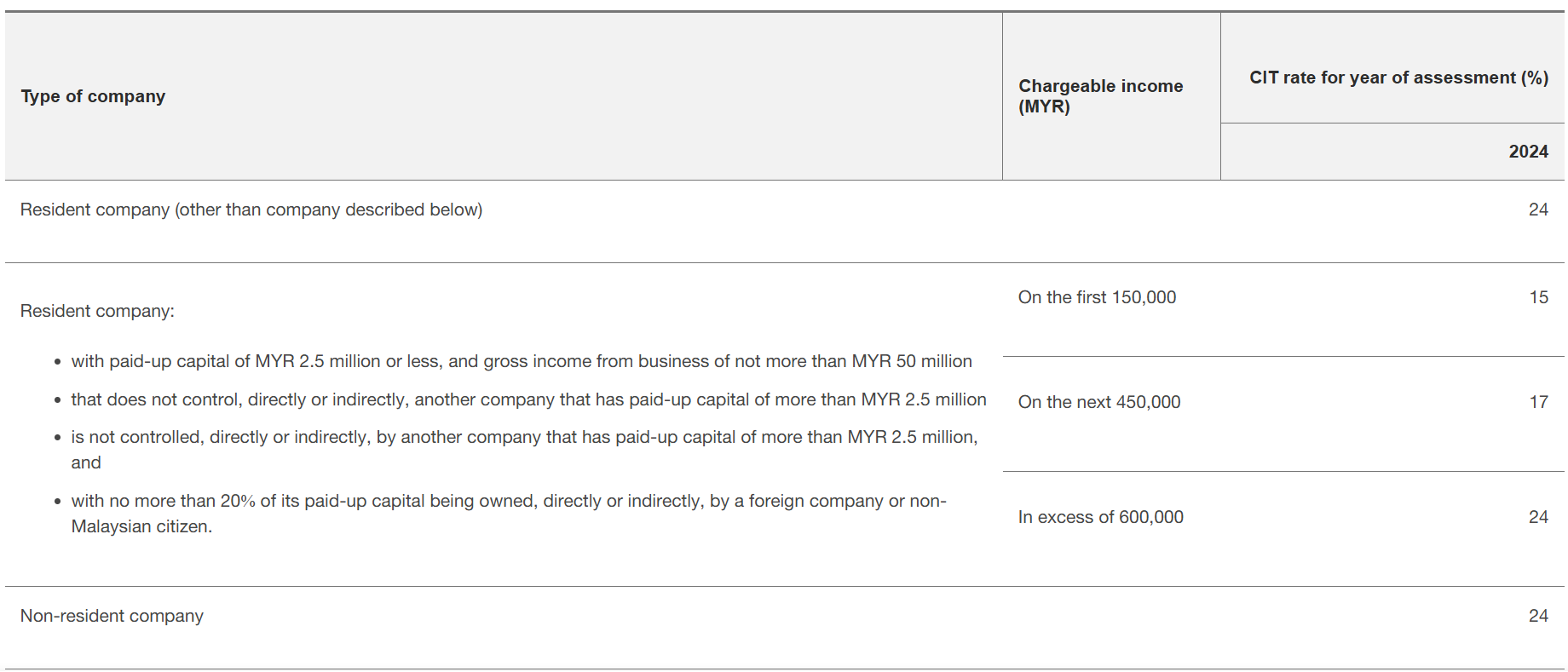
In Malaysia, income your company generates is taxed on a current-year assessment basis. Under LHDN rules, most companies pay a flat 24% corporate tax rate. Qualifying small and medium enterprises (SMEs), however, enjoy a preferential tiered rate — a meaningful saving worth structuring your business around. For a deeper breakdown, see our full guide to the corporate tax rate in Malaysia.
Here is how the 2026 rates compare at a glance:
| Company type | Chargeable income band | Tax rate (YA 2025/2026) |
|---|---|---|
| Qualifying SME | First RM150,000 | 15% |
| Qualifying SME | RM150,001 – RM600,000 | 17% |
| Qualifying SME | Above RM600,000 | 24% |
| Non-SME / standard company | All chargeable income | 24% |
To qualify as an SME for the 15%/17% tiers, your company must be Malaysian resident, have paid-up ordinary share capital of RM2.5 million or less at the start of the year, and gross business income of no more than RM50 million. Crucially, since Year of Assessment 2024, an SME is disqualified from the preferential rate if more than 20% of its paid-up capital is owned by a foreign company or non-Malaysian citizen — such companies pay the flat 24% instead.
Now that you can estimate how much tax is chargeable to your company, let’s look at the ways you can legally reduce it.
4 Ways to Reduce Company Income Tax in Malaysia
The most important rule when reducing your company income tax is to use legal means only. Every method below is fully legitimate and designed to help Malaysian businesses lower their company income tax the right way.
1. Register for the right business entity
Every business entity in Malaysia is taxed differently, so your choice of structure directly affects your bill. Choosing the right one from the start — or restructuring as you grow — is often the single biggest tax lever a small business has.
| Sole Proprietorship | Business income is treated as the owner’s own income, so the owner pays individual income tax (scaled 0%–30%). Simple to run, but high earners can end up paying more than the 24% corporate rate. |
|---|---|
| Partnerships | Profits and losses are shared, and each partner pays individual income tax on their share (scaled up to 30% for chargeable income above RM2 million). |
| Limited Liability Partnership (LLP) | Taxed as a separate entity at corporate rates — a qualifying LLP can access the same 15%/17%/24% SME tiers as a Sdn Bhd. |
| Company (Sdn Bhd) | Pays the flat 24%, but a qualifying SME pays the tiered 15%/17%/24% — usually the most tax-efficient structure once profits are consistent. |
Rule of thumb: once your annual profit consistently pushes your personal income into the higher individual brackets, incorporating as a private limited company (Sdn Bhd) and qualifying for the SME tiers usually saves tax — while also separating your personal assets from business liability.
2. Claim every allowable expense, deduction and capital allowance
Malaysian companies can deduct expenses “wholly and exclusively” incurred in producing income. Claiming these properly is the most reliable way to lower your taxable profit. Common deductibles include:
- Wages, salaries, EPF/SOCSO contributions & staff training: payments to employees, full-time or part-time, are deductible, and approved training can attract further incentives.
- Operating costs: office rental, utilities, supplies and other day-to-day running costs.
- Marketing & advertising: online or offline promotion of your products or brand.
- Entertainment: deductible, but note most client entertainment is only 50% deductible under Section 39; entertainment wholly for employees (e.g. staff annual dinners) and promotional gifts to the public are 100% deductible.
- Capital allowances: instead of deducting the cost of assets like machinery, vehicles or computers directly, you claim capital allowances over time. Small assets costing RM2,000 or less each qualify for 100% allowance in the year of purchase.
Keep in mind that private, domestic or capital expenses are not deductible, and poor record-keeping is the most common reason legitimate claims get disallowed on audit. Keep receipts, e-Invoices and records for at least seven years. For the full list, see LHDN’s official guidance.
3. Take advantage of available tax incentives
Beyond routine deductions, the government offers powerful incentives — mostly administered by MIDA — that can dramatically cut, or even eliminate, tax for a period:
- Pioneer Status: a partial or full exemption on statutory income (typically 70%–100%) for 5 to 10 years, granted to promoted activities in manufacturing, agriculture, tourism, R&D, and certain technical/vocational and commercial sectors.
- Investment Tax Allowance (ITA): an alternative to Pioneer Status giving a 60% allowance on qualifying capital expenditure over five years, which can offset up to 70% of statutory income each year.
- Reinvestment Allowance (RA): under Schedule 7A, resident manufacturing companies reinvesting to expand, modernise or diversify can claim 60% of qualifying capital expenditure for up to 15 years.
- Accelerated Capital Allowance (ACA): for qualifying plant, machinery, ICT systems and licensed software acquired between 11 October 2025 and 31 December 2026, a 20% initial plus 40% annual allowance writes the asset off in roughly two years.
Note that under the New Investment Incentive Framework rolling out in 2026, incentive approvals are increasingly tied to measurable outcomes — ESG governance, export performance and local job creation — so applications should be built around those metrics. Check eligibility on the MIDA incentives portal.
4. Make charitable contributions through your company
Your company can deduct donations and gifts — but only when they go to an LHDN-approved institution or organisation (or directly to the Government or an approved project) under Section 44(6) of the Income Tax Act.
The important limit to know: cash donations to approved institutions are capped at 10% of your company’s aggregate income (not gross income). So a company with RM100,000 of aggregate income can deduct up to RM10,000. That 10% cap is shared across several categories — approved charities, sports bodies, national-interest projects and wakaf — pooled together, and any excess cannot be carried forward to the next year. Always obtain and keep the official receipt or e-Invoice with the LHDN reference.
How to choose the right tax-saving strategy
With several levers available, the trick is matching the method to your company’s stage and activity. Work through these four questions:
| Ask yourself… | If yes, focus on… |
|---|---|
| Are personal earnings pushing you into high individual brackets? | Restructure — incorporate as a Sdn Bhd and qualify for the SME tiers (Method 1). |
| Are you profitable but claiming few expenses? | Tighten bookkeeping and claim all allowable deductions and capital allowances (Method 2). |
| Are you investing in equipment, R&D or a promoted activity? | Apply for Pioneer Status, ITA, RA or ACA before you commit the spend (Method 3). |
| Do you already support community causes? | Route donations through approved bodies to claim up to 10% of aggregate income (Method 4). |
A quick worked example
Suppose a qualifying SME has chargeable income of RM500,000 for 2026. At the flat 24% rate the tax would be RM120,000. Under the SME tiers it is: 15% on the first RM150,000 (RM22,500) + 17% on the next RM350,000 (RM59,500) = RM82,000 — a saving of RM38,000 simply from qualifying for the SME rate. Layer in an approved donation and a capital allowance on a new machine, and the effective saving grows further. This is why planning ahead matters more than scrambling at filing time.
2026 updates every company should plan for
Two changes are reshaping tax compliance in 2026 and are worth building into your planning:
- e-Invoicing (MyInvois): Phase 4 brings businesses with annual turnover up to RM5 million into mandatory e-invoicing from 1 January 2026, with a relaxation period to 31 December 2026 and an exemption threshold raised to RM1 million. Qualifying e-invoicing setup costs can be written off via capital allowance within one year.
- Sales & Service Tax (SST): the expanded SST scope affects pricing and input costs for many companies — see our guide to SST in Malaysia to check whether you now need to register.
Conclusion
Reducing your company income tax in Malaysia isn’t complicated once you know the levers: register the right business entity, claim every allowable expense and capital allowance, tap the incentives you qualify for, and make approved charitable contributions. The recurring theme is planning in advance — decisions made before year-end are what turn into savings at filing time.
Tax rules shift with every Budget, so if your situation is complex, engage a licensed tax agent or accountant. A good adviser typically saves more than their fee. This article is general information from Kayatoday and is not tax, legal or financial advice; confirm current rules and your eligibility with LHDN or a licensed professional before acting.