A crypto whale tracker is one of the most useful tools an investor or trader can keep open in a second tab. The actions of whales — individuals, funds, or institutions holding very large amounts of cryptocurrency — can move liquidity, sentiment, and short-term price in a matter of minutes. When a single wallet shifts eight figures onto an exchange, that transfer is public and visible on-chain the moment it confirms. A good whale tracker turns that raw blockchain data into readable signals you can actually act on. Below we compare the eight best crypto whale tracker tools in 2026, explain how they work, and show how traders in Malaysia and Singapore can put the signals to use.
- What Is a Crypto Whale Tracker?
- How a Crypto Whale Tracker Works
- At a Glance: 8 Crypto Whale Trackers Compared (2026)
- The Best Crypto Whale Tracker Tools in 2026
- 1. Whale Alert — best for real-time large-transfer alerts
- 2. Arkham Intelligence — best for deep wallet and entity investigation
- 3. Lookonchain — best free signal
- 4. Nansen — best for labelled “Smart Money” analytics
- 5. DeBank — best for following whale DeFi portfolios
- 6. ClankApp — best free multi-chain alerts
- 7. Whalemap — best for Bitcoin whale support and resistance
- 8. Blockchain Explorers — best free manual verification
- Pros and Cons of Using a Crypto Whale Tracker
- How to Choose the Right Whale Tracker
- Common Pitfalls to Avoid
- Whale Tracking for Malaysia & Singapore Traders
- Frequently Asked Questions
- Conclusion
For context, whale-watching has never mattered more: Bitcoin trades around US$79,000 as of late August 2026 (having set an all-time high of roughly US$128,000 in October 2025), and institutional wallets now dominate the top of the rich list. BlackRock’s iShares Bitcoin Trust (IBIT) alone holds over 760,000 BTC as of August 2026, after peaking above 806,000 BTC in April. When holders that size rebalance, everyone else feels it.
Key Takeaways
- 🧭 A crypto whale tracker monitors the large on-chain transactions of whales — the individuals, funds, and institutions holding significant crypto.
- ⚡ Main function: real-time visibility of whale transfers, which can hint at potential price moves before they show up on the chart.
- 🔍 How it works: trackers read the public blockchain ledger and surface details like sender/recipient addresses, amount, token, and timestamp — often with human-readable entity labels.
- 📈 Best free picks (2026): Lookonchain, DeBank, ClankApp, Whalemap, and Whale Alert’s free feed; best paid analytics: Nansen and Arkham.
- 🌊 On-chain context matters: a transfer to an exchange can signal selling pressure, while a move to self-custody can reduce circulating supply — but neither is a guarantee.
What Is a Crypto Whale Tracker?
A crypto whale tracker is a tool designed to monitor and analyse the on-chain transactions made by whales — individuals, groups, or organisations holding significant cryptocurrency assets. Because every transaction on a public blockchain is visible, these tools can flag unusually large transfers the moment they settle, then attach useful context such as which exchange or entity a wallet belongs to.
A clear example of a whale is BlackRock. Through its iShares Bitcoin Trust (IBIT), the asset manager holds over 760,000 BTC as of August 2026 — a position worth tens of billions of dollars. Like other whales, BlackRock’s flows (and those of other spot-ETF issuers, exchanges, and long-dormant wallets) can have a considerable impact on the market. By watching how the biggest holders move their coins, you gain a window into potential market shifts before they are reflected in price.
Tracking each whale manually is impractical, which is exactly why these tools exist. Modern trackers in 2026 go well beyond simple alerts: the best of them use entity labelling, AI-driven wallet clustering, and deanonymisation to tell you not just that a big transfer happened, but who is likely behind it.
How a Crypto Whale Tracker Works
Using a crypto whale tracker, investors can pull out a range of information and trends that are otherwise buried in raw blockchain data, such as:
1. Real-time visibility of whale movements
When whales transfer large amounts of crypto to an exchange, it can signal they are preparing to sell, which may lead to a price correction. Conversely, when a whale moves a significant amount from an exchange to a private (self-custody) wallet, it reduces the readily sellable supply on that venue, which can be read as bullish accumulation.
2. Early warning of possible manipulation
When a cluster of whale wallets moves in a coordinated way, it can hint at market manipulation or an orchestrated move. Being aware of this helps you avoid getting caught on the wrong side of a pump or a dump.
3. Spotting potential entry and exit points
Large sell-offs can trigger a price drop; large accumulation can precede a run. You can use this information to time your own entries and exits — but remember that price is ultimately driven by how the rest of the market reacts. If other participants follow a whale’s sell-off, the drop deepens; if they treat it as a discount and buy, the correction may be shallow. Whale data is a clue, not a crystal ball.
At a Glance: 8 Crypto Whale Trackers Compared (2026)
Here is a quick comparison of the tools reviewed below. Some are best as an alert layer, some for deep wallet investigation, and some for connecting a movement to broader portfolio or protocol context.
| Tool | Best for | Free tier | Paid from | Coverage |
|---|---|---|---|---|
| Whale Alert | Real-time large-transfer alerts | Yes (recent alerts, BTC/USDT analytics, X feed) | ~US$29.95/mo | 10+ chains, 200+ assets |
| Arkham Intelligence | Deep wallet & entity investigation | Yes (dashboards + alerts) | Free core; ARKM-powered Intel | Multi-chain (BTC, ETH, L2s +) |
| Lookonchain | Highest-signal free feed | Yes (fully free) | — | Multi-chain via web + X |
| Nansen | Labelled “Smart Money” analytics | Limited free | ~US$99/mo (Standard) | 25+ chains, 300M+ labels |
| DeBank | Following whale DeFi portfolios | Yes (fully free) | — | 100+ EVM chains, 1,500+ protocols |
| ClankApp | Simple multi-chain alerts | Yes (fully free) | — | 20+ chains |
| Whalemap | Bitcoin whale support/resistance | Yes (free) | — | BTC + select ERC-20 |
| Blockchain explorers | Manual verification of any tx/wallet | Yes (fully free) | — | Per chain (Etherscan, Solscan, etc.) |
Pricing verified August 2026 and can change; always confirm the current plan on each provider’s official site.
The Best Crypto Whale Tracker Tools in 2026
1. Whale Alert — best for real-time large-transfer alerts
Whale Alert is the best-known name in the space, tracking large cryptocurrency transactions across major blockchain networks and pushing real-time alerts about big transfers. Each alert shows who is moving large amounts of digital assets — for example, an exchange deposit versus a wallet-to-wallet move — which can help you spot potential market trends early.
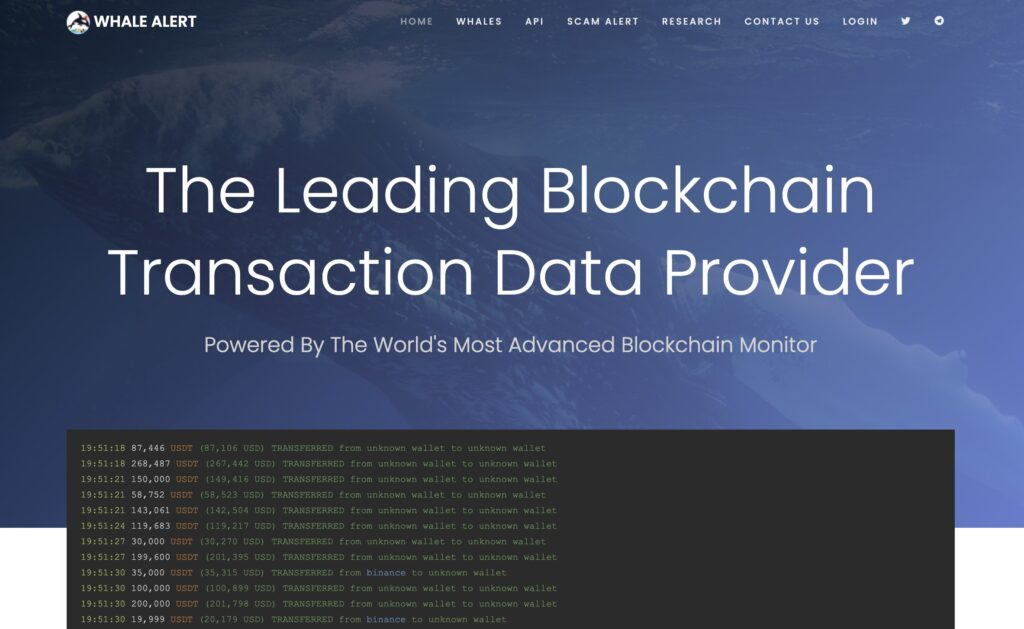
Whale Alert now covers more than ten major blockchains — including Bitcoin, Ethereum, Solana, Tron, Polygon, Cardano, Dogecoin, Litecoin, Bitcoin Cash, and Algorand — and monitors 200+ crypto assets, including major stablecoins. Its pricing has been simplified since our last review: the entry Alerts plan is around US$29.95 per month (with a short free trial), while power users and businesses that need full API access pay significantly more, into the hundreds of dollars per month. For a genuinely free option, Whale Alert still publishes major movements on its X (Twitter) account and offers a free dashboard with recent alerts plus BTC and USDT analytics — handy for newer investors getting a feel for how the market reacts to big transfers.
2. Arkham Intelligence — best for deep wallet and entity investigation
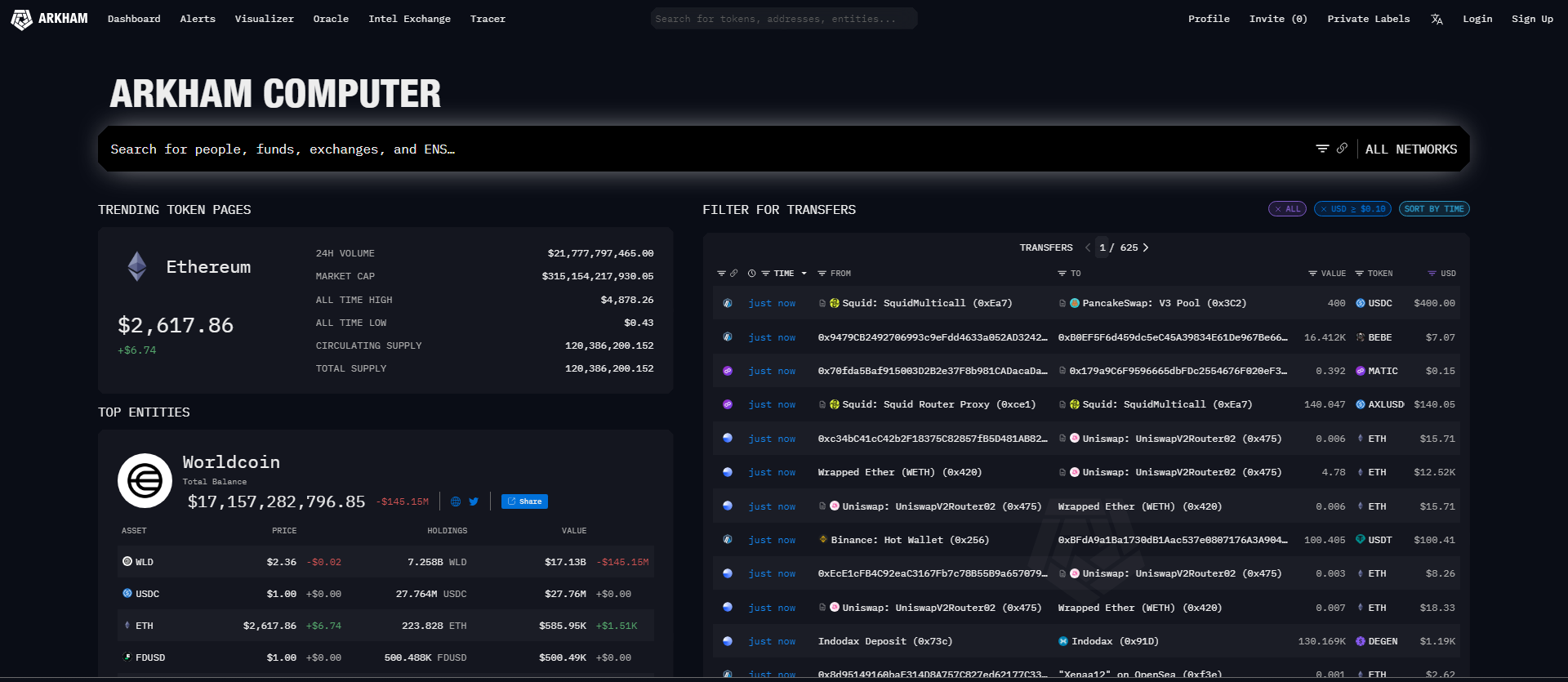
Pages can take a moment to load, but Arkham Intelligence is worth the wait for serious investigation. It lets you view the detailed holdings of any wallet address — including centralised-exchange deposits and withdrawals — sort holdings by blockchain, and explore full transaction history. Its standout feature is deanonymisation: Arkham attaches real-world entity names (funds, exchanges, governments, and named whales) to addresses, so you can see who is actually moving money.
Arkham’s Dashboard gives a quick market overview and links to user-created dashboards covering chains, tokens, CeFi, and DeFi. Arkham Alerts are free and fully customisable — you can watch a single wallet, a group of wallets, or large ETH and BTC transfers. Beyond analytics, the platform’s Intel Exchange is a bounty marketplace (powered by the ARKM token) where users are paid to trace hacked funds or identify suspicious wallets, and in 2026 Arkham launched “Season 2” rewards for high-quality analysis. Notably, Arkham has also rolled out its own exchange, letting on-chain traders act on wallet activity and place trades without switching platforms. One limitation carries over from previous years: very new meme coins and freshly launched tokens may not appear in balances yet.
3. Lookonchain — best free signal
Lookonchain has become the default free whale-watching feed for many traders in 2026. With 700,000+ followers, its team surfaces real-time whale movements, exchange flows, and notable on-chain findings — often breaking large transfers (such as multi-million-dollar OTC-desk moves to exchanges) before they hit mainstream crypto media. It is completely free to follow on the web and on X, which makes it the lowest-effort, highest-signal option on this list. The trade-off is that you are consuming curated highlights rather than querying the data yourself, so pair it with a tool like Arkham or DeBank when you want to dig deeper into a specific wallet.
4. Nansen — best for labelled “Smart Money” analytics
If your budget allows, Nansen is the most polished professional-grade on-chain analytics platform for whale tracking. It attaches human-readable names to wallet addresses — over 300 million labelled addresses across 25+ chains — and its signature Smart Money dashboards let you follow the buying and selling of wallets tagged as whales, venture funds, and hedge funds. Real-time alerts flag when those wallets accumulate or exit a token. Nansen offers a limited free tier, with paid plans starting around US$99 per month for its Standard plan and scaling up to premium VIP tiers; reported pricing varies, so check the current plans before subscribing. It is overkill for a casual holder but genuinely powerful for active DeFi and altcoin traders who want to see where informed capital is flowing.
5. DeBank — best for following whale DeFi portfolios
DeBank is a free, multi-chain Web3 portfolio tracker that doubles as a whale-watching tool. It supports 100+ EVM-compatible blockchains and 1,500+ protocols, automatically detecting what any address holds, stakes, or provides as liquidity. Its whale-tracking and follow features let you monitor high-value wallets — the homepage even highlights featured whales with their total value, earnings, and top holdings — and its Web3 social layer (profiles, a following feed, and the on-chain “Hi” messaging system) makes it easy to build a watch-list of wallets and see their moves in one place. The Bundle feature groups several addresses into a single unified view. Because it is free and DeFi-native, DeBank is the best pick when you care less about a one-off transfer alert and more about what a whale’s entire portfolio is doing over time.
6. ClankApp — best free multi-chain alerts
ClankApp is a crypto whale tracker that provides real-time updates on whale transactions across a wide range of blockchains — 20+ networks — and all of its core features are completely free, with no registration required. Its standout feature is push notifications via Telegram and X, plus email alerts, so you can be pinged the moment a large transfer lands. The trade-off versus premium tools is that ClankApp does not offer charts or deep on-chain analysis; that simplicity makes it an excellent choice for beginners and casual traders who just want broad, no-cost coverage, while experienced analysts may find it too light on investigative tools.
7. Whalemap — best for Bitcoin whale support and resistance
Whalemap takes a different, chart-driven approach: rather than a firehose of transfer alerts, it maps where Bitcoin whales have historically accumulated, helping you identify likely support and resistance levels. It focuses on Bitcoin and select ERC-20 tokens, offering distinctive metrics such as whale inflows/outflows, on-chain volume profiles, HODL Waves, and address waves. With 120,000+ registered users, it has become a trusted reference for swing traders who want to know the price zones big holders defend or dump into. The core dashboards are currently offered for free, though feature availability can change — check the site for the latest access model.
8. Blockchain Explorers — best free manual verification
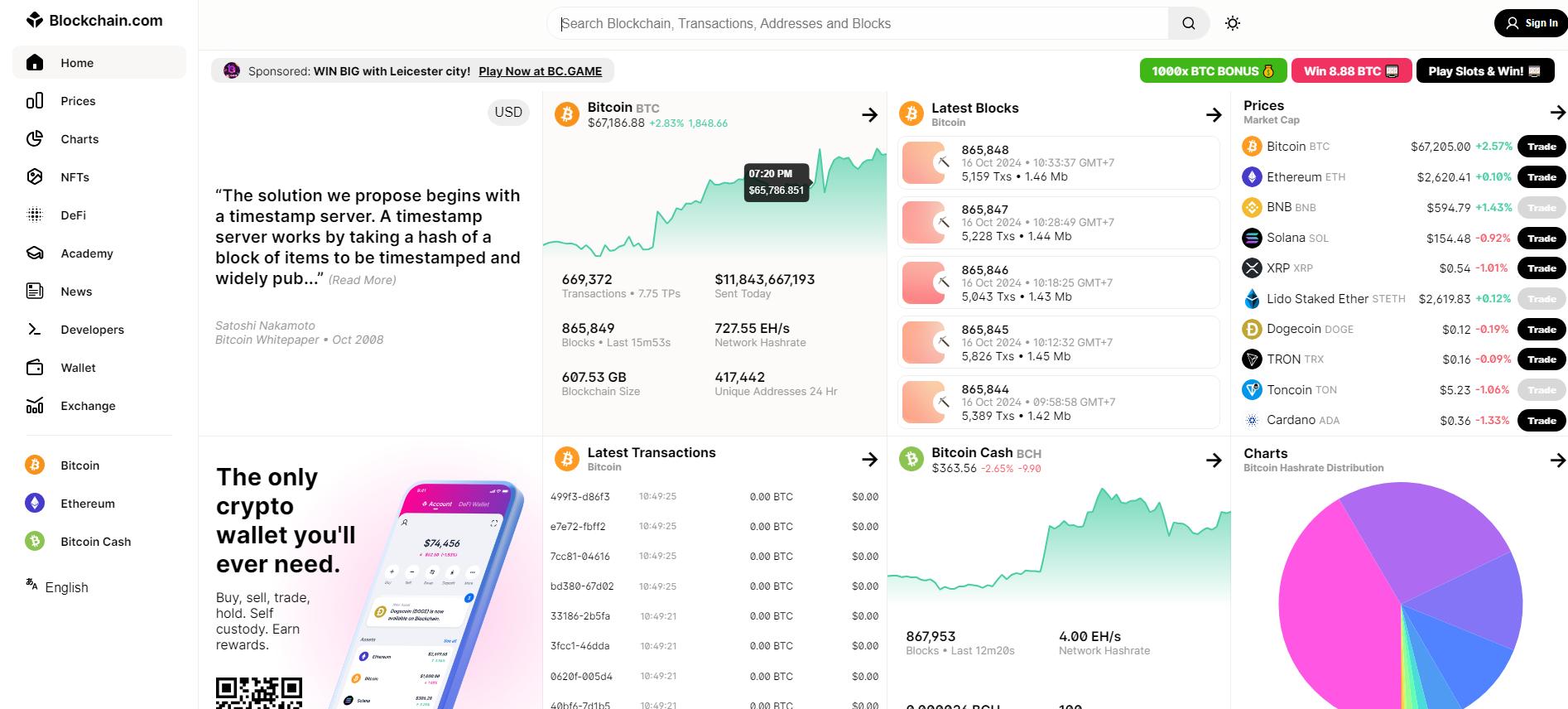
A blockchain explorer works like a specialised search engine for a blockchain. Tools such as Etherscan (Ethereum), Solscan (Solana), Tronscan (Tron), BscScan (BNB Chain), mempool.space (Bitcoin), and blockchain.com let you look up any wallet’s balance, a token’s transfers, and the complete history of transactions — all in real time and straight from the source. They are the authoritative way to verify a rumour: if a whale-tracker feed claims a huge transfer happened, you can confirm it on the explorer yourself. The limitations are that explorers are manual (you need the wallet address), they do not label most wallets, and the interface can feel intimidating to beginners. Explorers pair best with a labelling tool like Arkham or DeBank, which supply the “who” that the explorer leaves blank.
Pros and Cons of Using a Crypto Whale Tracker
As an analytical aid, a whale tracker has clear strengths and real limitations. Weigh both before you lean on one for decisions:
| Pros | Cons |
|---|---|
| Spot trends early. Monitoring whale movements can reveal shifts in momentum before they appear on the chart. | Over-focus on big players. Fixating on large transactions can blind you to other drivers — macro news, funding rates, and retail flows all move markets too. |
| Faster analysis. Trackers save hours of manual on-chain digging and surface the transfers that matter. | Signals can be faked. Sophisticated players use spoofing, wash trades, and decoy transfers to mislead sentiment and smaller traders. |
| Market context. Entity labels and exchange-flow data give you a clearer picture of conditions and positioning. | Different playbooks. Whales operate with capital, time horizons, and risk tolerance unlike a retail trader — copying them blindly is risky. |
| Security & research. The same tools help trace hacks, scams, and stolen funds across chains. | Not always market-moving. Many large transfers are internal (exchange cold-to-hot wallet moves or custody reshuffles) and carry no trading signal at all. |
How to Choose the Right Whale Tracker
There is no single “best” tool — the right choice depends on how you trade and how much you want to spend. Use this framework to match a tool to your goal:
| If you are… | Start with | Why |
|---|---|---|
| A beginner who wants zero-cost signals | Lookonchain + Whale Alert (free) + ClankApp | Curated context plus broad push alerts, with no setup or subscription |
| A DeFi user tracking specific wallets | DeBank | Follow whole portfolios across 100+ EVM chains for free |
| A serious trader wanting labelled Smart Money | Nansen | 300M+ labels and whale/VC/fund tags with real-time alerts |
| An investigator tracing funds or entities | Arkham Intelligence | Deanonymised entity dashboards, alerts, and bounties |
| A Bitcoin-focused swing trader | Whalemap | BTC whale support/resistance, HODL waves, address waves |
| Anyone verifying a specific transaction | Blockchain explorers | Free, authoritative, straight from the on-chain source of truth |
A practical setup for most active traders is to combine one free alert layer (Lookonchain or Whale Alert), one investigation tool (Arkham or DeBank), and an explorer to verify anything that looks important. If you trade full-time, Nansen’s paid analytics can pay for itself; if you are casual, the free stack is more than enough.
Common Pitfalls to Avoid
Whale data is powerful but easy to misread. Keep these traps in mind:
- Assuming every transfer is a trade signal. Exchanges routinely move funds between their own cold and hot wallets. A “US$500M transfer” alert is often just internal custody housekeeping, not a whale about to sell.
- Chasing the alert late. By the time a transfer confirms and you react, the market may have already moved. Whale data is best for confirmation and context, not for split-second front-running.
- Trusting unlabelled wallets. Attribution can be wrong or outdated. Verify a claimed “whale” on a labelling tool and a blockchain explorer before acting.
- Ignoring manipulation. Spoofed orders and wash trades exist precisely to lure traders who watch big money. Learn to spot crypto scams and red flags before you follow a signal.
- Using signals without risk management. Even a correct read fails sometimes. Pair whale-watching with sound position sizing — see our guide on how to manage risk in crypto trading.
Whale Tracking for Malaysia & Singapore Traders
The trackers above are global and work anywhere, but acting on a signal means buying or selling on a regulated venue. In Malaysia, only Digital Asset Exchanges (DAX) registered with the Securities Commission (SC) may legally operate. As of the SC’s latest list (updated 26 June 2026), there are five registered DAX: Luno, HATA, MX Global, SINEGY, and Kinetic DAX (KDX). A revised DAX framework took effect on 20 May 2026, and all DAX operators are becoming members of the Financial Markets Ombudsman Service for formal dispute resolution. You can confirm the current list on the official SC register before funding any account. For a deeper look, see our guide to the best crypto trading platforms in Malaysia and our broader cryptocurrency in Malaysia guide.
In Singapore, act through MAS-licensed providers such as Coinhako, Independent Reserve, Crypto.com, and Coinbase Singapore. Local payment rails make execution fast: DuitNow in Malaysia and PayNow/FAST in Singapore let you move ringgit or Singapore dollars into a registered exchange quickly once a whale signal prompts a decision.
Tax note: Neither Malaysia nor Singapore levies a general capital-gains tax on individual crypto investment. However, if your activity looks like trading rather than long-term investing, profits can be treated as income under the badges of trade — assessable by LHDN in Malaysia and IRAS in Singapore (whose January 2026 digital-token guidance reaffirmed this). Frequent, whale-signal-driven trading is more likely to fall on the taxable “trading” side, so keep records. This is general information, not tax advice — confirm your position with a qualified professional.
Frequently Asked Questions
Conclusion
Crypto whale trackers give investors and traders a real window into the large transactions that shape market trends. By watching how whales — from spot-ETF issuers to long-dormant wallets — move their assets, you can spot momentum shifts, recognise possible manipulation, and identify potential entry and exit points. The eight tools reviewed here cover every budget and skill level: Lookonchain, DeBank, ClankApp, and Whalemap for free coverage; Whale Alert for real-time alerts; and Arkham and Nansen for professional-grade, labelled analysis.
None of these tools is a substitute for judgement. Over-reliance on whale activity can cause you to miss other market drivers, and the strategies big players use rarely map onto a retail portfolio. Use whale trackers as one part of a broader process — combined with technical analysis, fundamentals, and disciplined risk control. For more on that process, see our guide to smart crypto investment strategies and our roundup of the best crypto exchanges for acting on the signals you find.
The right tracker depends on your goals — deep analysis or simple, timely alerts. The key is to treat these tools as part of a wider strategy for navigating a fast-moving market, not as a shortcut around doing your own research.
All figures and features were verified in August 2026. Crypto tools, pricing, and coverage change quickly, so confirm the latest details on each provider’s official site before subscribing.
Disclaimer: This article is provided by KayaToday for informational and educational purposes only and does not constitute financial, investment, or trading advice. Cryptocurrency is highly volatile and whale-tracking signals can be misleading. Always do your own research and consider consulting a licensed financial adviser before making any investment decision.