When Hyperliquid first appeared, most traders filed it away as “just another decentralized exchange (DEX) for perpetual futures.” That framing is now badly out of date. Hyperliquid is a purpose-built Layer 1 blockchain, its HYPE token has grown into a top-10 cryptocurrency, and it settles a larger share of on-chain perpetual volume than any competitor. The obvious question — the one this guide answers — is whether Hyperliquid can realistically become “the next Binance,” and how its HYPE token stacks up against Binance’s BNB.
- What Is Hyperliquid? A Layer 1 Built for Trading
- Performance and Market Dominance
- The Team Behind Hyperliquid
- HYPE Tokenomics: Airdrop, Supply and Buybacks
- HYPE vs BNB: Will Hyperliquid Be the Next Binance?
- HyperEVM, USDH and the Growing Ecosystem
- BTC Spot and One-Click Trading
- How Hyperliquid Charges: Fees at a Glance
- Risks, the JELLY Incident and Decentralization Questions
- Other Risks to Weigh
- How to Access Hyperliquid in Malaysia and Singapore
- How to Decide If HYPE Is Right for You
- Frequently Asked Questions
- Conclusion
Below we break down what Hyperliquid actually is, the current (August 2026) numbers, how HYPE’s tokenomics and value capture work, and the risks — including the decision-defining JELLY episode — that any investor should weigh before buying. If you are new to on-chain trading, it helps to first read our overview of the best decentralized exchanges and how they differ from centralized platforms.
Key Takeaways
- Hyperliquid is a high-performance Layer 1 blockchain built specifically for trading, pairing an on-chain central-limit order book (HyperCore) with a general-purpose smart-contract layer (HyperEVM).
- HYPE is now a top-10 coin — trading around US$81 with a market cap near US$18 billion (August 2026), having entered the top 10 in 2026 as only the second DeFi token ever to do so.
- It dominates decentralized perpetuals, handling roughly 36–44% of all on-chain perp volume and about US$245 billion in 30-day volume — several times its nearest rival.
- No venture-capital funding. A ~310 million HYPE airdrop (31% of supply) went straight to ~94,000 users, and protocol fees fund an Assistance Fund that buys back HYPE.
- Still far smaller than Binance. BNB’s market cap (~US$93 billion) is roughly five times HYPE’s, so “the next Binance” is a direction of travel, not a present reality.
| Hyperliquid / HYPE at a glance | Detail (verified August 2026) |
|---|---|
| Token | HYPE — native gas, staking and governance token of the Hyperliquid L1 |
| Price / all-time high | ~US$81; ATH ~US$83 on 23 Aug 2026 |
| Market cap / rank | ~US$18 billion; around #9 by market cap |
| Fully diluted valuation | ~US$81 billion (1 billion HYPE max supply) |
| Circulating supply | ~222 million HYPE (~22% of 1 billion) |
| Protocol TVL | ~US$5.9 billion (peak ~US$6.2 billion, Sep 2025) |
| Perp DEX volume | ~US$245 billion / 30 days; ~36–44% of all on-chain perpetual volume |
| Open interest | ~US$9 billion (~60% of all perp-DEX open interest) |
| Key milestones | Perp DEX live 2023; HYPE airdrop 29 Nov 2024; HyperEVM mainnet Feb 2025 |
| Founders | Jeff Yan & “iliensinc” (Hyperliquid Labs) — no outside investors |
Live figures move constantly — confirm on CoinMarketCap and stats.hyperliquid.xyz.
What Is Hyperliquid? A Layer 1 Built for Trading
Hyperliquid is a Layer 1 (L1) blockchain engineered from the ground up for financial applications, rather than a trading app bolted onto someone else’s chain. It runs on a custom HyperBFT consensus mechanism and is split into two tightly integrated parts:
- HyperCore — a fully on-chain central-limit order book that powers spot and perpetual-futures trading with sub-second latency and no gas fees on trades.
- HyperEVM — an Ethereum-compatible smart-contract layer (live since February 2025) where developers deploy tokens, lending markets, and other DeFi apps that can tap Hyperliquid’s native liquidity.
The result is an experience that feels like a centralized exchange (CEX) — fast fills, deep books, one-click trades — while you keep custody of your own assets. That combination is exactly why crypto commentators nicknamed it “Binance on-chain.” If the self-custody angle is new to you, our explainer on what crypto custody is covers why “not your keys, not your coins” matters.
Performance and Market Dominance
Hyperliquid’s core claim is throughput: the L1 is designed to handle on the order of 100,000+ orders per second, enabling a genuinely on-chain order book rather than the automated-market-maker pools most DEXs rely on. In practice, that performance has translated into clear market leadership.
As of mid-2026, Hyperliquid processed roughly US$245 billion in trailing 30-day perpetual volume — around four times its nearest decentralized competitor, Aster — and its share of on-chain perpetual volume has climbed from single digits in 2024 to somewhere between 36% and 44% in 2026. Open interest sits near US$9 billion, close to 60% of all perp-DEX open interest, and protocol total value locked (TVL) is around US$5.9 billion, just shy of its September 2025 peak of ~US$6.2 billion.
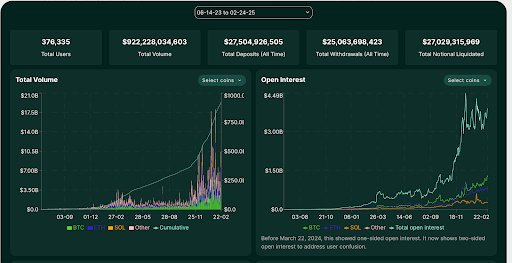
Illustrative dashboard — live volume, open interest and TVL update in real time at stats.hyperliquid.xyz.
Rival perp DEXs such as Aster, Lighter, edgeX, and Paradex have grown the overall category, but none has displaced Hyperliquid at the top. For a broader comparison of where it sits against the big centralized players, see our roundup of the best crypto exchanges in the world.
The Team Behind Hyperliquid
Hyperliquid Labs was co-founded in 2022 by Jeff Yan and a pseudonymous developer known as “iliensinc,” his Harvard classmate. Yan studied mathematics and computer science at Harvard, won a gold medal representing the United States at the International Physics Olympiad, and worked at the high-frequency trading firm Hudson River Trading before building Chameleon Trading, a crypto market-making firm. He funded Hyperliquid with those trading profits rather than raising from venture capital.
The team has stayed deliberately small — around a dozen people drawn from institutions like Harvard, Caltech, and MIT, with backgrounds at Citadel, Hudson River Trading, and others — and famously runs with no marketing department. That founder story matters for investors: it explains why so much of the token supply went to users rather than insiders, and why buying pressure at launch was community-driven.
HYPE Tokenomics: Airdrop, Supply and Buybacks
HYPE has a fixed maximum supply of 1 billion tokens. What made it stand out was the distribution. On 29 November 2024, Hyperliquid’s Genesis Distribution airdropped roughly 310 million HYPE (31% of supply) to about 94,000 early users — one of the largest and most valuable airdrops in DeFi history, with many wallets receiving tens of thousands of dollars in tokens.
| HYPE allocation | Share of 1B supply |
|---|---|
| Genesis airdrop (existing users) | 31.0% |
| Future emissions & community rewards | ~38.9% |
| Core contributors | 23.8% |
| Hyper Foundation budget | 6.0% |
| Community grants | 0.3% |
| HIP-2 (Hyperliquidity) | 0.01% |
The value-capture mechanism is just as important. Hyperliquid directs a large portion of protocol revenue into an Assistance Fund that buys HYPE on the open market — a structural, recurring bid that doesn’t appear in inflation schedules. HYPE also serves as the L1’s gas token and unlocks staking-based fee discounts (more on fees below). Investors should note the flip side: sizeable core-contributor and emissions tranches unlock over time (the next scheduled unlock is around 6 September 2026), which can add sell-side supply.
HYPE vs BNB: Will Hyperliquid Be the Next Binance?
This is the comparison that launched a thousand crypto-Twitter threads. Both tokens are the “share” of a trading empire — but the empires are built very differently. BNB backs Binance, the world’s largest centralized exchange; HYPE backs a decentralized, self-custodial L1. Here is how they line up in August 2026:
| Factor | HYPE (Hyperliquid) | BNB (Binance) |
|---|---|---|
| What it is | Token of a decentralized L1 + perp DEX | Token of a centralized exchange + BNB Chain |
| Market cap | ~US$18 billion (rank ~#9) | ~US$93 billion (rank ~#5) |
| Price | ~US$81 | ~US$699 |
| Custody | Non-custodial — you hold the keys | Custodial — Binance holds your funds |
| Core business | On-chain perps & spot trading | Full-service CEX: spot, derivatives, earn, launchpad, card |
| Regulation | Permissionless; not licensed anywhere | Licensed/registered in many markets (and restricted in some) |
| Value capture | Assistance Fund buybacks from fees | Buyback-and-burn from Binance profits |
The honest verdict: By the one metric where Hyperliquid competes head-to-head — decentralized perpetual trading — it has already out-executed everyone, and arguably beaten Binance’s on-chain ambitions. But as a business and as a token, BNB is still roughly five times larger, more diversified, and more deeply integrated into everyday crypto commerce. Hyperliquid is a credible challenger in one high-value niche, not a like-for-like replacement for Binance’s entire ecosystem. Whether HYPE can close that gap depends on sustained fee revenue, ecosystem growth, and it avoiding the kind of governance stumbles described below. For other tokens people are watching this cycle, see our list of the next big cryptocurrencies.
HyperEVM, USDH and the Growing Ecosystem
The launch of HyperEVM in early 2025 turned Hyperliquid from a single trading venue into a platform. By early 2026 it hosted 50+ deployed protocols with combined TVL above US$2 billion — roughly a 400% year-on-year increase — spanning lending, liquid staking, and token launches, all able to draw on HyperCore’s liquidity.
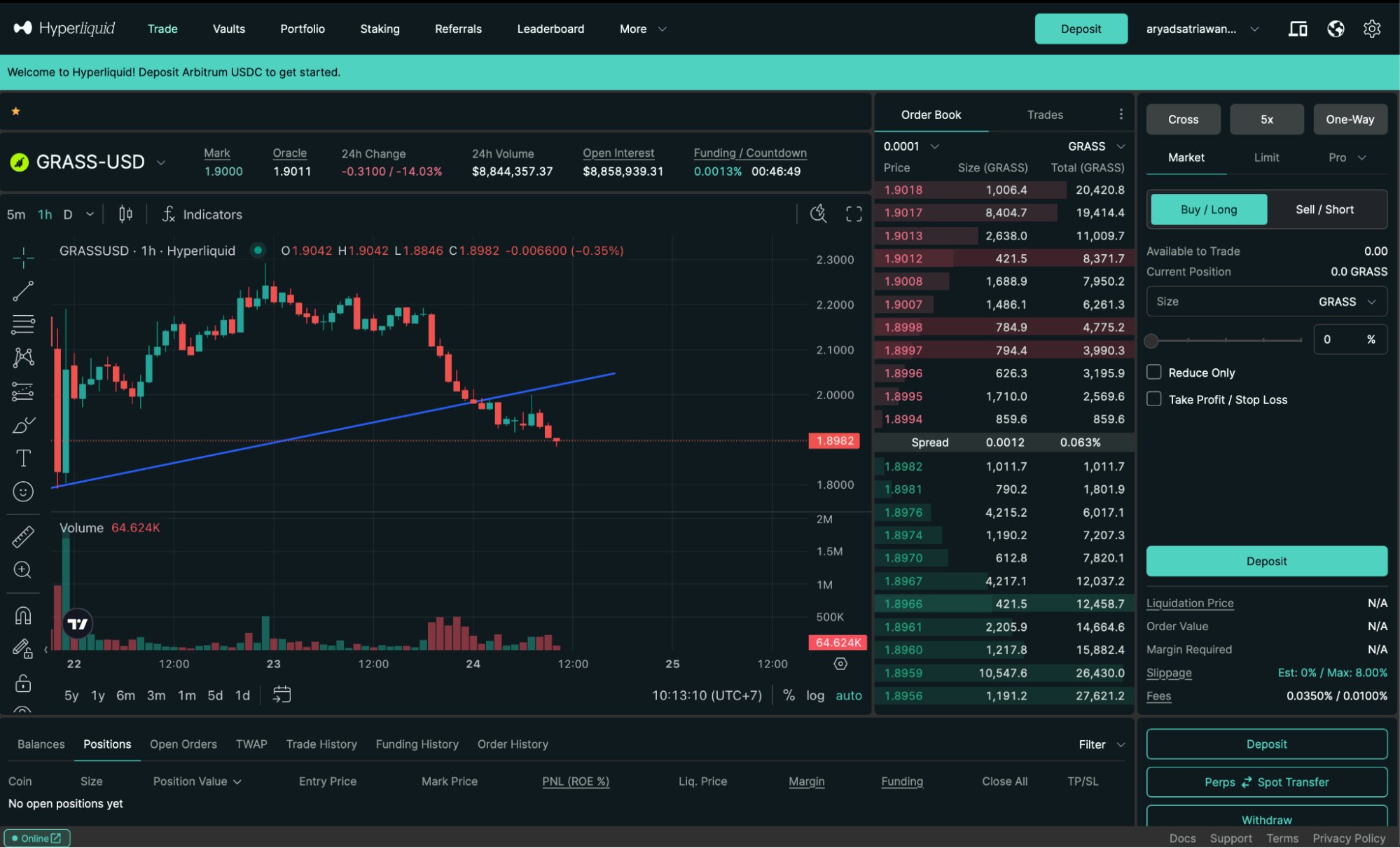
One of the most-watched storylines was the USDH stablecoin. In September 2025, following a public ticker auction won by Native Markets, Hyperliquid launched USDH as a native, fiat-backed dollar stablecoin — with reserves managed by BlackRock (off-chain) and Superstate (on-chain), and interest income split 50/50 between HYPE buybacks and ecosystem funding. The plan was to internalize the stablecoin revenue that had been flowing to external issuers. In a notable twist, Coinbase acquired the USDH brand assets in May 2026, and USDH holders were offered a 1:1 migration to USDC, which is now the platform’s primary “aligned quote asset” for margin, spot, and perpetual trading. It’s a reminder that even fast-moving crypto ecosystems reshuffle their plumbing.
BTC Spot and One-Click Trading
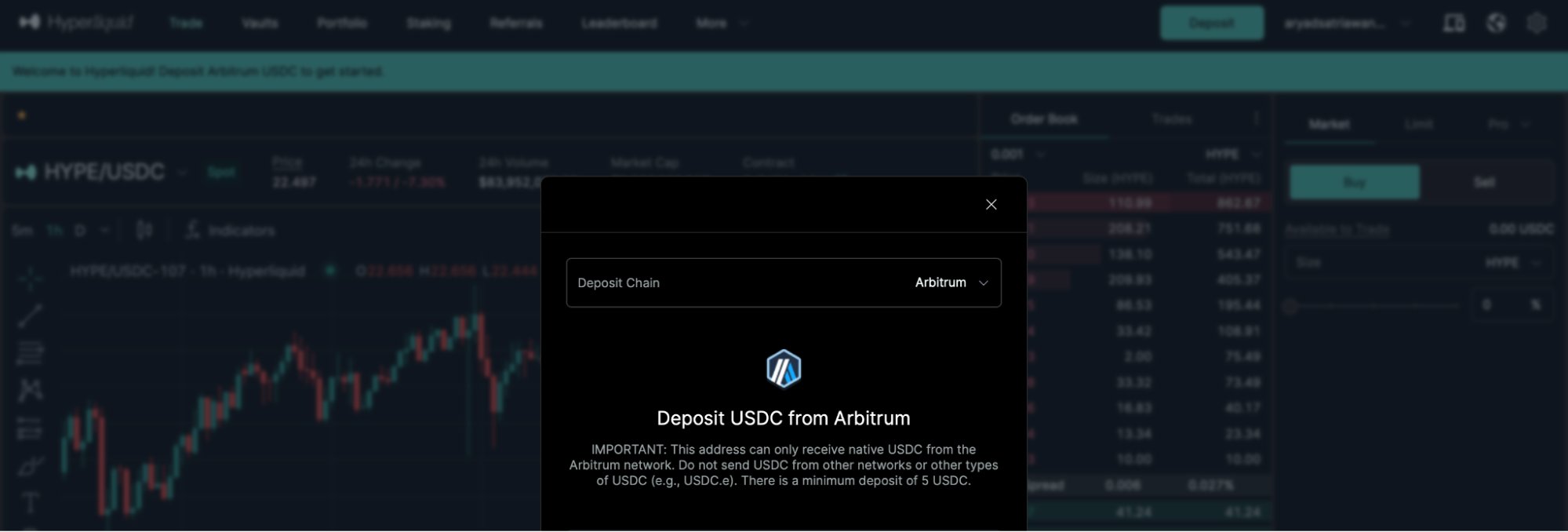
Hyperliquid was among the first on-chain venues to offer native Bitcoin spot trading via HyperUnit, letting users deposit, withdraw, and trade BTC (alongside assets like ETH and SOL) directly, without wrapping it through a third-party bridge. Deposits and trades are non-custodial — you retain control of your assets — though it’s worth understanding that the underlying Guardian Network uses multi-party computation (MPC) and still requires some trust in the operators.
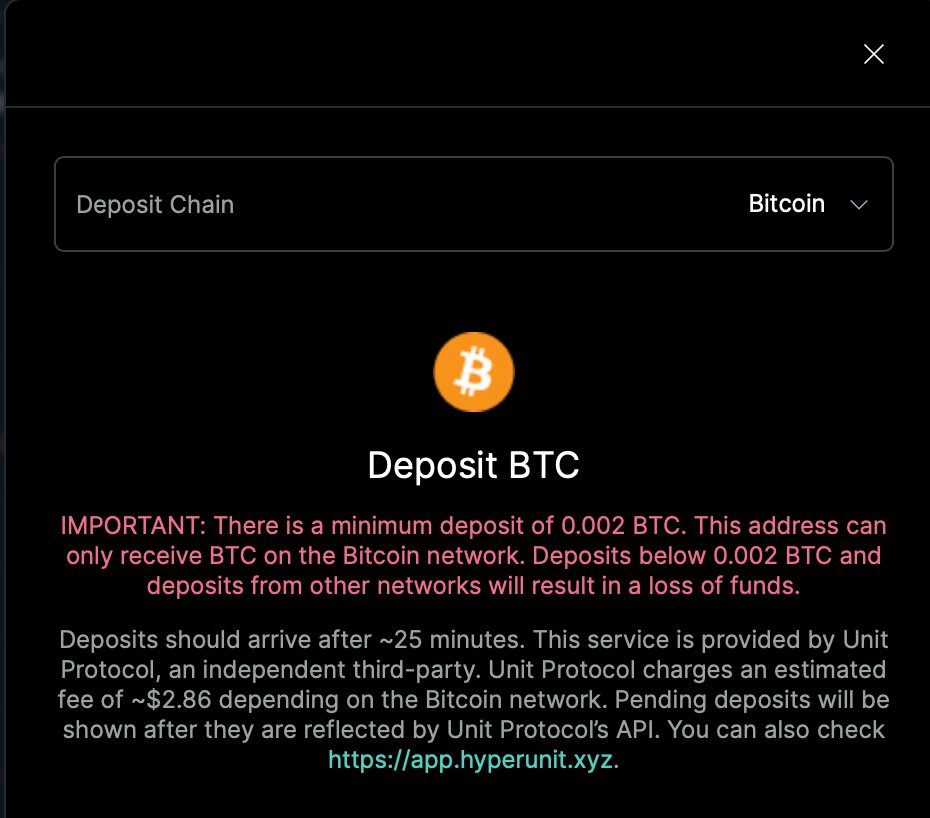
Day-to-day, the flow is simple: bridge USDC, then trade in one click with no per-trade gas. For active traders weighing venues, our guide to the best crypto exchanges for day trading puts Hyperliquid’s model in context against centralized alternatives.
How Hyperliquid Charges: Fees at a Glance
Fees are a big part of Hyperliquid’s appeal for high-volume traders. Base rates are competitive with tier-1 CEXs, and three stacking discounts can push them lower:
- Perpetuals: base 0.015% maker / 0.045% taker.
- Spot: base 0.04% maker / 0.07% taker.
- Discounts: VIP tiers based on 14-day rolling volume (from ~US$5M), HYPE staking tiers cutting fees up to ~40%, plus an automatic lifetime referral discount.
- Withdrawals: a flat 1 USDC to move funds back to Arbitrum.
Note that funding rates on perpetuals are a separate, market-driven cost that can dwarf trading fees for positions held over time — always factor them in.
Risks, the JELLY Incident and Decentralization Questions
Hyperliquid’s biggest open question is not performance — it’s how decentralized it really is. That tension came to a head on 26 March 2025 with the JELLY incident. A trader deliberately manipulated the thinly traded JELLY memecoin market, squeezing Hyperliquid’s community liquidity vault (HLP) into a large potential loss. In response, the validator set convened and voted to delist JELLY perpetuals, settle positions at a set price, and make ordinary users whole from the Hyper Foundation.
Supporters saw a fast, sensible emergency response that protected users. Critics argued it proved the system wasn’t fully trustless — a small validator set could intervene in markets, which is exactly what a truly decentralized exchange is supposed to avoid. Hyperliquid subsequently moved delisting decisions to on-chain validation to answer the criticism, but the episode remains the reference point in any honest decentralization debate.
Other Risks to Weigh
- Validator concentration: the network expanded beyond its original four validators, but the set is still smaller and more concentrated than mature L1s like Ethereum.
- Token unlocks: large core-contributor and emissions tranches vest over time, adding potential sell pressure.
- Smart-contract & bridge risk: HyperEVM apps and cross-chain bridges are common targets — approvals can be abused by wallet-drainers, so review them regularly. Our guide to spotting crypto scams explains the red flags.
- Concentration of activity: HYPE’s valuation is heavily tied to perp-trading demand; a downturn in derivatives volume would hit revenue and buybacks.
How to Access Hyperliquid in Malaysia and Singapore
Hyperliquid is a decentralized protocol, not a locally licensed exchange. It is not a Securities Commission (SC) registered Digital Asset Exchange in Malaysia, nor MAS-licensed in Singapore. That means you can access it directly via a self-custody wallet, but without the local consumer protections a registered platform provides — so the safest route is to on-ramp through a regulated exchange first, then self-custody.
| Step | Malaysia | Singapore |
|---|---|---|
| 1. Buy crypto legally | Use an SC-registered DAX: Luno, HATA, MX Global, SINEGY, or Kinetic DAX (5 registered as of 26 Jun 2026); fund via DuitNow/FPX | Use a MAS-licensed provider (e.g., Coinhako, Independent Reserve, Crypto.com, Coinbase SG); fund via PayNow/FAST |
| 2. Self-custody | Withdraw USDC/ETH to your own wallet, then bridge to Hyperliquid — never share your seed phrase | |
| 3. Understand tax | No general capital-gains tax, but LHDN can tax active trading as income under the “badges of trade” | No capital-gains tax; IRAS may treat frequent trading as taxable income |
For a fuller walkthrough of buying and staying compliant locally, see our cryptocurrency in Malaysia guide and our comparison of the best crypto trading platforms in Malaysia.
How to Decide If HYPE Is Right for You
| If you… | Then consider… |
|---|---|
| Want the deepest on-chain perpetual liquidity | Hyperliquid leads the perp-DEX category by volume and open interest |
| Prioritise self-custody and permissionless access | Hyperliquid (non-custodial) over a KYC-gated CEX — but manage your own security |
| Want an insured, fiat on-ramp with recourse | Start on an SC-registered DAX (MY) or MAS-licensed exchange (SG) |
| Are risk-averse or need consumer protection | Be cautious — Hyperliquid isn’t licensed in MY/SG, so there’s no local recourse |
| Believe in the long-term growth story | Size any HYPE position small (e.g., 1–5% of a portfolio) and dollar-cost average |
None of this is a recommendation to buy or sell. HYPE is a volatile asset tied to a fast-changing protocol; treat it accordingly.
Frequently Asked Questions
Conclusion
Hyperliquid has proven that a decentralized, self-custodial venue can match the speed and liquidity traders expect from a top CEX — and its HYPE token has ridden that success into the top 10. In the specific arena of on-chain perpetuals, it looks a lot like “Binance on-chain.” But calling it the next Binance overstates the case: BNB remains several times larger and backs a far broader business, and Hyperliquid still has to answer real questions about validator concentration, token unlocks, and the trust trade-offs the JELLY episode exposed. For traders who value self-custody and deep perp liquidity, it’s arguably the most compelling on-chain venue available; for everyone else, it’s a high-potential, high-risk asset best approached with position sizing and clear eyes.
All figures verified August 2026 from public market data and Hyperliquid’s own statistics; crypto prices and protocol details change rapidly, so confirm the latest numbers directly with the source before acting. This article is provided by KayaToday for general information and education only and does not constitute financial, investment, or tax advice. Cryptocurrency is highly volatile and largely unregulated — always do your own research and consider consulting a licensed adviser.