Stay connected with KayaToday—follow us on Instagram and Facebook for the latest news and reviews delivered straight to you.
We are watching the digital asset ecosystem in a phenomenon that many expert analysts have foreseen, but few expected to emerge with such clinical precision. The amount of Bitcoin on centralised exchanges dropped in early May 2026 to levels last seen in the early months of 2023.
This is not a mere statistical blip or a typical shakeup in market liquidity; this is a profound shift in the way the world’s most popular digital asset is being seen, stored and valued by retail players and institutional giants alike.
When approximately 100,000 BTC worth more than $8 billion is pulled off of platforms like Binance, OKX, and Gemini in less than three months, it is a huge vote of confidence towards long-term value over short-term speculation.
The invisible strain is generating a “supply shock” scenario. A supply shock is defined in conventional economics as a sudden reduction in the amount of a commodity available, while the demand for the commodity remains the same or rises. This move off of exchanges is a force multiplier in the context of Bitcoin since the protocol itself puts a hard cap on supply.
We are entering an era of diminishing “sell-side liquidity” in which the market becomes highly sensitive to any incremental buy-side push. Looking at the data of CryptoQuant and the insights of analysts like Amr Taha, it is evident that the central storyline of the 2026 crypto market is the “Great Bitcoin Vanishing Act.”
Discovering the Exodus from Major Trading Centres
For the intensity of the present situation to be appreciated, we must focus on the precise centres of gravity in the world of exchange. Binance, the world’s biggest cryptocurrency exchange by volume, has long been a barometer of market sentiment.
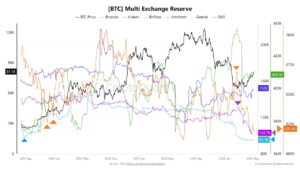
Binance’s Bitcoin reserves have declined from a peak of around 670,000 BTC to just 620,000 BTC since late February 2026. A loss of 50,000 BTC might look like a minor percentage of their entire holdings, but in the high-frequency trading environment and spot market liquidity, it is a momentous move.
This means that the world’s most active traders are no longer holding their “dry powder” on exchange to flip for short-term profits, they are pulling their assets into cold storage and removing them from the circulating supply.
And when we look at OKX and Gemini, the tendency is even more pronounced. OKX, a popular trading venue for professional and institutional traders in Asia and Europe, saw its Bitcoin holdings plunge by 22% in just two months.
Meanwhile, Gemini saw a persistent outflow that reduced its reserves down below 95,000 BTC. The key is that this is happening at many, geographically dispersed exchanges, simultaneously. The loss of Bitcoin from a single exchange could just indicate people moving to a competitor. It’s happening everywhere, confirming a systemic shift: investors are choosing self-custody instead of exchange-based custody.
The financial toll of these withdrawals is mind boggling. The 100,000 BTC that has departed these three platforms That is capital that can no longer be lent out for short-selling, used as collateral for high-leverage margin bets, or rapidly sold in a market panic. Every Bitcoin that transfers into a private, non-custodial wallet is a Bitcoin that is “off the board”, which makes the remaining supply on exchanges more precious and the price discovery process more volatile.
The Drying Up of the OTC Markets
The headline-grabbing data are on public exchanges, but a more subtle and perhaps more significant trend is taking place in the shadows of the Over-the-Counter (OTC) markets. OTC desks are the preferred places for institutional investors, hedge funds and “whales” who want to move large blocks of Bitcoin without creating a huge price slippage on public order books. OTC desks have historically served as a supplemental cushion when exchange reserves fall. However, the latest data from CryptoQuant indicates that this buffer is also depleting.
The balance change of the OTC over the last month has gone deep into the negative region with a -24,940 BTC mark. For perspective, a few months back OTC desks were experiencing significant inflows as institutions bought the dip around the $60,000 level. Now that OTC balances are now decreasing alongside exchange reserves, it indicates that the institutional “supply chain” for Bitcoin is under great strain. Large buyers who typically source liquidity from these private desks are finding fewer sellers willing to part with their coins at current levels.
The absence of liquidity in the OTC market sometimes compels major purchasers to eventually take their orders to the public spot markets. If there is a buy order for several billion dollars on an exchange that is already under pressure and has low reserves, the price movement can be tremendous. This is the “aggressive movement” analysts like Amr Taha are warning about. We are effectively watching a high-stakes game of musical chairs, but the chairs are being taken out of the room every single day.
The Rise of the Conviction Accumulators
Who’s buying up all this Bitcoin? The data indicates one type of investor: the “Accumulator Address.” These are wallets that have only bought and never sold. These aren’t the day traders, the “weak hands” that panic sell at the first sign of a 10% correction. Instead, these are entities from high-net-worth individuals to corporate treasuries who see Bitcoin as a sovereign reserve asset.
Demand from these accumulator addresses surged to 264,000 BTC in early May 2026, a sharp spike from the 164,000 BTC seen a few weeks earlier. This surge in accumulation happened even as Bitcoin price climbed towards the $82,000 mark. A normal market cycle hopes for accumulation during the “blood in the streets” stages, and distribution (selling) during the rallies. The current behaviour is unusual and very bullish. Investors are buying the breakout not only the drop. They’re basically claiming that even at $82,000, Bitcoin is cheap relative to its future potential.
aggressive accumulation signals a shift in market psychology. Bitcoin has been viewed for years as a “risk-on” asset to be traded alongside tech equities. In 2026, we are seeing the rise of Bitcoin as a “conviction asset.” “How much can I make trading this week?” has become “How much of this limited resource can I get for the next decade?” This change in thinking is what is forcing the currencies off the exchanges and into deep cold storage.
Scarcity as a Tactic
It cannot be looked at in isolation, this supply bottleneck. We are in a global economy with inflationary pressures on traditional fiat currencies and geopolitical uncertainty has made the concept of “neutral money” more appealing than ever. In that context, the programmed scarcity of Bitcoin, that there will only ever be 21 million, stands in stark contrast to the endless printing powers of central banks.
The latest update on MicroStrategy’s quarterly reporting where they reported huge paper losses but opted to stay on to their huge amount of over 818,334 BTC is a testament to the dedication of institutions to this asset class. Michael Saylor and other corporate leaders have successfully converted their enterprises into Bitcoin vaults. They don’t care about the “realized profit” of a quarter. They’re playing a multi-decade game of capital preservation. So when the biggest players in the world won’t sell even as things get crazy volatile, it sets a floor on the market that is hard as hell to break.
Looking forward to the remainder of 2026, the confluence of these dynamics – declining exchange reserves, shrinking OTC liquidity, and record-breaking accumulation – leads towards a fundamental supply-demand imbalance.
If history is any guide, when supply hits these historic lows it doesn’t take much of a spark of increased popular interest or a positive macroeconomic catalyst to ignite a parabolic surge. The bitcoin is disappearing from the exchanges, but it is not gone, it is only going into the hands of those with the strongest confidence and the rest of the market is fighting for what little is left. We are no longer looking at a price chart, we are looking at the world re-price scarcity in real time.
Read Also: Bitcoin Reclaims $80,000+ After Its Best Month In A Year