BlackRock and Blackstone are two of the most powerful names in global finance, both born in New York City and both often confused for one another because of their near-identical names and shared origin story. Yet they run fundamentally different businesses, chase different returns, and suit very different investors.
- BlackRock vs Blackstone at a glance
- BlackRock
- Strengths
- Weaknesses
- Blackstone
- Strengths
- Weaknesses
- Differences between Blackstone vs BlackRock
- 1. Company structure
- 2. Core business models
- Key differences in investment approach
- 1. Sector strategies: BlackRock vs Blackstone
- 2. Social impact and ESG
- 3. Financial showdown: BlackRock vs Blackstone
- 4. Products and services
- 5. Management and leadership
- 6. Market reach and global impact
- 7. Growth strategies for 2026
- 8. Emerging challenges and opportunities
- How to choose between BlackRock and Blackstone
- Common pitfalls to avoid
- How Malaysian & Singaporean investors can buy BlackRock or Blackstone
- Overview of BlackRock vs Blackstone
- Conclusion
- Comparative advantages and disadvantages
- Investor insights
- Final thoughts
- Frequently Asked Questions
BlackRock is the world’s largest asset manager, overseeing roughly US$13.9 trillion as of the first quarter of 2026 — a scale built mostly on low-cost index funds, ETFs and bonds. Blackstone is the world’s largest alternative asset manager, with around US$1.3 trillion concentrated in private equity, real estate, private credit and infrastructure. Put simply: one dominates public markets, the other dominates private ones.
In this guide we break down the real differences between BlackRock vs Blackstone — their business models, fees, financials, leadership, risks and growth plans — and, importantly for Malaysian and Singaporean readers, how you can actually invest in either one. Whether you are diversifying a portfolio or just trying to keep these two “Black” giants straight, this is your plain-English map.
Figures below were verified in July 2026 using each firm’s latest quarterly and full-year filings. Markets move quickly, so always confirm current numbers with the company’s investor-relations page before acting.
BlackRock vs Blackstone at a glance
If you only read one section, make it this one. The table below summarises how the two firms differ across the factors that matter most to investors.
| Aspect | BlackRock (NYSE: BLK) | Blackstone (NYSE: BX) |
|---|---|---|
| What it is | World’s largest asset manager | World’s largest alternative asset manager |
| AUM (Q1 2026) | ~US$13.9 trillion | ~US$1.3 trillion |
| Core focus | Index funds, ETFs (iShares), fixed income, Aladdin technology | Private equity, real estate, private credit, infrastructure |
| Investment style | Mostly passive / long-term buy-and-hold | Active ownership and asset enhancement |
| How it earns | Management fees on AUM (low, high-volume) | Management fees + performance fees / carried interest |
| Typical investor | Retail and institutions (very accessible) | High-net-worth and institutions (higher minimums) |
| Liquidity | High — funds trade daily | Lower — capital often locked for years |
| FY2025 revenue | ~US$24.2 billion | ~US$13.8 billion |
| Market cap (Jul 2026) | ~US$167 billion | ~US$145 billion |
| Founded | 1988 (independent from Blackstone by 1994) | 1985 |
| Chief Executive | Laurence (Larry) Fink | Stephen Schwarzman |
Notice how BlackRock manages more than ten times the assets of Blackstone, yet the two are much closer in stock-market value. That gap tells the whole story: Blackstone earns far more per dollar managed because performance fees on private deals are richer than management fees on index funds. Keep that trade-off in mind as we go deeper.
 BlackRock
BlackRock is the global leader in asset management, best known for popularising low-cost index investing through its iShares ETF family and for its dominance in fixed income and risk management. It serves clients in more than 100 countries and, through the index funds it runs, holds significant stakes in nearly every large listed company — Apple, Microsoft, Amazon, Nvidia and more.
Historically BlackRock was almost entirely a traditional, public-markets manager. That is changing fast. Through its 2024–2025 acquisitions of Global Infrastructure Partners, data provider Preqin, and private-credit specialist HPS Investment Partners (completed December 2025), BlackRock is muscling into the private-markets territory Blackstone has long owned — one of the most important shifts in the industry today.
Strengths
- Unmatched scale and stability: At ~US$13.9 trillion, BlackRock is the largest money manager on earth. That scale drives down costs and gives clients deep liquidity.
- Accessibility for everyone: From a beginner buying a single ETF to a sovereign wealth fund, BlackRock serves both retail and institutional investors — a far wider door than Blackstone’s.
- Technology moat (Aladdin): Its Aladdin risk-and-portfolio platform is used by institutions worldwide and is a genuine, hard-to-copy competitive advantage.
- Diverse, low-cost product shelf: Stocks, bonds, ETFs, mutual funds and now private assets — broad diversification that lowers overall risk.
Weaknesses
- Fee compression: The passive/ETF business runs on razor-thin fees, so profits depend on ever-growing volume and buoyant markets.
- Market dependence: Because so much AUM is index-linked, revenue rises and falls with global markets and investor sentiment.
- Political and regulatory scrutiny: Its sheer size — and its past ESG positioning — draws criticism from across the political spectrum and invites regulatory attention.
Blackstone
The Blackstone Group is an investment powerhouse and the world’s largest alternative asset manager. Where BlackRock buys slices of thousands of public companies, Blackstone typically buys whole businesses, office towers, warehouses, data centres and loan portfolios — then works to make them more valuable before selling.
Founded in 1985 as a mergers-and-acquisitions boutique, Blackstone has evolved into a versatile alternative-investment firm spanning private equity, real estate, private credit and insurance, and hedge-fund solutions. It is famous — and occasionally controversial — for bold, large-scale deals and for its aggressive push into private credit and AI-related infrastructure.
Strengths
- The alpha of alternatives: Blackstone finds private opportunities unavailable on public exchanges, targeting higher risk-adjusted returns.
- Hands-on value creation: It doesn’t just buy assets — it actively improves their operations, which is how it justifies premium performance fees.
- Richer economics: Performance fees (carried interest) mean Blackstone can earn far more per dollar managed than a low-fee index shop.
- Perpetual capital engine: A growing base of long-dated and “perpetual” capital — roughly US$540 billion — gives it stable, recurring fees.
Weaknesses
- Low liquidity: Its assets don’t trade publicly, so investors’ capital can be locked up for years — a serious consideration in a downturn.
- High minimums: Many funds are built for high-net-worth and institutional clients, not everyday savers.
- Cycle sensitivity: Returns are tied to real-estate and private-equity cycles, so rising interest rates or slow exits can dent performance and valuations.
Differences between Blackstone vs BlackRock
1. Company structure
Both firms are publicly listed holding companies (BlackRock trades as NYSE: BLK; Blackstone as NYSE: BX), each sitting atop a web of regulated subsidiaries and fund vehicles.
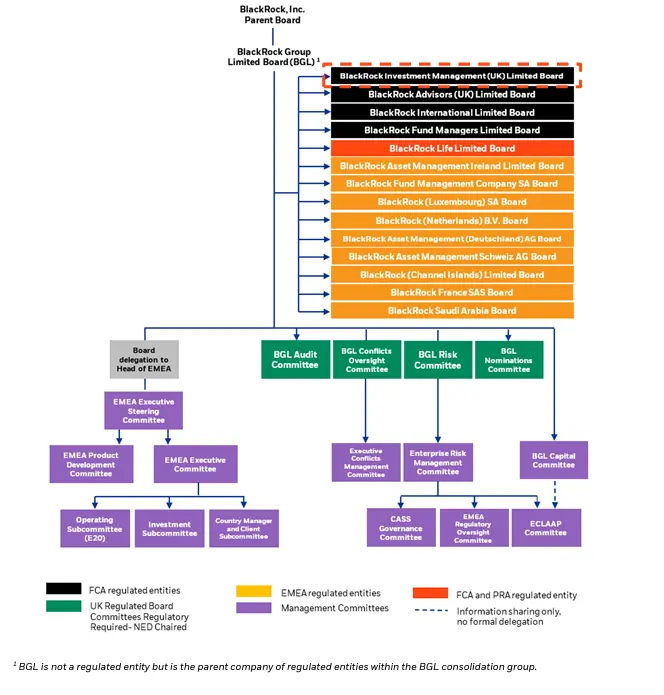
Photo credit: BlackRock.com
Blackstone’s four reporting segments
Blackstone Inc. is the listed parent. Rather than a handful of named legal subsidiaries, the way to understand it is through its four business segments (these are reporting segments, not standalone legal entities). Here is how its ~US$1.3 trillion was split as of the end of 2025:
| Segment | Approx. AUM (end 2025) | What it covers |
|---|---|---|
| Credit & Insurance | ~US$443 billion | Private & liquid corporate credit, CLOs, insurance mandates (BXCI) |
| Private Equity | ~US$416 billion | Corporate PE, infrastructure, life sciences, growth, secondaries/GP stakes |
| Real Estate | ~US$319 billion | Opportunistic & core-plus property, plus non-listed REITs (e.g. BREIT) |
| Multi-Asset Investing (BXMA) | ~US$96 billion | Discretionary allocation to hedge funds and multi-asset portfolios |
A common myth to bust: BlackRock and The Vanguard Group are not subsidiaries of Blackstone (an error you will find repeated across the web). They are entirely separate, competing firms. The three simply appear together on the shareholder registers of most big public companies because their index funds each own small stakes in nearly everything.
2. Core business models
BlackRock: passive scale
BlackRock is the pioneer of the index-fund and ETF era. Through iShares it offers exposure to almost every asset class at very low cost. The business model is high-volume and low-margin: charge a tiny fee on an enormous, ever-growing pile of assets. Increasingly it is bolting a private-markets and technology business on top of that foundation.
Blackstone: private-market active ownership
Blackstone is the leader in private equity and alternatives. Its edge is buying undervalued or under-managed assets, improving them through active management, and selling for a gain — earning both management fees and a share of the profits. It is a lower-volume, higher-margin model that depends on skill and timing rather than sheer scale.
Key differences in investment approach
1. Sector strategies: BlackRock vs Blackstone
Blackstone leans heavily into real estate and, more recently, digital infrastructure — data centres and AI-related facilities have become a signature theme. BlackRock, by contrast, emphasises technology and data across its whole platform, using tools like Aladdin to deliver data-driven, systematically managed exposure at scale.
2. Social impact and ESG
BlackRock has historically been vocal on Environmental, Social and Governance (ESG) factors, though it has softened its public messaging amid political backlash in the United States. Blackstone integrates sustainability into large real-asset and energy-transition projects — renewable power, grid and infrastructure — where its capital can move the needle directly.
3. Financial showdown: BlackRock vs Blackstone
a. Revenue streams
BlackRock earns primarily from management fees on its funds and accounts, supplemented by:
- Technology services: subscriptions to the Aladdin platform.
- iShares ETFs: a huge and growing contributor as passive investing keeps expanding.
Blackstone earns from managing private equity, real estate, credit and hedge funds, plus:
- Performance fees (carried interest): a share of profits when funds do well — the high-octane part of its income.
- Real-estate and credit income: rent, interest and asset appreciation.
b. Financial highlights (FY2025 & Q1 2026)
BlackRock
- Assets under management: ~US$13.9 trillion as of 31 March 2026, up about 20% year-on-year — an all-time high, boosted by strong flows and the HPS acquisition.
- Revenue: ~US$24.2 billion for full-year 2025, up roughly 19% year-on-year — its first year above US$24 billion.
- Momentum: Q1 2026 revenue reached ~US$6.7 billion (+27% YoY) with US$135.9 billion of long-term net inflows in the quarter and an industry-leading adjusted operating margin near 44.5%.
Blackstone
- Assets under management: ~US$1.30 trillion as of 31 March 2026, up about 12% year-on-year — a record, and firmly past the US$1 trillion milestone.
- Revenue: ~US$13.8 billion of GAAP revenue for full-year 2025 (up ~22% YoY), with distributable earnings of roughly US$7.1 billion.
- Momentum: fee-related earnings rose 23% to ~US$1.55 billion in Q1 2026; the firm pulled in US$239 billion of inflows in 2025 (+40%).
Verified July 2026 from the latest BlackRock investor relations and Blackstone earnings releases; confirm the latest figures with each company before relying on them.
c. Risk and volatility factors
BlackRock
- Market dependence: passive-heavy AUM makes revenue sensitive to market swings and sentiment.
- Fee compression: fierce ETF competition keeps pushing management fees lower.
- Regulatory and political scrutiny: its size and ESG history invite oversight from multiple directions.
Blackstone
- Cycle risk: performance tracks real-estate and private-equity cycles, so revenue is inherently lumpier.
- Valuation and exit risk: higher rates or slow deal markets can delay exits and pressure valuations.
- Liquidity mismatch: in stressed markets, redemption limits on vehicles like BREIT can make headlines.
4. Products and services
BlackRock
- Asset management across mutual funds, ETFs (iShares) and institutional accounts.
- Risk-management solutions: analytics and advisory to help clients manage exposure.
- Technology (Aladdin): its flagship investment-management platform used by institutions globally.
- Private markets: fast-growing private credit, infrastructure and data capabilities via HPS, GIP and Preqin.
Blackstone
- Real estate: one of the world’s largest owners of commercial property, warehouses and data centres.
- Private equity: acquiring and improving private companies to generate returns.
- Credit & insurance: direct lending, CLOs and insurance-linked mandates — now its biggest segment.
- Life sciences (BXLS): funding drug development and healthcare innovation.
5. Management and leadership
BlackRock
BlackRock is led by co-founder Laurence (Larry) Fink as Chairman and CEO, with co-founder Rob Kapito as President. Key executives include CFO Martin Small and COO Rob Goldstein, both widely viewed as part of the long-term succession picture. Decisions run through a Global Executive Committee and a seasoned Board of Directors.
Blackstone
Blackstone is led by co-founder Stephen Schwarzman as Chairman and CEO. His clear number-two is President and COO Jonathan (Jon) Gray, who built the firm’s real-estate empire and is seen as heir apparent. Michael Chae serves as Chief Financial Officer.
6. Market reach and global impact
BlackRock
- Presence: offices in more than 40 countries; clients in over 100.
- Workforce: approximately 25,000+ employees as of early 2026.
Blackstone
- Presence: around 25+ offices worldwide, focused on alternative investments.
- Workforce: a leaner team of roughly 5,000, reflecting its high-value, deal-driven model.
7. Growth strategies for 2026
BlackRock
- Private markets push: integrating HPS (private credit), GIP (infrastructure) and Preqin (data) to build a private-markets business that rivals the alternative specialists — including Blackstone.
- Technology expansion: deepening Aladdin and adding AI-driven tools to lock in institutional clients.
- Whole-portfolio solutions: bundling public and private assets into model portfolios for advisers and retirement savers.
- Emerging-market growth: expanding ETFs in Asia and other fast-growing regions.
Blackstone
- AI & digital infrastructure: aggressively funding data centres and the power to run them — a defining 2026 theme.
- Private credit: capitalising on tighter bank lending to expand its now-largest Credit & Insurance segment.
- Insurance partnerships: managing long-dated capital for global insurers to grow stable, perpetual fees.
- Wealth channel: designing semi-liquid products to bring alternatives to (wealthier) individual investors.
8. Emerging challenges and opportunities
BlackRock
- Challenges: continued fee compression, political crossfire over ESG and index-fund voting power, and integrating several large acquisitions at once.
- Opportunities: booming demand for private assets, technology/data monetisation, and retirement-savings growth in Asia and Latin America.
Blackstone
- Challenges: interest-rate sensitivity, slower exit markets, and rising competition in private credit — including from BlackRock itself.
- Opportunities: the AI-infrastructure buildout, surging demand for private credit, and opening the individual-investor channel.
How to choose between BlackRock and Blackstone
There is no universally “better” firm — the right choice depends on what you are trying to do. Use this quick framework:
- Want simple, low-cost, liquid exposure? BlackRock’s iShares ETFs are hard to beat, and you can buy or sell any trading day. Great for beginners and core portfolios. If you are new, start with our guides on how to invest in stocks and the S&P 500.
- Want the shares of the company itself? Decide whether you prefer BlackRock’s steadier, fee-based earnings (BLK) or Blackstone’s higher-growth, more volatile performance-fee model (BX). BX often pays a larger but more variable dividend.
- Chasing higher returns and can lock money up? Blackstone’s private funds target bigger gains but demand patience, higher minimums and tolerance for illiquidity.
- Prioritising stability and diversification? BlackRock’s breadth across long-term stocks, bonds and ETFs makes it the lower-drama option.
- Want a slice of both? Many investors simply hold both BLK and BX shares to capture public-market scale and private-market upside at once.
Common pitfalls to avoid
- Confusing the two names: they are separate, competing firms — not the same company, and not parent-and-subsidiary.
- Assuming bigger AUM means a better stock: BlackRock manages 10× the assets, but Blackstone’s richer fee model means the market values them far more closely.
- Ignoring liquidity: Blackstone’s private funds can restrict withdrawals; never commit money you may need soon.
- Chasing the dividend blindly: BX’s payout swings with performance fees, so a high headline yield can shrink in a slow year.
- Overlooking currency and tax: as a Malaysian or Singaporean investor, factor in USD exposure and the 30% US dividend withholding tax (see below).
How Malaysian & Singaporean investors can buy BlackRock or Blackstone
Both BLK and BX are listed on the New York Stock Exchange, so you cannot buy them on Bursa Malaysia or SGX directly. Here is how local investors typically gain exposure:
- US-market brokers: platforms such as Moomoo, Webull, Interactive Brokers, Tiger and (for Malaysians) home-grown apps that offer US stocks let you buy BLK or BX directly. Compare them in our roundup of the best trading platforms in Malaysia.
- Fractional shares: BlackRock’s share price runs into four figures, so many brokers let you buy a fraction rather than a whole share — handy for smaller budgets.
- Dividend withholding: the US levies a 30% withholding tax on dividends paid to Malaysian and Singaporean investors. This bites more on Blackstone (a higher yielder) than on BlackRock.
- Prefer the funds, not the shares? You can also access BlackRock’s iShares ETFs or, closer to home, Malaysian REITs for property exposure without US paperwork.
Always weigh brokerage fees, FX spreads and platform regulation before committing.
Overview of BlackRock vs Blackstone
Is BlackRock a better bet, or is Blackstone more favourable? Too much detail can overwhelm, so the snapshot below captures the key differences and a few similarities at a glance.
| Aspect | BlackRock | Blackstone |
|---|---|---|
| Core business model | Asset management | Private equity & alternatives |
| Fund strategy | Passive investment | Active asset enhancement |
| Investment vehicles | Stocks, bonds, ETFs | Real estate, private equity, credit |
| Global presence | Extensive (100+ countries) | Focused on alternatives |
| Investor base | Institutions and retail | High-net-worth and institutions |
| AUM (Q1 2026) | ~US$13.9 trillion | ~US$1.3 trillion |
Conclusion
Comparative advantages and disadvantages
BlackRock offers unparalleled scale, liquidity and stability through its low-cost, passive product range, making it a natural core holding. The flip side is thin fees and questions about the influence that comes with its size. Blackstone excels in private equity and alternatives, leveraging active ownership to chase outsized returns — but with higher risk, lower liquidity and lumpier, cycle-driven earnings.
Investor insights
Match the firm to your own risk tolerance and goals. If you want stability and easy diversification through traditional investing, BlackRock is the more comfortable fit. If you can stomach volatility and illiquidity in exchange for higher potential returns, Blackstone appeals. And nothing stops you from owning both.
Final thoughts
BlackRock and Blackstone both sit at the centre of global finance, and in 2026 their worlds are converging: BlackRock is charging into private markets while Blackstone courts everyday investors. That growing rivalry is reshaping the investment landscape — and giving investors a richer set of choices than ever.
Disclaimer: This article is provided by KayaToday for general information and education only. It is not financial advice, and figures can change quickly. Do your own research and consult a licensed adviser before making any investment decision.