Sustainability has moved from a niche concern to a boardroom priority. Roughly 73% of global greenhouse gas emissions come from how we produce and use energy — which is why almost every serious climate solution eventually comes back to three things: transparency, measurement, and trust.
- Quick Introduction to What Blockchain Is
- The Pressing Concern in Sustainability
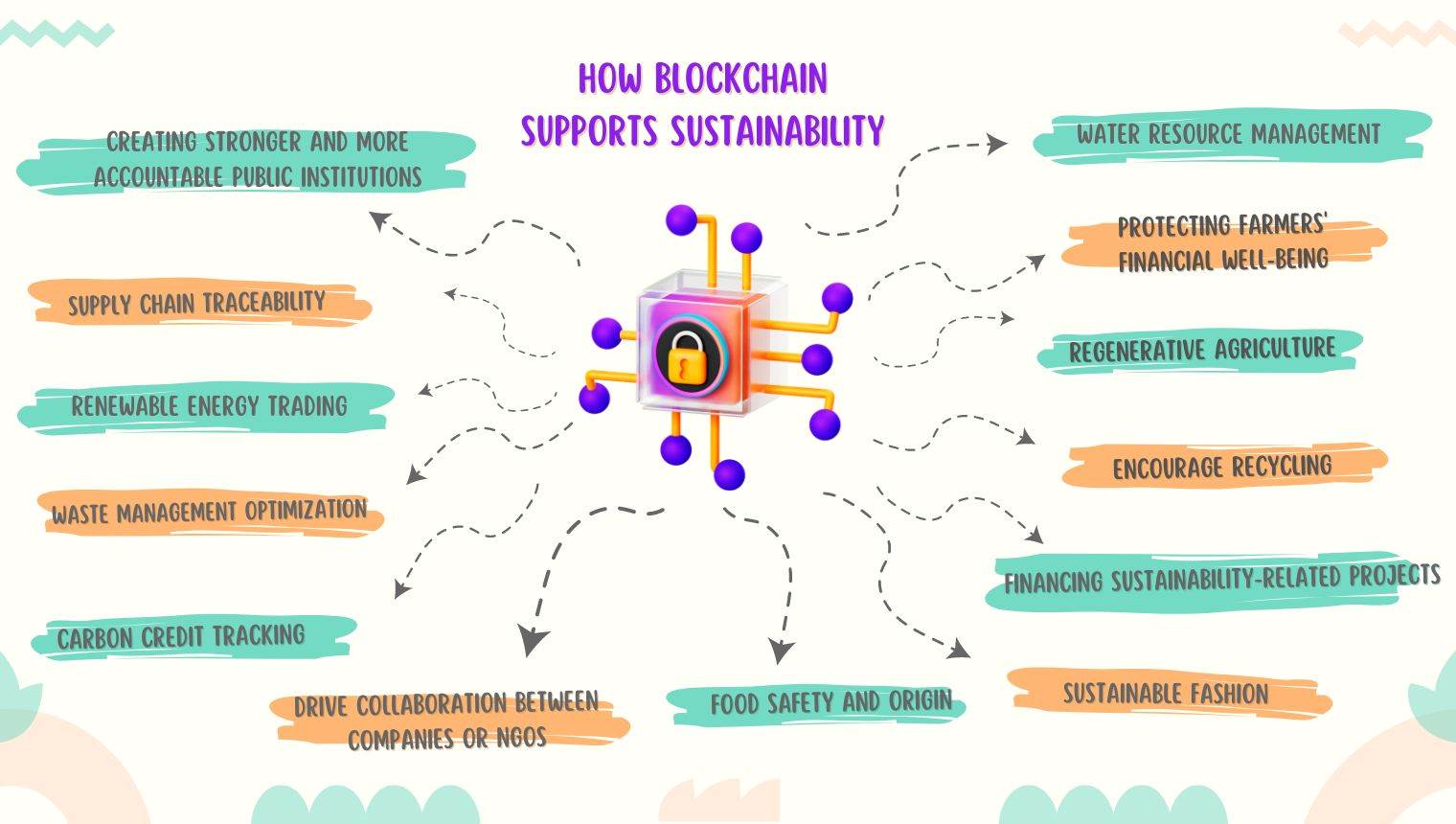
- 13 Ways Blockchain Technology Can Support Sustainability Efforts
- 1. Supply Chain Traceability
- 2. Renewable Energy Trading
- 3. Waste Management Optimization
- 4. Carbon Credit Tracking
- 5. Drive Collaboration Between Companies or NGOs in Different Countries
- 6. Food Safety and Origin
- 7. Sustainable Fashion
- 8. Financing Sustainability-related Projects
- 9. Encourage Recycling
- 10. Regenerative Agriculture
- 11. Protecting Farmers’ Financial Well-Being
- 12. Creating Stronger and More Accountable Public Institutions
- 13. Water Resource Management
- The Catch: Energy Use and Greenwashing
- Frequently Asked Questions (FAQs)
That is exactly where blockchain earns its place in the conversation. Beyond the crypto headlines, a blockchain is simply a shared, tamper-proof record-keeping system — and record-keeping is the quiet backbone of nearly every sustainability effort, from carbon markets to ethical supply chains.
So, how can blockchain features support sustainability efforts? Below are 13 practical, real-world ways, refreshed for 2026 and viewed through a Malaysia and Singapore lens where it matters.
Figures in this guide were verified in August 2026. Carbon prices, project data, and platform availability change quickly, so always confirm current details with the relevant exchange or provider before acting on anything below.
Quick Introduction to What Blockchain Is
Blockchain:
Imagine a digital chain made of blocks, each containing information. Once a block is added, it cannot be quietly changed or removed — it is a highly secure, tamper-evident ledger. If you want the mechanics, our guide on how a blockchain actually works breaks it down step by step.
People use blockchains to record transactions (such as money transfers), track ownership (such as who owns a parcel of land or a tonne of verified carbon), and even to run transparent voting or grant systems.
Think of it as a public notebook that everyone can read, but where pages cannot be torn out or rewritten after the fact. Thanks to zero-knowledge (ZK) technology, some of these proofs can even be verified without exposing the underlying private data.
Smart Contracts:
Smart contracts live on the blockchain. They are written in code and execute automatically when pre-set conditions are met — no middleman required. For example, a rental smart contract might release a digital key the moment rent is paid. In sustainability, the same idea pays a farmer automatically when a verified rainfall target is missed, or releases a reward when satellite data confirms new tree cover. (New to the jargon? Our plain-English crypto and blockchain glossary is a handy companion.)
The Pressing Concern in Sustainability
The scale of the problem keeps growing. The World Meteorological Organization confirmed that 2024 was the warmest year on record, at about 1.55°C above pre-industrial levels — likely the first calendar year to breach the symbolic 1.5°C mark. Even more striking, the ten warmest years on record are the ten most recent ones (2015–2024), a clustering scientists say has never happened before.
The knock-on effects are everywhere. The World Health Organization estimates that air pollution contributes to millions of premature deaths each year, with the Western Pacific Region among the hardest hit. Deforestation in developing economies continues to strip out natural carbon sinks. And globally, roughly a third of all food produced is lost or wasted — squandering water, land, and energy while adding emissions on the way to the landfill.
The clock is ticking, and no single technology is a silver bullet. But blockchain’s specific strengths — transparency, traceability, and automated trust — map neatly onto problems that have long been held back by bad data and weak accountability. Used well (and paired with genuinely low-energy networks), it can quietly make sustainability efforts more honest and more efficient.
13 Ways Blockchain Technology Can Support Sustainability Efforts
Here is a quick map of the 13 use cases below, the core blockchain feature each one leans on, and a real-world example you can look up.
| # | Use case | Key blockchain feature | Real-world example |
|---|---|---|---|
| 1 | Supply chain traceability | Immutable record | IBM-backed traceability networks |
| 2 | Renewable energy trading | Peer-to-peer + smart contracts | Brooklyn Microgrid |
| 3 | Waste management | Transparency | Municipal waste tracking pilots |
| 4 | Carbon credit tracking | Traceability | Bursa Carbon Exchange (MY), Climate Impact X (SG) |
| 5 | Cross-border collaboration | Fast, low-fee transfers | Stablecoins (USDC/USDT) |
| 6 | Food safety & origin | Farm-to-table records | IBM Food Trust |
| 7 | Sustainable fashion | Digital product identity | Aura Blockchain Consortium |
| 8 | Financing green projects | Tamper-proof donations | Gitcoin |
| 9 | Encouraging recycling | Tokenized rewards | Plastic Bank |
| 10 | Regenerative agriculture | Oracles + smart contracts | Green World Campaign |
| 11 | Protecting farmers | Parametric insurance | Etherisc, Arbol |
| 12 | Accountable institutions | Transparent procurement | Colombia procurement pilot |
| 13 | Water resource management | Decentralized metering | Smart-meter networks |
1. Supply Chain Traceability
A blockchain is a transparent digital ledger that keeps a permanent record of every step a product takes, from raw material to finished good.
According to ManMohan S. Sodhi, Professor of Operations and Supply Chain at Bayes Business School, City University of London, there are three ways this supports sustainability.
- Transparency makes it far harder for shady practices like fraud or corruption to go undetected.
- Traceability lets every participant on the chain see verified details about the others — ethical sourcing, shipping, processing, and distribution of goods and materials.
- Traceability also unlocks operational efficiency. Imagine a t-shirt maker that records where its cotton comes from, how each shirt is produced, and where it ships.
That visibility lets the company track real customer demand, spot pockets of excess inventory, and redistribute stock to where it is actually needed.
The result is faster order fulfilment and fewer unsold shirts sitting in a warehouse — a more efficient use of materials and a more sustainable answer to overproduction.
2. Renewable Energy Trading
Peer-to-peer (P2P) energy markets remain one of the most common blockchain energy use cases. In a P2P market, neighbours trade and buy unused electricity directly from one another.
The Brooklyn Microgrid project is the classic example: it uses blockchain to run a P2P energy exchange so residents can sell surplus rooftop solar to the people next door.
This delivers three benefits.
- Every homeowner can track the grid’s — and their neighbours’ — energy production and consumption in near real time.
- That visibility nudges households to match their usage to actual need.
- Surplus energy is sold locally instead of triggering new generation, keeping the grid stable, lowering costs, and cutting reliance on fossil fuels.
3. Waste Management Optimization
Because a blockchain is transparent, it enforces accountability across the whole waste journey — collection, disposal, and recycling.
Sustainability consultant Oluwatosin Adebayo notes that this transparency benefits every stakeholder — waste generators, regulators, and environmental groups — in two ways.
- All parties can monitor the entire waste lifecycle, confirming legal compliance and flagging anomalies early.
- It deters illegal dumping, because any unauthorized disposal can be traced straight back to the responsible party.
4. Carbon Credit Tracking
Carbon credits let a company emit a set amount of greenhouse gases. One credit typically permits one tonne (1,000 kg) of carbon dioxide, or the equivalent in other greenhouse gases.
Here is a simplified example of how they work:
- Companies receive a set number of credits. Say Company A and Company B each hold 1 credit.
- Company A uses only 10% (0.1) of its credit for the year, while Company B uses 60% (0.6).
- Company A has 0.9 credits left; Company B has 0.4 left.
- Because Company B needs more than it holds, it must either cut emissions or buy spare credits from Company A.
- By reducing emissions, Company A earns money; Company B pays.
- The net effect: carbon credits give businesses a financial incentive to cut emissions.
Fun fact: the cap-and-trade system used to curb sulfur pollution in the 1990s is the blueprint for today’s carbon-credit markets.
So how does blockchain help? Carbon markets have long been dogged by double-counting and questions over credit quality. A shared, tamper-proof ledger makes each credit traceable — who issued it, who retired it, and whether it has already been used — which is exactly why the newest exchanges are building on this technology.
Closer to home: Malaysia’s Bursa Carbon Exchange (BCX) launched in December 2022 as the world’s first Shariah-compliant carbon exchange, and held Malaysia’s first carbon-credit auction in March 2023. In Singapore, Climate Impact X (CIX) — a joint venture of SGX, DBS, Standard Chartered, and Temasek — runs a global carbon marketplace that explicitly uses satellite monitoring, machine learning, and blockchain to strengthen credit integrity. Carbon credits are, in effect, an early form of tokenizing real-world assets, and both exchanges show how the region is putting the idea to work.
5. Drive Collaboration Between Companies or NGOs in Different Countries
Traditional cross-border payment systems rely on middlemen, fees, and slow currency conversions that can take days to settle. Blockchain-based transfers strip out those intermediaries, making transactions faster and cheaper — which means green projects and NGOs can move funds and coordinate across borders far more quickly.
To show the difference, we once compared sending USD 1,000 from the United States to the United Kingdom two ways: through Wise, and through an on-chain stablecoin.
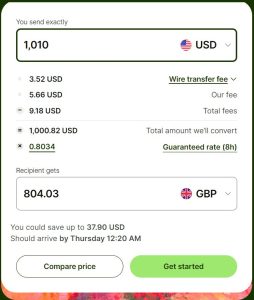
The traditional transfer took about a day to arrive, cost roughly USD 9 in fees, and required an extra top-up so the recipient still received the full 1,000.
The stablecoin transfer was a different story.
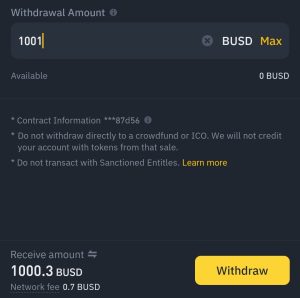
Fees were under a dollar, and instead of a full day, the transfer landed in roughly seven minutes.

A note on this example: our original test used Binance USD (BUSD), which was wound down through 2023–2024 after its issuer stopped minting it. The mechanics are unchanged, though — the same speed and cost advantage now applies to mainstream, fully-backed stablecoins such as USDT and USDC. The takeaway holds: blockchain enables faster, cheaper transfers, and therefore quicker cross-border collaboration and problem-solving.
6. Food Safety and Origin
According to IBM research on food transparency:
- A majority of consumers say it is important to know where their food comes from.
- Many are willing to pay a premium for products that are openly sourced and responsibly made.
Platforms such as IBM Food Trust record a food item’s journey from farm to table. That traceability matters to growers, processors, wholesalers, distributors, retailers, and shoppers alike — anyone who wants to verify food safety and sustainability and make decisions based on reliable data rather than marketing claims.
7. Sustainable Fashion
Luxury and lifestyle brands are increasingly discovering the commercial upside of transparency.
By combining blockchain with NFC chips and IoT sensors, a brand can give each garment or product a unique, verifiable digital identity — effectively a tamper-proof passport that follows it from raw material to resale.
The clearest current example is the Aura Blockchain Consortium, a non-profit founded in 2021 by LVMH, the Prada Group, Cartier (Richemont), and OTB. It has since grown to more than 50 luxury member brands with over 60 million products registered on-chain — names like Louis Vuitton, Bulgari, Hublot, and Prada. Because the record is transparent and traceable, revealing a product’s life cycle delivers two wins:
- It combats counterfeiting.
- It supports ethical, verifiable material sourcing.
A cautionary note: an earlier pioneer in this space, the diamond-tracking firm Everledger, collapsed into administration in 2023 despite raising over USD 50 million — a reminder that even promising blockchain projects can fail when industry adoption and running costs do not add up. Transparency is powerful, but it still has to be commercially sustainable.
8. Financing Sustainability-related Projects
Crowdfunded green projects have a persistent trust problem: donors rarely know whether their money is used as promised.
Blockchain platforms such as Gitcoin help solve this with a secure, tamper-proof record. Because every transaction is transparent, traceable, and permanent, donors can follow funding for sustainability projects from wallet to outcome — verifying that money is spent as intended and making fraud far harder.
9. Encourage Recycling
Another blockchain feature is tokenization — rewarding real-world action with digital value.
Plastic Bank is the standout example. It builds recycling ecosystems in developing economies, paying collectors in digital tokens for the plastic they gather. As of 2025, its communities had collected more than 162 million kilograms of plastic — the equivalent of over 8 billion bottles kept out of the ocean, a huge jump from its early years.
The tokens carry real utility. Members can use them to:
- Buy groceries, and
- Pay for essentials like health insurance and school fees.
Co-founder Shaun Frankson has described members whose collection income was enough to put food on the table and fund their children’s education — proof that environmental and social goals can reinforce each other.
10. Regenerative Agriculture
Regenerative agriculture encourages communities to adopt more sustainable land-use practices — usually conservation and tree planting — to shrink their carbon footprint.
Blockchain makes this scalable through oracles: services that let a blockchain read and act on real-world data.
Take the Green World Campaign. Using satellite data, it deploys smart contracts that automatically reward land regenerators who successfully improve soil, plant trees, and restore degraded land.
Payouts trigger when oracles pull data from satellite imagery and activate the smart contract, ensuring rewards reach the local population fairly and transparently — with no opaque middleman deciding who gets paid.
11. Protecting Farmers’ Financial Well-Being
Climate change is already scrambling weather patterns, and bad weather can wipe out a farmer’s income — undermining sustainability efforts at the source.
Parametric crop insurance via projects like Etherisc and Arbol offers a buffer. Using smart contracts, a farmer sets up a policy for a small plot, defines a trigger (say, a minimum amount of rainfall), and relies on oracles to monitor the weather.
If the oracle network confirms the trigger was breached, the farmer receives an automatic payout — no lengthy claims process. In effect, a smartphone becomes a financial safety net.
12. Creating Stronger and More Accountable Public Institutions
The World Economic Forum notes that public procurement is one of the largest sources of government spending — and, consequently, a common source of corruption.
Opacity between the parties involved lets significant public money leak away. To improve external oversight, the Colombian government piloted a blockchain-based procurement system, making bids and awards easier to audit in the open.
13. Water Resource Management
Pairing smart water meters with blockchain creates a decentralized monitoring network. The meters track usage and update the ledger in near real time.
The advantages are:
- Users can watch their own consumption,
- Leaks can be detected quickly, and
- Water conservation is easier to measure and reward.
The Catch: Energy Use and Greenwashing
Here is the honest trade-off. Not every blockchain is climate-friendly. The design that secures the network matters enormously.
Proof-of-Work (PoW) networks like Bitcoin secure themselves through energy-intensive mining, which draws heavy criticism for its electricity footprint. Proof-of-Stake (PoS) networks secure themselves with staked tokens instead of raw computing power — and use a tiny fraction of the energy. When Ethereum switched from PoW to PoS in its September 2022 “Merge,” it cut its energy consumption by roughly 99.95%, according to the Ethereum Foundation.
| Factor | Proof-of-Work (e.g. Bitcoin) | Proof-of-Stake (e.g. Ethereum) |
|---|---|---|
| Secured by | Mining (computing power) | Staked tokens |
| Energy use | High | Very low (~99.9% lower) |
| Best fit for sustainability projects | Rarely | Usually |
The practical lesson: a sustainability project built on an energy-hungry PoW chain can undercut its own green claims. Most credible environmental applications now run on PoS networks or private, permissioned ledgers that use negligible energy. If you are curious about the staking model that makes PoS possible, see our guide to the best crypto for staking rewards.
How to tell genuine impact from greenwashing. Before you trust a “blockchain-for-good” claim, run it through four quick checks:
- What consensus does it use? PoS or permissioned ledgers are green; PoW is hard to justify for sustainability use cases.
- Is the data real and independently verified? A ledger only records what it is fed — look for third-party audits, satellite data, or accredited standards (e.g. Verra).
- Does the blockchain actually solve the problem? If a normal database would work just as well, the “blockchain” label may be marketing.
- Is it commercially durable? As Everledger showed, projects fail when running costs outpace adoption. Longevity is part of sustainability.
Blockchain is a tool, not a cure. Weighed against its broader pros and cons, it shines where transparency and trust are the bottleneck — and adds little where they are not.
Frequently Asked Questions (FAQs)
Editorial note from KayaToday: This guide is for general education only and is not financial, investment, or environmental-compliance advice. Blockchain, crypto, and carbon markets carry real risks, and projects can change or shut down without notice. All figures were verified in August 2026 — please confirm current details with the relevant exchange, provider, or official source before making any decision.