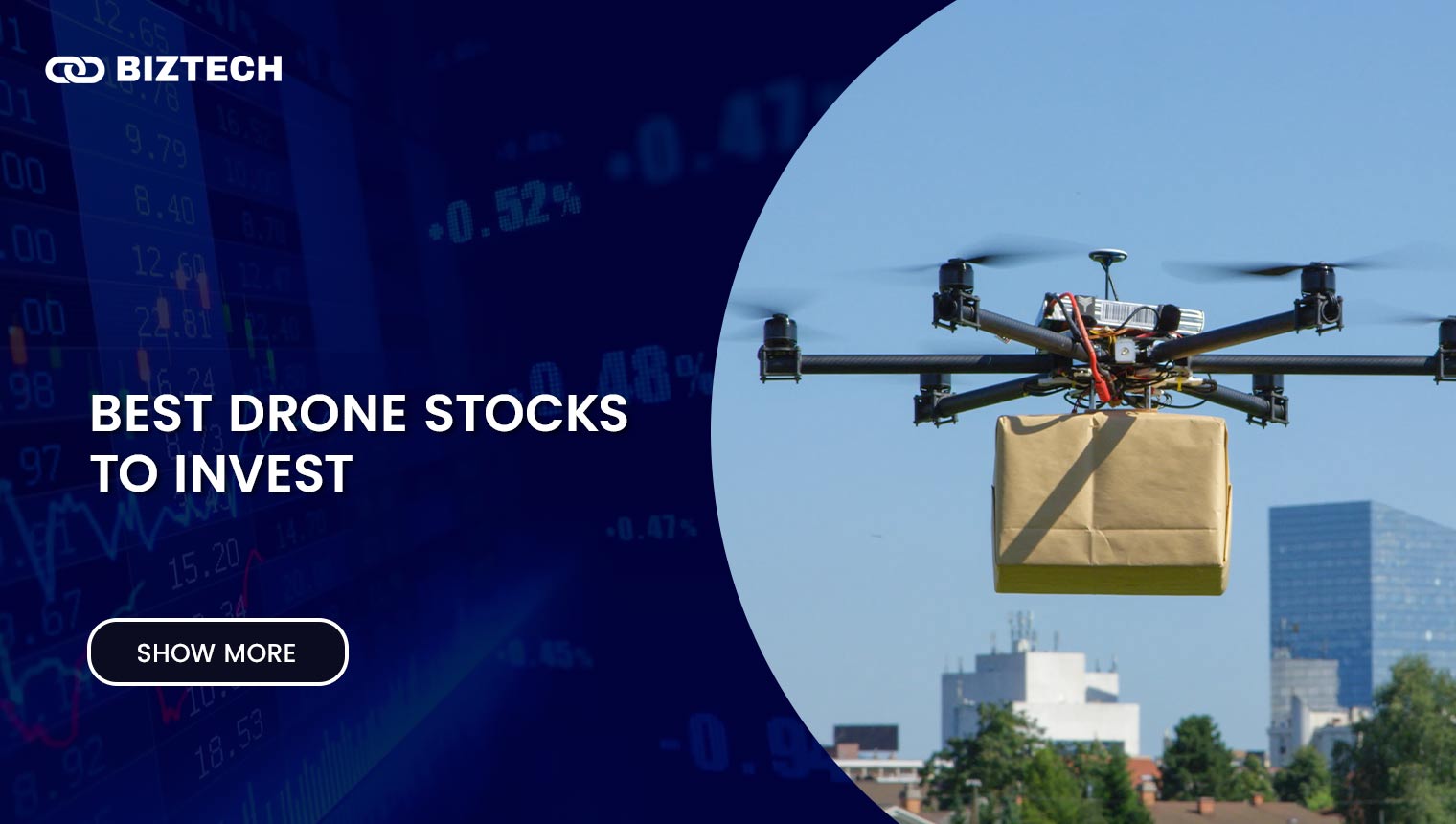
The drone industry has moved from hobby gadgets to a strategic priority for governments, logistics giants and city planners alike. Two forces reshaped the investing story in 2026: the war-driven surge in demand for military and counter-drone systems, and a fast-growing push to build a domestic (non-Chinese) drone supply chain in the United States. That combination has turned “best drone stocks” from a niche search into one of the hottest themes in the market. If you are weighing where to put your money, here are 8 of the best drone stocks to consider in 2026 — plus a group of fast-moving pure-play drone makers now stealing the spotlight.
- Why Drone Stocks Are in Focus in 2026
- Best 8 Drone Stocks to Invest in 2026 (At a Glance)
- Drone Stocks for the Long Term
- 1. Amazon.com Inc. (AMZN)
- 2. Joby Aviation Inc. (JOBY)
- 3. Northrop Grumman Corp. (NOC)
- 4. Boeing Co. (BA)
- 5. AeroVironment Inc. (AVAV)
- 6. Kratos Defense & Security Solutions Inc. (KTOS)
- Drone Stocks for the Short Term (Higher Risk)
- 7. EHang Holdings Ltd. (EH)
- 8. Parrot SA (PAOTF)
- Also on Your Radar: U.S. Pure-Play Drone Stocks
- Red Cat Holdings (RCAT)
- Unusual Machines (UMAC)
- Ondas Holdings (ONDS)
- Types of Drone Stocks to Consider
- Defence and Military Drone Stocks
- Commercial and Delivery Drone Stocks
- Consumer and Recreational Drone Stocks
- Autonomous Air Mobility and eVTOL Stocks
- How to Choose a Drone Stock: A Simple Framework
- How to Buy Drone Stocks From Malaysia or Singapore
- Risks and Challenges of Investing in Drone Stocks
- Valuation and Hype Risk
- Dilution and Cash Burn
- Regulatory and Political Uncertainty
- Competition and Technology Risk
- Market Volatility
- Conclusion
- FAQ
All prices and market values below were verified in early July 2026. Markets move fast — always confirm the latest figure with your broker before you buy.
Why Drone Stocks Are in Focus in 2026
The rise of drone stocks has been fuelled by real-world demand, not just hype. Several catalysts are driving the sector right now:
- Defence and counter-drone demand: Conflicts in Ukraine and the Middle East have made cheap, attritable drones and loitering munitions front-line weapons. Counter-UAS (systems that detect and neutralise hostile drones) is now one of the fastest-growing corners of the defence budget.
- The “made in America” drone push: In 2026 the U.S. government moved to fund domestic drone makers and phase Chinese-made drones (led by market leader DJI) out of federal use. Reports that the Trump administration was in talks to back companies such as AeroVironment, Red Cat and Unusual Machines sent pure-play drone shares sharply higher.
- eVTOL edges toward take-off: Electric air-taxi makers such as Joby Aviation and EHang moved deeper into certification and early commercial service, keeping urban air mobility on investors’ radar.
- Delivery and commercial use: Amazon Prime Air and others continued expanding drone delivery, while agriculture, mapping and inspection kept growing as everyday use cases.
One important nuance for 2026: after a huge run, many defence and drone names pulled back from their highs mid-year on ceasefire hopes and political uncertainty. For long-term investors that volatility can create entry points — but it is also a reminder that this is a high-beta, headline-driven sector.
Best 8 Drone Stocks to Invest in 2026 (At a Glance)
Here is a quick side-by-side of the eight drone stocks covered in this guide. Prices and market caps were verified around 10 July 2026 and will change — treat them as a snapshot, not a live quote.
| Company (Ticker) | Recent price | Market cap | Main drone exposure | Investor profile |
|---|---|---|---|---|
| Amazon (AMZN) | ~$246 | ~$2.6T | Prime Air delivery drones | Mega-cap; drones a tiny slice |
| Joby Aviation (JOBY) | ~$10 | ~$7.7B | eVTOL air taxi | Pre-revenue, high risk/reward |
| Northrop Grumman (NOC) | ~$540 | ~$77B | MQ-4C Triton, Global Hawk UAS | Large-cap defence, pays a dividend |
| Boeing (BA) | ~$222 | ~$175B | MQ-25, MQ-28, Wisk eVTOL | Large-cap turnaround story |
| AeroVironment (AVAV) | ~$145 | ~$7.3B | Switchblade, Puma, counter-UAS | Mid-cap, near pure-play defence drone |
| Kratos (KTOS) | ~$48 | ~$9.0B | XQ-58A Valkyrie jet drones | Mid-cap defence growth |
| EHang (EH) | ~$5.60 | ~$0.43B | EH216-S pilotless eVTOL | Small-cap China eVTOL, speculative |
| Parrot SA (PAOTF) | ~$10.60* | ~$0.3B | Consumer & commercial UAVs | Micro-cap, thinly traded OTC |
*Parrot trades over-the-counter in the U.S. (ticker PAOTF) and on Euronext Paris; the OTC quote is illiquid and can lag. Figures verified early July 2026.
Drone Stocks for the Long Term
Long-term drone investing is about backing companies with durable demand, strong balance sheets and a real technology edge — not just a good story. These larger, more established names fit that brief.
1. Amazon.com Inc. (AMZN)
Recent price: ~$246 | Market cap: ~$2.6 trillion | Drone angle: Prime Air delivery
Amazon remains the most visible name in commercial drone delivery. Its Prime Air division has kept expanding drone delivery to more U.S. and international markets, and Amazon’s logistics scale and AI expertise give it a genuine long-term edge in last-mile automation.
The key reality check for investors: drones are a rounding error in Amazon’s roughly $2.6 trillion business, which is really an e-commerce, cloud (AWS) and advertising story. You are not buying a “drone stock” so much as a mega-cap tech leader with optional drone upside. That makes AMZN one of the lower-risk ways to get indirect drone exposure, but do not expect Prime Air alone to move the share price.
2. Joby Aviation Inc. (JOBY)
Recent price: ~$10 | Market cap: ~$7.7 billion | Drone angle: eVTOL air taxi
Joby builds electric vertical take-off and landing (eVTOL) aircraft — effectively large, piloted passenger drones for urban air mobility. In 2026 Joby advanced into the later stages of the FAA’s type-certification process, began flying FAA-conforming aircraft, and continued scaling with backing from Toyota plus partnerships tied to Delta and Uber.
Joby is a classic high-risk, high-reward holding: essentially pre-revenue, burning cash, and dependent on certification timelines that can slip. The stock was down sharply year-to-date at the time of writing. It suits investors who want a long-runway bet on air taxis and can stomach big swings — not those seeking stability.
3. Northrop Grumman Corp. (NOC)
Recent price: ~$540 | Market cap: ~$77 billion | Drone angle: MQ-4C Triton & high-altitude UAS
Northrop Grumman is a defence heavyweight and a genuine leader in military unmanned systems, including the high-altitude MQ-4C Triton surveillance drone. In mid-2026, NATO allies including Norway, Finland, Germany and Denmark signalled plans to buy additional Triton drones — a reminder of the recurring, government-backed demand behind this name.
For investors, NOC offers what the small-caps cannot: profitability, a dividend (yielding around 1.7%), and a huge backlog spanning drones, the B-21 bomber, missiles and space. It is one of the steadier ways to own the defence-drone theme, though like its peers it traded well below its 52-week high after a mid-year defence pullback.
4. Boeing Co. (BA)
Recent price: ~$222 | Market cap: ~$175 billion | Drone angle: MQ-25, MQ-28 & Wisk eVTOL
Boeing plays in drones on several fronts: the MQ-25 Stingray carrier-based refuelling drone, the MQ-28 Ghost Bat “loyal wingman,” and — through its Wisk Aero subsidiary — autonomous eVTOL air taxis. Multi-year government programmes give Boeing steady defence revenue as unmanned systems scale.
The catch is that Boeing is primarily a commercial-aircraft turnaround story. Its share price is far more sensitive to 737 MAX production, safety headlines and free cash flow than to any drone programme. Treat BA as a recovery play with drone optionality rather than a focused drone bet, and keep an eye on execution risk.
5. AeroVironment Inc. (AVAV)
Recent price: ~$145 | Market cap: ~$7.3 billion | Drone angle: Switchblade, Puma & counter-UAS
AeroVironment is one of the closest things to a large, pure-play defence-drone stock. It makes the Switchblade family of loitering munitions, Puma small UAS, and — increasingly — counter-drone systems. Its 2025 acquisition of BlueHalo transformed the company, more than doubling revenue and pushing it into directed energy, space and counter-UAS. In mid-2026 it won major awards including a $500 million counter-UAS contract for the U.S. Army.
The important caveats: the enlarged company was posting net losses as it integrated BlueHalo, and the stock fell heavily from its 52-week high after a disclosed contract issue triggered shareholder lawsuits. AVAV offers arguably the most direct listed exposure to combat drones, but it is volatile and now carries integration and litigation risk — do your own due diligence.
6. Kratos Defense & Security Solutions Inc. (KTOS)
Recent price: ~$48 | Market cap: ~$9.0 billion | Drone angle: XQ-58A Valkyrie jet drones
Kratos specialises in low-cost, high-performance unmanned systems, most famously the stealthy XQ-58A Valkyrie jet drone designed to fly autonomously or alongside crewed fighters. It also builds target drones, the Firejet, and jet engines for missiles and loitering munitions — and in 2026 it expanded its Oklahoma City plant to ramp jet-drone production.
Kratos delivered strong double-digit revenue growth, but the market prices in a lot of that future: the stock carries a very high valuation multiple, and shares sat well below their 52-week high after the sector’s mid-year cooldown. It is a compelling growth story for investors comfortable paying up for it.
Drone Stocks for the Short Term (Higher Risk)
These names are smaller, more speculative and more headline-driven. They can move fast in both directions, so they suit risk-tolerant traders far more than conservative long-term investors.
7. EHang Holdings Ltd. (EH)
Recent price: ~$5.60 | Market cap: ~$430 million | Drone angle: EH216-S pilotless eVTOL
EHang is a Chinese pioneer of autonomous aerial vehicles. Its two-seat EH216-S has secured production and airworthiness certificates from China’s aviation regulator (CAAC), and the company has been rolling out early pilotless passenger operations in China and expanding into markets such as Thailand, with 2026 revenue guidance around CNY 600 million.
EHang is a genuine first-mover in certified pilotless eVTOL, but it is a small, volatile micro/small-cap that traded near the bottom of a very wide 52-week range. Add China-specific regulatory and geopolitical risk, and this is strictly a speculative position sized accordingly.
8. Parrot SA (PAOTF)
Recent price: ~$10.60 (OTC) | Market cap: ~$0.3 billion | Drone angle: Consumer & commercial UAVs
Parrot is a French drone maker known for consumer drones and, increasingly, professional and defence-oriented UAVs (its ANAFI platform is used for mapping, inspection and security). Revenue has been growing and losses narrowing, and its European base is a plus in a market wary of Chinese hardware.
That said, U.S. investors can only access Parrot through a thinly traded OTC listing (PAOTF), so the quote is illiquid and can lag the primary Euronext Paris shares. Analysts have flagged persistent losses, intense competition and limited exposure to the higher-value counter-drone segment. It is a niche, high-risk holding — verify the live price carefully before trading.
Also on Your Radar: U.S. Pure-Play Drone Stocks
Some of the biggest moves of the past year did not come from the eight names above, but from small U.S. companies riding the “domestic drone” wave. These are the tickers most people now mean when they search “drone stocks” — but they are also among the most speculative, loss-making and dilution-prone in the market. Treat them as high-risk satellites, not core holdings.
Red Cat Holdings (RCAT)
Recent price: ~$8.80 | Market cap: ~$1.3 billion.
Red Cat makes small tactical drones (Black Widow, Teal 2, FANG FPV) for defence and national security. In 2026 it landed a Japanese Ministry of Defense order for 173 Black Widow systems, saw its Teal Drones unit advance in the U.S. Army’s “Drone Dominance” programme, and was reportedly on the shortlist for U.S. government funding. Revenue is exploding off a tiny base, but the company is deeply loss-making and recently raised capital, diluting shareholders.
Unusual Machines (UMAC)
Recent price: ~$19 | Market cap: ~$900 million.
Unusual Machines makes NDAA-compliant drone components — flight controllers, motors, FPV goggles and batteries — positioning it as a domestic supplier as U.S. agencies drop Chinese parts. It was added to the Russell 2000 in 2026 and is frequently cited among the companies in line for federal drone support. It is tiny, unprofitable and extraordinarily volatile (with a very high beta), so position sizing matters.
Ondas Holdings (ONDS)
Recent price: ~$7.30 | Market cap: ~$4 billion.
Ondas spans two areas: counter-drone (its autonomous Iron Drone Raider interceptor) and “drone-in-a-box” automated systems for security and infrastructure monitoring, plus a private-wireless networks arm. Revenue rocketed in 2025 and management raised its 2026 outlook sharply, but the stock has been one of the most volatile in the group, with a 52-week range spanning from under $2 to over $15.
Read also: 5 Best Penny Stocks: Where Are These Hidden Gems? and Top 10 Defense ETFs to Consider for a lower-risk, diversified way to play the defence-drone theme.
Types of Drone Stocks to Consider
The drone sector is broad, and different categories carry very different risk profiles. Knowing which bucket a stock sits in helps you match it to your goals.
Defence and Military Drone Stocks
This is the deepest, best-funded part of the market. Large primes such as Northrop Grumman (NOC) and Boeing (BA) supply high-end unmanned systems, while mid-caps like AeroVironment (AVAV) and Kratos (KTOS) — and small-caps like Red Cat (RCAT) — chase the fast-growing market for cheap, attritable drones, loitering munitions and counter-UAS. Government budgets make demand relatively durable, though the stocks can still be volatile.
Commercial and Delivery Drone Stocks
Retail and logistics players use drones for last-mile delivery, warehouse automation and inspection. Amazon (AMZN) is the marquee name via Prime Air, but here drones are usually one small piece of a much bigger business, so the “drone” exposure is diluted.
Consumer and Recreational Drone Stocks
The consumer market — photography, videography, racing — is dominated by privately held DJI of China, which is not investable on public markets. Parrot SA (PAOTF) is the main listed consumer/commercial option, though competition here is brutal and margins thin.
Autonomous Air Mobility and eVTOL Stocks
eVTOL companies such as Joby Aviation (JOBY) and EHang (EH) are building electric air taxis. The upside is enormous if urban air mobility scales, but these firms are largely pre-profit and tied to certification timelines, making them among the most speculative names in the sector.
How to Choose a Drone Stock: A Simple Framework
With so many options, it helps to run any drone stock through a few questions before buying:
- How much of the business is actually drones? A Northrop or Amazon gives you diluted, lower-risk exposure; an AeroVironment or Red Cat gives you concentrated, higher-risk exposure. Decide which you want.
- Is it profitable — or a “story” stock? Primes like NOC earn real profits and pay dividends. Many small pure-plays lose money and fund growth by issuing shares, which dilutes existing holders. Check the cash burn and share count.
- What is driving the revenue? Recurring government contracts and backlog are sturdier than one-off orders or pure hype. Look for named contracts, order backlogs and repeat customers.
- How expensive is it? Several 2026 winners trade at very high multiples that already assume years of flawless growth. A great company can still be a poor investment at the wrong price.
- Can you handle the volatility? This is a high-beta, headline-driven sector. Size positions so a 30-50% drawdown in a single name will not derail your plan.
A practical approach for most investors: anchor the theme with a diversified defence or thematic ETF (or a profitable large-cap), then add a small, deliberately sized “satellite” position in one or two pure-plays if you want extra upside.
How to Buy Drone Stocks From Malaysia or Singapore
Almost all the drone stocks above are listed in the U.S. (or, for Parrot, on Euronext), so Malaysian and Singaporean investors will typically buy them via a broker that offers global/U.S. market access. A few practical points:
- Use a broker with U.S. market access. Local and regional platforms — for example Moomoo, Webull, Interactive Brokers, Tiger Brokers or a bank brokerage with global trading — let you buy U.S.-listed tickers such as NOC, AVAV or RCAT. Compare commissions, FX spreads and custody fees.
- Mind the currency. You will convert MYR or SGD into USD, so exchange-rate moves affect your returns on top of the share price.
- Understand U.S. tax. The U.S. withholds 30% on dividends paid to foreign investors (there is generally no U.S. capital-gains tax for non-residents). Most of these drone names pay little or no dividend, so this matters most for a payer like Northrop Grumman.
- Consider fractional shares. High-priced names like Northrop (~$540) or Boeing (~$222) can be bought in fractions on many platforms, letting you diversify with a smaller outlay.
New to overseas investing? See our guides to the best share trading platforms in Malaysia and how to invest in stocks for beginners.
Risks and Challenges of Investing in Drone Stocks
Drone investing can be rewarding, but the risks are real — arguably more so after 2025-2026’s sharp rallies. Keep these in mind.
Valuation and Hype Risk
Several drone stocks rose hundreds of percent in a year on funding headlines and momentum. When expectations are that high, even good news can disappoint, and pullbacks can be brutal. Avoid chasing vertical charts.
Dilution and Cash Burn
Many pure-play drone makers are unprofitable and repeatedly raise money by selling new shares. That dilutes existing shareholders and can cap gains even when the business grows. Always check the trend in shares outstanding.
Regulatory and Political Uncertainty
Drones fly in tightly regulated airspace. Rules from bodies like the U.S. FAA (and China’s CAAC for eVTOL) shape how fast commercial and passenger drones can scale, while the “domestic drone” theme depends heavily on government policy and funding that could change.
Competition and Technology Risk
From aerospace primes to venture-backed startups and dominant China-based DJI, competition is fierce. Battery life, autonomous-navigation safety, and the infrastructure needed for large-scale delivery and air taxis all remain works in progress.
Market Volatility
This is a high-beta sector that swings on geopolitics, budget headlines and sentiment. Short-term traders face big price swings; long-term investors should focus on companies with real backlogs, sound finances and a credible path to profits.
Read also: 11 Best Airline Stocks to Invest in and Best Semiconductor Stocks — the chips that make autonomous drones possible.
Conclusion
Drones have become a serious, multi-industry investment theme, spanning defence, delivery, eVTOL air taxis and the components that power them. In 2026 the standout story is the race to build a domestic, non-Chinese drone supply chain, which has supercharged pure-play names like Red Cat, Unusual Machines and Ondas — while established players such as Northrop Grumman, Boeing, AeroVironment and Kratos offer steadier, better-funded exposure. Amazon, Joby and EHang round out the delivery and air-taxi angles.
The opportunity is large, but so is the risk: valuations are stretched in places, many small players lose money, and the whole sector swings hard on headlines. Match each stock to your risk tolerance, diversify, size your positions sensibly, and do your own research before committing capital.
FAQ
Figures in this guide were verified in early July 2026 using company disclosures and reputable market data. Prices move constantly — always confirm the current price and fundamentals with the provider or your broker before investing.
Disclaimer: This article is provided by KayaToday for informational purposes only and does not constitute financial advice. Always do your own research and consult a licensed professional before making any investment decisions. Stock investments involve risk, and you should only invest what you can afford to lose.