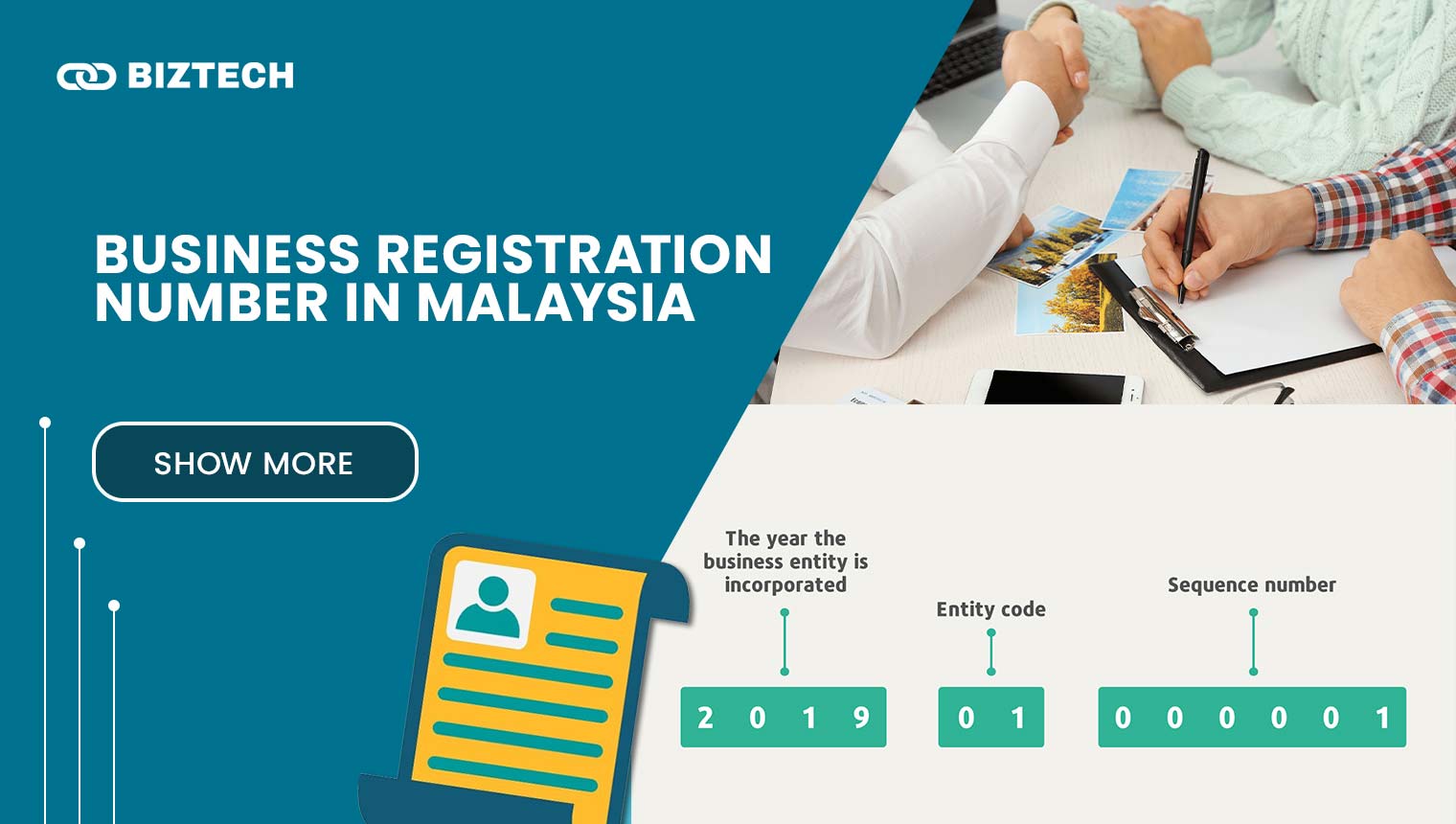
If you’re planning to start a business or incorporate a company in Malaysia, one of the first things you’ll receive is a business registration number (BRN). This unique identifier is essential for legal and administrative purposes such as opening a corporate bank account, filing taxes, applying for licences and permits, and — increasingly important from 2026 — issuing compliant e-invoices through LHDN’s MyInvois system.
- What is a Business Registration Number in Malaysia?
- Decoding the 12-Digit Business Registration Number Format
- Breakdown of the 12 Digits
- Why Your Business Registration Number Matters
- The 2026 Change Every Business Must Know: BRN and e-Invoicing
- How to Obtain Your Business Registration Number
- How to Verify a Business Registration Number
- Using Your Business Registration Number Effectively
- Changes to Your Business Registration Number
- Frequently Asked Questions
- Conclusion
In this guide, we explain what a business registration number is, how to decode Malaysia’s 12-digit format, why it matters, how to obtain and verify one, and the one 2026 rule change every business owner needs to know about. Whether you’re a seasoned entrepreneur or registering your first venture, understanding your BRN is crucial for navigating the Malaysian corporate landscape.
Verified August 2026 against the Companies Commission of Malaysia (SSM) and LHDN e-Invoice guidelines. Fees and rules change — always confirm the latest details with SSM before acting.
What is a Business Registration Number in Malaysia?
A business registration number in Malaysia is a unique identifier assigned to every registered business entity. It is legal proof that your business has been formally recognised and authorised to operate within Malaysia’s jurisdiction.
The number is issued by the Companies Commission of Malaysia (SSM), or Suruhanjaya Syarikat Malaysia — the statutory body that governs the incorporation and registration of businesses, companies, and limited liability partnerships. SSM oversees everything from your application to the issuing of your official registration number.
Think of your business registration number as your company’s identity card: you’ll need to quote it whenever you engage in official transactions or communications. It’s both a legal requirement and a means of establishing your business’s credibility with customers, partners, banks, and government agencies.
Note that the BRN is not the same as your Tax Identification Number (TIN). The BRN comes from SSM and identifies your entity; the TIN comes from LHDN (Inland Revenue Board) and identifies you as a taxpayer. From 2026, you’ll often need both — more on that below. For a fuller picture of the entity types behind these numbers, see our guide on choosing the right business entity in Malaysia.
Decoding the 12-Digit Business Registration Number Format
Effective 11 October 2019, SSM introduced a new 12-digit format for business registration numbers. This standardised structure applies across companies, businesses, and LLPs, replacing the old system of mixed letters and numbers that varied in length by entity type and often caused confusion.
Importantly, the change did not invalidate existing numbers. Older registration numbers remain valid, and during the transition SSM has displayed both the old and new numbers together on records. However — as we explain in the 2026 section below — the new 12-digit format is now the one that matters for e-invoicing.
Breakdown of the 12 Digits
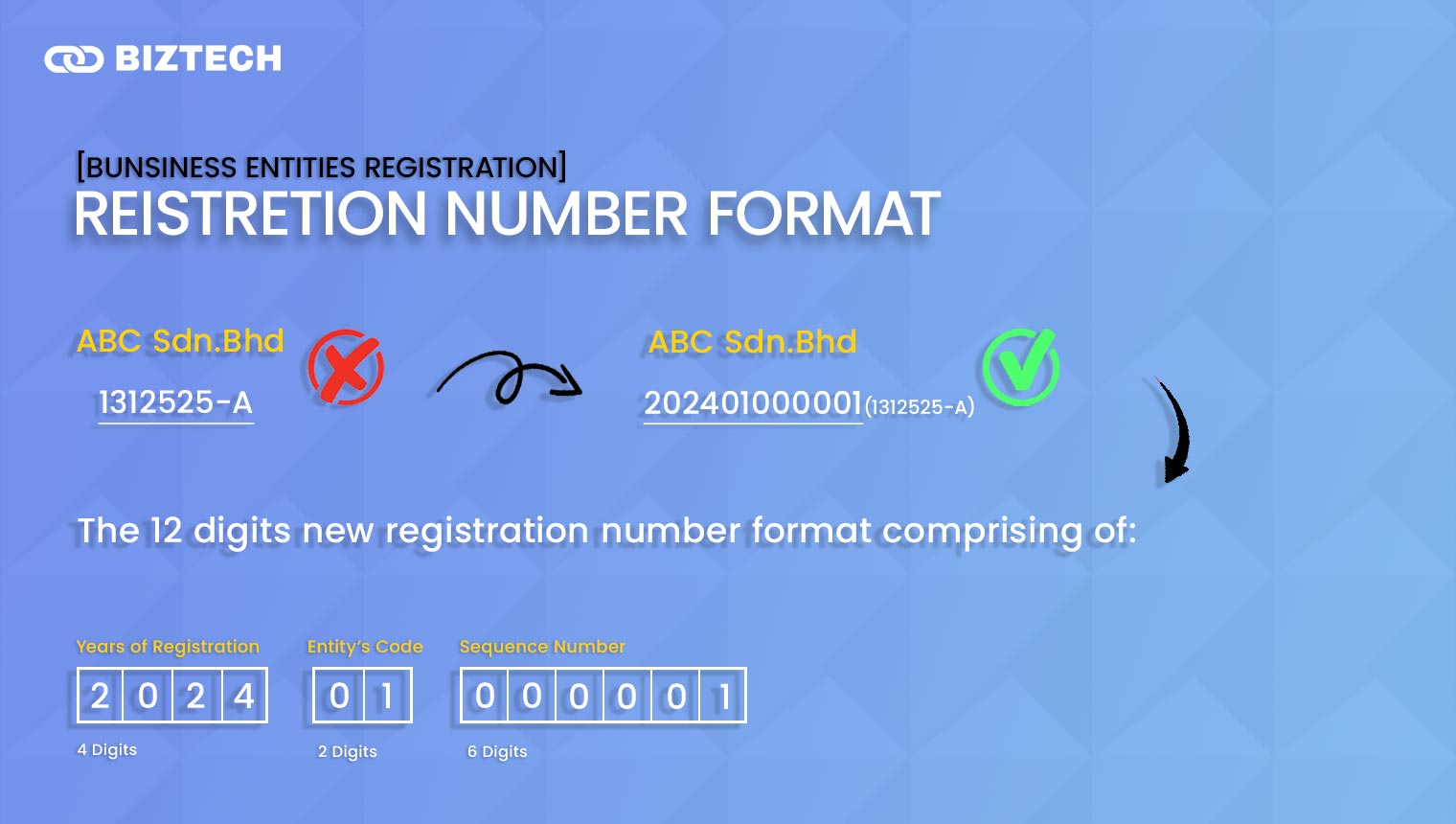
Take an example number like 202401000123. Here’s what each block tells you:
| Segment | Digits (example) | What it means |
|---|---|---|
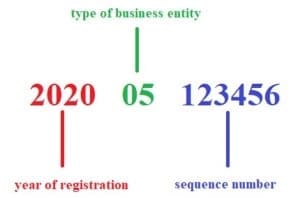
| Year of registration | First 4 — 2024 | The year your entity was registered with SSM. Useful for gauging a company’s age. |
| Entity type code | Next 2 — 01 | Identifies the type of business entity (see the code table below). |
| Unique sequential number | Last 6 — 000123 | A running number assigned in order of registration. This entity was the 123rd of its type registered that year. |
The two-digit entity code is the part most people misread. Here are the official categories:
| Code | Entity type |
|---|---|
| 01 | Local company (e.g. Sdn Bhd, Berhad) |
| 02 | Foreign company |
| 03 | Business (sole proprietorship or partnership) |
| 04 | Local limited liability partnership (LLP) |
| 05 | Foreign limited liability partnership (LLP) |
| 06 | Professional practice limited liability partnership (LLP) |
So a number beginning 2024 03 is a sole proprietorship or partnership registered in 2024, while 2024 01 is a locally incorporated company such as a private limited company (Sdn Bhd). Understanding the code helps when dealing with legal, compliance, or verification matters specific to your structure.
Why Your Business Registration Number Matters
Your BRN is far more than a string of digits — it underpins the smooth operation and growth of your company.
1. Legal identity and legitimacy
- It proves your company has been legally incorporated and is recognised by the Malaysian government.
- It demonstrates you met the criteria to operate as a legitimate entity, which builds trust with customers, suppliers, and stakeholders.
2. Official documentation and government transactions
- The BRN is mandatory when submitting forms and reports to SSM, LHDN (Inland Revenue Board), EPF, SOCSO, and other agencies.
- These agencies use it to identify your business and keep accurate compliance records. Without a valid number, you may face delays or penalties.
3. Verification by customers, partners, and banks
- Third parties can cross-reference your BRN against SSM’s public databases to confirm your registration date, entity type, and status.
- This transparency is often a precondition for opening bank accounts, onboarding with marketplaces, or securing B2B contracts.
The 2026 Change Every Business Must Know: BRN and e-Invoicing
The biggest recent development isn’t a change to the number itself — it’s how strictly it must now be quoted. Under LHDN’s MyInvois e-invoicing rollout, your BRN has become a compliance-critical field.
- Mandatory new-format validation from 1 August 2026: LHDN validates the buyer’s TIN and BRN combination on every e-invoice. Any buyer BRN submitted in the old format (rather than the current 12-character SSM standard) is rejected. In practice, everyone must migrate to quoting the 12-digit number.
- TIN + BRN, not either/or: The TIN confirms the party is a registered taxpayer with LHDN; the BRN confirms the SSM-registered entity. You generally need both to submit or receive a valid e-invoice.
- Phase 4 is live: E-invoicing became mandatory for businesses with annual turnover of RM1 million to RM5 million from 1 January 2026, with a relaxation period running to 31 December 2027.
- Permanent exemption raised: On 6 December 2025 the Cabinet raised the permanent exemption threshold from RM500,000 to RM1 million in annual turnover. Businesses below RM1 million are exempt but may opt in voluntarily.
The practical takeaway: locate your current 12-digit BRN now, make sure it’s the version stored on your invoicing system, and confirm your TIN with LHDN. For the wider rules, see our explainer on Sales and Service Tax (SST) in Malaysia.
How to Obtain Your Business Registration Number
You don’t apply for the BRN separately — it is issued automatically when you register your entity with SSM. The route depends on your structure:
| Entity type | SSM portal | Where your BRN appears |
|---|---|---|
| Sole proprietorship / partnership | EzBiz (Registration of Business) | Business registration certificate |
| Company (Sdn Bhd / Berhad) | MyCoID | Notice of Registration / Certificate of Incorporation |
| Limited liability partnership (LLP) | MyLLP | LLP registration certificate |
Once your application is approved, SSM issues the 12-digit number and it is printed on your registration document. For a step-by-step walkthrough of the incorporation process itself, read our complete guide to registering a company in Malaysia. Foreign owners should also see our guide on registering a company in Malaysia as a foreigner.
How to Verify a Business Registration Number
Whether you’re checking a supplier or confirming your own record, you can verify a BRN through SSM’s official channels:
- SSM e-Search / e-Info: Enter the registration number (new or old format) to confirm the entity name, status, and type.
- MYDATA-SSM: Purchase detailed company information and profiles.
- The registration certificate: The most direct source — the number is printed on the SSM-issued document.
A quick sanity check: read the first six digits. If the year and entity code don’t match what you’d expect of the business (for example, a “01” local-company code on what’s described as a sole proprietorship), treat it as a red flag and verify further before transacting.
Using Your Business Registration Number Effectively
Now that you understand its importance, put your BRN to work:
1. Display it on official documents
- Show it on invoices and receipts, contracts and agreements, business correspondence, and marketing materials such as brochures and business cards.
- Under the Registration of Businesses and Companies rules, the number should appear on your business letters, statements, and official publications.
2. Show it on your website and premises
- Add it to your website footer or “About Us” page to build trust with visitors.
- For physical storefronts, display it clearly on signage or at reception to reinforce your legal status.
3. Use it for registrations and e-invoicing
- Quote your official BRN when signing up for e-commerce marketplaces, payment gateways, and business platforms that require verification.
- Ensure the exact 12-digit version is stored in your accounting or e-invoicing software so MyInvois submissions validate correctly.
Changes to Your Business Registration Number
In most cases your BRN stays the same for the life of your company, because it is tied to your specific entity regardless of changes to your name, address, or other particulars.
However, certain significant changes may require a new number:
- Mergers or acquisitions: The resulting entity may receive a new number to reflect the change in structure.
- Change in entity type: Converting, say, from a sole proprietorship to a private limited company means registering a new entity — and receiving a new BRN.
Even when the number doesn’t change, keep your associated details current with SSM. Update company particulars through the correct portal — EzBiz for sole proprietorships and partnerships, MyCoID for companies, and MyLLP for LLPs. Details you can update include:
- Business or company name
- Registered address
- Business activities
- Directors, partners, or shareholders
- Contact information
You may need to attach supporting documents such as a board resolution approving the change, proof of a new registered address, or identification for new directors. Failing to keep particulars updated can lead to missed notices, penalties, or even the striking-off of your company from the register.
Frequently Asked Questions
Conclusion
Your business registration number is the backbone of your company’s legal identity in Malaysia — proving legitimacy, enabling official transactions, and, from 2026, keeping your e-invoicing compliant. Familiarise yourself with the 12-digit format and its entity codes, display the number consistently on documents and platforms, verify it through SSM’s official channels, and keep your particulars up to date through EzBiz, MyCoID, or MyLLP. With LHDN’s TIN and BRN validation taking effect on 1 August 2026, now is the time to confirm you’re quoting the correct 12-digit number everywhere it appears.
For authoritative guidance, consult the Companies Commission of Malaysia (SSM) and the LHDN e-Invoice portal directly.
Disclaimer: This article is provided by KayaToday for general information only and is not legal, tax, or financial advice. Rules, fees, and thresholds change — verify the latest details with SSM and LHDN before making decisions. Information verified August 2026.