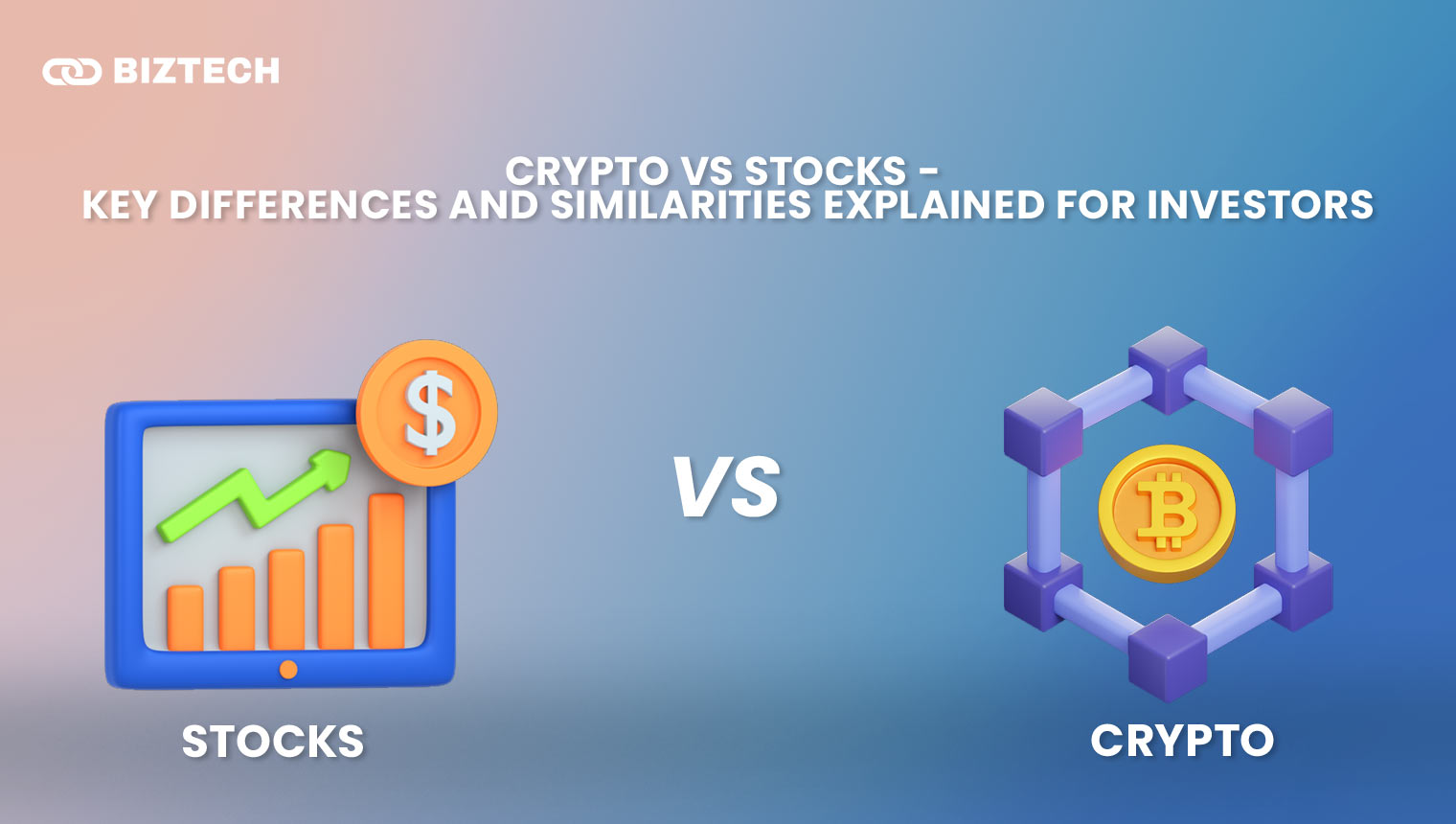
Crypto and stocks are the two asset classes new investors compare most often, yet they behave almost nothing alike. As of August 2026, Bitcoin trades around US$68,000 with a market cap near US$1.37 trillion (about 57% of a roughly US$2.3 trillion crypto market), still sitting some 46% below its October 2025 all-time high of about US$126,000 — a vivid reminder of how sharply crypto can swing. Over the same period, the stock market has quietly done what it usually does: the S&P 500 has returned roughly 10% a year on average over the past century.
- What Is Cryptocurrency?
- What Are Stocks?
- Crypto vs Stocks at a Glance
- Crypto vs Stocks: The Key Differences in Depth
- 1. Technology & What Backs the Value
- 2. Volatility & Risk
- 3. Returns & Growth Potential
- 4. Regulation — The Big 2026 Update
- 5. Accessibility & Trading Hours
- 6. Income: Dividends vs Staking
- 7. Taxation in Malaysia & Singapore
- Crypto vs Stocks: The Similarities
- Both Diversify a Portfolio
- Both Offer Real Growth Potential
- Both Are Now Bought Through Simple Apps
- How to Choose: A Simple Decision Framework
- A Worked Example (Illustration Only)
- How to Buy Crypto and Stocks Legally in Malaysia & Singapore
- Malaysia
- Singapore
- Common Pitfalls to Avoid
- Conclusion
- Frequently Asked Questions (FAQ)
That contrast — explosive but erratic versus slower but steadier — sits at the heart of the crypto vs stocks debate. Many Malaysians and Singaporeans now hold both, using each for a different job in their portfolio. This guide breaks down exactly how they differ, where they overlap, the pros and cons of each, and — importantly — how to buy either one legally in Malaysia and Singapore.
Key Takeaways
- Core difference: Crypto is a decentralised digital asset secured by blockchain; a stock is part-ownership of a real company, tied to its earnings and assets.
- Volatility & returns: Crypto can move 5–10%+ in a day and has produced both fortunes and 80% drawdowns; the S&P 500 has averaged ~10% a year over the long run with far smaller swings.
- Regulation (2026): Crypto is no longer “unregulated” — the EU’s MiCA, the US GENIUS Act, and Malaysia’s revised SC framework now govern it, though oversight is still younger and thinner than for stocks.
- Access: Crypto trades 24/7 via apps; stock exchanges open only during weekday market hours.
- Income: Stocks can pay dividends; crypto can pay staking rewards — but staking carries extra technical and platform risk.
- Malaysia & Singapore tax: Neither country charges a general capital gains tax on long-term investors — but frequent trading of either asset can be taxed as income.
- Bottom line: They are complements, not rivals. Most balanced portfolios keep stocks as the core and crypto as a small, high-risk satellite (often 1–5%).
What Is Cryptocurrency?
According to PwC, “a cryptocurrency is a medium of exchange such as the US dollar, but is digital and uses cryptographic techniques and protocols to verify the transfer of funds and control the creation of monetary units.”
In plain terms, crypto is a digital asset that runs on a decentralised network (a blockchain) rather than a central bank. Bitcoin and Ethereum are the two largest examples. You can buy, sell, send, or in some cases stake it 24/7. Unlike a company share, most cryptocurrencies represent no claim on earnings or assets — their price is driven by supply, demand, adoption, and sentiment. If you are new to it, our beginner’s guide to cryptocurrency in Malaysia is a good starting point.
What Are Stocks?
A stock (or share) is a unit of ownership in a publicly listed company. When you buy shares of a company on an exchange such as Bursa Malaysia or the SGX, you own a slice of a real business and are entitled to a share of its profits — usually through capital appreciation (the share price rising) and sometimes dividends. Because a share is backed by a company’s assets, cash flow, and earnings, its value has a fundamental anchor that most cryptocurrencies lack.
Crypto vs Stocks at a Glance
Here is a side-by-side snapshot of the key differences, updated for 2026:
| Factor | Cryptocurrency | Stocks |
| What you own | A digital token; usually no claim on any company’s assets or profits | Part-ownership of a real, revenue-generating company |
| What drives value | Supply/demand, adoption, network use, sentiment | Company earnings, growth, assets, the wider economy |
| Trading hours | 24/7, 365 days a year, globally | Weekday market hours only (e.g., Bursa 9am–5pm MYT) |
| Volatility | Very high — 5–10%+ daily moves are normal | Moderate — large crashes usually need a major shock |
| Long-run track record | ~16 years; spectacular gains but repeated 70–80% drawdowns | 150+ years; S&P 500 has averaged ~10% a year |
| Regulation (2026) | Now regulated (MiCA, US GENIUS Act, SC Malaysia) but still younger and lighter | Long, heavily regulated by bodies like the SEC, SC & MAS |
| Income potential | Staking / lending rewards (with extra risk) | Dividends, plus voting rights |
| Custody risk | Self-custody & hacks — lose your keys, lose your funds | Held by regulated brokers/custodians; investor protection schemes |
| Tax in MY/SG | No CGT for long-term investors; active trading taxed as income | No CGT for investors; frequent trading can be taxed as income |
Crypto vs Stocks: The Key Differences in Depth
1. Technology & What Backs the Value
Crypto is powered by blockchain — a distributed ledger that is extremely hard to alter or counterfeit. That makes the network itself robust, but the asset is still exposed to exchange hacks, smart-contract bugs, and lost private keys. Crucially, most tokens are not backed by any underlying asset or cash flow; their value rests on demand and utility.
A stock, by contrast, is tied to the equity of a company. Its value is anchored to real things — revenue, profits, factories, brands, intellectual property. When you own Maybank or Apple shares, you own a claim on an actual, cash-generating business.
2. Volatility & Risk
Crypto’s volatility is in a different league. It is routine for a major coin to move 5–10% in a single day, and the market as a whole has repeatedly fallen 70–80% from its peaks — including the roughly 46% drop from the October 2025 high to today. High risk can mean high reward, but only if your risk appetite (and time horizon) can survive the drawdowns.
Stocks are far steadier. A broad index rarely crashes without a genuine shock — the 2020 COVID sell-off or the 2008 financial crisis, for example — and even then it has historically recovered over time. Individual stocks can still be volatile, which is why diversification matters; our guide to the pros and cons of investing in a single stock covers this. If you do trade crypto actively, learn to manage risk in crypto trading first.
3. Returns & Growth Potential
This is where the two diverge most. Crypto has delivered some of the fastest wealth creation in modern markets — and some of the fastest destruction. Early Bitcoin and Ethereum holders saw life-changing gains, but anyone who bought at the 2021 or 2025 tops sat through brutal losses. The upside is real; so is the downside.
Stocks compound more slowly but far more reliably. The S&P 500 has returned roughly 10% a year on average over the past 100 years (about 10.6% annualised), turning patient, diversified investors into millionaires over decades rather than months. As a rough rule of thumb: crypto is where you might multiply your money quickly or lose most of it; a diversified stock portfolio is where you build wealth steadily over time.
4. Regulation — The Big 2026 Update
The old line that “crypto is completely unregulated” is out of date. In 2024–2026, three big frameworks arrived: the EU’s MiCA (crypto-service-provider licensing in force since December 2024), the US GENIUS Act (federal stablecoin law signed July 2025), and a joint SEC–CFTC ruling in March 2026 classifying Bitcoin, Ethereum, and XRP as digital commodities. Malaysia’s Securities Commission overhauled its Digital Asset Exchange rules effective 20 May 2026, and Singapore licenses providers under the MAS.
That said, crypto oversight is still younger, thinner, and less consistent across borders than the century-old rulebook around stocks. Listed companies must clear stringent disclosure requirements before an IPO, insider trading is illegal, and shareholders have defined rights if a company fails. Crypto investors have more protection than they did in 2021, but still less recourse than stock investors if something goes wrong.
5. Accessibility & Trading Hours
Crypto never sleeps. With a phone, an internet connection, and an account on a licensed exchange, you can buy or sell any time of day, any day of the year. Stocks trade only during exchange hours — roughly 9am to 5pm on weekdays for Bursa Malaysia — and access to foreign markets may need a specific broker. Apps like Robinhood, eToro, and local brokers have made stock investing far easier, but the market still closes at night and on weekends.
6. Income: Dividends vs Staking
Stocks can pay dividends — a slice of company profits paid to shareholders — on top of any price gains, and shares often carry voting rights. Some cryptocurrencies pay staking rewards for helping secure the network, which can look attractive on paper. But staking yields come with extra layers of risk (lock-up periods, validator or slashing risk, and platform failures), and the reward is paid in a volatile token whose price can fall faster than the yield. Treat a headline “8% staking APY” very differently from a blue-chip dividend.
7. Taxation in Malaysia & Singapore
Here the two assets are treated surprisingly similarly. Malaysia has no general capital gains tax, so a genuine long-term investor’s profits — whether from crypto or shares — are generally not taxed. But if the LHDN judges you to be trading frequently as a source of income (the “badges of trade”), those gains can be taxed at normal income-tax rates. Singapore works the same way: no CGT for investors, but active traders can be assessed to income tax by IRAS. Dividends are effectively tax-free in the shareholder’s hands in both countries. Always confirm your own position with a tax professional.
Crypto vs Stocks: The Similarities
Both Diversify a Portfolio
Savvy investors rarely put all their eggs in one basket. Holding both crypto and stocks — along with cash, bonds, or gold — spreads risk across asset classes that don’t always move together. That diversification is one of the strongest arguments for owning some of each rather than choosing sides.
Both Offer Real Growth Potential
Both can grow your wealth meaningfully. Stocks have created generational wealth through companies like Apple, Amazon, and Nvidia; crypto has produced outsized (if far riskier) gains for early adopters of Bitcoin and Ethereum. The difference is the shape of the ride: crypto tends to be faster and wilder, stocks slower and smoother.
Both Are Now Bought Through Simple Apps
The days of needing a stockbroker on the phone are gone. Both asset classes are now a few taps away — regulated crypto exchanges for digital assets and online brokerages for shares — lowering the barrier to entry for retail investors in Malaysia and Singapore alike.
How to Choose: A Simple Decision Framework
Rather than asking “which is better,” ask “which fits this goal?” Use the table below to match your situation to the asset that tends to suit it:
| If your priority is… | Better fit | Why |
| Steady long-term wealth (retirement) | Stocks (core) | ~10% long-run average, real business backing, deep regulation |
| A small high-risk / high-reward bet | Crypto (1–5% satellite) | Big upside potential, but size it so a total loss won’t hurt |
| Regular passive income | Stocks (dividends) | Dividends are steadier than volatile staking rewards |
| 24/7 access & short-term trading | Crypto | Trades round the clock, high liquidity and movement |
| Owning a stake in a real business | Stocks | Shares are legal ownership with rights and cash flow |
| Lowest volatility & drawdowns | Stocks (index/ETF) | Broad indices swing far less than any single coin |
A Worked Example (Illustration Only)
Suppose a moderate-risk Malaysian investor has RM10,000 to put to work. A common balanced approach might be roughly 80% in a diversified stock or index fund (RM8,000), 15% in crypto such as Bitcoin and Ethereum bought through a licensed exchange (RM1,500), and 5% in cash (RM500) for flexibility. If crypto halved in a bad year, the total portfolio would fall about 7.5% from that sleeve — painful but survivable — while the stock core keeps compounding. If crypto doubled, it adds a welcome kicker without having bet the house. The exact split depends on your age, goals, and risk appetite; this is an illustration, not advice. For more, see our smart strategies for crypto investment.
How to Buy Crypto and Stocks Legally in Malaysia & Singapore
Malaysia
For crypto, stick to the exchanges registered with the Securities Commission. As of 26 June 2026 there are five SC-registered Digital Asset Exchanges (DAX): Luno, HATA, MX Global, SINEGY, and Kinetic DAX (KDX). You can fund them via DuitNow/online transfer in ringgit. Global platforms like Binance and OKX are not SC-registered for Malaysian retail users, so favour the licensed local options — see our roundup of the best crypto trading platforms in Malaysia. For stocks, you buy Malaysian shares on Bursa Malaysia through a licensed broker or an online trading app, and international shares through a broker that offers foreign-market access.
Singapore
In Singapore, buy crypto through MAS-licensed providers (such as Coinhako, Independent Reserve, Crypto.com, and Coinbase Singapore), funded via PayNow/FAST in Singapore dollars. Buy stocks on the SGX or overseas markets through a MAS-regulated brokerage. In both countries, remember the tax rule of thumb: long-term investing is generally CGT-free, but frequent trading can be assessed as taxable income.
Common Pitfalls to Avoid
Whichever you choose, a few mistakes trip up beginners again and again: over-allocating to crypto because of a recent rally (then getting wiped out in the next drawdown); chasing headline staking or dividend yields without checking the underlying risk; ignoring custody — on crypto, losing your keys or falling for an approval-drainer scam means losing your funds with no recourse; trying to time the market instead of investing consistently; and forgetting the tax angle if you trade frequently. A little discipline — position sizing, diversification, and steady contributions — beats chasing the hot asset of the month.
Conclusion
Crypto vs stocks isn’t really an either/or question. Stocks give you regulated, business-backed, steadier growth that has compounded at roughly 10% a year for a century — ideal as the core of a long-term portfolio. Crypto offers 24/7 access and far higher upside, but with volatility and risk to match — better suited to a small, deliberately sized satellite position.
Measure your risk appetite and time horizon honestly, keep your position sizes sensible, use only regulated platforms in your country, and consider holding a bit of both. The most important step is to be comfortable and well-informed before you invest a single ringgit or dollar — in either asset.
Prices, rates, and rules in this article were verified in August 2026. Markets and regulations move quickly, so please confirm current figures with the provider or an official source before investing.
Frequently Asked Questions (FAQ)
Disclaimer: This article is provided by KayaToday for general information and education only and does not constitute financial advice. Cryptocurrency and stock investing carry risk, including the possible loss of your capital. Always do your own research and consult a licensed financial adviser before making any investment decision.
References