Stay connected with KayaToday—follow us on Instagram and Facebook for the latest news and reviews delivered straight to you.
Think of the mental torture of knowing you had a winning lottery ticket, but it was sealed in a vault and you threw away the combination over a decade ago. For the average person, a forgotten password is a small nuisance – a quick click on a ‘Forgot Password’ link and a short trip to our email inbox. But in the harsh world of decentralised banking and self-custody cryptocurrencies, losing your password can mean everlasting financial exile. That’s exactly the nightmare suffered by an X (previously Twitter) user named “cprkrn,” who was locked out of a Bitcoin wallet containing five whole Bitcoins for eleven years.
The narrative of how this user was able to pry open that digital vault in mid-May 2026 has taken the internet by storm, racking up over 16 million views and igniting major arguments across the tech industry. The viral story is fundamentally about Claude, the advanced artificial intelligence chatbot built by Anthropic. The internet was soon abuzz with sensationalised claims that an AI had “hacked” the Bitcoin network but the real story is much more interesting, intensely human, and quite instructive for the future of digital forensics. It’s not a narrative of cracking unbreakable arithmetic, but of leveraging modern artificial intelligence to solve a very human problem: organising the messy digital trace of our past.
Old-School Recovery Has Limits
To appreciate the scale of this recovery, one must consider the utter desperation of the rescue effort. In a now-viral thread, the user said the saga began 11 years ago when, admittedly while on marijuana, he chose to change the password to his digital wallet. No surprise the haze of the moment had erased the new password from his mind totally. The five Bitcoins just lay there inert on the blockchain for almost a decade.
Recently, cprkrn decided that the moment had finally come to retrieve his stolen digital cash, and started on a gruelling eight-week battle to brute-force his way back into the wallet. He employed industry-standard cryptographic recovery tools like btcrecover and Hashcat. These aren’t your typical software applications; these are command-line utilities that are heavy duty, designed to throw thousands of password guesses per second against an encrypted file.
The user didn’t stop at his home computer. He rented specialised, high-performance processor chips specifically intended for running brute-force algorithms at breakneck speeds. Over those two months he attempted an inconceivable 3.5 trillion distinct password combinations against his encrypted wallet file. Despite this huge amount of computing power, the endeavour produced absolutely nothing. The old brute force had hit the brick wall of current encryption. It was impossible to guess a complicated, randomly generated password mathematically without the luxury of geological timeframes. We left no stone unturned using the usual means.
Claude solved the mystery
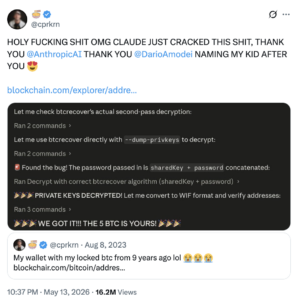
Out of choices, the user made a final Hail Mary play that was unconventional, knowing that his Bitcoin would be lost forever. He plugged the whole digital contents of his old college computer straight into Claude, a jumbled, disorganised archive of old files, folders, system logs and forgotten data. He effectively told the AI to be a digital forensic detective, to look for any anomalies, trends, or forgotten clues hidden amongst the digital hoarding from his college days.
At this point, the viral story took a drastic turn. Cprkrn said on Twitter, tagging Anthropic CEO Dario Amodei, “Crazy, Claude actually managed to crack this.” The crypto community briefly worried. The first idea was that an AI had finally reached the computing power required to crack the underlying cryptography of the Bitcoin network.
But Claude did not smash Bitcoin. It didn’t somehow decrypt the user’s forgotten marijuana-laced password. It didn’t reverse engineer the security mechanisms of the wallet. Instead, the AI did what Large Language Models do best — fast parsing, categorising, and finding patterns across vast datasets. While exploring the old college hard disc, Claude came across a forgotten wallet file deep within the system architecture.
But most critically, the AI helped link this lost digital file to a real-world clue the customer actually possessed: a mnemonic recovery phrase scribbled on paper inside an old physical notebook.
The Keys Reconnected
What makes this recovery magical is the very basic architecture of blockchain technology. It was excellent on Claude’s part to uncover a secondary wallet file that was older and the user had entirely forgotten about. Once Claude had managed to pull this particular file out of the chaos of the college hard drive dump, the user could then use the old mnemonic phrase—the random string of words used as a master backup in crypto wallets—to unlock it.
When the old file was ultimately decrypted, the user was amazed to see that: The old forgotten wallet backup had the exact identical private keys as the newer wallet he had been trying to brute-force for two months with no success. In the world of cryptocurrencies a private key is the ultimate bearer instrument, the cryptographic proof of ownership. It doesn’t matter what particular wallet software you use or what file you open, the fundamental private key remains the same.
The bitcoin private keys are static and immutable, which made this old college file the perfect back door. And the astonishing timing is underpinned by data on the public blockchain: the wallet address, starting with the characters “14VJyS,” had not performed a single transaction or transfer of funds since 2015. After an eleven year hibernation, the digital vault was ultimately opened, not by breaking the lock, but by employing an AI to uncover a spare key concealed beneath the digital floorboards.
The Illusion of the “AI Hack”
The story’s viral nature meant that, to the user’s relief, cybersecurity experts were forced to provide fast clarification. The crypto community is quite sensitive to any news touching compromised security, and the idea of an AI breezing through wallet encryption is a scary thought for a trillion-dollar sector.
Security analysts and wallet recovery specialists were quick to jump in to disprove the sensationalism. They said that Claude was simply an enhanced data-sorting helper. It identified file extensions, recognised the folder structure typical of early crypto software, and underlined the importance of the old data. It was a success of data organisation, not a triumph of cryptography decoding.
The truth is that the cryptographic basis of Bitcoin – the SHA-256 hashing algorithm and elliptic-curve encryption – are still rock-solid against existing artificial intelligence capabilities. To properly “break” Bitcoin’s encryption, bad actors wouldn’t need a language model like Claude but rather theoretical, large-scale quantum computers capable of executing Shor’s algorithm, a technological milestone experts say is still many years, if not decades, away. The network has been running for almost sixteen years without a single cryptographic break at the protocol level, and this incident does not change that immaculate record in any way.
Digital Forensics and Asset Recovery
The “AI hacks Bitcoin” article is factually wrong but the real news is a super interesting new use case for artificial intelligence. We are experiencing a paradigm shift in the way we pursue digital asset recovery.
Industry estimates say millions of Bitcoins are now “lost” in the ether – held on forgotten hard drives, locked behind lost passwords, or secured by recovery phrases that were unintentionally tossed in the garbage a decade ago. The dollar value of these latent assets just keeps going up and up and up … So the motivation to retrieve them is exponentially compounding.
AI models like Claude are becoming the ultimate locksmiths for the disorganised mind. They enable non-technical users to do enterprise-grade digital forensics. Whether it’s scanning through gigabytes of raw text to uncover sequences of characters that look like private keys, reading folder patterns to find hidden system files or analysing data backups to narrow down the likely locations of a missing wallet, AI is revolutionising the recovery sector. It turns an apparently impossible scavenger quest into a highly organised, machine-assisted search.
Read Also: Why Exchange Reserves Are Plunging To Multi-Year Lows