In Malaysia, Islamic credit cards (credit card-i) have become a mainstream way to spend, earn rewards and manage credit in a way that aligns with Shariah principles. They work almost identically to conventional cards at the checkout, yet the contract behind them is structured to avoid riba (interest). This guide explains what changed in 2026, how these cards now work, which ones offer the best value, and a simple framework for choosing the right one.
- The Big 2026 Change: Ujrah Has Moved to Tawarruq
- Top Islamic Credit Cards in Malaysia (2026)
- 1. Maybank Islamic Ikhwan Mastercard Platinum Card-i
- 2. HSBC Amanah MPower Platinum Credit Card-i
- 3. RHB Rewards Credit Card-i
- 4. Bank Islam Visa Credit Card-i
- How Do Islamic Credit Cards Work?
- What Do They Actually Cost? Profit Rates & Fees in 2026
- How to Choose the Right Islamic Credit Card
- A Quick Worked Example
- Common Pitfalls to Avoid
- Benefits of Using an Islamic Credit Card
- Conclusion: Finding the Right Islamic Credit Card for Your Lifestyle
- Frequently Asked Questions
Verified June 2026. Card terms change often — always confirm the latest rates, caps and fees on the issuer’s product disclosure sheet before applying.
The Big 2026 Change: Ujrah Has Moved to Tawarruq
The most important update this year is structural. Between October 2025 and early January 2026, Malaysia’s Islamic banks completed an industry-wide conversion of their credit card-i contracts from the older Ujrah (fee-based) model to Tawarruq (also called Commodity Murabahah). Both structures were approved by each bank’s Shariah Advisory Committee and by Bank Negara Malaysia’s Shariah Advisory Council, so cardholders did not need to re-apply — the change happened automatically.
What this means in practice: instead of paying a fixed monthly management fee (Ujrah) on your outstanding balance, the bank now arranges a sale-and-purchase of a Shariah-compliant commodity to generate a pre-agreed profit when you carry a balance. The headline cost to you is broadly similar, but the underlying mechanism is different. If you settle your statement in full every month, you typically pay no profit at all — just like before.
Top Islamic Credit Cards in Malaysia (2026)
Here is a quick-answer table before we go into detail. Figures are indicative for 2026 and should be confirmed with each issuer.
| Credit Card-i | Headline Reward | Annual Fee | Best For |
| Maybank Islamic Ikhwan Mastercard Platinum Card-i | 5% cashback Fri & Sat on petrol & groceries (capped) | Free for life | Everyday weekend spenders |
| HSBC Amanah MPower Platinum Credit Card-i | 8% on petrol, groceries & e-wallet (min RM2,000/mo spend, RM15/category cap); 0.2% on the rest | Free Year 1; waived after with RM6,000/yr spend | Households who hit the monthly minimum |
| RHB Rewards Credit Card-i | Up to 10x LoyaltyPlus Points; bonus on overseas, dining & Takaful | From RM60 (waiver on spend) | Points collectors & travellers |
| Bank Islam Visa Credit Card-i | Up to 8% on online, auto-billing, groceries & dining; 0.2% unlimited local | Waived with 12 transactions/year | Online shoppers wanting a fully Islamic bank |
1. Maybank Islamic Ikhwan Mastercard Platinum Card-i
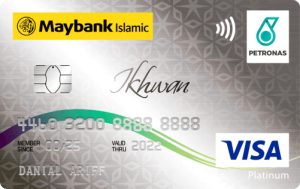
Key features (2026): 5% cashback every Friday and Saturday on petrol and groceries (monthly cap applies), and no annual fee for life. If you fill up at PETRONAS, Maybank’s PETRONAS Ikhwan Visa Platinum Card-i pushes weekend fuel cashback up to 8% (1% on weekdays), capped at RM50/month. Minimum income starts from about RM2,500/month, making the entry-level Ikhwan range accessible to fresh graduates.
Who is it best for? Everyday households who spend most on groceries and fuel and want a genuinely free-for-life Shariah card.
2. HSBC Amanah MPower Platinum Credit Card-i
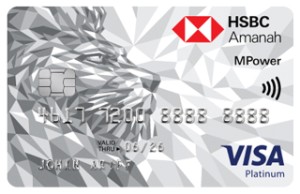
Key features (2026): 8% cashback on petrol, groceries and e-wallet reloads when your total monthly spend reaches RM2,000 or more, plus 0.2% on everything else. The bonus is capped at RM15 per category per month (so up to RM45/month across the three bonus categories). The card is free for the first year; from Year 2 the RM240 annual fee is waived with a minimum RM6,000 annual spend.
Who is it best for? Households confident of spending at least RM2,000 a month who can max out all three bonus categories. If your spend is lower or irregular, a free-for-life card may suit you better.
3. RHB Rewards Credit Card-i
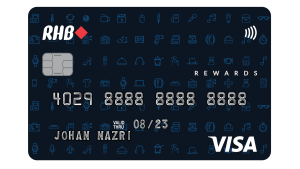
Key features (2026): Up to 10x LoyaltyPlus Points, with accelerated points on overseas spend, dining, entertainment and Takaful contributions. Prefer cashback? RHB’s Islamic line-up also includes the RHB Cash Back Credit Card-i (up to RM600/year, capped RM10 per category on utilities, dining, petrol and groceries) and the RHB Shell Visa Credit Card-i, which offers up to 12% cashback at Shell — the highest fuel rate in RHB’s range.
Who is it best for? Frequent travellers and points collectors, or Shell loyalists who want maximum petrol cashback.
4. Bank Islam Visa Credit Card-i
Key features (2026): As a fully Islamic bank, Bank Islam’s Visa/Mastercard Credit Card-i range offers up to 8% cashback on online transactions, auto-billing, groceries and dining, plus 1% on overseas spend (when monthly spend reaches RM8,000) and unlimited 0.2% on local spend. The annual fee is waived simply by making at least 12 transactions a year, and the entry tier starts from RM24,000 annual income. Higher tiers (Visa Platinum, Visa Infinite/Mastercard World) add Takaful travel coverage and lounge access.
Who is it best for? Online shoppers who want every part of their banking — not just the card — to be Shariah-based, with an easy fee waiver.
Note: an earlier version of this guide listed a “Public Bank Petron Visa Gold” here. That is a conventional (non-Islamic) card, so we have replaced it with a genuine credit card-i. For petrol-focused options, see our best petrol credit cards in Malaysia guide.
How Do Islamic Credit Cards Work?
Islamic credit cards function like conventional cards at the point of sale but differ in how the bank earns from them and what you can buy:
- No interest (riba): If you settle your statement balance in full by the due date, you pay no profit charge at all. Carry a balance and the bank applies a profit charge instead of compounding interest.
- Tawarruq (Commodity Murabahah): Since the 2025–2026 conversion, banks use a commodity sale arrangement to generate a pre-agreed profit on revolved balances, replacing the older Ujrah management fee.
- Halal-only transactions: A built-in filtering system blocks payments to merchants categorised as non-permissible (for example gambling outlets, bars and breweries).
- Takaful, not insurance: Any bundled protection (travel, purchase) is provided through Shariah-compliant Takaful.
These features make credit card-i appealing to Muslims and to non-Muslims who simply prefer the transparency and ethical screening of Islamic banking.
What Do They Actually Cost? Profit Rates & Fees in 2026
Even though there is no interest, an Islamic card is not free money if you revolve a balance. The key numbers to know in 2026:
| Charge | 2026 Figure | Notes |
| Profit rate (revolved balance) | 15% / 17% / 18% p.a. tiered | Same BNM ceiling as conventional cards; charged daily, not compounded |
| Government service tax | RM25 per card / year | Applies to each principal & supplementary card-i under SST |
| Minimum monthly payment | 5% of balance (or RM50, whichever higher) | Paying only the minimum keeps you in profit charges |
| Late payment charge | 1% of outstanding, capped at RM100 | Regulated maximum |
Under Bank Negara Malaysia’s tiered structure, you qualify for the lowest 15% profit rate by paying your minimum due on time for 12 consecutive months; 17% applies for 10 out of 12 months; and 18% is the default otherwise. Because profit is calculated daily and does not compound, settling your balance quickly makes a large difference to what you pay.
How to Choose the Right Islamic Credit Card
Match the card to how you actually spend, not to the biggest advertised number:
- Step 1 — Will you pay in full? If yes, the profit rate is irrelevant; chase the best rewards and a waived fee. If you sometimes revolve, prioritise a low fee and avoid stacking balances.
- Step 2 — Where does your money go? Heavy on fuel → RHB Shell-i or Maybank PETRONAS Ikhwan. Groceries and e-wallets → HSBC Amanah MPower-i. Online shopping → Bank Islam Card-i.
- Step 3 — Can you hit the minimum spend? Tiered cashback like HSBC’s only pays out above RM2,000/month. If your spend is lower, a free-for-life flat card (Maybank Ikhwan) wins.
- Step 4 — Check the caps. A headline “8%” capped at RM15/month is worth at most RM180/year per category. Multiply the rate by the cap to see the real ceiling.
- Step 5 — Confirm eligibility. Minimum income ranges from about RM24,000 to RM60,000 p.a. depending on tier; have your latest payslips or BE/EA forms ready.
A Quick Worked Example
Say you spend RM2,500 a month: RM600 fuel, RM700 groceries, RM300 e-wallet, RM900 other. On the HSBC Amanah MPower-i you would earn the 8% bonus on fuel, groceries and e-wallet — but each category is capped at RM15, so your bonus is RM15 + RM15 + RM15 = RM45, plus 0.2% (RM1.80) on the rest, roughly RM46.80/month. On a flat free-for-life card paying 5% on weekend petrol and groceries, your return depends on how much of that spend falls on Fri/Sat. The lesson: model your own spend against the caps before applying.
Common Pitfalls to Avoid
- Paying only the minimum. “No riba” does not mean no cost — profit charges still apply to revolved balances at up to 18% p.a.
- Ignoring category caps. Most cashback is capped per category per month; spend beyond the cap earns the base rate only.
- Missing the fee-waiver condition. Many waivers need a minimum annual spend or transaction count — miss it and the fee returns.
- Assuming all merchants qualify. Government bodies, insurance/Takaful premiums and some bill payments are often excluded from cashback.
- Forgetting the RM25 service tax. It applies per card each year, including supplementary cards.
Benefits of Using an Islamic Credit Card
- Shariah compliance: Your spending aligns with Islamic principles, with non-permissible merchants screened out.
- Transparent cost: A capped, non-compounding profit charge rather than open-ended compounding interest.
- Rewards parity: Cashback, points and Takaful perks comparable to conventional cards.
- Open to all: Non-Muslims are welcome to apply.
Want to compare against conventional options too? See our guides to the best credit cards in Malaysia and the best cashback credit cards. If you tend to carry a balance, a balance transfer may cut your cost, and it is always worth knowing your CTOS credit score before you apply. Prefer to spend only what you have? Compare the best debit cards in Malaysia.
Conclusion: Finding the Right Islamic Credit Card for Your Lifestyle
Credit card-i products give Malaysians a genuinely competitive, Shariah-compliant way to spend and save. With the 2026 shift to Tawarruq, the contracts are more standardised, while the rewards remain as strong as conventional cards. Start from how you actually spend, respect the caps and fee conditions, and pay in full whenever you can — that is how you get the savings without the cost.
**Looking for the most ethical and rewarding options? Our guide will help you discover the best credit cards in Malaysia.
Disclaimer: This article is provided by KayaToday for general information only and is not financial advice. Rates, fees and offers were verified in June 2026 but change frequently — always confirm the latest terms on the issuer’s official product disclosure sheet before applying.