If you’re shopping for a new car and need financing, you’ve come to the right place. Car loans help spread the cost of a big purchase, but the interest can quietly add thousands of ringgit to what you pay overall — so understanding the rate before you sign matters more than almost any other decision in the showroom.
- What’s Changed in 2026: Reducing Balance & EIR
- What Are Car Loan Interest Rates in Malaysia in 2026?
- Current Car Loan Interest Rates by Bank (2026 Comparison)
- How Car Loan Interest Is Calculated in Malaysia
- The flat-rate formula (legacy & transition loans)
- The reducing-balance method (loans from 2026)
- Factors That Affect Your Car Loan Interest Rate
- Loan Tenure
- Car Type (New vs Used)
- Down Payment (Margin of Finance)
- Credit Score and Income
- Bank Promotions & Partner Deals
- How to Choose: A Simple Decision Framework
- Tips to Secure the Lowest Car Loan Interest
- Should You Settle Your Car Loan Early in 2026?
- Car Loan Eligibility and Requirements in Malaysia
- Car Loans for Foreigners in Malaysia
- Conclusion — Getting the Best Deal on Your Car Loan
- FAQ about Car Loan Interest Rates in Malaysia
- References
This guide walks you through the latest car loan interest rates in Malaysia for 2026, explains the major change to how car loan interest is now calculated under the Hire Purchase (Amendment) Act 2026, compares the main banks, and shows you exactly how to lock in the lowest rate.
What’s Changed in 2026: Reducing Balance & EIR
For decades, Malaysian car loans (hire purchase) ran on a flat rate system: interest was charged on the full original loan amount for the entire tenure, regardless of how much you’d already repaid. A “2.7% flat” rate sounded cheap, but the true cost was roughly double once you accounted for your shrinking balance.
The Hire Purchase (Amendment) Act 2026 (HPAA), which came into force on 1 June 2026 (gazetted 30 January 2026), overhauls this. Here are the five changes that matter most to borrowers:
| What changed | What it means for you |
| Flat rate & Rule of 78 abolished | New loans use the reducing balance method — interest is charged only on your outstanding principal, so it falls as you repay. |
| Effective Interest Rate (EIR) must be shown | Every agreement and advert must display the EIR, total cost of credit, and a full amortisation schedule — making an apples-to-apples comparison between banks finally possible. |
| Fairer early settlement | Without Rule of 78 front-loading interest, settling early saves you far more — potentially around half the remaining interest compared with the old system. |
| Goodwill discounts on existing loans | If your current loan still uses Rule of 78, banks offer a goodwill discount on early settlement from 1 June 2026 so your payoff is closer to a reducing-balance figure. |
| Stronger borrower protections | Longer default-notice periods before repossession, plus formal recognition of e-agreements and digital signatures. |
Banks have until 31 March 2027 to fully upgrade their systems, so during this transition you may still see flat-rate quotes alongside new EIR-based ones. Always ask for the EIR and amortisation schedule — that’s now your right.
What Are Car Loan Interest Rates in Malaysia in 2026?
As of 2026, advertised flat rates for new cars sit roughly between 2.30% and 3.00% p.a., while used cars typically range from 3.20% to 4.50% p.a. Islamic vehicle financing (profit rates) lands in a similar band, around 2.50%–3.75% p.a.
Here’s the crucial part under the new rules: a flat rate is not the rate you actually pay. As a rule of thumb, the EIR is roughly double the flat rate. So a 2.65% flat rate works out to roughly 4.8%–5.0% EIR, and a 3.0% flat rate to around 5.7% EIR. When you compare offers in 2026, compare the EIR, not the flat headline number.
Car loan rates in Malaysia are set by each bank and are not directly tied to the Overnight Policy Rate (OPR), which Bank Negara Malaysia has held at 2.75% (last changed in July 2025). Still, a stable OPR generally means stable hire-purchase pricing — useful context when timing a purchase.
Current Car Loan Interest Rates by Bank (2026 Comparison)
The table below shows indicative new- and used-car flat rates from major Malaysian banks. Treat these as benchmarks — your actual offer depends on tenure, margin of finance, the specific car, and your credit profile.
| Bank | New Car (flat p.a.) | Used Car (flat p.a.) | Approx. EIR (new)* |
| Maybank | from 2.30%–2.40% | from 3.30% | ~4.4%–4.6% |
| Public Bank | from 2.35%–2.50% | from 3.20% | ~4.5%–4.8% |
| CIMB | from 2.40%–2.55% | from 3.25% | ~4.6%–4.9% |
| Bank Islam (Islamic) | from 2.65% | – (new cars only) | ~5.0% |
| RHB | from 3.18% | from 4.00% | ~6.0% |
| Hong Leong Bank | from 3.24% | from 3.78% | ~6.1% |
*EIR is approximate and based on the “roughly 2× flat rate” rule of thumb for a typical 7–9 year tenure; the exact figure now appears in your loan agreement. Rates verified June 2026 — always confirm the current rate and EIR directly with the bank, as promotions and dealer-tie-up rates change frequently.
On these benchmarks, Maybank, Public Bank and CIMB tend to advertise the lowest new-car flat rates, while Hong Leong has historically been competitive for used cars. But because every bank must now publish an EIR, don’t stop at the headline — a lower flat rate with a longer tenure can still cost more in total interest than a slightly higher rate over a shorter tenure. For sibling comparisons, see our guides to the lowest car loan rates in Malaysia, used car loan rates, and electric car loan rates.
How Car Loan Interest Is Calculated in Malaysia
Understanding both the old flat-rate maths (still relevant for existing loans) and the new reducing-balance maths (for loans taken from 2026) helps you compare offers and judge early-settlement decisions.
The flat-rate formula (legacy & transition loans)
Under a flat rate, total interest is simply:
Interest = Principal × flat rate × years
Let’s use a Perodua Bezza 1.3 X at an on-the-road price of RM43,980:
Car price:                RM43,980
Down payment (10%):       RM4,398
Loan principal:           RM39,582
Flat rate:                2.7% per year
Tenure:                   9 years
Total interest:           RM9,618.43  (2.7% x 9 x RM39,582)
Total repayable:          RM49,200.43 (RM39,582 + RM9,618.43)
Monthly instalment:       RM455.56    (RM49,200.43 / 108 months)
The catch with flat rate: you keep paying interest on the full RM39,582 even in year 9, when you’ve nearly cleared the balance. That 2.7% flat is really closer to a ~5.2% EIR.
The reducing-balance method (loans from 2026)
Under the HPAA, interest is recalculated each period on your remaining principal. Early instalments still carry more interest (because the balance is larger), but as your balance shrinks, so does the interest portion — and crucially, paying extra or settling early genuinely reduces what you owe. Your agreement now includes an amortisation schedule showing the principal-versus-interest split of every instalment, so there are no surprises.
The practical takeaway: shorter tenures and bigger down payments save dramatically more under reducing balance, and early settlement is no longer “punished” by Rule of 78. To model your own numbers, try our loan calculator guide or the RinggitPlus car loan calculator.
Factors That Affect Your Car Loan Interest Rate
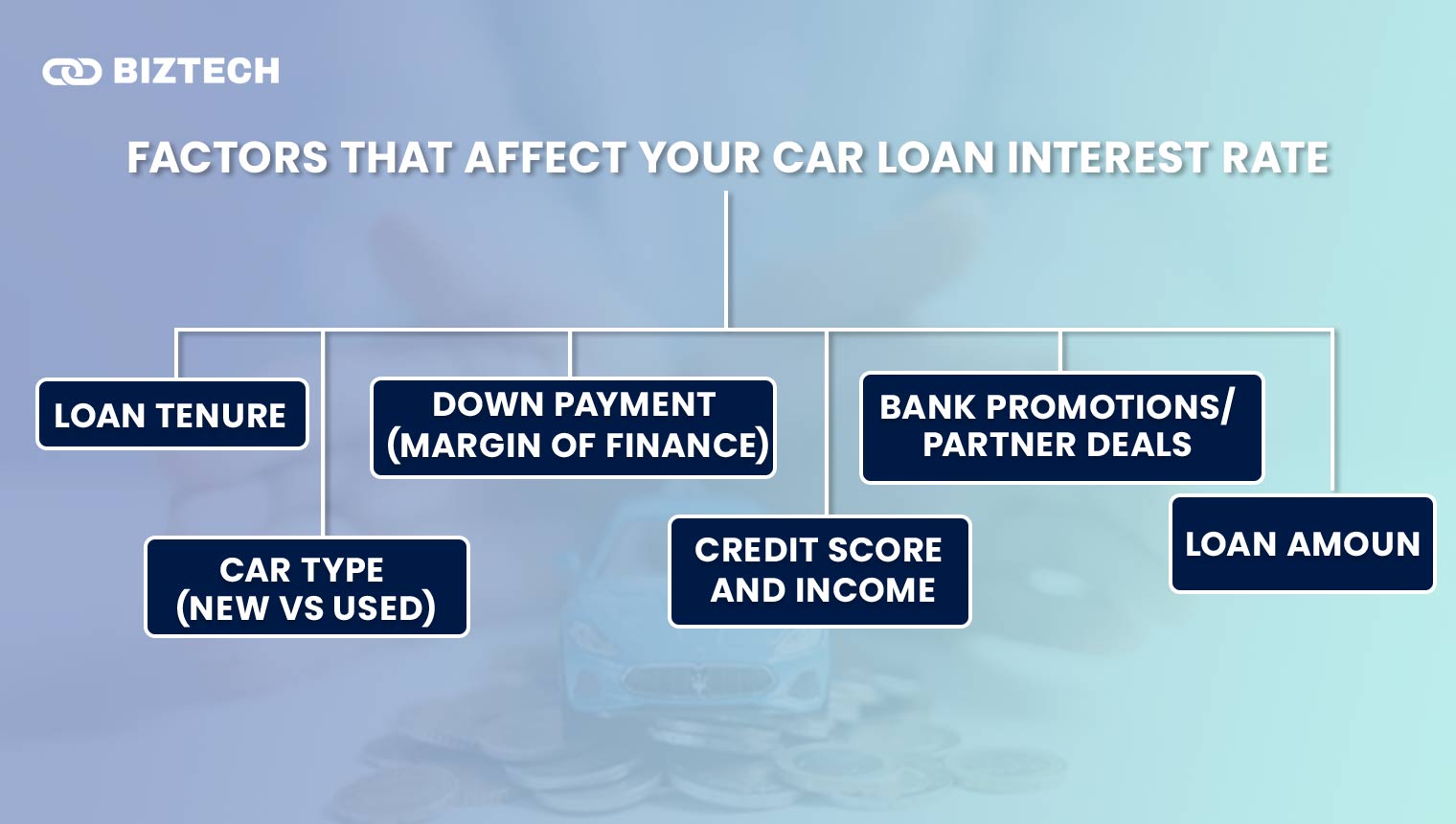
Several levers move the rate a bank offers you. Understanding them is how you negotiate a better deal.
Loan Tenure
Shorter loans usually attract lower rates and always cost far less in total interest. A 9-year loan can incur nearly double the total interest of a 5-year loan at the same rate. Under the new reducing-balance rules, the saving from a shorter tenure is even more pronounced.
Car Type (New vs Used)
New cars carry lower rates than used cars because they depreciate more predictably and pose less risk to the bank. New national cars and new foreign cars can also differ slightly.
Down Payment (Margin of Finance)
Most banks finance up to 90% of the car’s value, requiring a 10% down payment. Putting down 20%–30% reduces the principal, lowers your monthly instalment, and can earn you a better rate — and under reducing balance, a smaller principal compounds into bigger savings.
Credit Score and Income
Your repayment history and debt-service ratio determine whether you qualify for the bottom of the rate range. A clean credit record is worth real money here — it’s smart to check your CTOS credit score before you apply, and clear outstanding bills first.
Bank Promotions & Partner Deals
Manufacturer tie-ups, dealership campaigns and year-end promotions can shave the rate for a limited window. These are most common around major sales events and new-model launches.
How to Choose: A Simple Decision Framework
Don’t fixate on the lowest flat rate. Work through these steps instead:
- Compare EIR, not flat rate. From 2026 every bank must publish it. The EIR is the only number that lets you compare two loans fairly.
- Pick the shortest tenure you can comfortably afford. The monthly instalment is higher, but total interest can roughly halve versus a 9-year loan.
- Maximise your down payment. Every extra ringgit upfront cuts principal — and under reducing balance, that means compounding interest savings.
- Read the amortisation schedule. It now comes with every agreement. Check the total cost of credit, not just the monthly figure.
- Get at least three quotes. Banks, the dealer’s panel financier, and an Islamic option. Use them against each other.
Tips to Secure the Lowest Car Loan Interest
- Strengthen your credit profile: clear outstanding debts and check your credit report before applying. A strong score moves you to the lower end of the rate range.
- Increase your down payment: 20%–30% instead of the usual 10% can earn a better rate and lower monthly repayments.
- Shorten the loan duration: slightly higher monthly payments, but potentially half the total interest.
- Shop around and compare EIRs: collect offers from multiple banks and the dealer’s financiers, then compare like for like.
- Time your purchase: year-end and festival promotions from banks and dealers often bring temporary rate cuts or rebates.
Should You Settle Your Car Loan Early in 2026?
This is where the 2026 reforms change the maths most. Under the old Rule of 78, interest was front-loaded, so settling early gave you only a small interest rebate — it rarely paid off. Now:
- New (reducing-balance) loans: early settlement directly reduces outstanding principal, so it almost always saves meaningful interest.
- Existing (Rule of 78) loans: from 1 June 2026, banks offer a goodwill discount on early settlement, bringing your payoff closer to a reducing-balance figure. To qualify, your account generally must not be more than 90 days in arrears, under legal action, or in a formal debt-management programme.
If you have spare cash or are refinancing, request an early settlement quote from your bank and ask specifically about the goodwill discount — the exact figure depends on your tenure and how far into the loan you are.
Car Loan Eligibility and Requirements in Malaysia
For Malaysian citizens, the basic requirements are straightforward:
| Requirement | Details |
| Basic eligibility | At least 18 years old with a stable income; 10% down payment ready; IC, valid driving licence, and 3 months’ payslips/bank statements as proof of income. |
| Employment status | Employed or self-employed; self-employed applicants need extra documents such as bank statements or tax filings. |
| Approval time | Typically a few days to a week for approval. |
These apply to local Malaysians. Foreigners should see the section below. If you’re weighing a car loan against other borrowing, our guide to the best personal loans in Malaysia is worth a look.
Car Loans for Foreigners in Malaysia
Yes, foreigners living in Malaysia can secure a car loan — but the terms differ. Margins of finance are usually lower, so you’ll need a larger down payment than the standard 10%, and you may face a slightly higher rate as banks treat non-residents as higher risk.
You’ll typically need a valid passport, work permit or visa, proof of local employment and income, and often a local guarantor. Major banks such as Maybank, CIMB and Public Bank do lend to foreigners, frequently with a guarantor requirement. If the process feels too involved, subscription-based car services like FLUX are an alternative.
Conclusion — Getting the Best Deal on Your Car Loan
The 2026 shift to reducing balance and EIR is genuinely good news for borrowers: it ends the hidden cost of flat rates, makes comparison honest, and rewards anyone who settles early or pays a bigger deposit. The smart approach hasn’t changed in spirit — compare offers, keep the tenure short, put more down, and protect your credit score — but now you have a fairer system and clearer numbers to work with.
Compare the EIR across at least three lenders, read your amortisation schedule, and you’ll drive away with a car loan that fits your budget rather than fighting it.
FAQ about Car Loan Interest Rates in Malaysia
Disclaimer: This guide is provided by KayaToday for general information only and is not financial advice. Interest rates, fees, and eligibility were verified in June 2026 but change frequently — always confirm current figures and the Effective Interest Rate directly with the bank before committing. Figures for individual banks are indicative benchmarks.
References
- Bank Negara Malaysia (2026). Five Key Highlights of the Hire-Purchase (Amendment) Act 2026 — Consumer Guide.
- The Association of Banks in Malaysia (2026). Banks Introduce Changes to Hire Purchase Financing with Early Settlement Discounts.
- RinggitPlus (2026). Best Car Loans in Malaysia 2026.
- Bank Negara Malaysia (2026). OPR Decisions. Overnight Policy Rate held at 2.75%.






![Malaysia Best Fixed Deposit Rates [October 2026]](https://kayatoday.com/wp-content/uploads/2025/07/Best-Fixed-Deposit-Rate-Malaysia-300x170.jpg)