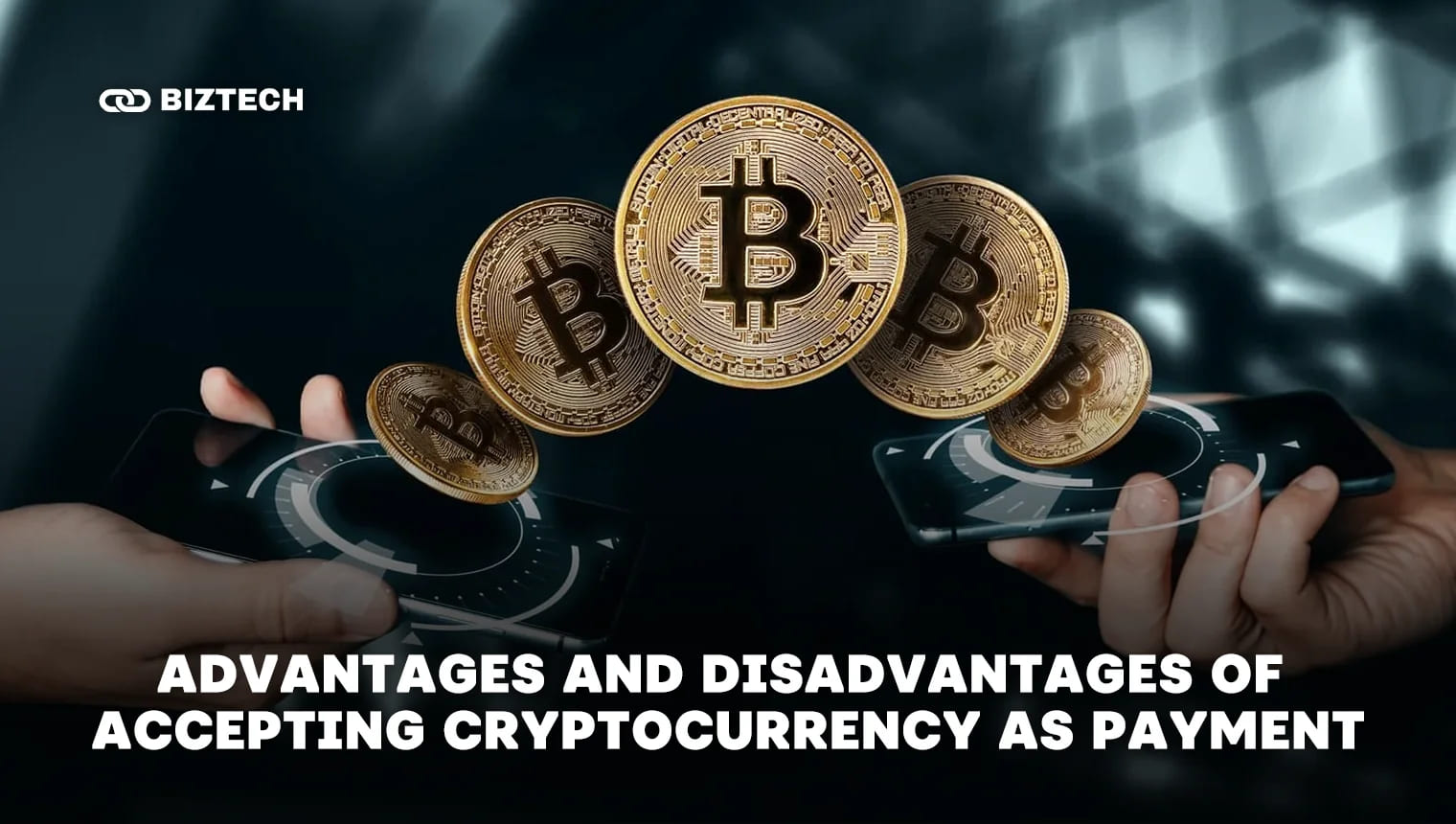
Cryptocurrency has moved from novelty to a real payment option, and more than 741 million people owned crypto by the end of 2025 (up from 659 million a year earlier) — a customer base that keeps growing. For a business owner, that raises a practical question: should you accept cryptocurrency as payment, and if so, how do you do it without getting burned by price swings?
- What Does “Accepting Cryptocurrency as Payment” Actually Mean?
- The Two Ways a Business Can Accept Crypto
- Advantages of Accepting Cryptocurrency as Payment
- 1. Lower Transaction Fees
- 2. No Chargebacks (Strong Fraud Protection)
- 3. Fast, Sometimes Instant, Settlement
- 4. Access to a Large, Global Customer Base
- 5. Enhanced Accessibility for the Unbanked
- 6. Volatility Can Be Neutralised
- 7. Optional Exposure to Crypto as a Reserve Asset
- Disadvantages of Accepting Cryptocurrency as Payment
- 1. Price Volatility (If You Hold the Coin)
- 2. Still-Limited Everyday Demand
- 3. Technical and Operational Complexity
- 4. Custody, Theft, and Loss Risk
- 5. Regulatory Uncertainty and Legal Status
- 6. No Buyer Protection and Irreversible Errors
- Advantages vs Disadvantages at a Glance
- How the Fees Really Compare
- Accepting Cryptocurrency in Malaysia & Singapore
- Malaysia: Legal to Trade, But Not Legal Tender
- Singapore: A Regulated Payment Instrument Under the PSA
- Security of Cryptocurrency Payments
- 1. What the Blockchain Gets Right
- 2. Where the Risk Actually Lives
- 3. Reducing Your Exposure
- Privacy: A Double-Edged Sword
- Should Your Business Accept Crypto? A Decision Framework
- Conclusion
- Frequently Asked Questions (FAQs)
This guide weighs the real advantages (lower fees, no chargebacks, a wider audience) against the genuine drawbacks (volatility, complexity, patchy demand), then shows you the two ways a business can actually accept crypto and how the rules work specifically in Malaysia and Singapore. The single most important thing to understand up front: for most merchants, the volatility problem is already solved — a payment processor can convert crypto to ringgit, Singapore dollars, or a stablecoin the instant a customer pays.
Verified as of August 2026. Prices, fees, and regulations change quickly — always confirm current figures with the provider or regulator before acting. This article is general information for a Malaysian/Singaporean audience, not financial, legal, or tax advice.
What Does “Accepting Cryptocurrency as Payment” Actually Mean?
Cryptocurrency is a digital payment system that runs without a central bank or government. Its security relies on cryptography and on blockchain technology — a shared public ledger that records every transaction across a network of computers, making entries extremely hard to alter or fake.
When a customer pays you in crypto, they send a digital asset (say Bitcoin, Ethereum, or a stablecoin like USDT) from their wallet to yours, and that transfer is recorded on the blockchain as proof of payment. Unlike a card payment, there is no bank in the middle approving the transaction and no chargeback window afterwards. That single difference — finality — drives most of crypto’s advantages and disadvantages for merchants.
If you want the bigger-picture view of the asset class before deciding, our guide to the advantages and disadvantages of cryptocurrency is a good companion to this merchant-focused piece.
The Two Ways a Business Can Accept Crypto
Before the pros and cons, understand this fork in the road — it determines almost everything about your risk and workload. You can either receive crypto directly into your own wallet, or route payments through a crypto payment processor (also called a gateway) that converts to cash or a stablecoin at checkout.
| Method | How it works | Volatility risk | Typical fees | Best for |
|---|---|---|---|---|
| Direct to your own wallet | Customer sends crypto straight to your wallet address; you hold the coin until you decide to sell. | High — you carry the price swing until you convert to cash. | Only the network (gas) fee — often just cents on Layer-2 networks or Tron. | Crypto-native businesses comfortable holding and managing digital assets. |
| Via a payment processor / gateway | Services such as BitPay, Coinbase Commerce, Binance Pay, or CoinGate convert the payment at the point of sale. | Low to none — instant conversion to fiat or a stablecoin removes the swing. | Roughly 0.5%–2% processor fee (bank payout is usually free). | Most ordinary retailers who simply want the sale settled in cash. |
The takeaway: if price volatility worries you, you almost certainly want a processor that settles in your local currency. You get the sale, the customer pays in crypto, and you never actually hold a volatile coin. Keep this distinction in mind as you read the advantages and disadvantages below.
Advantages of Accepting Cryptocurrency as Payment
1. Lower Transaction Fees
Card payments are not cheap for merchants. In 2026, credit-card processing typically costs a business 1.5%–3.5% per transaction plus a 10–30 cent fixed fee, with the average Visa/Mastercard cost around 2.35% (online “card-not-present” sales sit near the top of that range). By contrast, crypto processors such as Coinbase Commerce charge about 1% flat, and direct wallet payments cost only network fees — often cents. On cross-border sales the gap is even wider, because crypto skips international card and FX markups.
2. No Chargebacks (Strong Fraud Protection)
Because blockchain transactions are final, there are no chargebacks. For merchants in high-fraud categories — digital goods, travel, electronics — this is a genuine benefit: once a crypto payment confirms, it cannot be reversed by the buyer’s bank weeks later. (The flip side, covered below, is that this also removes buyer protection.)
3. Fast, Sometimes Instant, Settlement
Crypto payments settle in minutes rather than the 1–3 business days typical of cards, and some rails (like Binance Pay between users) settle instantly with zero fees. Faster access to funds is valuable for any business managing tight cash flow.
4. Access to a Large, Global Customer Base
With 700 million-plus crypto owners worldwide — a young, digitally native, often affluent demographic — accepting crypto signals that you cater to them. It also opens the door to international customers who may not have a card that works with your local processor.
5. Enhanced Accessibility for the Unbanked
Crypto does not require a bank account, making it usable by the unbanked and underbanked. In markets with limited banking access, that can expand your addressable customers.
6. Volatility Can Be Neutralised
The classic objection — “the coin might drop before I cash out” — is largely solved for merchants who use a processor. Payments can be auto-converted to ringgit, Singapore dollars, or a fully-backed stablecoin at the moment of sale, so the swing never touches your revenue. You get crypto’s reach and low fees without holding the asset.
7. Optional Exposure to Crypto as a Reserve Asset
Businesses that choose to hold what they receive gain optional upside if the asset appreciates, and some see scarce coins like Bitcoin (capped at 21 million) as a long-term hedge. This is a deliberate treasury decision, not a requirement — and it carries real risk, so treat it separately from your day-to-day payments strategy.
Disadvantages of Accepting Cryptocurrency as Payment
1. Price Volatility (If You Hold the Coin)
Bitcoin traded around US$77,000 in late August 2026, still well below its October 2025 all-time high near US$126,000 — a reminder of how sharply prices move. Imagine a customer pays for an RM500 order in Bitcoin. If BTC slips 5% before you convert to cash, that sale is suddenly worth RM475 — you have lost RM25 to volatility. The fix is the one above: use a processor that converts instantly, or accept a stablecoin, and never hold the volatile coin unless you mean to.
2. Still-Limited Everyday Demand
Adoption is growing but real-world spending remains niche. Of the tens of trillions of dollars in stablecoin transfers in 2025, researchers estimate only about US$350–550 billion were genuine real-economy payments — the rest was trading and moving funds between wallets. For many local shops, few customers will actually ask to pay in crypto, so weigh the setup effort against likely demand.
3. Technical and Operational Complexity
Setting up wallets, understanding network fees, choosing a processor, and reconciling crypto in your accounts adds a learning curve for you and your staff. A good gateway hides most of this, but there is still more to learn than with a familiar card terminal.
4. Custody, Theft, and Loss Risk
If you hold crypto directly, security is entirely your responsibility. Lose your private keys or fall for a scam and the funds are gone, with no bank to call. Even funds parked on an exchange or processor carry counterparty risk. If you plan to self-custody, read up on hot wallet versus cold wallet security before you accept your first payment.
5. Regulatory Uncertainty and Legal Status
Rules are tightening worldwide — the EU’s MiCA regime (since December 2024), the US GENIUS Act for stablecoins (July 2025), and Malaysia’s and Singapore’s own frameworks. That is good for legitimacy but means your obligations can change. Crucially, in both Malaysia and Singapore crypto is not legal tender, which shapes how you can accept it (see the localized section below).
6. No Buyer Protection and Irreversible Errors
The same finality that kills chargebacks also means a customer who pays the wrong amount or address has little recourse — and neither do you if you send a refund to the wrong place. Refunds must be handled manually and carefully.
Advantages vs Disadvantages at a Glance
| Advantages | Disadvantages |
|---|---|
| Lower fees (~1% vs ~2.35% avg for cards) | Volatility if you hold the coin (avoidable with a processor) |
| No chargebacks — strong merchant fraud protection | No buyer protection; irreversible mistakes |
| Fast, sometimes instant settlement | Everyday spending demand is still limited |
| Access to 700M+ global, crypto-savvy customers | Technical and accounting complexity |
| Works for the unbanked; borderless | Custody/theft risk if self-custodied |
| Volatility can be neutralised via instant conversion | Shifting regulation; not legal tender in MY/SG |
How the Fees Really Compare
Fees are one of the strongest reasons merchants explore crypto, so here is a realistic side-by-side. Figures were verified in 2026; always confirm current pricing with each provider, as fee tiers change.
| Payment method | Typical merchant fee | Chargebacks? | Settlement speed |
|---|---|---|---|
| Credit/debit card (Visa/Mastercard) | ~1.5%–3.5% + 10–30¢ (avg ~2.35%) | Yes | 1–3 business days |
| Coinbase Commerce | 1% flat, free auto-convert to fiat | No | Minutes to ~1 day payout |
| BitPay | 1%–2% + $0.25 (tiered by monthly volume) | No | ~1 business day |
| Binance Pay | 0% for user-to-user transfers | No | Instant |
| Direct wallet (self-custody) | Network/gas fee only (often cents) | No | Minutes |
Watch the “last mile,” though: converting crypto to a non-USD bank account, payout/withdrawal fees at smaller processors ($1–$25 each), and FX spread can add 0.3%–2% to the headline rate. If you need cash in your bank every week, the fiat off-ramp is the expensive part — factor it in.
Accepting Cryptocurrency in Malaysia & Singapore
This is where generic guides go wrong for local businesses. The rules here are specific, and getting them right matters.
Malaysia: Legal to Trade, But Not Legal Tender
Bank Negara Malaysia (BNM) has repeatedly stated that cryptocurrencies are not legal tender and not a recognised payment instrument. That means a Malaysian business cannot treat crypto as official payment the way it treats ringgit — but nothing stops a willing buyer and seller from agreeing to exchange goods or services for a digital asset (effectively a voluntary barter). In practice, most local businesses that “accept crypto” use a processor that instantly converts to ringgit, or they cash out received crypto through one of the country’s regulated exchanges.
Crypto trading itself is legal and overseen by the Securities Commission Malaysia (SC), which regulates digital-asset exchanges (DAX). As of 20 July 2026 there are five SC-registered DAX — Luno, HATA, MX Global, SINEGY, and Kinetic DAX — operating under the SC’s revised DAX framework effective 20 May 2026. To turn crypto payments into ringgit, use a registered platform and confirm it is on the SC’s current list first; our roundup of the best crypto trading platforms in Malaysia and our guide on how to cash out Bitcoin to your bank walk through the process. New to the space? Start with our cryptocurrency guide for Malaysian beginners.
Tax (Malaysia): there is no general capital gains tax, but LHDN can tax active, systematic crypto activity as income under the “badges of trade” (Income Tax Act 1967). Payment you receive for goods or services is ordinary business income measured in ringgit at the time of the sale, regardless of the form it arrives in. Rules depend on your circumstances — consult LHDN or a qualified tax professional.
Singapore: A Regulated Payment Instrument Under the PSA
Singapore also does not treat crypto as legal tender, but under the Payment Services Act (PSA) it can function as a regulated payment instrument, and the Monetary Authority of Singapore (MAS) licenses digital-payment-token service providers. Singapore has gone further than most on stablecoins: MAS-regulated single-currency stablecoins must be fully backed 1:1 by high-quality liquid reserves and redeemable at par within five business days. That is why many Singapore merchants accept MAS-regulated stablecoins — they get blockchain settlement without the volatility.
Tax (Singapore): there is no capital gains tax; IRAS taxes businesses on profits from crypto received or traded, and its e-Tax guide on digital tokens sets out the treatment (the supply of digital payment tokens has been GST-exempt since 2020). As always, confirm with IRAS or an advisor for your situation.
Bottom line for MY/SG merchants: you can accept crypto, but treat it as a supplementary option, not a replacement for ringgit or Singapore dollars. Use a processor or registered exchange to settle in local currency, and keep clean records for tax.
Security of Cryptocurrency Payments
Blockchain provides a strong security foundation, but it is not foolproof, and the weakest link is usually human.
1. What the Blockchain Gets Right
Immutable ledger: transactions are recorded chronologically and are practically impossible to alter on an established network. Decentralisation: data is spread across countless computers, so there is no single point of failure to breach.
2. Where the Risk Actually Lives
Custody and exchanges: the biggest losses come from where crypto is stored, not the chain itself. The 2014 Mt. Gox collapse (over US$450 million in Bitcoin) is the historical warning; the modern one is the February 2025 Bybit hack, when North Korea-linked attackers stole about US$1.5 billion — though Bybit made users whole and replenished reserves within 72 hours. The lesson for merchants: don’t leave large balances sitting on any platform longer than necessary.
Scams and wallet drainers: phishing, fake “support,” and malicious token approvals target businesses and individuals alike. If you self-custody, verify every transaction on your device and periodically revoke unused approvals. Our crypto scams guide covers the red flags in detail.
3. Reducing Your Exposure
Using a reputable processor shifts most custody risk off your plate. If you hold crypto yourself, keep the bulk in cold storage, enable strong authentication, and treat any received stablecoins as your default for stability — see our guide to buying and using USDT.
Privacy: A Double-Edged Sword
Crypto is often called “anonymous,” but it is really pseudonymous — transactions link to public wallet addresses, not names, and specialist analytics firms increasingly trace flows. So the privacy is real but limited, and it cuts both ways.
Upside: customers gain financial privacy and freedom from some forms of profiling, and merchants can transact across borders without exposing a full banking trail. Downside: the same properties have been exploited for money laundering and illicit purchases, which is exactly why regulators worldwide now impose KYC and “travel rule” requirements on exchanges and payment firms. For a legitimate business, this mostly means using regulated, compliant platforms — which is good practice anyway.
Should Your Business Accept Crypto? A Decision Framework
| If your business… | Then… |
|---|---|
| Sells online to a global or crypto-savvy audience | Crypto can widen reach and cut fees — use a processor that settles in your local currency. |
| Is a local shop with mostly local, card-using customers | Demand is likely low; the setup and accounting overhead may outweigh the benefit. |
| Suffers high card chargeback fraud (digital goods, travel, electronics) | Crypto’s no-chargeback finality is a real, measurable advantage. |
| Is worried about price swings | Choose instant fiat/stablecoin settlement and never hold the coin. |
| Operates in Malaysia | Remember crypto isn’t legal tender (BNM); treat it as a voluntary exchange and cash out via an SC-registered DAX. |
| Operates in Singapore | You can accept crypto as a regulated payment instrument under the PSA if you comply with MAS rules. |
Conclusion
Accepting cryptocurrency as payment is more practical in 2026 than ever: fees are lower than cards, chargebacks disappear, settlement is fast, and modern processors let you sidestep volatility entirely by converting to ringgit, Singapore dollars, or a stablecoin at checkout. The honest counterweights are still real — everyday demand is limited, the accounting and security take effort, regulation keeps shifting, and in both Malaysia and Singapore crypto is not legal tender. For most local businesses, the sensible path is to offer crypto as a supplementary option through a reputable, regulated processor, settle in local currency, and keep meticulous records. Approach it with cautious optimism, match the choice to your customers and risk appetite, and you can capture the upside without taking on the parts you don’t want.
Frequently Asked Questions (FAQs)
For official guidance, see Bank Negara Malaysia, the Securities Commission Malaysia (for the current list of registered digital-asset exchanges), and the Monetary Authority of Singapore.
Disclaimer: This article is published by KayaToday for general informational purposes only and does not constitute financial, legal, or tax advice. Cryptocurrency is volatile and regulations differ by jurisdiction and change over time. Figures and rules were verified as of August 2026 and may since have changed; always confirm current details with the relevant provider or regulator. Any decisions should be based on your own circumstances and, where appropriate, advice from a qualified professional. KayaToday makes no representation or warranty as to the accuracy, completeness, or reliability of the information, and you use it at your own risk.