
The legal structure you choose when starting a business in Malaysia is one of the most important early decisions you will make. It shapes your personal liability, how you are taxed, how easily you can raise money, and how far the business can scale.
- Business Entities in Malaysia at a Glance (2026)
- 7 Types of Business Entities in Malaysia
- 1. Sole Proprietorship
- 2. Partnership
- 3. Private Limited Company (Sdn. Bhd.)
- 4. Unlimited Companies
- 5. Foreign Company
- 6. Limited Liability Partnership (LLP)
- 7. Public Limited Company (Berhad)
- Choosing the Right Business Entity
- A Quick 4-Question Framework
- Frequently Asked Questions
- Conclusion
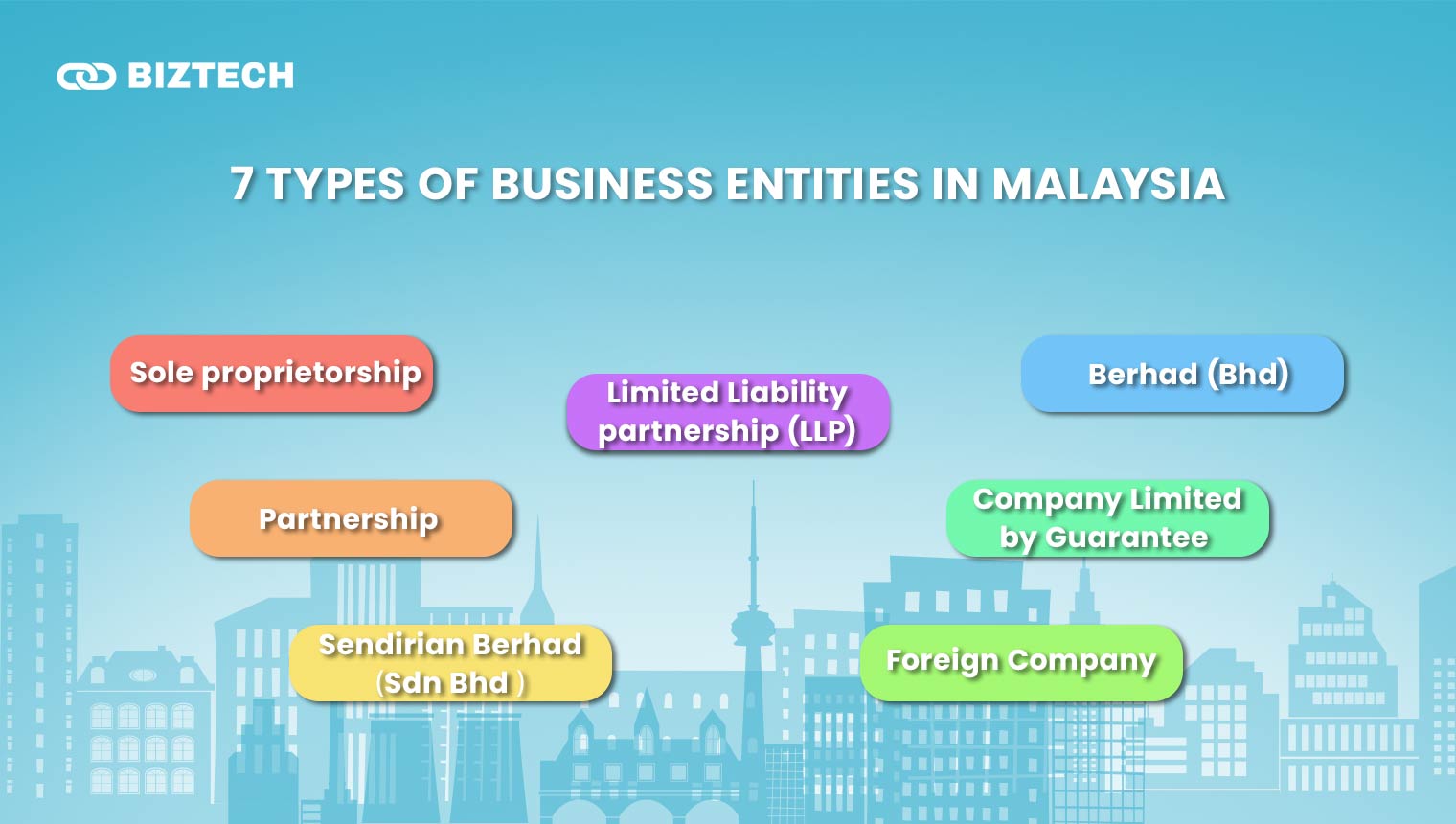
Malaysia recognises several types of business entities: sole proprietorships, partnerships, private limited companies (Sdn. Bhd.), unlimited companies, foreign companies, limited liability partnerships (LLPs), and public limited companies (Berhad). Each is registered with the Companies Commission of Malaysia (SSM) and taxed by Lembaga Hasil Dalam Negeri (LHDN/HASiL).
Simple forms such as sole proprietorships and general partnerships are cheap and fast to set up but expose owners to unlimited personal liability. Private limited companies and LLPs cost more to run but ring-fence your personal assets from business debts. The right answer depends on your appetite for risk, how you plan to fund growth, and how much compliance you are willing to handle.
Data verified August 2026 against SSM and LHDN. Fees, thresholds and tax rates can change at each Budget — always confirm the latest figures with SSM or a licensed company secretary before you register.
Business Entities in Malaysia at a Glance (2026)
Before the detailed breakdown, here is a quick comparison of setup cost, liability and who each entity suits best. Figures are indicative official SSM charges for 2026 and exclude professional/secretarial fees.
| Entity | Setup Cost (SSM, 2026) | Liability | Taxed As | Best For |
| Sole Proprietorship | RM30/yr (personal name) or RM60/yr (trade name) | Unlimited | Personal income | Freelancers, solo micro-businesses testing an idea |
| Partnership | RM60/yr (trade name); 2–20 partners | Unlimited (joint & several) | Each partner’s personal income | Small professional/family businesses sharing capital |
| LLP (PLT) | RM500 registration via MyLLP | Limited | Corporate rates (SME tiers may apply) | Professionals, startups, JVs wanting protection + flexibility |
| Private Limited (Sdn. Bhd.) | RM1,010 incorporation + RM50 name reservation | Limited | Corporate rates (SME tiers may apply) | Growth businesses raising funds or hiring a team |
| Unlimited Company | Similar to Sdn. Bhd. incorporation | Unlimited | Corporate rates | Rare; niche uses needing a body corporate without liability cap |
| Foreign Company / Branch | Scaled by share capital (from ~RM5,000+) | Limited (parent) | Corporate rate (24%, non-resident) | Overseas companies entering the Malaysian market |
| Public Limited (Berhad) | Highest; listing & compliance costs | Limited | Corporate rate (24%) | Large companies raising capital from the public |
7 Types of Business Entities in Malaysia
1. Sole Proprietorship
A sole proprietorship is the simplest business entity in Malaysia, owned and run by one person. It shares a single legal identity with its owner, so any debts or obligations of the business are borne personally by the owner. Registration is handled through SSM’s ezBiz portal (or any SSM counter) and costs RM30 per year to trade under your personal name or RM60 per year for a trade name — you can often be trading within a day.
Advantages
- Full Ownership and Control — you have total authority over every business decision.
- Financial Benefits — you keep all profits and pay tax at personal income rates rather than corporate tax, which can be cheaper at low income levels.
- Ease of Setup — quick and cheap to register online via ezBiz or in person at SSM.
Disadvantages
- Unlimited Liability — the company’s debts are your personal responsibility, putting your personal assets at risk.
- Limited Growth Potential — raising external funding is difficult, which caps expansion.
- Skills and Expertise Constraints — running every function alone can hold back productivity and growth.
- Malaysians and PRs only — foreigners cannot register a sole proprietorship or conventional partnership; they must use a Sdn. Bhd. or LLP.
2. Partnership
A partnership is owned by two to twenty individuals. In a general partnership, partners share equal rights and obligations and bear personal, joint-and-several responsibility for all liabilities. A limited liability partnership (LLP) — covered separately below — blends partnership flexibility with corporate-style limited liability.
Profit Sharing and Decision Making
- Profit Sharing — the partnership agreement sets how profits are split: equally, by capital contributed, by effort, or by other agreed terms.
- Decision Making — partners typically decide by democratic vote, delegation or consensus on investments, operations and goals.
Advantages
- Combined Resources — partners pool capital, skills and know-how.
- Ease of Setup — simple and affordable, with no complex formalities.
- Low Annual Compliance Costs — trade-name renewal is about RM60 per year and there is no corporate tax; each partner reports their share as personal income.
- Shared Responsibility — tasks can be divided to play to each partner’s strengths.
Disadvantages
- Unlimited Liability — every partner is personally liable for business debts, including those caused by another partner.
- Internal Disputes — disagreements can strain relationships; removing a partner is hard without a proper agreement.
- Taxation — large combined profits taxed at each partner’s personal rate can push them into higher personal tax brackets.
3. Private Limited Company (Sdn. Bhd.)
A private limited company, or Sendirian Berhad (Sdn. Bhd.), is Malaysia’s most popular business entity thanks to its limited liability and flexibility. It can be formed by locals or foreigners and is governed by the Companies Act 2016. Incorporation costs RM1,010 in SSM fees (plus RM50 to reserve the name for 30 days) and is done through the MyCoID portal, usually via a licensed company secretary.
Minimum Shareholders and Directors
A Sdn. Bhd. needs at least one director ordinarily resident in Malaysia and a minimum of one shareholder, up to a maximum of 50 shareholders. Cross the 50-shareholder mark and it must convert to a public company.
Advantages
- Limited Liability — shareholders’ personal assets are protected; their risk is capped at the capital they invest.
- Separate Legal Entity and Perpetual Succession — the company is distinct from its owners and continues even if shareholders retire or die.
- Transferability of Ownership — shares can be sold or transferred without disrupting operations.
- Ease of Fund Raising — its recognised structure makes bank loans and equity investment easier, often at better rates than unincorporated businesses.
- Attractive Tax Rates — a resident Sdn. Bhd. that qualifies as an SME (paid-up capital ≤ RM2.5m and gross income ≤ RM50m) is taxed at 15% on the first RM150,000, 17% on the next RM450,000, and 24% above RM600,000 of chargeable income, versus a flat 24% for non-SMEs.
Disadvantages
- Compliance and Reporting — a Sdn. Bhd. must comply with the Companies Act 2016, appoint a company secretary, and file annual returns and financial statements with SSM.
- Audit Requirement (with new exemptions) — accounts historically had to be audited yearly. Under SSM’s phased audit-exemption rules, small private companies can now skip the audit: for financial years starting in 2026 (Phase 2) a company qualifies if it meets any two of — turnover ≤ RM2m, total assets ≤ RM2m, or ≤ 20 employees — for the current and preceding two years; dormant companies also qualify.
- 2% Dividend Tax — since 2025, individual shareholders pay a 2% tax on annual dividend income above RM100,000 (on the excess only).
4. Unlimited Companies
An unlimited company is a body corporate whose members have no cap on their liability — unlike a limited company, all members are fully personally liable for the company’s debts. Its name must end with “Sendirian” or “Sdn.” to distinguish it. Because of the heavy financial risk, unlimited companies are rarely incorporated in Malaysia.
Advantages
- Ownership and Control — members directly control decisions and operations.
- Simple Structure — often a straightforward organisational setup.
- Fewer Public-Disclosure Pressures — typically lower administrative visibility than large corporations.
Disadvantages
- No Limit on Liability — members are fully responsible for all business debts and liabilities.
- Limited Access to Capital — the absence of liability protection makes investors cautious.
5. Foreign Company
A foreign company is one incorporated outside Malaysia that wants to do business here. There are four common routes:
1. Establishing a Local Company
Incorporate a new Malaysian entity, usually a Sdn. Bhd. See our guide to company registration for foreigners for the full process.
2. Registration of a Foreign Company
Register the foreign entity directly with SSM and operate under its existing legal structure while complying with Malaysian rules.
3. Setting Up a Representative Office
A representative office lets a foreign company explore the market and act as a liaison without conducting direct commercial (revenue-earning) activities.
4. Establishing a Branch Office
A branch lets the parent trade in Malaysia as an extension of itself, without a separate legal entity, and must meet local regulatory and tax requirements. Note that a non-resident company is taxed at the flat 24% corporate rate and does not enjoy the SME tiers.
Advantages
- Limited Liability for the Parent — incorporating a Malaysian subsidiary (e.g. a Sdn. Bhd.) caps the parent’s exposure to its investment.
- Proactive Government Support — Malaysia actively courts FDI with incentives such as Pioneer Status, Investment Tax Allowance, R&D and training grants, import-duty exemptions, and fast-tracked approvals via MIDA.
Disadvantages
- Cost and Complexity — registration involves legal, administrative and compliance costs.
- Strict Compliance — foreign companies must secure the required licences and permits.
- Limited Conversion Flexibility — switching entity type after registration (e.g. Sdn. Bhd. to LLP) is not straightforward.
- Potential Double Taxation — income may be taxed in both Malaysia and the home country; Malaysia’s network of double-tax treaties can mitigate this with planning.
6. Limited Liability Partnership (LLP)
An LLP (Perkongsian Liabiliti Terhad, “PLT”) combines the flexibility of a partnership with the limited liability of a company. It is governed by the Limited Liability Partnerships Act 2012, registered via SSM’s MyLLP portal for about RM500, and is popular with professionals such as lawyers and accountants as well as startups and joint ventures.
Profit-Sharing and Management
- Profit-Sharing — partners set profit-sharing ratios in the LLP agreement based on effort, capital or other factors.
- Management — the LLP agreement defines the internal structure; partners can run it collectively or appoint specific partners to manage day-to-day operations. At least one compliance officer is required.
Advantages
- Limited Liability Protection — unlike a conventional partnership, partners’ personal assets are shielded from business debts.
- No Minimum or Maximum on Partners — flexible ownership from two partners upward.
- Reduced Compliance — lighter, and cheaper, than a Sdn. Bhd.: no mandatory annual audit and simpler filings.
- Flexible Management — the internal structure is set by agreement, like a partnership.
- Competitive Tax Treatment — an LLP is a separate taxable entity taxed at corporate rates, and a resident LLP with capital contribution ≤ RM2.5m and gross income ≤ RM50m enjoys the same SME tiers (15%/17%/24%). Profits distributed to partners are not taxed again as personal income — though from 2026 a 2% tax applies to LLP distributions above RM100,000 received by individual partners, mirroring the dividend tax.
Disadvantages
- Less Familiar Structure — awareness among some banks, investors and stakeholders is still lower than for a Sdn. Bhd.
- Harder to Raise Equity — an LLP cannot issue shares, so it is less suited to raising outside equity or listing.
- Limited Precedent — as a relatively newer form, it has fewer established legal precedents.
7. Public Limited Company (Berhad)
A Public Limited Company, or “Berhad” (Bhd.), can offer shares to the general public and may list on a stock exchange. It is regulated by the Companies Act 2016. See our explainer on what a public limited company (Bhd.) is for more.
Key characteristics of a Berhad:
- At least two directors aged 18 or older, ordinarily resident in Malaysia.
- At least one shareholder, who may be a local or foreign individual or corporation.
- A registered office in Malaysia open during normal business hours.
- A qualified, certified company secretary must be appointed.
Share Capital and Listing
1. Minimum Share Capital — there is no fixed minimum, but to raise public capital the company must issue shares; the amount depends on business needs and market demand.
2. Listing Requirements — to trade publicly, a Berhad must apply to list on an exchange such as Bursa Malaysia and meet its transparency, financial-disclosure and governance rules.
Advantages
- Access to Large Capital — public share issues can fund major growth and expansion.
- Increased Visibility — a public listing raises profile and builds trust with customers, partners and investors.
- Institutional Investment — easier to attract institutional investors.
- Employee Share Schemes — share ownership can boost morale and retention.
- Exit Strategy — owners can sell shares on the market for potentially large returns.
Disadvantages
- High Compliance Burden — AGMs, audited reports and regular regulatory filings are mandatory.
- Complex Regulations — heavy governance can slow decision-making.
- Market Volatility — share prices move with market conditions.
- Loss of Privacy — financial data must be publicly disclosed.
- Risk of Hostile Takeovers — listed shares are open to takeover attempts.
Choosing the Right Business Entity
Here are the key factors to weigh when picking a business entity in Malaysia:
- Exposure to personal liability
- The scope and complexity of your operations
- Long-term growth goals
- Potential for raising capital
- Regulatory compliance requirements
- Management structure
- Tax implications
| Factor | Sole Proprietorship | Partnership | Private Limited (Sdn. Bhd.) | Unlimited Company | Foreign Company | Limited Liability Partnership (LLP) | Public Limited Company (Berhad) |
| Exposure to Personal Liability | Unlimited | Unlimited | Limited | Unlimited | Limited | Limited | Limited |
| Scope and Complexity of Operations | Moderate | Moderate | Moderate to Extensive | Extensive | Extensive | Moderate to Extensive | Extensive |
| Long-Term Growth Goals | Low | Moderate | High | High | High | Moderate to High | High |
| Potential for Raising Capital | Low | Moderate | Moderate to High | High | High | Moderate | High |
| Regulatory Compliance Requirements | Low | Moderate | High | High | High | Moderate | High |
| Management Structure | Owner-Managed | Shared | Board of Directors | Shared | Shared | Flexible | Board of Directors |
| Tax Implications | Personal Income Tax | Partners’ Personal Tax | Corporate (SME tiers may apply) | Corporate | Corporate (24% non-resident) | Corporate (SME tiers may apply) | Corporate (24%) |
A Quick 4-Question Framework
If the table still leaves you unsure, run through these four questions in order:
- 1. Do I need to protect personal assets? If yes, rule out sole proprietorships, general partnerships and unlimited companies — choose an LLP or Sdn. Bhd.
- 2. Will I raise outside investment or list one day? Only a Sdn. Bhd. (and later a Berhad) can issue shares to investors. An LLP cannot, so pick a Sdn. Bhd. if equity funding is on the horizon.
- 3. How much compliance can I handle? A Sdn. Bhd. needs a company secretary, annual returns and (unless exempt) an audit. An LLP is lighter; a sole prop/partnership is lightest.
- 4. What are my expected profits? At low profit, personal tax on a sole prop can beat corporate tax. Once profits are steady and sizeable, the SME tiers of a Sdn. Bhd. or LLP (15%/17%/24%) usually win — and you gain liability protection too.
A common path for Malaysian founders: start as a sole proprietor to test the idea cheaply, then convert to a Sdn. Bhd. once revenue, hiring or investor interest justify the extra compliance. For more, see our guides to corporate tax rates in Malaysia, SST, and how to register a company in Malaysia.
Frequently Asked Questions
Conclusion
Choosing the right business entity means balancing control, liability, tax and simplicity against where you want the business to go. Each structure has clear trade-offs: sole proprietorships and partnerships are cheap and simple but leave you personally exposed, while LLPs and Sdn. Bhd. companies cost more to run but protect your assets and unlock better funding and tax outcomes as you grow. Weigh your options against the four questions above, and the right choice becomes much clearer.
Disclaimer: This guide is provided by Kayatoday for general information only and is not legal, tax or financial advice. Fees, tax rates and regulatory thresholds are accurate to the best of our knowledge as of August 2026 but can change. Always confirm the latest requirements with SSM, LHDN or a licensed company secretary before making a decision.