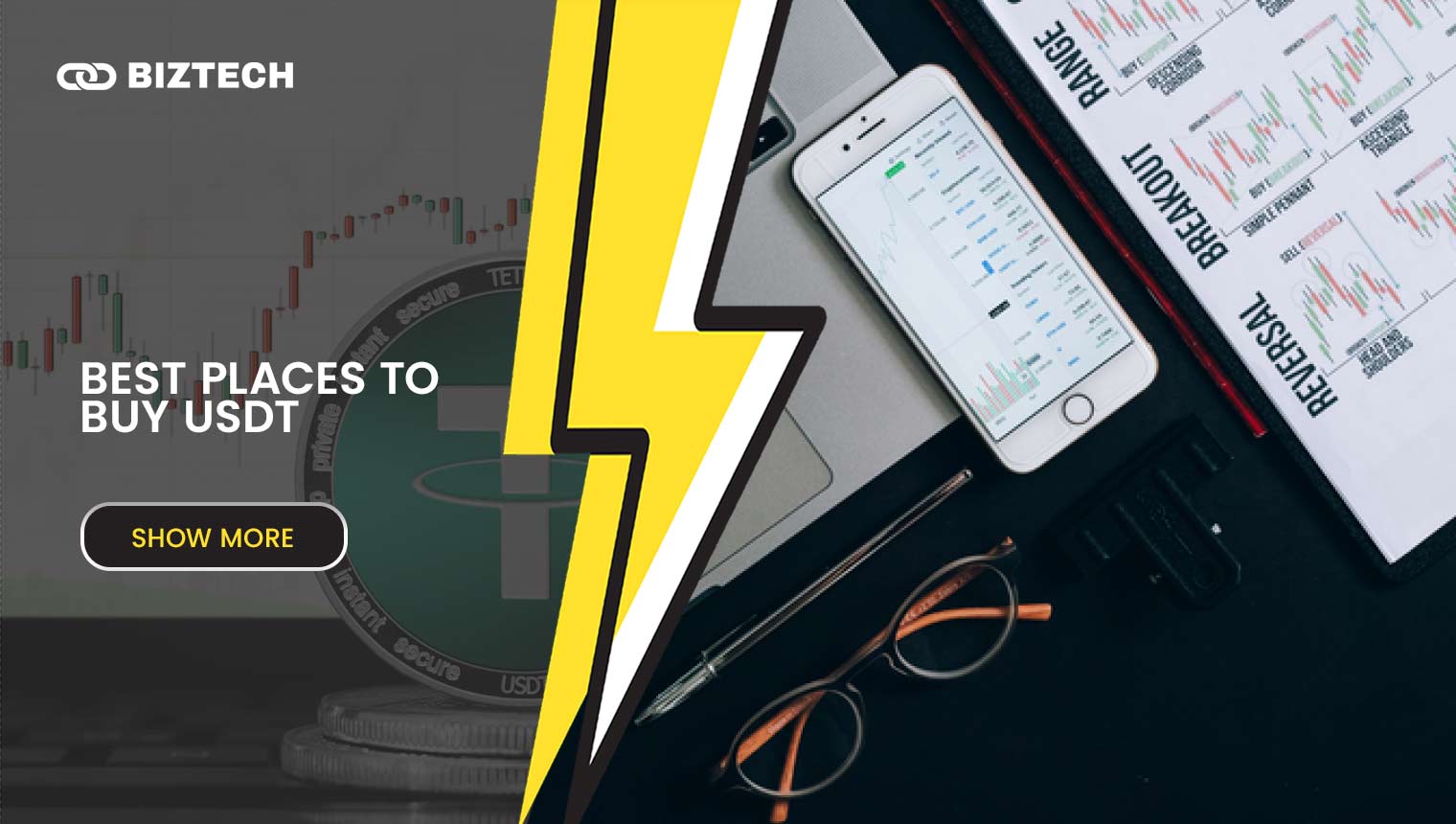
Choosing the best place to buy USDT is trickier than it looks — especially if you are in Malaysia or Singapore, where where you buy matters as much as the price. USDT, or Tether, is the world’s largest stablecoin, engineered to hold a steady value of about US$1. As of August 2026 it has a market capitalisation of roughly US$183 billion — more than double its nearest rival, USDC — and accounts for close to 59% of all stablecoins in circulation.
- What Is USDT and Why Use It?
- Is It Legal to Buy USDT in Malaysia and Singapore?
- How to Choose Where to Buy USDT
- The 5 Best Places to Buy USDT (Global Platforms)
- 1. Binance
- 2. Coinbase
- 3. Kraken
- 4. KuCoin
- 5. eToro
- How to Buy USDT in Malaysia (Step by Step)
- How to Buy USDT in Singapore
- USDT Networks and Fees: Avoid This Costly Mistake
- Tips to Buy USDT Safely
- Conclusion
- Frequently Asked Questions
In this guide we review five of the most popular global platforms for buying USDT, then go a step further than most articles by showing you exactly how Malaysians and Singaporeans can buy USDT legally, which regulated exchanges actually list it, and how to avoid the network-fee mistakes that cost first-time buyers real money. All figures were verified in August 2026 — always confirm the live rate and licensing status before you transact.
What Is USDT and Why Use It?
USDT (Tether) is a stablecoin pegged to the U.S. dollar, so one USDT is designed to always equal about US$1. It lets traders sidestep the volatility of coins like Bitcoin and Ethereum while staying inside the crypto ecosystem — you can "park" funds in USDT during a market dip without cashing out to your bank.
A few reasons USDT is so widely used:
- Deep liquidity: USDT is the most-traded asset in crypto, so it is quick to buy and sell on almost every exchange.
- Fast, low-cost transfers: Moving USDT between wallets is usually faster and cheaper than a traditional bank wire, particularly on the Tron (TRC-20) network.
- Multi-chain flexibility: USDT runs on several blockchains — Tron (the largest single network for USDT), Ethereum (ERC-20), Solana, Avalanche and more — giving you a choice of speed and fees.
- A stable store of value: Traders and savers hold USDT to preserve value between trades without converting back to ringgit or Singapore dollars each time.
The trade-off is that USDT is only as reliable as Tether’s reserves. Tether publishes regular attestations of the cash, U.S. Treasury bills and other assets backing the token; you can review the latest figures on Tether’s transparency page. USDT has held its peg through several major market shocks, but no stablecoin is completely risk-free.
Read also: Cryptocurrency in Malaysia: A Comprehensive Guide for Beginners
Is It Legal to Buy USDT in Malaysia and Singapore?
Yes — buying and holding USDT is legal in both countries, but you should use a locally regulated platform. In Malaysia, digital assets are regulated by the Securities Commission Malaysia (SC), and only SC-registered Digital Asset Exchanges (DAX) may legally offer crypto trading to residents. In Singapore, exchanges must hold a Digital Payment Token (DPT) licence from the Monetary Authority of Singapore (MAS).
This is where a lot of global "best place to buy USDT" lists fall down: several of the biggest names are not licensed locally. Binance, for example, is not licensed in Malaysia — the SC has taken enforcement action against it and its website and app remain blocked, a position the Ministry of Finance reaffirmed in July 2026. So before you fund any account, match the platform to your region using the table below.
| Region | Regulator | Best regulated route to USDT | Fiat on-ramp | Key note |
|---|---|---|---|---|
| Malaysia | Securities Commission (SC) | HATA Digital (SC-registered DAX; lists USDT & USDC) | MYR via bank transfer | Of the six SC-registered DAX, HATA is the one that lists USDT directly with ringgit pairs. |
| Singapore | Monetary Authority of Singapore (MAS) | Independent Reserve, Coinbase SG, Crypto.com, Coinhako, Gemini, OKX SG | SGD via FAST / PayNow | All are MAS-licensed and support USDT; verify current licence status on the MAS register. |
As of 20 July 2026 the SC lists five registered DAX in Malaysia: HATA, Luno Malaysia, MX Global, SINEGY DAX and Kinetic DAX (KDX). Importantly, most of them only list a handful of major coins — HATA is currently the SC-registered exchange that lists USDT (and USDC) with MYR pairs, while Luno Malaysia, MX Global, SINEGY and KDX focus on assets like BTC, ETH, XRP and SOL. You can confirm the up-to-date list on the SC’s official register of registered Digital Asset Exchanges. Singapore users can check licensing on the MAS website.
Read also: Best Crypto Trading Platforms to Buy in Malaysia
How to Choose Where to Buy USDT
With so many options available, it helps to weigh platforms against the same short checklist. These are the factors that actually affect your cost and safety:
- Local regulation first: In Malaysia use an SC-registered DAX; in Singapore use a MAS-licensed exchange. This protects your funds and keeps you on the right side of the law.
- All-in fees, not just the headline: Compare the trading fee, the spread and any card or deposit fees. A "zero-fee" buy button often hides a wide spread.
- Network support: Check which USDT networks the platform supports (TRC-20, ERC-20, Solana). Choosing the right one can be the difference between a US$1 and a US$10 withdrawal fee.
- Fiat on-ramp: Can you deposit MYR or SGD directly via bank transfer, DuitNow or PayNow? Direct fiat rails are cheaper than buying with a card.
- Liquidity: High USDT liquidity means tighter spreads and faster fills, especially for larger orders.
- Security and track record: Look for two-factor authentication, cold storage, proof-of-reserves and a clean operating history.
- Withdrawal freedom: Make sure you can move your USDT to a private wallet. For anything you don’t plan to trade soon, self-custody is safer — see our guide on hot vs. cold wallets.
The 5 Best Places to Buy USDT (Global Platforms)
These five exchanges are among the most popular worldwide for buying USDT thanks to their liquidity, features and fees. The at-a-glance table compares them first; detailed reviews follow. Note the availability column carefully if you are in Malaysia or Singapore.
| Platform | Spot fee (maker/taker) | Instant / card buy | Standout strength | MY / SG availability |
|---|---|---|---|---|
| Binance | 0.10% / 0.10% (0.075% with BNB) | ~1.8–2% card; P2P often 0% | Deepest liquidity, lowest spot fees | Blocked/unlicensed in MY; no SG retail |
| Coinbase | 0.40% / 0.60% on Advanced (falls with volume) | Simple buy ~1.2–3.7% all-in | Beginner-friendly, strong compliance | MAS-licensed in SG; not SC-registered in MY |
| Kraken | 0.25% / 0.40% on Kraken Pro | Instant Buy ~1.5% | Security and reliability | Check MAS register for SG; not SC-registered in MY |
| KuCoin | 0.10% / 0.10% (0.08% with KCS) | Varies by provider | Huge altcoin range, low fees | Not locally licensed in MY or SG |
| eToro | 1% flat on buy and sell | 1% (built into price) | Multi-asset & copy trading | Check local availability; not SC-registered in MY |
Fees verified August 2026. USDT is usually bought as a USDT/USD, USDT/USDC or USDT/local-currency pair; stablecoin pairs sometimes carry lower fees, so always confirm the live rate before you buy.
1. Binance

Launched in 2017, Binance is the world’s largest crypto exchange by trading volume and offers the deepest USDT liquidity anywhere. Its standard spot fee is a low 0.10% maker/taker, dropping to 0.075% if you pay fees in BNB, and its peer-to-peer (P2P) marketplace often lets users buy USDT with no platform fee at all. For traders who can access it, Binance is hard to beat on cost.
The catch for our readers is availability: Binance is not licensed in Malaysia, where the SC has taken enforcement action and access to its site and app is blocked, and it no longer serves Singapore retail customers. Treat it as a reference point rather than a local on-ramp.
Pros
- Lowest headline trading fees and enormous USDT liquidity.
- Advanced trading tools and a wide range of trading pairs.
- Strong security features including 2FA and cold storage.
Cons
- Not licensed in Malaysia; unavailable to Singapore retail users.
- Interface can overwhelm complete beginners.
- Ongoing regulatory scrutiny in several markets.
2. Coinbase

Coinbase is known for simplicity, which makes it a common first stop for new crypto users. It is a publicly listed, heavily regulated company, and crucially Coinbase Singapore holds an MAS licence, so it is a legitimate route for Singaporeans (it is not an SC-registered DAX in Malaysia). Watch the fees, though: the simple "buy" screen is convenient but expensive once the spread is added, whereas Coinbase’s Advanced Trade tab starts at 0.40% maker / 0.60% taker and falls with volume. For USDT, always use Advanced Trade.
Pros
- Very easy for beginners, with strong educational resources.
- MAS-licensed in Singapore and SGD-friendly.
- Robust security and insurance on custodial holdings.
Cons
- The simple buy screen carries high all-in costs.
- Fewer coins than some competitors.
- Not an SC-registered DAX in Malaysia.
3. Kraken

Operating since 2011, Kraken has one of the strongest security and reliability track records in the industry and supports a wide range of fiat and crypto pairs. On Kraken Pro, spot fees are around 0.25% maker / 0.40% taker at the entry tier — considerably cheaper than the roughly 1.5% Instant Buy screen. Kraken is not an SC-registered DAX in Malaysia; Singapore users should confirm its current status on the MAS register before signing up.
Pros
- Excellent security record and transparent fee schedule.
- Competitive Kraken Pro fees for active traders.
- Wide selection of fiat and USDT pairs.
Cons
- Advanced tools can feel complex for newcomers.
- Instant Buy is far pricier than Kraken Pro.
- Verification can take time during busy periods.
4. KuCoin
KuCoin is prized for its enormous altcoin selection and low, flat trading fees of 0.10% maker/taker (about 0.08% if you pay in KCS). It is a solid choice for USDT liquidity and for pairing USDT against hundreds of smaller tokens. However, KuCoin is not locally licensed in Malaysia or Singapore, so it should not be your primary MYR or SGD on-ramp; if you use it, fund it by transferring USDT you already bought on a regulated platform.
Pros
- Low flat fees and deep USDT trading pairs.
- Access to a very wide range of cryptocurrencies.
- Staking and lending options to earn on idle USDT.
Cons
- Not licensed in Malaysia or Singapore.
- Fewer direct fiat options; best funded with crypto.
- Customer support can be slow at peak times.
5. eToro
Founded in 2007, eToro is a multi-asset platform best known for social and copy trading. It applies a simple, transparent 1% fee on every crypto buy and sell, built into the price, plus a flat US$5 withdrawal fee. That flat 1% is easy to understand but pricier than the sub-0.5% spot fees on Binance, Kraken or KuCoin for anyone trading actively. eToro is regulated in various jurisdictions but is not an SC-registered DAX in Malaysia, and its crypto availability varies by country — check whether it is offered in your region before funding.
Pros
- Simple, transparent 1% crypto fee and slick interface.
- Copy-trading and a broad range of asset classes.
- Long operating history and strong brand recognition.
Cons
- 1% is expensive for frequent traders.
- Crypto availability and features vary by country.
- Not an SC-registered DAX in Malaysia.
How to Buy USDT in Malaysia (Step by Step)
If you are in Malaysia and want to buy USDT legally with ringgit, the cleanest route is an SC-registered DAX that lists USDT. Here is the general process using HATA as the example:
- Register and verify: Sign up on an SC-registered DAX that lists USDT (currently HATA) and complete KYC with your MyKad.
- Deposit MYR: Fund your account by bank transfer or DuitNow from a Malaysian bank account.
- Buy USDT: Place a market or limit order on the USDT/MYR pair. A limit order usually gets you a better price than an instant buy.
- Choose your network wisely: If you withdraw, pick the network (TRC-20 is typically the cheapest) that matches the destination wallet or exchange.
- Secure your USDT: Keep only what you’re actively trading on the exchange and move the rest to a wallet you control.
Because SC-registered platforms differ in the coins they list, always confirm USDT is available before depositing. For a wider comparison of local exchanges, see our guide to the best crypto trading platforms in Malaysia.
How to Buy USDT in Singapore
Singaporeans have more MAS-licensed choices. Platforms such as Independent Reserve, Coinbase Singapore, Crypto.com, Coinhako and Gemini support USDT and accept SGD deposits via FAST or PayNow. Independent Reserve, for instance, lists USDT on both ERC-20 and TRC-20 networks and settles SGD through local bank rails. The steps mirror the Malaysian process: verify your identity, deposit SGD, buy the USDT/SGD or USDT/USD pair, and withdraw on the right network. Confirm any platform’s licence on the MAS register first.
USDT Networks and Fees: Avoid This Costly Mistake
The single most common — and expensive — error new buyers make is ignoring the network when they send or withdraw USDT. The same USDT exists on multiple blockchains, and they are not interchangeable when transferring:
| Network | Typical transfer fee | Speed | Best for |
|---|---|---|---|
| Tron (TRC-20) | ~US$1 or less | Fast | Cheap everyday transfers between exchanges |
| Ethereum (ERC-20) | Several US dollars (gas-dependent) | Moderate | DeFi and ERC-20 wallets |
| Solana (SPL) | A few cents | Very fast | Low-cost transfers, Solana apps |
Worked example: Suppose you buy 500 USDT and want to move it to another wallet. Withdraw on Tron (TRC-20) and you might pay about US$1. Withdraw the same amount on Ethereum (ERC-20) during a busy period and the gas fee could be several dollars — many times more for exactly the same result. The golden rule: the sending and receiving network must match. Send TRC-20 USDT to an ERC-20-only address and the funds can be lost permanently. Always send a small test amount first.
Planning to convert USDT back to cash later? Our guide on cashing out crypto to your bank walks through the off-ramp side.
Tips to Buy USDT Safely
- Verify the licence: Confirm the platform is SC-registered (Malaysia) or MAS-licensed (Singapore) before depositing a cent.
- Enable 2FA: Use an authenticator app rather than SMS where possible.
- Beware "too good" P2P deals: Off-platform USDT deals promising below-market rates are a classic scam. Learn the warning signs in our crypto scams guide.
- Test transfers first: Send a small amount to confirm the address and network before moving the full balance.
- Don’t leave large balances on exchanges: Consider a crypto-friendly banking setup and self-custody — see our roundup of crypto-friendly banks.
Conclusion
Each of these platforms has genuine strengths. Binance offers the deepest liquidity and lowest spot fees, Coinbase is the friendliest on-ramp and MAS-licensed in Singapore, Kraken pairs strong security with reasonable Kraken Pro pricing, KuCoin excels on altcoin range and low fees, and eToro keeps things simple with a flat 1%. But for readers in Malaysia and Singapore, the most important filter is regulation: in Malaysia, buy USDT through an SC-registered DAX that lists it (currently HATA); in Singapore, stick to MAS-licensed exchanges such as Independent Reserve or Coinbase.
Match the platform to your region, compare the all-in fees, pick the right network, and secure your USDT once you own it. Do that, and you’ll buy Tether cheaply, legally and safely.
Frequently Asked Questions
Figures and platform details were verified in August 2026. Fees, coin listings and licensing status change frequently — always confirm the current rate and registration on the provider’s website, the SC register or the MAS register before transacting.
**Disclaimer: This article is provided by KayaToday for informational purposes only and does not constitute financial advice. Cryptocurrency is volatile and carries risk. We recommend doing your own research and consulting a licensed financial adviser before making any investment decisions.