In the crypto world, which is full of opportunities as well as risks, keeping your digital assets safe is a top priority. Imagine if one small mistake—forgetting your password or losing your private key—could wipe out your entire investment in an instant. Scary, isn’t it? That fear is exactly why crypto custody has become one of the fastest-growing corners of the industry: as of 2026, Coinbase alone safeguards more than US$350 billion in client assets, and regulators from Kuala Lumpur to Singapore now license custody as a distinct, supervised activity.
- What is Crypto Custody?
- Why Crypto Custody Matters
- Types of Crypto Custody
- 1. Self-Custody: Full Control in Your Hands
- 2. Third-Party (Custodial) Storage: Professional-Grade Security
- Self-Custody vs. Custodial: At a Glance
- Crypto Custody vs. Crypto Storage: What’s the Difference?
- Top 5 Crypto Custody Providers in 2026
- Coinbase Prime (Coinbase Custody)
- BitGo
- Gemini Custody
- Anchorage Digital
- Fireblocks
- How to Choose the Right Custody Option
- Crypto Custody in Malaysia & Singapore
- Malaysia (Securities Commission)
- Singapore (MAS)
- Tax note (MY & SG)
- Common Custody Pitfalls to Avoid
- Frequently Asked Questions
- Conclusion
Especially for beginners, the crypto world can feel like a wilderness without a map. So, before you dive in deeper, let’s discuss one of the best solutions for protecting your assets: crypto custody. What is it, how do you choose between doing it yourself and handing the keys to a professional, and what does the law now require in Malaysia and Singapore? Let’s break it down.
What is Crypto Custody?
In simple terms, crypto custody is a service—or a method—for storing and safeguarding your digital assets against threats such as theft, hacking, or personal negligence. Think of it as a super-advanced safe deposit box for your Bitcoin, gold-equivalent holdings, Ethereum, and other altcoins. With proper custody in place, you gain an extra layer of protection that is difficult to achieve if you rely only on yourself.
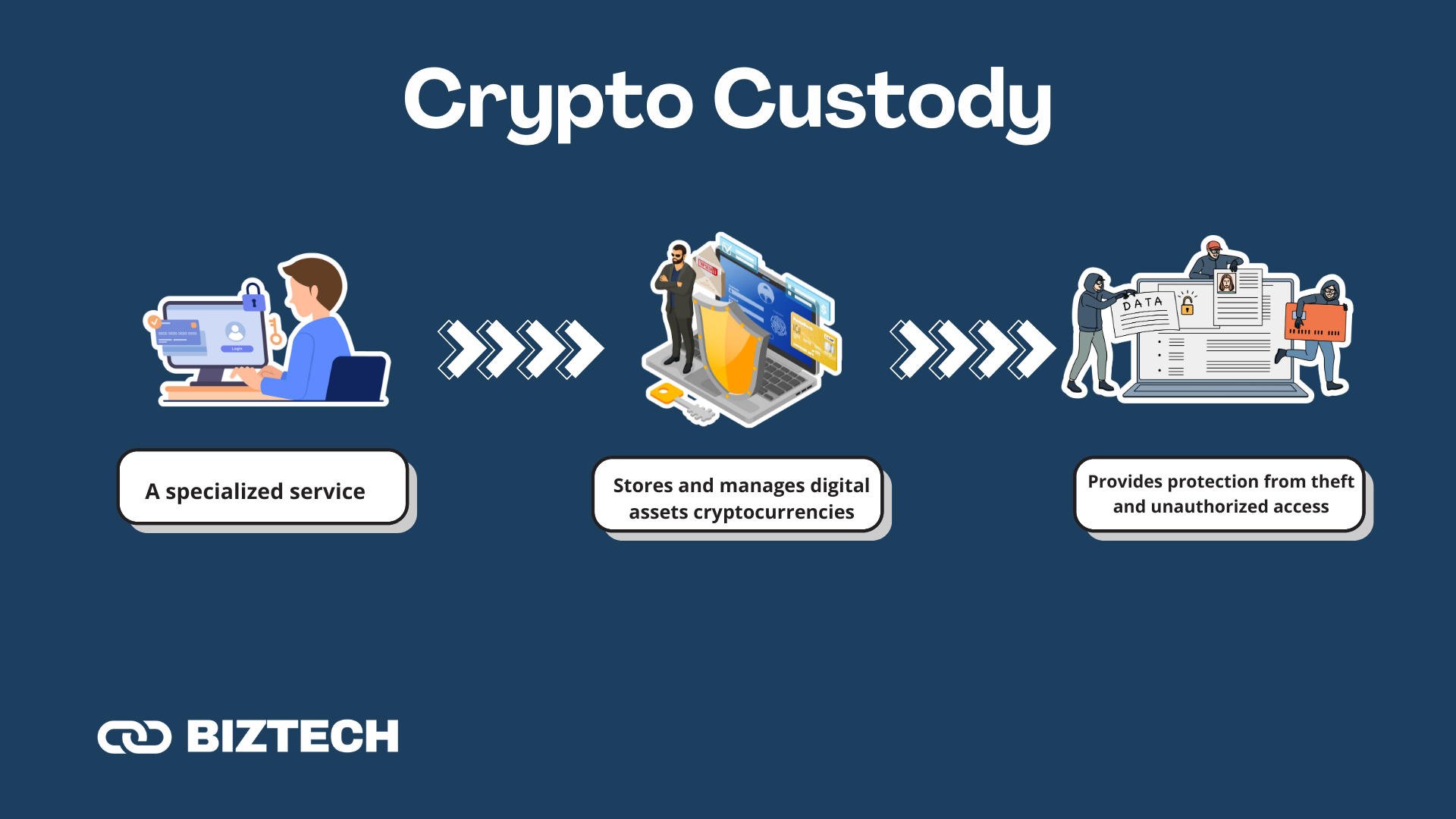
At its core, custody is really about one thing: who controls the private key. A private key is the secret string of characters that authorises transactions from a wallet. Whoever holds the key controls the coins—which is why the phrase “not your keys, not your coins” has become the industry’s most repeated warning. Custody solutions typically combine cold wallet (offline) and hot wallet (online) storage with security layers such as two-factor authentication (2FA), multi-signature (multi-sig) approvals, and increasingly multi-party computation (MPC), which splits a key into fragments so no single device ever holds it whole.
Why Crypto Custody Matters
The main role of crypto custody is to be a fortress of defence for your assets. In a decentralised blockchain ecosystem, security depends entirely on the private key. Lose it, and there is no “forgot password” button—your assets are gone forever. Have it stolen, and a thief can drain your wallet in seconds, with transactions that are irreversible by design.
Professional custodians reduce that risk with layered defences: a small hot wallet for fast transactions backed by the bulk of assets in deep cold storage, multi-sig or MPC signing so no single person can move funds alone, hardware security modules (HSMs), insurance, and independent audits. The result is that the risk of a catastrophic loss is drastically reduced.
Custody also matters because the industry has learned the hard way what happens without it. The 2022 collapse of FTX—where customer funds were commingled and misused—and the February 2025 Bybit breach, in which the Lazarus Group stole roughly US$1.5 billion in the largest crypto theft on record (later reimbursed by Bybit within days), both underscored the same lesson: how and where assets are held is not a technicality. It is the whole ballgame. That is exactly why institutions and regulators now treat qualified custody as a baseline requirement rather than an optional extra.
Types of Crypto Custody
Crypto custody is generally divided into two main models—self-custody and third-party (custodial) storage. A growing middle ground, sometimes called collaborative or MPC custody, blends the two. Each has trade-offs you need to understand before choosing.
1. Self-Custody: Full Control in Your Hands
Self-custody means you store and manage your own private key without relying on anyone else. You can use a hot wallet (a phone or browser app connected to the internet) or a cold wallet (an offline device such as a Ledger or Trezor).
Advantages:
- 100% control over your assets—no need to trust a third party.
- Minimal cost, since there is no custody subscription fee.
- Direct, permissionless access to DeFi, staking, and self-directed transfers.
Disadvantages:
- High risk if the private key or seed phrase is lost or stolen—there is no recovery line.
- You are fully responsible for security, including against phishing, malware, and “approval-drainer” scams.
- No insurance and no institutional-grade controls.
This model suits tech-savvy individuals who value complete freedom and are willing to shoulder the responsibility that comes with it.
2. Third-Party (Custodial) Storage: Professional-Grade Security
A third-party custodian—usually a specialised firm, licensed bank, or regulated exchange—stores and manages assets on your behalf. Examples include Coinbase Prime, BitGo, and Gemini Custody.
Advantages:
- Institutional security: HSMs, deep cold storage, multi-sig/MPC, and 24/7 monitoring.
- Insurance coverage and regulatory compliance (a must for funds, ETFs, and companies).
- You can focus on strategy instead of key management.
Disadvantages:
- You must trust the provider—counterparty risk exists if it is hacked, mismanaged, or fails.
- Service fees, which vary by provider and asset size.
- Less direct control and, at some providers, slower withdrawal processes.
This model is favoured by institutions, funds, and high-net-worth investors—and, increasingly, by everyday users who simply want peace of mind.
Self-Custody vs. Custodial: At a Glance
| Factor | Self-Custody | Third-Party Custodian |
|---|---|---|
| Who holds the keys | You | The provider (or shared) |
| Control | Full | Delegated |
| Cost | Low (hardware only) | Custody / AUC fees |
| Insurance | None | Often included |
| Main risk | Losing your own key | Counterparty / provider failure |
| Best for | Hands-on individuals | Institutions, large holdings, hands-off users |
Crypto Custody vs. Crypto Storage: What’s the Difference?
Many people use “crypto custody” and “crypto storage” interchangeably, but they are not the same. Crypto storage is simply how you keep a private key—in a hot wallet, a cold wallet, or even on paper. It is the technical act of holding the key. If the key is lost, the assets are gone.
Crypto custody is broader: a service that not only stores keys but also manages, protects, insures, and—where regulated—is legally accountable for your assets. Picture storage as keeping your car keys in your pocket, and custody as handing your car to a licensed, insured valet who parks it, guards it, and answers for it. Storage is a tool; custody is a responsibility.
Top 5 Crypto Custody Providers in 2026
Based on assets under custody, regulatory standing, and institutional adoption, here are five of the most established crypto custody providers to know in 2026. (Figures are approximate and change with the market—confirm current terms directly with each provider.)
-
Coinbase Prime (Coinbase Custody)
- Why top? Coinbase Prime safeguards more than US$350 billion in client assets—around 12% of the entire crypto market—and acts as custodian for over 80% of U.S. spot Bitcoin and Ether ETFs. In April 2026 it received preliminary conditional OCC approval to operate a national trust company, tightening its regulated footing.
- Standout features: Deep cold storage, on-chain staking from custody, SOC 1 & SOC 2 compliance, and integration with Coinbase’s broader prime-brokerage stack.
- Best for: Institutions, ETF issuers, and large investors.
-
BitGo
- Why it matters: Founded in 2013, BitGo pioneered multi-sig custody and holds more than US$100 billion in assets across 700+ tokens. In January 2026 it became the first pure-play crypto-custody firm to go public, listing on the NYSE (ticker BTGO) at a roughly US$2 billion valuation.
- Standout features: Industry-standard multi-signature security, large insurance policy, and independently audited cold storage.
- Best for: Exchanges, funds, and businesses that need flexible qualified custody.
-
Gemini Custody
- Why trusted? A New York–chartered fiduciary and qualified custodian regulated by the NYDFS, Gemini holds more than US$30 billion under custody and serves as custodian for regulated products such as the VanEck Solana ETF.
- Standout features: Offline cold storage, SOC 1 Type 2 and SOC 2 Type 2 certification, insurance, and a clean, user-friendly interface.
- Best for: Everyone from cautious beginners to institutions wanting a regulated U.S. custodian.
-
Anchorage Digital
- Why unique? Anchorage is the only U.S. federally chartered crypto bank, supervised by the OCC since 2021. It secures tens of billions in digital assets and, in 2026, expanded custody to new networks (including TRON) and launched stablecoin issuance under the GENIUS Act. A February 2026 investment lifted its valuation to about US$4.2 billion.
- Standout features: Hardware security modules, biometric authentication, and instant trading without compromising cold-storage security.
- Best for: Large institutions with complex, compliance-heavy needs.
-
Fireblocks
- Why stand out? Fireblocks is the leading MPC-based custody and wallet infrastructure provider—technology that banks and exchanges build on rather than a retail service. It has secured over US$6 trillion in cumulative transfers for 2,400+ organisations, supporting 1,500+ tokens across 70+ networks.
- Standout features: Multi-party computation key security, a configurable policy engine, and enterprise-grade APIs for treasury and DeFi.
- Best for: Businesses, fintechs, and institutions building their own custody workflows.
How to Choose the Right Custody Option
There is no single “best” answer—the right choice depends on how much you hold, how often you transact, and how much responsibility you want to carry. Use this framework as a starting point.
| Your situation | Suggested approach | Why |
|---|---|---|
| Small holding, active trader | Regulated exchange wallet + small cold wallet | Convenience for trading; move long-term holdings offline |
| Long-term holder (“HODLer”) | Self-custody cold wallet | Lowest counterparty risk; you control the keys |
| Large personal holding | Cold wallet + regulated/insured custodian | Diversify storage; add insurance and recovery |
| Institution, fund, or business | Qualified third-party custodian (or MPC) | Compliance, audits, insurance, and legal accountability |
| Not confident managing keys | Regulated custodial provider | Professional security without the technical burden |
A practical rule many investors follow: keep only what you actively trade on an exchange, and move everything else into custody you trust—whether that is your own hardware wallet or a licensed custodian.
Crypto Custody in Malaysia & Singapore
Custody is no longer just a technical choice in this region—it is a regulated activity. If you are investing from Malaysia or Singapore, it pays to keep your assets within the supervised perimeter.
Malaysia (Securities Commission)
The Securities Commission Malaysia (SC) regulates the crypto space through three registered categories: Digital Asset Exchanges (DAX), Initial Exchange Offering (IEO) platforms, and—importantly for this topic—Digital Asset Custodians (DAC). As of the SC’s update on 26 June 2026, there are five registered DAX where Malaysians can legally buy, sell, and store crypto: Luno, HATA, MX Global, SINEGY, and Kinetic DAX (KDX). These platforms hold client assets under DAC-standard safeguards, and several dedicated custodians are also registered.
Under the SC’s revised framework (effective 20 May 2026), exchanges can now list eligible tokens without case-by-case approval—but in exchange, they face stricter capital requirements and tighter client-asset custody rules, including mandatory independent annual custody assessments. Existing operators have until 20 May 2028 to meet the new capital thresholds. For everyday investors, the takeaway is simple: use an SC-registered platform, and be cautious of any offshore exchange that is not on the SC’s official list. Funding is easy via DuitNow bank transfer.
Singapore (MAS)
The Monetary Authority of Singapore (MAS) licenses Digital Payment Token (DPT) service providers under the Payment Services Act. Its 2026 rules for custody are among the strictest in the region: customer assets must be held in a segregated trust structure (no commingling with the firm’s own funds), with mandatory insurance for custodial wallets, guidance to keep around 90% of assets in offline cold storage, daily reconciliations, and real-time reserve attestation. MAS-licensed providers include Coinhako, Independent Reserve, Crypto.com, and Coinbase Singapore, with funding via PayNow/FAST.
Tax note (MY & SG)
Neither Malaysia nor Singapore imposes a general capital gains tax on long-term crypto investors. However, if trading is frequent and business-like, profits can be taxed as income under the LHDN “badges of trade” test in Malaysia or IRAS rules in Singapore. Keep records and consult a tax professional for your situation.
Common Custody Pitfalls to Avoid
- Leaving everything on an exchange indefinitely. Convenient, but you are trusting the platform’s solvency and security—stick to regulated, insured providers and move large holdings you don’t trade.
- Losing your seed phrase. In self-custody, your recovery phrase is your money. Store it offline, in more than one secure location, and never type it into a website.
- Blind-signing and approval scams. The Bybit 2025 breach exploited a manipulated signing interface. Always verify transaction details on your device screen, and periodically revoke unused token approvals.
- Chasing “too good to be true” custody yields. Failed lenders like Celsius and Voyager promised high returns while quietly taking on risk with customer assets. Prioritise safety of principal over headline yield.
- Using unregistered offshore platforms. If it isn’t on the SC or MAS list, you have little recourse if something goes wrong.
Frequently Asked Questions
Conclusion
Both self-custody and third-party custodians have a place in the crypto world. If you are a hands-on investor who values full control, a self-custody cold wallet may be your best fit. If you hold large amounts, run a business, or simply want professional peace of mind, a regulated third-party custodian—or a crypto-friendly bank offering custody—is the answer. With providers like Coinbase, BitGo, Gemini, Anchorage, and Fireblocks, and clear rules now in place from the SC and MAS, 2026 offers more safe, regulated options than ever.
So before you invest, decide how you will protect your assets. Choose a custody approach that matches your needs, holdings, and comfort with responsibility—because in the crypto world, security isn’t an option, it’s a must.
Figures and provider details verified in August 2026; custody terms, fees, and regulatory lists change often, so always confirm directly with the provider and the SC or MAS before acting.
Disclaimer: This article is provided by KayaToday for general educational purposes only and does not constitute financial, investment, or legal advice. Cryptocurrency involves significant risk. Always do your own research and consult a licensed professional before making any investment decision.