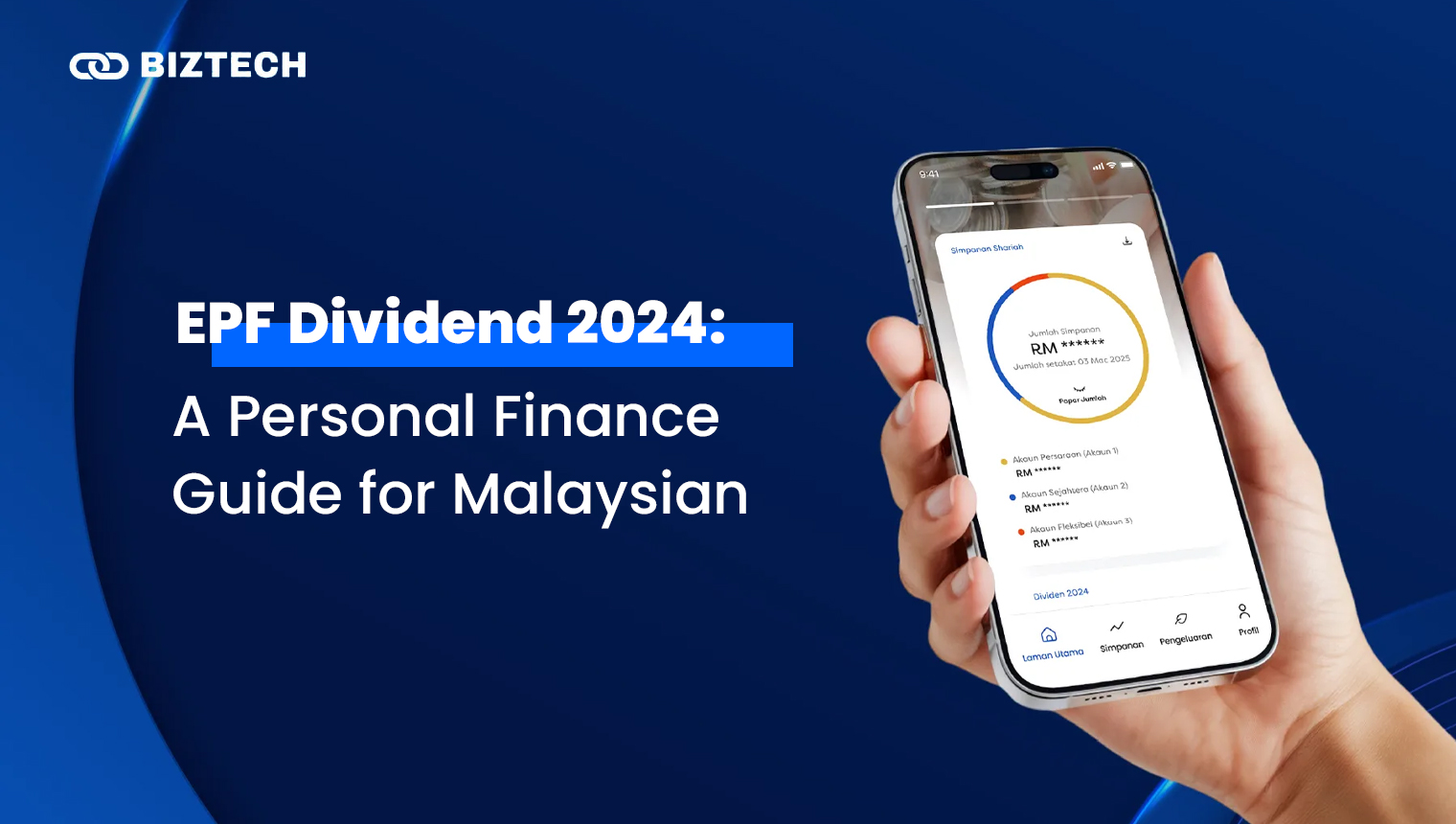
If you have been contributing to your EPF, then the dividend payout is one of those moments you wait for every year.
- EPF Dividend 2025 at a Glance
- What is a Dividend?
- Why Keeping Money in EPF Helps You Grow Financially
- Guaranteed Long-Term Savings
- Compound Growth Through Dividends
- Capital Protection, Steady Returns
- Tax Relief
- Housing, Education and Medical Withdrawals
- Peaceful Retirement
- Understanding the New 3-Account Structure
- How to Budget Your Salary While Saving with EPF
- Understand Your EPF Contribution
- Calculate Your Take-Home Pay
- Follow the 50/30/20 Rule
- Treat EPF as Retirement Savings, Not Emergency Cash
- Top Up Voluntarily If You Can
- Track Your Spending Monthly
- EPF Dividend 2025: What the 6.15% Really Tells Us
- A Record Income, a Slightly Lower Rate
- A Bigger, Stronger Fund
- Why It Dipped from 6.30%
- What It Means for You
- How to Calculate Your EPF Dividend
- How to Check Your EPF Dividend
- EPF vs Other Low-Risk Options: How to Choose
- Common Pitfalls to Avoid
- Frequently Asked Questions
- Conclusion
For 2025, the EPF declared a 6.15% dividend for both Simpanan Konvensional (Conventional) and Simpanan Shariah, announced on 28 February 2026 and credited to members’ accounts on 1 March 2026. That is slightly below the 6.30% paid for 2024 (the highest since 2017), but still a strong, government-linked return that comfortably beats most fixed deposits.
Does this make EPF one of the best places for Malaysians to grow their money? And how should the small dip from 6.30% to 6.15% change your plan, if at all? In this guide we break down what the rate means, how EPF dividends are calculated, how the new three-account structure affects you, and how to make EPF work harder as part of your overall financial plan.
Figures verified March 2026 against KWSP’s official announcement. Dividend rates change yearly — always confirm the latest rate in your i-Akaun or at kwsp.gov.my.
EPF Dividend 2025 at a Glance
| Item | Simpanan Konvensional | Simpanan Shariah |
|---|---|---|
| 2025 dividend rate | 6.15% | 6.15% |
| 2024 dividend rate | 6.30% | 6.30% |
| 2025 payout | RM67.1 billion | RM12.5 billion |
| Total 2025 distribution | RM79.6 billion | |
| Total distributable income | RM82.7 billion (up 9.5% from RM75.5b in 2024) | |
| Investment assets | RM1.41 trillion (up 12.8% from RM1.25t) | |
| Announced / credited | 28 Feb 2026 / 1 Mar 2026 | |
The headline takeaway: even after dipping by 0.15 percentage points, the 6.15% payout was supported by EPF’s highest-ever distributable income of RM82.7 billion. The lower rate reflects a larger membership base and a more cautious global investing environment, not weaker fund performance.
What is a Dividend?
A dividend is the portion of profit that an investment pays out to those who hold it. If you have RM10,000 sitting in a fund and it declares a 3% dividend at year-end, you earn RM300.
With EPF, the “fund” is your retirement savings, and the dividend is credited directly back into your account each year — where it then compounds. Because the dividend is added to your balance rather than paid out as cash, every ringgit you leave untouched keeps earning in the years that follow.
Why Keeping Money in EPF Helps You Grow Financially
Although EPF can feel like forced savings, it remains one of the most effective low-risk tools Malaysians have for building long-term wealth. Here is why.
Guaranteed Long-Term Savings
Automatic monthly deductions, combined with restrictions on early withdrawals, build a disciplined saving habit that is hard to replicate on your own. While EPF is built for retirement, parts of it can also support major milestones such as buying your first home or funding education.
Compound Growth Through Dividends
Compounding means earning returns not only on your original savings but also on the dividends already credited. With the 2025 dividend at 6.15%, money left in EPF keeps snowballing year after year — the single biggest reason not to dip into it early.
Capital Protection, Steady Returns
EPF dividends are guaranteed to be at least 2.50% per year by law, and the fund is government-backed. That makes it far less volatile than the stock market while still delivering returns well above a typical fixed deposit.
Tax Relief
If you pay income tax in Malaysia, EPF contributions qualify for up to RM4,000 in tax relief. Combined with life insurance or Takaful premiums, the EPF-plus-insurance relief can reach RM7,000 (RM4,000 EPF + RM3,000 insurance/Takaful).
Housing, Education and Medical Withdrawals
Even though most of your EPF is locked away, partial withdrawals are allowed for specific needs such as buying a home, financing education, or covering certain medical expenses.
Peaceful Retirement
Ultimately, EPF exists so you can retire with dignity — without leaning on others or scrambling for income later in life.
Understanding the New 3-Account Structure
Since the EPF account restructuring took effect, your savings are split across three accounts. Knowing how each one behaves is key to understanding where your 6.15% dividend lands and what you can actually touch.
| Account | Share of contribution | Purpose | Access |
|---|---|---|---|
| Akaun Persaraan | 75% | Core retirement nest egg | Locked until 55/withdrawal age |
| Akaun Sejahtera | 15% | Housing, healthcare, education | Conditional withdrawals |
| Akaun Fleksibel | 10% | Short-term flexible needs | Anytime, via the KWSP/MyKWSP app |
All three accounts earn the same annual dividend. The trade-off to understand: money you pull from Akaun Fleksibel stops compounding, so convenient access comes at the cost of long-term growth. Treat it as a last resort, not a spending wallet.
How to Budget Your Salary While Saving with EPF
With a 6.15% dividend on the table, growing your EPF balance is worthwhile. Here is how to budget around your contributions.
Understand Your EPF Contribution
Contributions are deducted automatically each month. Employees below 60 contribute 11% of wages, while employers contribute 13% for wages of RM5,000 and below, or 12% for wages above RM5,000. For most workers that is roughly 24% of salary flowing into retirement savings every month.
Calculate Your Take-Home Pay
Because the 11% employee share comes out of your gross salary, your spendable income is lower than your headline pay. For example:
RM6,000 monthly income − 11% EPF (RM660) = RM5,340 before any other deductions.
Budget around the RM5,340, not the RM6,000.
Follow the 50/30/20 Rule
A simple framework: 50% for needs (rent, utilities, transport), 30% for wants (leisure, travel), and 20% for savings — with roughly 10% going to EPF and another 10% to an emergency fund or other investments.
Treat EPF as Retirement Savings, Not Emergency Cash
The new Akaun Fleksibel makes withdrawals easier than ever, but easy access is a double-edged sword. Every ringgit you withdraw stops earning the 6.15% dividend and loses years of compounding. Build a separate emergency fund of 3–6 months of expenses so you never have to raid your retirement savings.
Top Up Voluntarily If You Can
You can contribute beyond the mandatory amount through voluntary top-ups such as i-Saraan (for the self-employed and gig workers) or self-contributions. Voluntary money earns the same dividend and enjoys the same capital protection and tax relief — a rare win-win for low-risk savers.
Track Your Spending Monthly
“If you fail to plan, you plan to fail.” Use a budgeting app to monitor expenses, plug money leaks, and free up cash for voluntary EPF top-ups or other goals.
EPF Dividend 2025: What the 6.15% Really Tells Us
A Record Income, a Slightly Lower Rate
It can seem contradictory that EPF earned more in 2025 yet paid a lower rate. The fund’s total distributable income hit a record RM82.7 billion (up 9.5% from RM75.5 billion in 2024), but it is spread across a larger pool of members and balances, so the percentage rate eased from 6.30% to 6.15%.
A Bigger, Stronger Fund
EPF’s investment assets grew to RM1.41 trillion in 2025, up 12.8% from RM1.25 trillion. A larger, well-diversified asset base across equities, fixed income, real estate and infrastructure is what lets EPF keep paying steady, above-FD returns through global ups and downs.
Why It Dipped from 6.30%
A softer domestic equity market and a more cautious global investing climate in 2025 trimmed returns at the margin. EPF also prioritises capital protection over chasing yield, which smooths out the rate but can cap the upside in any single year.
What It Means for You
A 0.15-point dip is normal year-to-year variation, not a warning sign. On a RM100,000 balance the difference between 6.30% and 6.15% is about RM150 a year. EPF remains one of the safest, most rewarding low-risk options in Malaysia — the right response is to keep contributing, not to withdraw.
How to Calculate Your EPF Dividend
EPF dividends are calculated on your monthly closing balance and compounded over the year. The basic monthly formula is:
Monthly dividend = (Month-end balance × annual dividend rate) ÷ 12
Add up all 12 months to get your annual dividend.
[su_box title=”Worked Example (2025 rate):” box_color=”#77001d” title_color=”#ffffff” radius=”10″]If your balance is RM50,000 held for the full year at 6.15%: RM50,000 × 6.15% = RM3,075 for the year, or about RM256 credited per month. A RM6,000 balance held all year would earn RM6,000 × 6.15% = RM369 a year (about RM30.75/month).[/su_box]
Points to remember:
- New contributions start earning dividends only from the month after they are credited.
- Withdrawals stop earning dividends from the month of withdrawal.
- The full annual dividend is credited once a year, usually in late February or early March.
How to Check Your EPF Dividend
The fastest way to see your 2025 dividend is through i-Akaun — either the KWSP/MyKWSP mobile app or the web portal at kwsp.gov.my. Log in, open your Member Statement, and select the 2025 financial year. Note that dividends announced in 2026 appear under the 2025 statement, not 2026. You can also print a statement at any EPF Self-Service Terminal (SST) nationwide. New to EPF? See our guide on how to check your EPF number.
EPF vs Other Low-Risk Options: How to Choose
EPF is excellent, but it should not be your only tool. Use this quick framework:
| If your goal is… | Consider | Why |
|---|---|---|
| Long-term retirement growth | EPF (and voluntary top-ups) | ~6% historical returns, tax relief, capital protected |
| Money you may need in 1–12 months | Fixed deposits / emergency fund | Liquid, predictable, no lock-in beyond the tenure |
| Starting to invest with a small sum | Starting with RM1,000 / low-risk funds | Builds the habit and diversifies beyond EPF |
| Broad capital-safe diversification | Other low-risk investments | Spreads risk across instruments |
A sensible approach for most people: let EPF do the heavy lifting for retirement, keep a 3–6 month emergency fund in cash or FDs, and add other investments once those foundations are in place.
Common Pitfalls to Avoid
- Withdrawing from Akaun Fleksibel for non-essentials. Convenient, but it permanently lowers your compounding base.
- Treating the dividend dip as a reason to stop contributing. 6.15% still beats most savings products in Malaysia.
- Forgetting the RM4,000 tax relief. If you are employed or self-employed and pay tax, make sure you claim it.
- Ignoring voluntary top-ups. Even a few hundred ringgit a month compounds into a meaningful sum over decades.
Frequently Asked Questions
Conclusion
The 6.15% EPF dividend for 2025 is a small step down from 2024’s 6.30%, but it sits on top of record distributable income and a fund that grew to RM1.41 trillion. For everyday Malaysians, the message is steady rather than dramatic: EPF remains one of the safest, most rewarding ways to build retirement savings. Keep contributing, resist the temptation to withdraw from Akaun Fleksibel, claim your tax relief, and pair EPF with an emergency fund and a little diversification — that is how you let the compounding do the work.
Sources for the 2025 figures include the EPF’s official announcement (KWSP), The Edge Malaysia, and data.gov.my.
Disclaimer: This article is provided by KayaToday for general information only and is not financial advice. Dividend rates, contribution rates and tax reliefs change over time — figures were verified in March 2026. Always confirm the latest details with EPF (KWSP) or a licensed financial adviser before making decisions.