Captivated by film photography’s grainy, nostalgic look and want to try it yourself? Choosing from the best film cameras for beginners is the first step — and in 2026 it matters more than ever, because the analog boom has pushed both camera and film prices up sharply.
- What is a film camera?
- Essential Factors to Consider of The Best Film Camera for Beginners
- Simplicity
- Camera type
- Controls
- Budget and running costs
- Availability and servicing
- Battery dependence
- 10 Best Film Cameras for Beginners Compared
- How to Choose the Best Film Camera for Beginners (A Simple Framework)
- Top 10 Film Cameras Best for Beginners
- 1. Nikon F3 – Capturing Art with Precision
- 2. Fujifilm GW690 – Mastery of The Medium Format
- 3. Pentax K1000 – Timeless Shots, with Classic Simplicity
- 4. Holga 135 – Lo-Fi Magic at Your Fingertips
- 5. Diana F+ – The Key to Dreamlike Art
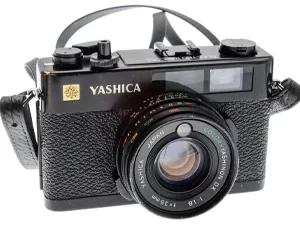
- 6. Yashica Electro 35CC – Elegance Meets Precision
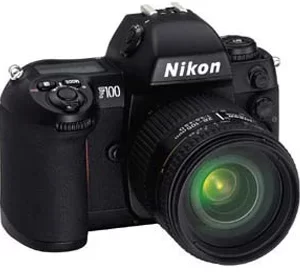
- 7. Nikon F100 – Elevating Photography Through Modern Mastery
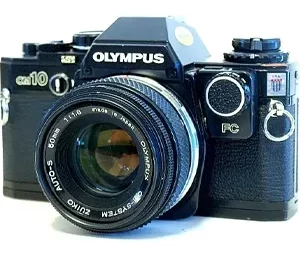
- 8. Olympus OM-10 FC – Compacted Brilliance
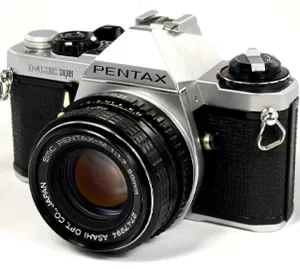
- 9. Pentax ME Super – Crafting Your Nostalgia, Creating Your Story
- 10. Yashica T4 – Timeless Quality, But Make It Pocket-Sized
- What It Really Costs to Shoot Film in 2026
- Common Beginner Mistakes to Avoid
- Prefer Something Brand-New? The Pentax 17
- Ventures Into Vintage Photography with The Best Film Camera for Beginners Now
- Frequently Asked Questions (FAQs)
I’ve tested, repaired, and shot with dozens of film bodies over the years, which has given me a keen eye for what actually holds up for a first-timer versus what just looks good in a shop window. Below, I’ll help you choose the right camera and avoid the money pits — so you can start your film photography journey without regret.
Film isn’t a fading fad anymore. Roughly 42 million people worldwide now shoot film, and about 35% of them are aged 18–30, while online searches for analog photography jumped 41% in a single year. PetaPixel even called 2024 “film’s best year in decades.” That demand is exactly why used bodies now sell for more than they did two years ago — and why buying smart is essential.
So, here is our updated 2026 top 10 list of the best film camera for beginners, followed by a plain-English framework for choosing and a realistic look at what shooting film actually costs today.
[su_box title=”Key Takeaways” box_color=”#000877″ title_color=”#ffffff” radius=”6″]
1. Film cameras use photographic film — not a memory card — to capture images, giving that distinctive analog look you can’t fully fake in editing.
2. When buying a beginner-friendly film camera, weigh four things: simplicity, camera type, manual controls, and — often overlooked — the ongoing cost of film and developing.
3. Our team’s final pick is still the Pentax K1000: fully mechanical, dead-simple, and widely serviceable. Expect roughly $75–$270 for a good used body in 2026 (mint or with a lens costs more).
4. Prefer buying brand-new instead of used? The Pentax 17 half-frame (launched 2024, ~$500) is the only fresh option from a major maker — we cover it below.
[/su_box]
What is a film camera?
Unlike modern, digitalized cameras, a film camera uses photographic film to capture images. An example would be a 35mm film camera, which is versatile and user-friendly.
There’s also a point-and-shoot camera with automatic settings for those who prefer simplicity and a medium format film camera, which helps capture more detail and nuances.
Essential Factors to Consider of The Best Film Camera for Beginners
Simplicity
Since you are just starting, it’s better if you take on a film camera that’s user-friendly and not too complicated to operate.
There are older cameras that might require more technical knowledge.
Starting off strong might not be so fun if you were to blindly choose a film camera that requires so much to use.
Camera type
The next factor to consider is the camera type you would like to start with.
Ranging from 35mm, rangefinder, medium format, and point-and-shoot cameras, the camera type that suits your goals and interests would be your best choice.
Capturing photographs that suit your aesthetic choice requires you to select the type that suits your own criteria.
Controls
Managing any camera requires you to understand basic manual controls.
So, starting off with easy-to-use cameras is recommended, but you still need to learn the settings. Find a camera with manual controls like aperture, shutter speed, and focus.
Learning to use and adjust the settings for your camera will improve your photography skills and enhance the type of photographs you can take.
Budget and running costs
The sticker price is only half the story. In 2026 a roll of colour film runs about $9–$18 (Kodak Gold 200 at the low end, Portra 400 at the high end), and lab develop-and-scan adds roughly $12–$20 per roll. That’s real money every time you finish 36 frames, so factor it in before you fall in love with a body. If a tight budget worries you, a cheaper camera paired with affordable film beats an expensive body you can’t afford to feed.
Availability and servicing
Every camera on this list is discontinued, so you’re buying used. Prices have climbed with demand, and condition varies wildly. Favour bodies from tested sellers — a reputable used dealer like KEH grades and warranties its stock — and budget for a possible CLA (clean, lubricate, adjust) on older mechanical cameras. Light seals and foam often need replacing on 30-to-50-year-old bodies.
Battery dependence
Fully mechanical cameras (like the Pentax K1000) fire at every shutter speed without a battery — only the meter needs one, so you can still shoot if it dies. Electronic bodies (the Yashica Electro 35, Pentax ME Super, and most point-and-shoots) are effectively bricks without a working battery, and a few rely on discontinued mercury cells that need adapters. Beginners who want zero fuss should lean mechanical.
10 Best Film Cameras for Beginners Compared
| Camera | Price | Types of Cameras | Film Types | Unique Features |
| Nikon F3 | $200 – $500 | 35mm Single-Lens Reflex (SLR) Camera | 35mm Film |
|
| Fujifilm GW690 | $500 | Medium Format Film Camera | 120 and 220 Roll Film (Medium Format) |
|
| Pentax K1000 | $75 – $270 | 35mm Single-Lens Reflex (SLR) Camera | 35mm Film |
|
| Holga 135 | $60 | 35mm Film Camera | 35mm Film |
|
| Diana F+ | $40 – $100 | Medium Format Film Camera | 120 Roll Film (Medium Format) |
|
| Yashica Electro 35CC | $50 – $150 | 35mm Rangefinder Camera | 35mm Film |
|
| Nikon F100 | $200 – $400 | 35mm Single-Lens Reflex (SLR) Camera | 35mm Film |
|
| Olympus OM-10 FC | $40 – $100 | 35mm Single-Lens Reflex (SLR) Camera | 35mm Film |
|
| Pentax ME Super | $160 | 35mm Single-Lens Reflex (SLR) Camera | 35mm Film |
|
| Yashica T4 | $300 – $600 | 35mm Compact Point-And-Shoot Camera | 35mm Film |
|
Note: the prices above are 2026 used-market estimates in USD and have risen sharply since 2023. Individual listings vary with condition — always confirm current prices on the platform you buy from (KEH, eBay, or Carousell/Shopee in Malaysia and Singapore). Verified July 2026.
How to Choose the Best Film Camera for Beginners (A Simple Framework)
Feeling overwhelmed by ten options? Work through these questions in order and the shortlist narrows fast.
| Your priority | Best fit | Why |
| Learn manual exposure | Pentax K1000, Pentax ME Super | Simple, mechanical-leaning SLRs that make aperture and shutter obvious |
| Point-and-shoot ease | Yashica T4, Yashica Electro 35CC | Auto exposure and sharp lenses — just load film and shoot |
| Cheapest way in | Holga 135, Diana F+, Olympus OM-10 FC | Lowest entry prices; the lo-fi look is a feature, not a flaw |
| Best image quality | Fujifilm GW690, Nikon F100, Nikon F3 | Medium format or pro-grade 35mm for maximum detail |
| Buy brand-new | Pentax 17 | The only current-production option from a major maker |
Worked example: Say you’re a student in Kuala Lumpur with about $150 to spend, you’ve never shot manual, and you want to actually understand exposure. Skip the tempting Yashica T4 (its cult status has pushed prices past $300) and buy a serviced Pentax K1000. Pair it with a few rolls of Kodak Gold 200, shoot slowly, and develop and scan at a local lab. You’ll learn faster on a mechanical camera than on any automatic one — and if film isn’t for you, a K1000 holds its resale value better than almost anything else here.
Top 10 Film Cameras Best for Beginners
1. Nikon F3 – Capturing Art with Precision
| Specs | |
| Exposure Control | The camera offers aperture-priority-automatic (A) and manual modes to accommodate and provide flexibility as your skill levels increase. |
| Metering System | The TTL center-weighted full-aperture metering system ensures accurate exposure control.
The metering range spans from EV 1 to 18 with ASA/ISO 100 film, and the film speed setting covers ASA/ISO 12 to 6,400, offering you versatility in different lighting conditions. |
| Shutter | The shutter can be adjusted to be automatic or manual.
While automatic, it ranges from 8 to 1/2,000 sec and provides flexibility in manual mode with 18 steps, including T (time), B (bulb), and X (1/80 sec). A backup manual release lever is also available if the battery is weak or dies. |
| DImension & Weight | It is approximately 148.5 x 96.5 x 65.5 mm and weighs 700g, providing a compact and manageable camera. |
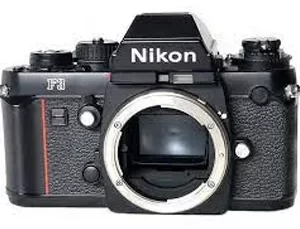
The Nikon F3 is a 35mm single-lens reflex (SLR) camera with a focal-plane shutter.
It is the best film camera for beginners who would like to learn the ropes, as it is a versatile, reliable, and customizable film camera that can be adjusted to suit your shooting style.
The blend of automatic and manual modes and its robust features make it a well-rounded choice for beginners.
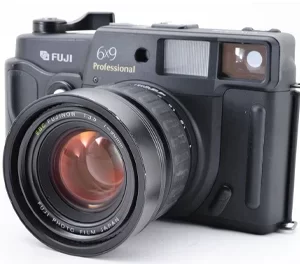
2. Fujifilm GW690 – Mastery of The Medium Format
| Specs | |
| Format & Picture Size | The camera captures images in a 6 x 9 cm (6 x 7 cm) format, with a picture size of 56 x 82.6 mm (56 x 68.5 mm).
It supports 120 half-length, 120, and 220 roll films. |
| Film Advance | The film advance lever is at the camera’s top, a 2-stroke advance mechanism.
The first stroke is 138, and the second depends on the film roll diameter. |
| Exposure | The exposure counter is automatic with a reset function and features double exposure prevention. |
| Shutter | The camera has a No. 0 interlens shutter with T, 1-1/1500 sec. shutter speeds, and X sync.
It includes a shutter release lock and provides a hot shoe and sync contact. |
| Lens | The lens is a fixed Fujinon 90mm, an F3.5 lens with 5 components and 5 elements suitable for everyday shots with a 1m nearest focusing distance.
It also has a wider Fujinon SW 65mm lens, an F5.6 lens with 4 components and 6 elements for broader shots. Both lenses feature protective hoods and are suitable for various distances and lighting. |
| Dimensions & Weight | The camera dimensions are 119 x 201 x 129 mm, weighing 1,460g.
The camera is slightly bigger and a tad hefty, but it is still a manageable choice for beginners. |
The Fujifilm GW690 is one of the best medium format film cameras for beginners with a large 6x9cm format, automatic exposure, non-interchangeable lenses, and a coupled range viewfinder for precision shots.
Its 6x9cm format offers a unique shooting experience.
Also, the straightforward design accommodates those starting their journey into film photography.
The manual control and accessibility to the setting allow you to steadily understand and provide a suitable platform to learn the world of medium format film.
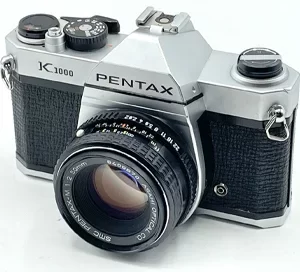
3. Pentax K1000 – Timeless Shots, with Classic Simplicity
| Specs | |
| Metering | Utilizes a center-weighted metering system, measuring lights in the central area of the frame with a range of 3-18 EVs. |
| Exposure | Primarily operates in Manual (M) mode, allowing full control over the exposure settings, and Bulb (B) mode for extended exposure settings.
The film sensitivity ranges from ISO 20 to 3200, but it does not have automatic ISO detection. |
| Shutter | Offers a versatile shutter speed range from 1/1000 sec for fast action to Bulb for extended exposures.
The camera relies on manual focus and features a 0.88x magnification Pentaprism viewfinder, providing a clear and bright field of view. |
| Dimension & Weight | The camera’s dimensions are 142 x 91.5 x 49 mm, weighing 620g. A compact and lightweight camera camera. |
The Pentax K1000 is a classic 35mm Single-lens Reflex (SLR) camera, widely known for its manual control simplicity.
It can shoot multiple exposures, enabling you to be creative in taking photographs.
Pentax K1000 is an iconic 35mm SLR, suitable for beginners like you to learn. The camera also offers manual exposure control, a simple design, and adaptable shutter speeds.
The classic look and basic features make it the best 35mm film camera for beginners in learning film photography.
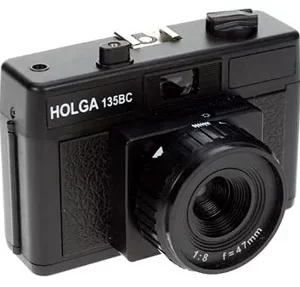
4. Holga 135 – Lo-Fi Magic at Your Fingertips
| Specs | |
| Lenses | You can switch between two lenses for different effects. The standard optical lens (55mm f/8) gives clear shots, while the pin-hole lens (o.25mm diameter, f/236) gives the vintage and dreamlike quality in the shot. |
| Shutter Speed | The shutter speed is fixed at 1/100 sec, ensuring consistent exposures.
Coupled with the adjustable focusing, it allows you to adapt to different situations, giving you some control over the clarity of the shots. |
| Film | The camera uses standard 135 format color or black/white film.
Beginners should start with ASA 400/ISO 27 speed film for the best results. You should expect panoramic shots as the Holga 135 has a frame size of 24 x 72 mm, giving the images a distinct and wider perspective. |
| Dimensions & Weight | The camera’s dimensions are 165 x 80 x 98 mm, weighing 235g.
It is a compact and lightweight camera, making it easy to carry and experiment on the go. |
A Holga 135 is the best film camera for beginners, known for its aesthetic and vintage quality that is difficult to replicate with other cameras.
The camera produces dreamlike quality, the nostalgic and scenic memory you’ll find in old albums and videos.
With its interchangeable lenses that offer different results, the Holga 135 is a camera known for producing unique, dreamlike panoramic shots.
The lack of complex functions on the camera, with the fixed shutter speed and adjustable focusing, makes it one of the best point-and-shoot film cameras for beginners due to its simplicity and depth in quality.
The lightweight and compact design of the camera makes it easy to carry and comfortable to use on the go.
(Read more about the best compact cameras for beginners.)
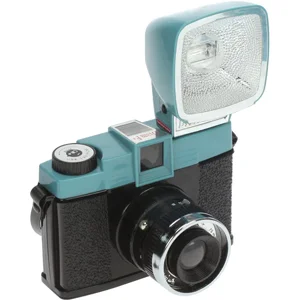
5. Diana F+ – The Key to Dreamlike Art
| Specs | |
| Film Format | The Diana F+ works with 120 films, which allows for larger and more detailed images. |
| Shutter Settings | The camera has two settings: one for regular daytime shots and “B” for long-exposure photographs.
The lens is removable, which turns the Diana F+ into a pin-hole camera that produces unique shots. Thus, you could expand your shooting and creative options with this camera. |
| Formats | It gives you various picture formats to choose from.
From 12-shot squares (52 x 52mm), 16-shot smaller squares (42 x 42mm), and panorama shots (46 x 46mm), the Diana F+ allows you some degree of freedom in creatively choosing your shot. |
| Dimensions | The dimensions of the Diana F+ are 125 x 95 x 76mm, making it a compact and easy camera to carry around. |
The Diana F+ is a sequel to the well-known Diana camera. The Diana F+ produces radiant, dreamlike photographs on 120 films.
Despite being similar in design and quality, The Diana F+ allows you to take pin-hole photos and is compatible with an entire line of accessories.
Its compact and versatile design makes it the best film camera for beginners.
Besides, the various film formats and two shutter settings allow you to experiment with your shots and capture the unique shots that suit your aesthetic.
6. Yashica Electro 35CC – Elegance Meets Precision
| Specs | |
| Lens | Equipped with a COLOR-YASHINON DX 35mm lens that provides clear images and stops down to f/16. |
| Shutter | Features an electronic shutter with adjustable speeds for various lighting conditions.
When using flash, the shutter speed is set at 1/30 sec, with a self-timer included and sync for external flash. It includes a fold-away crank handle for easy film rewinding and a hot shoe for flash attachment. |
| Exposure Control | The fully automatic exposure setting is adjusted by IC brain control that controls the electronic shutter according to the light intensity measured by its sensor.
The IC will warn you against over-exposure or slow shutter speed. It also supports ASA range from 25 to 500 for different film speeds and an automatic resetting exposure counter. |
| DImenions and Weight | The camera’s dimensions are 120 x 74 x 59mm, weighing 550 grams, making it easily portable and sturdy. |
A classic 35mm film camera known for its simplicity and reliability, the Yashica Electro 35CC is equipped with a COLOR-YASHINON DX 35mm lens that offers vibrant images and various other features.
It is user-friendly and one of the best 35mm film cameras designed for beginners.
Featuring a versatile 35mm lens, an electronic shutter for various lighting conditions, and automatic exposure control for easy shooting.
The viewfinder provides clear visuals, and the indicators help prevent overexposure or slow shutter speed.
With simple film handling, a compact design, and additional features like a self-timer and flash compatibility, the camera is an excellent choice.
7. Nikon F100 – Elevating Photography Through Modern Mastery
| Specs | |
| Metering System | The camera employs a TTL full-aperture exposure metering system.
It features three metering systems: 3D matrix metering, center-weighted metering, and spot metering. |
| Usable Lens | Compatible with AF, AF-I, and AF-S NIKKOR lenses for full AF and metering operation.
The AI-P lenses provide manual focus with an electronic rangefinder and full metering. AI lenses offer manual focus with aperture priority and manual exposure modes to support Center-Weighted and Spot metering. |
| Film Advance | Automatic advance with a built-in motor; offers Single-frame advance (S), Continuous shooting (C), and Continuous silent low-speed shooting (Cs) modes. |
| Shooting Modes | The camera provides various shooting modes, including Programmed Auto (with Flexible Program), Shutter priority, Aperture Priority, and Manual for creative control.
It also utilizes TTL phase detection with the Nikon Multi-CAM 1300 autofocus module. |
| Flash | Supports different flash modes such as Front-Curtain Sync (normal sync), Red-Eye Reduction, Red-Eye Reduction with Slow Sync, Slow Sync and Rear-Curtain Sync. |
The Nikon F100 is a versatile 35mm film camera renowned for its advanced features and user-friendly design.
With the advanced TTL full-aperture exposure metering system and compatibility with a diverse range of NIKKOR lenses, the camera is suitable for both beginners and enthusiasts alike.
The Nikon F100 offers a range of shooting options for beginners.
The versatile metering system that provides accurate exposures and compatibility with various NIKKOR lenses allows you to explore your creativity.
The camera is very reliable and user-friendly and features autofocus, multiple shooting modes, and flash options.
Utilizing both automatic and manual shooting preferences, the F100 is the best film camera for beginners to start their photography journey and improve their creativity in photography.
8. Olympus OM-10 FC – Compacted Brilliance
| Specs | |
| Camera Type | A 35mm single-lens reflex camera featuring electronic control for automatic exposure and a focal plane shutter.
Capturing images in the standard 24 x 36mm format. |
| Shutter | The camera utilizes an electronically controlled focal plane shutter for precise exposure control. |
| Automatic Exposure Control | It operates with aperture priority and an electronically controlled shutter, using a TTL direct measuring system.
The light measuring range spans from EV-0.5 to 18, offering flexibility from 2 to 1/1000 sec at normal temperatures and humidity. Featuring ASA 100 and an F1.2 standard lens, the automatic flash exposure is carefully integrated and automatically set to X sync (1/60 sec) when paired with the electronic flash T20. |
| Manual Exposure Control | The OM-10 provides manual control with a shutter speed dial, offering a full range of 11 manual shutter speeds, which extends up to 1/1000 sec.
A manual shutter speed of 1/30 sec is recommended for non-OM flash units. |
| Film Advance | Utilizing a lever-type mechanism and featuring a 130-degree angle, it can be wound with one long or several short strokes.
The 30-degree pre-advance angle enhances efficiency, and power winding is also possible with the Olympus OM system Winder 2. The camera also features a self-timer with a 12-second delay, which adds versatility in taking photographs. |
| Dimensions & Weight | The camera’s dimensions are 135 x 84 x 50mm, weighing 430g. |
The Olympus OM-10 FC is one of many other Olympus OM series of 35mm film cameras well-known for their compact design, advanced features, and exceptional optics.
The brand is renowned for creating compact and reliable imaging products. They continue to offer diverse camera options that mix cutting-edge and user-friendly design.
The Olympus OM-10 FC is a reliable choice for beginners to try their hand at film photography. The compact and lightweight design makes it easy to carry around, and the electronic control with automatic exposure ensures that you can easily take your photographs.
Featuring a user-friendly lever-type film advance and an electronic self-timer, capturing moments becomes simple and fun.
The mix of advanced features yet simplicity makes it the best film camera for beginners.
9. Pentax ME Super – Crafting Your Nostalgia, Creating Your Story
| Specs | |
| Camera Type | 35mm SLR camera with aperture-priority automatic exposure, electronic manual, and auto flash sync (with AF 2005 and AF 160 Units).
The camera utilizes various lenses: SMC Pentax 50mm f/1.2, SMC Pentax-M 50mm f/1.4, and SMC Pentax-M 50mm f/2. |
| Shutter | Utilizing Seiko MFC-E2 vertical-run metal focal plane shutter with automatic shutter speeds electronically controlled between 4 and 1/2000 sec.
The camera has an electronic manual shutter speed at 14 viewfinder settings, plus mechanical settings of 125X and 8. There is also a self-timer that delays the shutter release by 4-10 seconds to add to your creativity in taking photos. |
| Exposure | An open aperture, center-weighted through-the-lens light metering by GPD cells.
Exposure ranges from EV1 – EV19 (ASA 100 with 50mm f/1.4 lens). The film speed range is ASA 12 – 1600, and a 3-color LED shutter-speed readout is in the viewfinder. There are also various LEDs for camera shake warnings, exposure warnings, and auto flash readiness. |
| FIlm Advance | Single-stroke, rapid wind lever, plastic-tipped for winding comfort.135-degree throw with a 30-degree standoff angle and can rewind via film rewind crack. |
| Dimensions & Weight | The dimensions for the camera are 131.5 x 83 x 49.5mm, weighing 445g. |
The Pentax ME Super is a noteworthy camera among the ones listed here. It’s a 35mm SLR camera that blends advanced features with a user-friendly design.
Featuring aperture-priority automatic exposure, electronic manual control, and auto flash synchronization, the camera caters to both beginners and enthusiasts alike.
The Pentax ME Super is a lightweight 35mm SLR camera catering to beginners and enthusiasts.
With automatic aperture-priority and manual exposure modes, it strikes a balanced mix of ease of use and creative control. The compact design allows portability, and the LED indicators on the camera help simplify any adjustments and improve your experience in taking shots.
The camera’s compatibility with various lenses allows versatility and room for creative growth for beginners to learn and experiment with photograph-taking.
10. Yashica T4 – Timeless Quality, But Make It Pocket-Sized
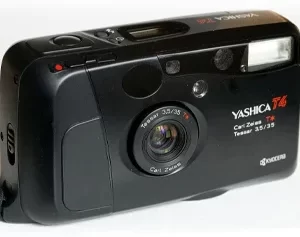
| Specs | |
| Type | 35mm lens shutter auto-focus AE camera with a built-in flash. Displaying a picture size of 24 x 36mm. |
| Lens | Carl Zeiss Tessar T 35mm F3.5 (4 elements in 3 groups). With a programmed electronic shutter. |
| Exposure | Programmed AE ensures well-lit photos without manual adjustments and automatically adjusts for backlighting, enhancing exposure in challenging lighting conditions. |
| Metering Range | Auto flash mode and red-eye reduction auto flash mode: EV9.5 (F3.5, 1/60 sec) – EV 17 (F15.5, 1/700 sec).
Flash-IN mode, Flash Mode, Landscape mode: EV3.5 (F3.5, 1 sec)- EV 17 (F15.5, 1/700 sec). Utilizing an external metering system with dual SPD element and automatic backlight compensation. |
| Film Speed | Automatic setting (DC method).
It’s linked in the range ISO 50 – ISO 3200 (for each step) and automatically set to ISO 100 with DX films outside ISO 50 – 3200 range and non-DX films. |
| Self-Timer | Electronic timer function (ten seconds), with a flashing LED indicator and cancel function. |
| Dimension and Weight | 118 x 64.5 x 39.5mm, weighing 200g. making it lightweight whilst featuring weatherproof construction to provide durability in various shooting scenarios. |
The Yashica T4 is one of the best examples of simplicity meets sophistication in the world of 35mm film cameras.
The compact camera features a Carl Zeiss Tessar Lens, an intuitive programmed electronic shutter, and an automatic exposure system.
This reliable and capable camera is noteworthy in accompanying beginners in learning and experimenting with film photography.
Some would argue that Yashica T4 is the best 35mm film camera for beginners. The 35mm lens, featuring a Carl Zeiss Tessar, makes your shots sharp and vibrant.
The programmed electronic shutter and automatic exposure make photography hassle-free and simple for beginners to understand the basics. The Yashica T4 is highly recommended for you to try when you’re just starting your trip down the photography world.
What It Really Costs to Shoot Film in 2026
The camera is a one-time cost; film and developing are forever. Here’s a realistic per-roll breakdown for a 36-exposure roll:
| Item | Typical 2026 cost (USD) | Rough cost in Malaysia (RM) |
| Colour film (per 36-exp roll) | $9 – $18 | RM40 – RM80 |
| Develop + scan (per roll) | $12 – $20 | RM25 – RM50 |
| All-in, per photo | ~$0.60 – $1.00 | ~RM2 – RM4 |
US film prices rose roughly 9% between early 2025 and 2026, so budget conservatively. The Malaysian and Singaporean figures are estimates — confirm with your local lab, as develop-and-scan pricing varies between shops in KL, Penang, and Singapore. The takeaway: film rewards shooting deliberately. Thirty-six considered frames teach you more than 3,000 casual digital snaps.
Common Beginner Mistakes to Avoid
Save yourself money and heartbreak by sidestepping these traps:
- Buying untested “as-is” bargains. A $40 body listed as “shutter fires” but with no meter or seal check often costs more to fix than a graded copy. Buy tested.
- Ignoring light seals. Crumbling foam causes light leaks on old cameras. A cheap seal kit or a quick CLA solves it.
- Chasing hyped point-and-shoots. The Yashica T4 is excellent, but so is a $60 Olympus that takes the same film. You’re often paying for social-media fame, not image quality.
- Forgetting the battery type. Some meters need discontinued mercury cells. Check before you buy, or choose a fully mechanical body.
- Loading film in bright sun. Load and unload in shade to avoid fogging the first and last frames.
Prefer Something Brand-New? The Pentax 17
Every camera above is used — but if you’d rather have a warranty and no servicing worries, the Pentax 17 is worth knowing about. Launched in June 2024 at around $500, it’s the first all-new film camera from a major manufacturer in roughly two decades. It’s a half-frame 35mm compact, so a 36-exposure roll gives you 72 shots — nearly halving your per-photo film cost, a real advantage now that film is pricey. It sold better than Ricoh expected, a clear sign the analog revival has legs. For beginners who want reliability over vintage character, it’s the safest new-in-box entry point.
Still weighing film against digital? It’s worth comparing with our guides to the best DSLR cameras for beginners and the best mirrorless cameras for beginners before you commit.
Ventures Into Vintage Photography with The Best Film Camera for Beginners Now
There you go with our top 10 list of the best film camera for beginners.
Depending on your requirements, intentions, and budget, your choice will be different from the others. However, our team has come to the conclusion that Pentax K1000 is our final top pick.
For its price range, the features the camera is equipped with are simply unparalleled.
Besides, its design is simplistic (perfect for beginners) and old-school looking (perfect for lovers of everything vintage).
However, if you are not a fan, you can check out our article on the other 5 categories of the best camera for beginners.
Frequently Asked Questions (FAQs)
Prices and availability verified July 2026 and can change quickly in the current market — always confirm the latest figures with the seller or your local lab before buying.
Disclaimer: This guide is provided by KayaToday for general informational purposes only. Camera and film prices fluctuate; please do your own checks before purchasing.