Are you looking to get into photography and want to buy your first camera? With so many options out there, it can be overwhelming trying to decide which is the best camera for beginners.
- What’s Changed for 2026
- How to Choose the Best Camera for Beginners
- The Best Cameras for Beginners in 2026 – Compared
- Best Mirrorless Camera For Beginners
- Fujifilm X-T200 (classic – now used only)
- Canon EOS M50 (classic – now used only)
- 2026 pick: Canon EOS R50 vs Nikon Z50 II
- Best DSLR Camera For Beginners
- Canon EOS Rebel SL3 / EOS 250D
- Nikon D3500 (discontinued – used only)
- Best Film Camera For Beginners
- Canon AE-1
- Pentax 17 (best new film camera) & Nikon EM (classic used)
- Best Video / Vlogging Camera For Beginners
- DJI Osmo Pocket 3 (2026 top vlogging pick)
- Sony ZV-1 (classic vlogging compact)
- Panasonic HC-X2000 (pro camcorder option)
- Best Compact Camera For Beginners
- Sony RX100 VII
- Panasonic Lumix ZS100 (value zoom compact)
- Worked Example: Building Your First Kit on a RM3,000 Budget
- Common Beginner Pitfalls to Avoid
- Start Your Photography Journey With The Best Camera for Beginners
- Frequently Asked Questions (FAQs)
Our camera experts have tested and evaluated the top beginner-friendly cameras across 5 major categories to help you find the perfect fit. In this guide, we’ll cover everything you need to know – fully refreshed for 2026, with current models, prices, and which older favourites are now discontinued – so you can choose the best camera to start your photography journey.
Key Takeaways (2026):
1. Weigh budget, type, features, size & weight, and lens ecosystem before buying – the “right” first camera is the one that matches how you actually shoot.
2. 5 beginner categories: mirrorless, DSLR, film, video/vlogging, and compact.
3. Best mirrorless for beginners in 2026: Canon EOS R50 (easiest to learn) & Nikon Z50 II (best autofocus).
4. Best DSLR route in 2026: Canon EOS Rebel SL3 / 250D (last widely-available new DSLR) & the Nikon D3500 used – DSLRs are now a used/clearance market.
5. Best film for beginners: Pentax K1000 (classic manual SLR, used) & the brand-new Pentax 17 half-frame if you want something new-in-box.
6. Best video/vlogging: DJI Osmo Pocket 3 (pocket gimbal) & Sony ZV-E10 II (grows into a full system).
7. Best compact: Sony RX100 VII (zoom flexibility) & the new Ricoh GR IV (pocketable APS-C).
What’s Changed for 2026
The beginner-camera landscape has shifted a lot since this guide first ran. Here’s what matters now:
- DSLRs are winding down. Canon and Nikon have effectively stopped developing new consumer DSLRs and moved entirely to mirrorless. Long-time favourites like the Nikon D3500 and Canon EOS M50 (EF-M mount) are discontinued – you’ll mostly find them used or as remaining stock.
- Mirrorless is the default first camera. The Canon EOS R50 and Nikon Z50 II have replaced the older EOS M50 / X-T200 as the go-to APS-C beginner bodies, with far better autofocus and subject tracking.
- Vlogging went pocket-sized. The DJI Osmo Pocket 3 (built-in gimbal, 1″ sensor) has become the default creator pick, and the Sony ZV-E10 II replaced the original ZV-1 / ZV-E10 for those wanting interchangeable lenses.
- Film is booming again. Demand for used SLRs like the Pentax K1000 and Canon AE-1 keeps pushing prices up, and Ricoh even launched a brand-new film camera, the Pentax 17 (~$500), in 2024.
- Premium compacts are hot – and pricey. The Sony RX100 VII and the pocketable APS-C Ricoh GR line stay in demand, so bargains are rare.
Prices below were verified in July 2026 and are approximate street/kit prices in USD; always confirm the latest price and stock with the retailer, as camera pricing moves quickly. Malaysian ringgit (RM) figures are rough conversions for guidance only.
How to Choose the Best Camera for Beginners
When buying your first camera, work through these five factors in order – they’ll narrow the field fast:
- Budget – Set a number and stick to it. Beginner bodies (or kits) generally run about $380 to $1,000 (roughly RM1,800–RM4,700). Remember to leave room for a memory card, spare battery, and a bag.
- Type – The five main types are mirrorless, DSLR, film, video/vlogging, and compact. Each has clear trade-offs (see below).
- Features – Don’t chase megapixels. For beginners, autofocus quality (subject/eye tracking), in-body or lens stabilisation, and a flip-out screen matter far more than a big MP number.
- Size & Weight – The best camera is the one you’ll actually carry. If you travel a lot, lean compact or mirrorless over a bulky DSLR.
- Lenses & ecosystem – A body is a long-term commitment to a lens mount. Check that affordable lenses exist for the system before you buy – this is where DSLR mounts (now shrinking) and abandoned mounts like Canon EF-M lose out to current mirrorless mounts (Canon RF, Nikon Z, Sony E).
A quick decision shortcut: want the easiest all-rounder? Get a mirrorless (R50 or Z50 II). Mostly filming yourself? Get the Osmo Pocket 3 or ZV-E10 II. Want to slow down and learn the craft? Try a film SLR. Want something that disappears into a pocket? Go compact.
The Best Cameras for Beginners in 2026 – Compared
Our current top pick in each category, with approximate July 2026 prices and status:
| Camera | Category | Approx. Price (USD) | 2026 Status | Best For |
|---|---|---|---|---|
| Canon EOS R50 | Mirrorless | ~$679 (kit) | Current | Easiest to learn; guided menus |
| Nikon Z50 II | Mirrorless | ~$909 (body) | Current | Best-in-class autofocus/tracking |
| Sony ZV-E10 II | Video / hybrid | ~$999 (body) | Current | Vloggers who’ll add lenses |
| DJI Osmo Pocket 3 | Video / vlogging | ~$439–529 | Current | Pocketable, stabilised vlogging |
| Canon EOS Rebel SL3 / 250D | DSLR | ~$650–750 | Last new DSLRs / clearance | Optical viewfinder fans |
| Nikon D3500 | DSLR | ~$300–450 (used) | Discontinued – used only | Cheapest DSLR entry |
| Sony RX100 VII | Compact | ~$1,300–1,500 | Current (premium) | Zoom flexibility in a pocket |
| Ricoh GR IV | Compact | ~$1,000+ | Current (2026) | APS-C quality, jeans-pocket size |
| Pentax K1000 | Film | ~$150–270 (used) | Used classic | Learning full-manual film |
| Pentax 17 | Film | ~$500 (new) | Current (new) | Buying a brand-new film camera |
Below, we break down each category with our 2026 picks – and keep the classic models many beginners still buy used.
Best Mirrorless Camera For Beginners
Mirrorless cameras are now the default first “proper” camera. They offer an excellent middle-ground between pocket compacts and heavy DSLRs – high-quality images, interchangeable lenses, and modern autofocus, all in a portable body.
2026 picks: The older Fujifilm X-T200 and Canon EOS M50 below are now discontinued (Canon has retired the EF-M mount entirely), so we no longer recommend buying them new. Today the two best beginner mirrorless cameras are the Canon EOS R50 (~$679 kit) for the friendliest learning experience, and the Nikon Z50 II (~$909 body) for the best autofocus and subject tracking in the class. Both use current, growing lens mounts (Canon RF-S and Nikon Z), so you can add lenses for years to come. For the full rundown, see our guide to the 10 best mirrorless cameras for beginners.
Fujifilm X-T200 (classic – now used only)
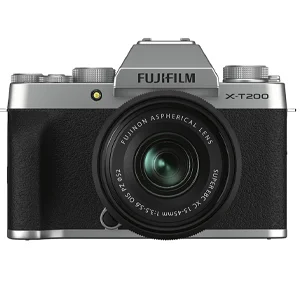
The Fujifilm X-T200 was a superb first mirrorless camera and is still a bargain on the used market. It combines great image quality with intuitive, dial-led design.
The X-T200 has a 24.2-megapixel APS-C sensor, a wide ISO range of 100–51,200 (expandable to 204,800), and a 425-point phase-detection autofocus system. It shoots 4K video up to 30fps and has a fully articulating touchscreen – handy for selfies and vlogging.
2026 note: discontinued. If you want a new Fujifilm today, look at the X-M5; otherwise a clean used X-T200 remains a great value learner.
Specs
| Feature | Specification |
| Lens | Fujifilm X-mount |
| Sensor Size | APS-C |
| Megapixels | 24.2MP |
| ISO Range | 100-51200 (expandable to 204800) |
| Video Resolution | 4K 30fps |
| Shutter Speed | 30s to 1/4000s |
Canon EOS M50 (classic – now used only)
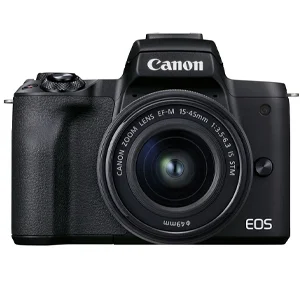
The Canon EOS M50 was one of the most popular beginner mirrorless cameras ever, thanks to its 24.1MP APS-C sensor, excellent Dual Pixel autofocus, vari-angle touchscreen, and vlogger-friendly design.
2026 note: the M50 uses Canon’s discontinued EF-M mount, which has no future lenses. For a new Canon, buy the EOS R50 instead (RF-S mount) – it’s the direct spiritual successor and our current top beginner pick.
Specs
| Feature | Specification |
| Lens | Canon EF-M mount |
| Sensor Size | APS-C |
| Megapixels | 24.1MP |
| ISO Range | 100-25600 (expandable to 51200) |
| Video Resolution | 4K 24fps |
| Shutter Speed | 1/4000 to 30 sec |
| Connectivity | WiFi, Bluetooth |
2026 pick: Canon EOS R50 vs Nikon Z50 II
| Camera | Canon EOS R50 | Nikon Z50 II |
|---|---|---|
| Approx. Price | ~$679 (kit) | ~$909 (body) |
| Sensor | 24.2MP APS-C | 20.9MP APS-C |
| Autofocus | Dual Pixel CMOS AF II, subject detect | Expeed 7, 3D tracking, 9-category detect |
| Video | 4K up to 30p (uncropped) | 4K up to 30p (oversampled) |
| Screen | Vari-angle touchscreen | Vari-angle touchscreen |
| Best for | Easiest learning curve, lightest body | Fast-moving subjects, low light |
Choose the R50 if you value a gentle learning curve, plain-English guided modes, and the lightest kit. Choose the Z50 II if you shoot kids, pets, or sports and want flagship-grade autofocus that rarely misses. You genuinely can’t go wrong with either.
(Read more about the 10 best mirrorless cameras for beginners.)
Best DSLR Camera For Beginners
DSLRs still deliver excellent image quality, huge lens libraries, and an optical viewfinder that shows the scene with zero lag. The catch in 2026: DSLRs are a sunset technology. Canon and Nikon have both stopped developing new consumer DSLRs, so this is now largely a used and clearance market. That’s not all bad – it makes some capable bodies very cheap.
2026 reality: The Canon EOS Rebel SL3 / 250D is one of the last beginner DSLRs you can still occasionally find new, while the excellent Nikon D3500 is now discontinued and sold used. If you specifically want the optical-viewfinder DSLR experience, buy a good used body and put your money into lenses. Otherwise, a mirrorless camera (above) is the more future-proof choice. See our full 10 best DSLR cameras for beginners guide for the used-buying checklist.
Canon EOS Rebel SL3 / EOS 250D
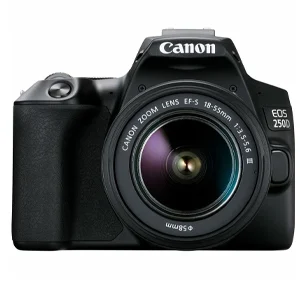
The Canon EOS Rebel SL3 (EOS 250D outside North America) remains our top DSLR pick for beginners thanks to its compact body, 24.2MP APS-C sensor, friendly guided interface, and fully articulating touchscreen. It shoots 4K at 24fps and includes Wi-Fi and Bluetooth.
2026 note: one of the last new-buyable beginner DSLRs – but stock is drying up. If you can only find it used, that’s fine; just check the shutter count.
Specs
| Feature | Specification |
| Lens | Canon EF-S mount |
| Sensor Size | APS-C |
| Megapixels | 24.2MP |
| ISO Range | 100-25600 (expandable to 51200) |
| Video Resolution | 4K 24fps |
| Shutter Speed | 1/4000 to 30 sec |
| Connectivity | WiFi, Bluetooth |
Nikon D3500 (discontinued – used only)
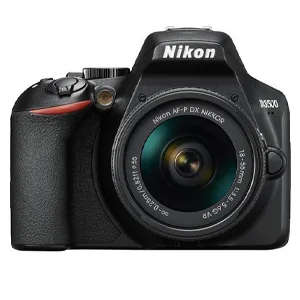
The Nikon D3500 is still the value king of entry-level DSLRs: a 24MP DX sensor, a beginner-friendly Guide Mode, and a class-leading ~1,550-shot battery life. It’s light, simple, and produces lovely images.
2026 note: officially discontinued and available used only (typically ~$300–450 with a kit lens). If you find a clean copy, it’s one of the cheapest ways into “real camera” photography – just know you’re buying into a lens mount Nikon is winding down.
Specs
| Feature | Specification |
| Lens | Nikon F mount |
| Sensor Size | APS-C |
| Megapixels | 24MP |
| ISO Range | 100-25600 (expandable to 51200) |
| Video Resolution | 1080p 60fps |
| Shutter Speed | 1/4000 to 30 sec |
| Connectivity | None |
(Read more about the 10 best DSLR cameras for beginners.)
Best Film Camera For Beginners
Film photography is having a genuine revival – and shooting film is a fantastic way to learn the fundamentals, because every frame costs money and makes you slow down. In 2026 you have two good routes: buy a proven used SLR, or buy the one brand-new film camera aimed at beginners.
2026 note on prices: the film boom has pushed used prices up. A Pentax K1000 or Canon AE-1 now typically runs ~$150–270 depending on condition – more than a few years ago. If you’d rather buy new with a warranty, the Pentax 17 half-frame (~$500, launched 2024) is the first new-design film camera in years. Budget for film and developing too (see the worked example below). For a deeper list, see our 10 best film cameras for beginners.
Canon AE-1
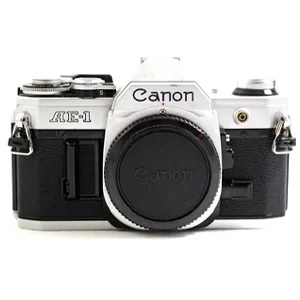
The Canon AE-1 is arguably the most popular 35mm film SLR ever made. First released in 1976, it delivers full manual control plus aperture-priority auto-exposure, with an abundance of cheap used FD-mount lenses.
It feels great in the hand and teaches the exact fundamentals – aperture, shutter, ISO, focus – that transfer straight to any digital camera later.
2026 note: still widely available used, now ~$150–270 with a 50mm lens; have any bargain copy checked for a working light meter and clean shutter.
Specs
| Feature | Specification |
| Lens | Canon FD mount |
| Sensor Size | 35mm film |
| Megapixels | N/A (film) |
| ISO Range | 12-3200 |
| Video Resolution | N/A (film camera) |
| Shutter Speed | 2s – 1/1000s |
| Connectivity | None |
Pentax 17 (best new film camera) & Nikon EM (classic used)
If you’d rather buy new than hunt for a used body, the Pentax 17 (~$500) is the standout 2026 option. It’s a half-frame 35mm camera with a 25mm f/3.5 lens that captures two vertical shots per frame – up to 72 exposures per roll – so it stretches your film budget further. Zone focusing and simple controls make it beginner-friendly, and it’s new-in-box with a warranty.
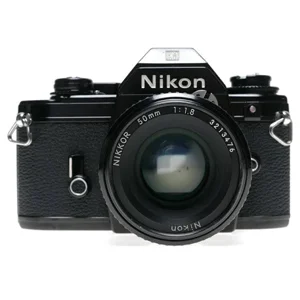
Prefer a classic on a tight budget? The Nikon EM (1979) is an ultra-compact, shutter-priority SLR that’s dead simple to shoot – a fun, cheap way to try 35mm if you find a working copy.
Specs (Nikon EM)
| Feature | Specification |
| Lens | Nikon F mount |
| Sensor Size | 35mm film |
| Megapixels | N/A (film) |
| ISO Range | 25-1600 |
| Video Resolution | N/A (film camera) |
| Shutter Speed | 1/1000s – 1s |
| Connectivity | None |
(Read more about the 10 best film cameras for beginners.)
Best Video / Vlogging Camera For Beginners
Shooting mostly video? A vlogging-focused camera gives you smoother footage, better built-in audio, and self-facing screens that dedicated stills cameras often lack. In 2026 the beginner video space is dominated by two very different tools.
2026 picks: For the simplest, most portable option, the DJI Osmo Pocket 3 (~$439–529) packs a 1″ sensor and a built-in 3-axis gimbal into something that fits in a jacket pocket – it’s the creator community’s default. If you want a camera that grows with you, the Sony ZV-E10 II (~$999) adds interchangeable lenses, great 4K, and Sony’s excellent autofocus. Both have replaced the older Sony ZV-1 below. The pro Panasonic HC-X2000 camcorder remains overkill for most beginners. See our 10 best video cameras for beginners for more.
DJI Osmo Pocket 3 (2026 top vlogging pick)
The DJI Osmo Pocket 3 is the camera we’d hand most new vloggers first. A 1-inch sensor delivers clean 4K footage, and the built-in mechanical gimbal keeps everything buttery-smooth even while walking – something you simply can’t get from a phone or a bare compact. Face-tracking keeps you centred, and the flip screen makes framing yourself easy. The Creator Combo (~$549) adds a wireless mic and grip that most people end up buying anyway.
Why it beats the old ZV-1 for beginners: the in-body gimbal removes the single biggest cause of amateur-looking video – shaky footage – with zero learning curve.
Sony ZV-1 (classic vlogging compact)
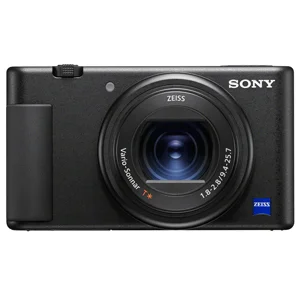
The Sony ZV-1 packed excellent 4K, a large 1″ sensor, a side-flip touchscreen, and a strong directional mic into a pocket body – a brilliant vlogging compact in its day.
2026 note: superseded by the Sony ZV-1 II (wider zoom) and, for interchangeable lenses, the ZV-E10 II. The original ZV-1 is still a fine used buy, but new beginners are better served by the Osmo Pocket 3 or ZV-E10 II.
Specs
| Feature | Specification |
| Lens | ZEISS® Vario-Sonnar® T* Lens |
| Sensor Size | 1″ |
| Megapixels | 20.1 MP (stills), 19.7 MP (video) |
| ISO Range | 100-12800 (expandable to 51200) |
| Video Resolution | 4K (3840×2160) at 30p |
| Shutter Speed | 1/4000s – 30s |
| Connectivity | Wi-Fi, Bluetooth, USB-C |
Panasonic HC-X2000 (pro camcorder option)
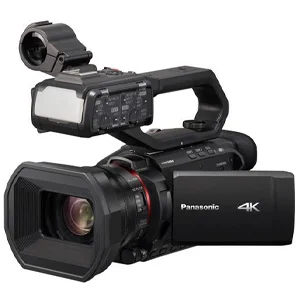
The Panasonic HC-X2000 is a fixed-lens pro camcorder with UHD 4K/60p, a 24x Leica zoom, twin manual lens rings, ND filters, and XLR audio inputs. It’s superb for event, wedding, and run-and-gun video work – but it’s more camera (and cost) than most beginners need. Consider it only if you already know you want a dedicated video rig.
(Read more about the 10 best video cameras for beginners.)
Best Compact Camera For Beginners
Want maximum portability without giving up image quality? Premium compacts slip into a pocket yet shoot far better than a phone in tricky light. Demand for these has surged, so prices are high and stock can be tight.
2026 picks: The Sony RX100 VII stays our pick when you want a versatile 24–200mm zoom in a pocket, while the new Ricoh GR IV is the one to beat for pure image quality – an APS-C sensor in a body that fits in jeans. The older Panasonic Lumix ZS100 below is now largely a used option. Full list: our 10 best compact cameras for beginners.
Sony RX100 VII
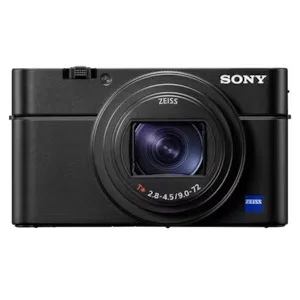
The Sony RX100 VII pairs a 24–200mm equivalent zoom with a 20MP 1″ sensor, real-time Eye AF, 20fps bursts, and 4K video – unmatched versatility in a pocket camera. It remains the go-to premium compact for travel and everyday shooting.
2026 note: still current but premium – expect ~$1,300–1,500. It rarely sees big discounts, so buy when you find fair stock.
Specs
| Feature | Specification |
| Lens | ZEISS Vario-Sonnar® T* 24-200mm F2.8-4.5 |
| Sensor Size | 1″ |
| Megapixels | 20.1 MP (stills), 19.7 MP (video) |
| ISO Range | 100-12800 (expandable to 51200) |
| Video Resolution | 4K (3840×2160) at 30p |
| Shutter Speed | 1/4000s – 30s |
| Connectivity | Wi-Fi, Bluetooth, USB-C |
Panasonic Lumix ZS100 (value zoom compact)
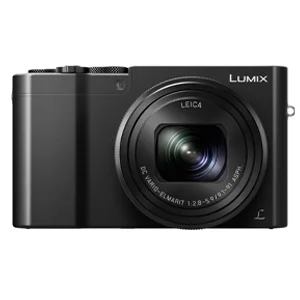
The Panasonic Lumix ZS100 (TZ100) offers a huge 25–250mm zoom, a 20MP 1″ sensor, a built-in EVF, and 4K video in a pocket body – a superb travel companion at a friendlier price than the Sony.
2026 note: mostly found used or as remaining stock; the newer ZS200 / TZ200 extends the zoom further if you want a current model.
Specs
| Feature | Specification |
| Lens | LEICA DC VARIO-ELMARIT F2.8-5.9 25-250mm |
| Sensor Size | 1″ |
| Megapixels | 20.1 MP |
| ISO Range | 125-12800 (expandable to 80-25600) |
| Video Resolution | 4K (3840×2160) at 30p |
| Shutter Speed | 1/4000s – 30s |
| Connectivity | Wi-Fi, Bluetooth, USB-C |
(Read more about the 10 best compact cameras for beginners.)
Worked Example: Building Your First Kit on a RM3,000 Budget
Here’s how we’d spend a realistic ~RM3,000 (≈$640) first-camera budget in 2026, depending on your goal:
| Goal | Body | Add-ons to budget | Notes |
|---|---|---|---|
| All-round photos | Canon EOS R50 kit (~RM3,200) | Card (~RM60), spare battery (~RM120) | Stretch slightly, or buy R50 body + used 50mm |
| Vlogging / YouTube | DJI Osmo Pocket 3 (~RM2,300) | microSD (~RM80), leaves room for mic | Easiest smooth video, no lens juggling |
| Cheapest “real camera” | Used Nikon D3500 kit (~RM1,800) | 50mm f/1.8 (~RM600), card, bag | Best bang-for-buck if bought used |
| Learning the craft (film) | Used Pentax K1000 (~RM900) | Film + dev/scan: ~RM55–90 per 36-shot roll | Low entry cost, ongoing per-roll cost |
Don’t forget running costs. Digital cameras are cheap to run after purchase; film is not. Budget roughly RM30–55 for a roll of film plus RM25–40 to develop and scan it – so every 36 shots costs about RM55–90. That’s part of film’s charm (it makes you deliberate) but plan for it.
Common Beginner Pitfalls to Avoid
- Buying into a dead lens mount. Avoid new purchases on discontinued mounts like Canon EF-M (EOS M50). Choose a current mount (Canon RF, Nikon Z, Sony E) so you can add lenses later.
- Over-spending on the body, under-spending on glass. A cheaper body plus one good prime lens (like a 50mm f/1.8) usually beats an expensive body with only the kit lens.
- Chasing megapixels. 24MP is plenty. Autofocus, stabilisation, and how the camera feels in your hands matter far more day to day.
- Ignoring size and weight. The best camera is the one you’ll actually bring. A bulky DSLR that stays home loses to a compact that’s always in your bag.
- Skipping the used-camera check. For used bodies, always test the shutter, check for sensor dust/fungus, and (for film) confirm the light meter works before paying.
- Forgetting the extras. A memory card, spare battery, and a small bag are not optional – leave budget for them.
Start Your Photography Journey With The Best Camera for Beginners
Choosing your first camera can feel overwhelming, given how many options are out there today. But by focusing on your needs, budget, and how you actually want to shoot, it becomes much simpler to narrow the field.
For most people in 2026, a mirrorless camera like the Canon EOS R50 or Nikon Z50 II is the best all-round starting point. If you mainly film yourself, reach for the DJI Osmo Pocket 3 or Sony ZV-E10 II; if you want to slow down and learn the craft, try a film SLR; and if pocketability is everything, a compact like the Sony RX100 VII or Ricoh GR IV is ideal.
Don’t stress about getting the “perfect” camera immediately. Skill matters far more than gear when you’re starting out. Pick an affordable model with approachable controls, then practise often, learn composition from photos you admire, and have fun documenting the world around you.
Happy shooting!
All prices and availability verified in July 2026 and are approximate – camera pricing and stock change frequently, so please confirm current figures with the retailer before buying. This guide is provided by KayaToday for general information only and is not professional purchasing advice.