In every crypto cycle there is one phrase traders wait for all year: altcoin season. It describes the stretch when coins other than Bitcoin suddenly run harder than BTC, and portfolios that were flat for months can double or triple in weeks. It is also one of the most misunderstood ideas in crypto — people call “alt season” far more often than it actually happens.
- What Is Alt Season?
- Alt Season Signals at a Glance (August 2026)
- Why the Alt-Season Cycle Matters
- How Do We Know When Altcoin Season Is Coming?
- 1. The Altcoin Season Index
- 2. Bitcoin Dominance Drops
- 3. A Reversal in the ETH/BTC Pair
- 4. Supporting Signals: Stablecoins, Funding and Sentiment
- Did Alt Season Happen in the 2024–2026 Cycle?
- Will Alt Season Happen Again?
- How to Position for a Possible Alt Season
- Altcoin Season in Malaysia & Singapore
- Common Alt-Season Mistakes to Avoid
- Conclusion
- Frequently Asked Questions
An altcoin (“alternative coin”) is simply any cryptocurrency other than Bitcoin — Ethereum, Solana, XRP, Cardano and the tens of thousands of smaller tokens, each with its own technology, use case and risk profile. This guide explains what alt season really is, the exact indicators professionals use to spot it, why the 2024–2026 cycle has been so different, and — the question everyone is asking — whether alt season will happen again. Figures are current as of August 2026.
Key Takeaways
- Alt season is a period when altcoins broadly outperform Bitcoin, creating outsized (but short-lived) profit windows.
- The classic trigger is falling Bitcoin dominance — BTC’s share of total market cap sliding toward or below ~50% because altcoins are rising, not because everything is crashing.
- The Altcoin Season Index confirms it: alt season is signalled only when more than 75% of the top 50 altcoins beat Bitcoin over 90 days. As of late August 2026 the index sits near 33/100 — not alt season.
- The ETH/BTC pair is the early tell. Ethereum’s ~30% weekly surge on record ETF inflows (Aug 2026) is the kind of move that historically front-runs broader altcoin strength.
- The 2024–2026 cycle broke the old pattern: no full, sustained alt season yet. It is more likely delayed than dead.
What Is Alt Season?
Altcoin season — often shortened to “alt season” — is a phase in which cryptocurrencies other than Bitcoin experience a substantial surge in value and, crucially, outperform Bitcoin itself. As the original and largest cryptocurrency by market capitalisation, Bitcoin sets the tone for the whole market. When capital rotates out of BTC and into altcoins faster than it flows into Bitcoin, alts start to lead — and that rotation is what traders call alt season.
The key metric analysts watch is Bitcoin dominance: Bitcoin’s market capitalisation as a percentage of the entire crypto market. In the earliest days of crypto, Bitcoin was close to 100% of the market. As thousands of new projects launched, that share eroded. When altcoins collectively gain ground and Bitcoin’s dominance falls, many observers read it as the market tilting toward a new altcoin season.
One important nuance most beginner guides skip: alt season is relative, not absolute. Altcoins can rise in dollar terms and still be in a “Bitcoin season” if BTC is rising faster. True alt season means altcoins are winning the race against Bitcoin, not just going up.
Alt Season Signals at a Glance (August 2026)
Here is where the four headline indicators stand right now. Read them together — no single number confirms alt season on its own.
| Signal | What it measures | Reading (late Aug 2026) | Alt-season trigger |
|---|---|---|---|
| Altcoin Season Index | % of top-50 alts beating BTC over 90 days | ~33 / 100 | ≥ 75, sustained ~2 weeks |
| Bitcoin dominance (BTC.D) | BTC’s share of total crypto market cap | ~58% | Falling toward / below ~50% |
| ETH/BTC ratio | Whether the largest altcoin is leading | ~0.032 — rebounding on ETF inflows | Sustained uptrend |
| Total market cap | Overall liquidity in the market | ~US$2.6 trillion | Rising led by alts, not just BTC |
| TOTAL3 (alts ex-BTC & ETH) | Small- and mid-cap altcoin strength | Subdued | Breaking to new highs |
Bitcoin traded around US$77,000 in late August 2026 (after briefly challenging US$80,000), still well below its October 2025 all-time high near US$126,000. Ethereum was around US$2,450 after a ~30% weekly surge. Readings move constantly — check the live sources linked below before acting.
Why the Alt-Season Cycle Matters
Understanding crypto’s seasonality can open up profit opportunities even if you are not a deep technical analyst. If you simply recognise which “season” the market is in, you can position accordingly instead of buying and selling at the worst possible times.
During a Bitcoin season, the market rewards BTC first. Positive news pushes Bitcoin up, and most altcoins merely follow at a lag — if BTC rises 5%, an alt might match it; if BTC drops 5%, alts often fall further. In practice that leaves two sensible plays in a Bitcoin-led market: accumulate Bitcoin and wait for rotation, or patiently build positions in a small number of high-conviction altcoins with strong fundamentals while they are cheap, then let an eventual alt season do the work.
The reason alt season is so coveted is the magnitude of the moves. In past cycles, quality mid-cap altcoins have gained multiples in a matter of weeks once rotation begins. The flip side — and the part hype accounts never mention — is that those gains reverse just as fast. Alt season is a window to take profit into, not a permanent new plateau.
How Do We Know When Altcoin Season Is Coming?
Alt season tends to arrive when Bitcoin dominance weakens and capital rotates down the risk curve — first into Ethereum, then large-cap alts, then mid- and small-caps. You can never call it with certainty, but these indicators together give you a reliable read.
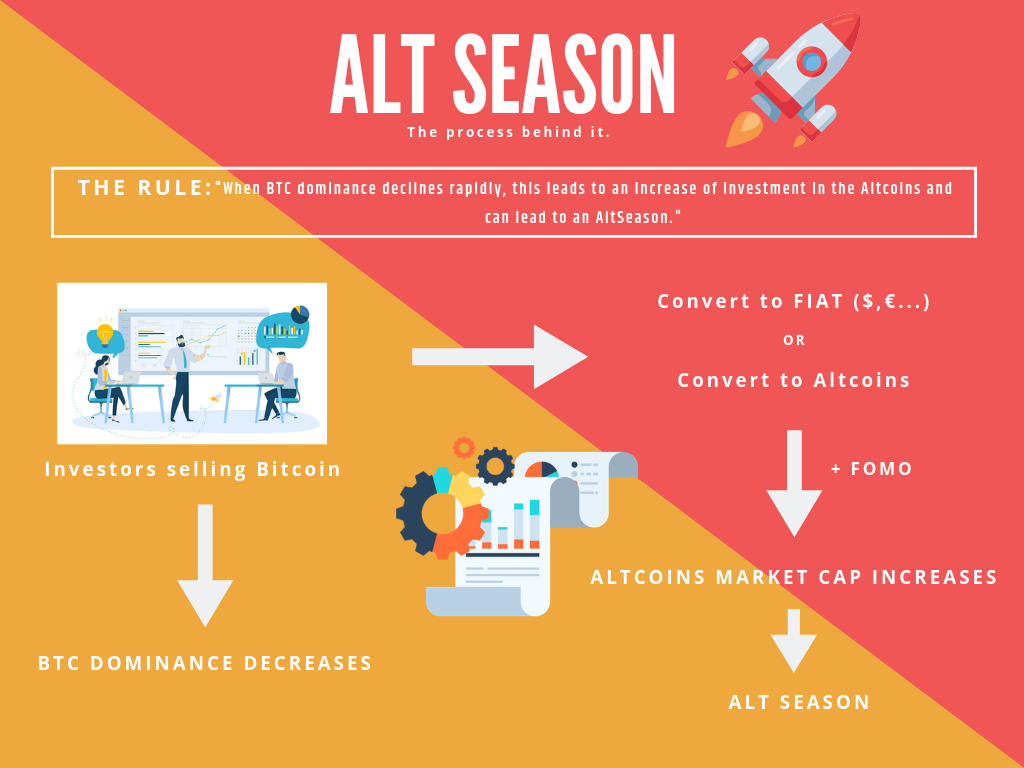
The mechanics are simple: when investors grow confident, many rotate profits out of Bitcoin (or out of stablecoins such as USDT and USDC) and into altcoins chasing higher returns. That inflow lifts the combined altcoin market cap and, if it outpaces Bitcoin, kicks off alt season. Here are the signals that tell you it is happening.
1. The Altcoin Season Index
The Altcoin Season Index — popularised by Blockchain Center and now also tracked by CoinMarketCap — is the cleanest single gauge. Its methodology is straightforward: it looks at the top 50 altcoins by market cap and checks how many outperformed Bitcoin over the last 90 days. When more than 75% of them beat BTC, the index reads “Altcoin Season.” When 75% or more underperform BTC, it reads “Bitcoin Season.”
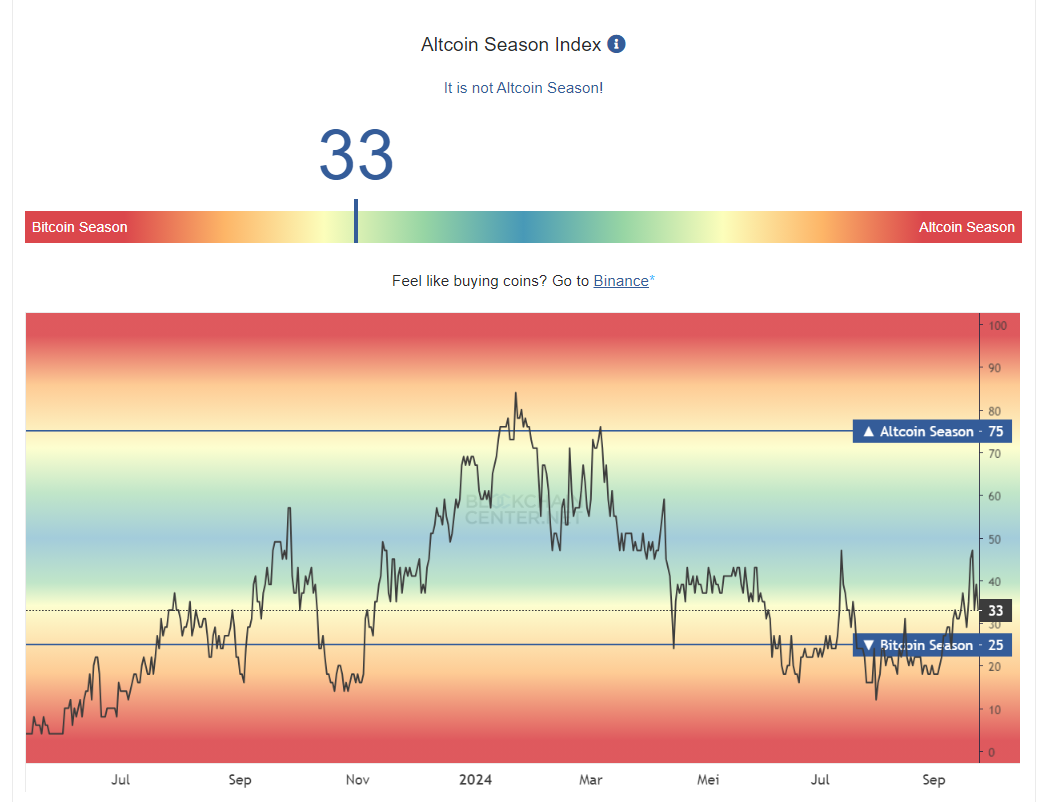
As of late August 2026, the index sits around 33 out of 100 — firmly in Bitcoin-season territory, meaning most large-cap altcoins are still trailing BTC. For context, the index only briefly touched the mid-70s during September 2025 before collapsing back toward 20 by December 2025. In other words, it has flirted with the alt-season threshold but has not held there. Treat a single day above 75 with caution: real alt seasons show the index parked above 75 for a couple of weeks, not spiking for a day.
2. Bitcoin Dominance Drops
Bitcoin dominance (ticker BTC.D) tells you how the biggest coin is performing relative to everything else. A falling dominance line can signal alt strength — but experts caution there are two very different reasons it can drop:
- Bullish case: altcoins surge while Bitcoin holds steady or rises more slowly. Dominance falls because alts are winning. This is the alt-season setup you want.
- Bearish trap: both Bitcoin and altcoins fall, but Bitcoin falls less. Dominance still drops — yet everyone is losing money. This is not alt season.
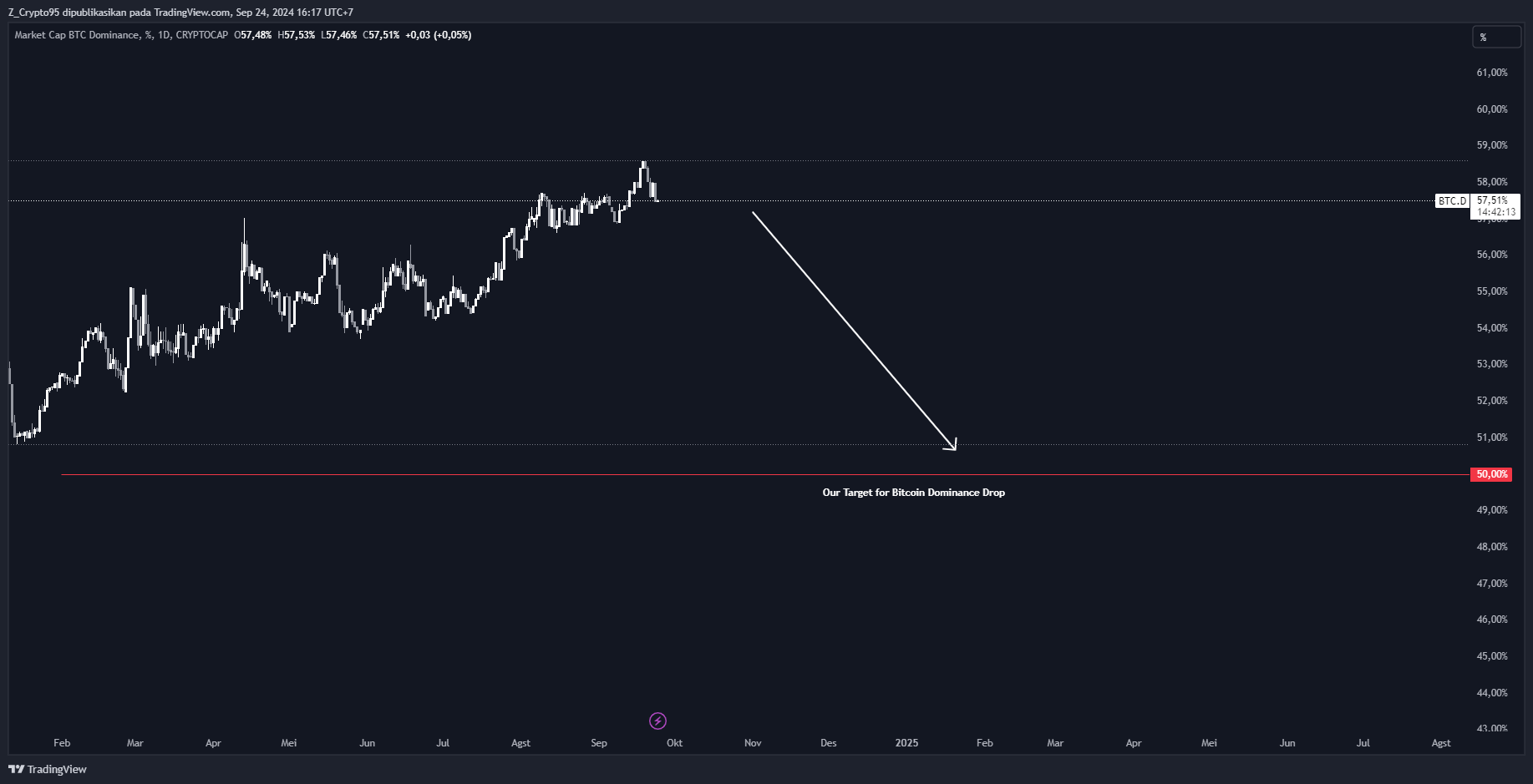
As of August 2026, BTC dominance is roughly 58% — elevated, and one of the clearest reasons this cycle has felt so brutal for altcoin holders. The arrival of US spot Bitcoin ETFs in January 2024 gave institutions a regulated way to hold BTC, and a large slice of new money has flowed straight into Bitcoin rather than fanning out across the altcoin market. For a genuine alt season, watch for dominance to trend down toward the low 50s while total market cap keeps rising.
3. A Reversal in the ETH/BTC Pair
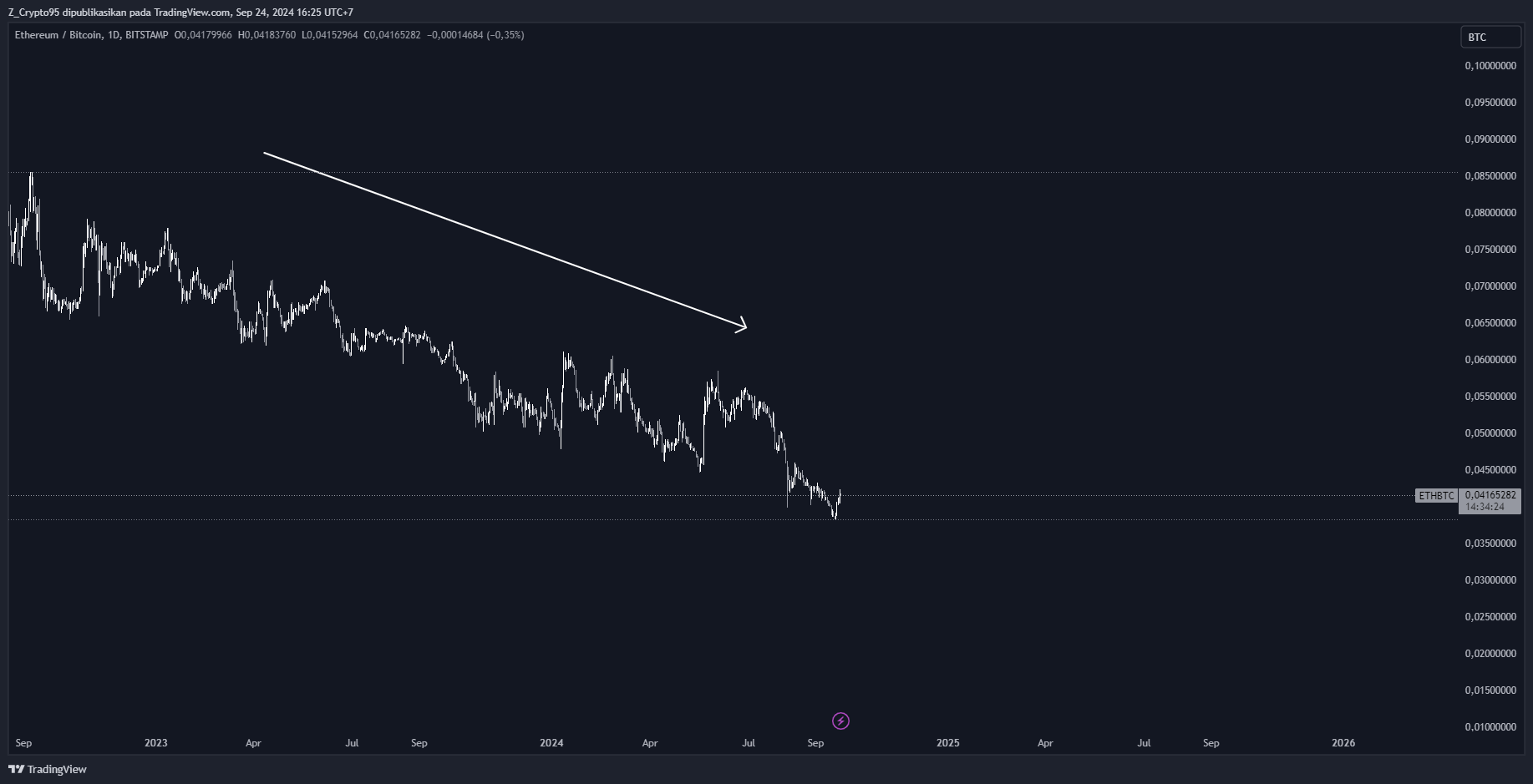
Ethereum is the largest altcoin, so the ETH/BTC ratio is the market’s canary. When Ethereum starts outperforming Bitcoin, capital is moving down the risk curve, and smaller altcoins have historically followed. A sustained ETH/BTC uptrend is one of the most reliable early signs that rotation into alts is underway.
This is exactly what makes August 2026 interesting. Ethereum jumped roughly 30% in a single week, driven by record-setting inflows into US spot Ethereum ETFs (BlackRock’s fund leading) and a wave of short-covering. That is the classic ETH-leads-first behaviour — but one week is not a trend. The signal is only confirmed if ETH/BTC keeps climbing and TOTAL3 (the market cap of all alts excluding BTC and ETH, viewable on TradingView) starts breaking higher too.
4. Supporting Signals: Stablecoins, Funding and Sentiment
Beyond the big three, seasoned traders cross-check a few more inputs: growth in stablecoin supply (dry powder waiting to buy), USDT dominance falling (money leaving the sidelines for coins), rising funding rates and open interest on alt perpetuals, and a jump in retail attention (Google Trends for “altcoins,” app-store rankings, social volume). When several of these turn up at once alongside a falling BTC.D, the odds of a real rotation improve.
Did Alt Season Happen in the 2024–2026 Cycle?
Short answer: not a full, sustained one — and understanding why is more useful than any price prediction. Bitcoin printed a fresh all-time high above US$126,000 in October 2025, yet the Altcoin Season Index only grazed the 75 threshold once (briefly, in September 2025) before sliding back to the low 20s by year-end. For most of the cycle, Bitcoin stayed firmly in control. Several structural shifts explain the “missing” alt season:
| Structural shift | Effect on altcoins |
|---|---|
| Spot BTC & ETH ETFs | New institutional money flows into regulated BTC/ETH wrappers — not the long tail of smaller alts. |
| Too many tokens | Tens of millions of tokens now exist. The same speculative capital is spread far more thinly than in 2021. |
| Meme-coin absorption | Retail’s gambling money rotated into memecoins instead of mid-cap “utility” alts, starving them of flows. |
| VC unlock overhang | Large scheduled token unlocks add steady sell pressure that caps rallies before they build momentum. |
| Liquidity & macro | Crypto now tracks global liquidity and Fed policy more than the old halving clock. |
| Shorter rally windows | When alts did run, the windows were briefer and shallower than in previous cycles. |
The takeaway is not that altcoins are finished — it is that the market has matured, capital is more selective, and the “everything pumps” alt seasons of 2017 and 2021 may be harder to repeat in the same broad form.
Will Alt Season Happen Again?
Probably — but likely in a more selective, delayed form rather than the indiscriminate melt-up of past cycles. Analysts increasingly describe Bitcoin’s famous four-year cycle as “stretched and dampened, not dead”: the same four phases still play out, but on a flatter curve shaped by deeper institutional liquidity, ETFs, derivatives and interest-rate policy rather than the halving alone.
The conditions that historically triggered alt season simply never lined up at the same time this cycle. If liquidity loosens (rate cuts, more stablecoin supply), risk appetite returns, and the ETH/BTC ratio confirms an uptrend, a delayed alt rotation is very possible — and Ethereum’s ETF-driven August 2026 surge may be an early hint. The likelier future, though, is a narrower alt season where quality large-caps with real usage, fees or ETF access outperform, while thousands of low-liquidity tokens are left behind. Position for selectivity, not a lottery.
How to Position for a Possible Alt Season
You do not need to predict the exact top. You need a plan that lets you participate if rotation comes without blowing up if it does not. Match your approach to your risk tolerance:
| Investor type | Approach | Typical allocation | Key discipline |
|---|---|---|---|
| Conservative | Stick to BTC and ETH; dollar-cost average; ignore the hype cycle. | Small crypto sleeve (e.g. 1–5% of total portfolio), majors only. | Take some profit into strength; rebalance. |
| Balanced | Majors as a core plus a few high-conviction large-cap alts with real fundamentals. | Core BTC/ETH + a modest alt allocation you understand. | Set stop-losses; rebalance to targets; avoid leverage. |
| Aggressive | Rotate into mid-caps only after signals confirm (index, BTC.D, ETH/BTC). | A small speculative bucket you can genuinely afford to lose. | Pre-set exit targets; scale out; never chase illiquid microcaps. |
Whichever bucket you fall into, three rules hold across all of them: decide your exit before you enter, size positions so no single altcoin can wreck your portfolio, and remember that during a real alt season the smart money is usually selling into euphoria, not buying it. For a deeper playbook, see our guides on smart crypto investment strategies and managing risk in crypto trading.
Altcoin Season in Malaysia & Singapore
If you are trading from Malaysia or Singapore, the mechanics of catching an alt season come with local rules worth knowing.
Malaysia. To buy and sell altcoins legally, use one of the Securities Commission (SC)–registered Digital Asset Exchanges (DAX). As of mid-2026 there are five: Luno, HATA, MX Global, SINEGY and Kinetic DAX (the SC’s revised Recognized Market Operator framework took effect 20 May 2026 — always confirm the current list on the SC website). You can fund these in ringgit via DuitNow/FPX. One honest caveat that matters enormously in an alt season: regulated DAX list a limited menu — mostly large-caps such as BTC, ETH, XRP and SOL — so many of the small- and mid-cap tokens that lead an alt season simply are not available on SC-registered venues. Accessing them means self-custody and global or decentralised platforms, which are not SC-regulated and carry materially higher risk. Note too that global exchanges like Binance and OKX are not SC-registered in Malaysia.
Singapore. Use MAS-licensed providers such as Coinhako, Independent Reserve, Crypto.com or Coinbase Singapore, funded via PayNow/FAST.
Tax. Neither country has a broad capital-gains tax on investments, but active alt-season trading can be treated as income under the LHDN and IRAS “badges of trade” tests — frequent, short-term, profit-seeking trading looks like a business. Keep detailed records of every buy and sell. New to buying here? Start with our cryptocurrency in Malaysia guide and our roundup of the best crypto trading platforms in Malaysia.
Common Alt-Season Mistakes to Avoid
- Chasing green candles. Buying an altcoin after it has already run 5× is how most retail money gets trapped at the top.
- Piling into illiquid microcaps. If daily volume is thin, you may not be able to sell without crashing the price. Liquidity is a feature, not a detail.
- No exit plan. Alt gains round-trip fast. Decide your take-profit levels before you buy and actually take them.
- Leverage on volatile alts. A routine 30–50% alt swing can liquidate a leveraged position in minutes. Spot only for most people.
- Ignoring the dashboard. Trading “alt season” while the index reads 33 and BTC dominance is 58% is fighting the tape.
- Falling for “next 100×” shills and drainers. Hype threads, fake airdrops and malicious token approvals spike during alt seasons. Revoke stale approvals and verify everything — see our guide to spotting crypto scams.
Conclusion
Alt season is one of the most rewarding — and most misread — phenomena in crypto. The profits can be extraordinary for those who catch the rotation and, just as importantly, exit into it. But as of August 2026 the data is clear: with the Altcoin Season Index near 33 and Bitcoin dominance around 58%, we are not in alt season. Ethereum’s ETF-fuelled surge is a genuine early tell worth watching, not a confirmation.
Rather than trying to time the exact turn, use this quieter period the way disciplined investors do: research fundamentally strong projects, build positions gradually, keep an eye on the ETH/BTC pair and Bitcoin dominance, and have a plan for when — or if — the rotation finally comes. If you want to go deeper, compare crypto versus stocks, review whether cryptocurrency is a good investment for your goals, and look at the altcoins worth watching for the next move.
Figures verified August 2026 against public sources including the Blockchain Center Altcoin Season Index, CoinMarketCap’s Altcoin Season Index and the SC Malaysia list of registered market operators. Crypto markets move fast — always confirm the live readings before acting.
Frequently Asked Questions
Disclaimer: This article is provided by KayaToday for educational purposes only and is not financial advice. Cryptocurrencies are highly volatile, and altcoins carry greater risk than Bitcoin — many lose most or all of their value. Never invest more than you can afford to lose, and do your own research or consult a licensed adviser before making any investment decision.