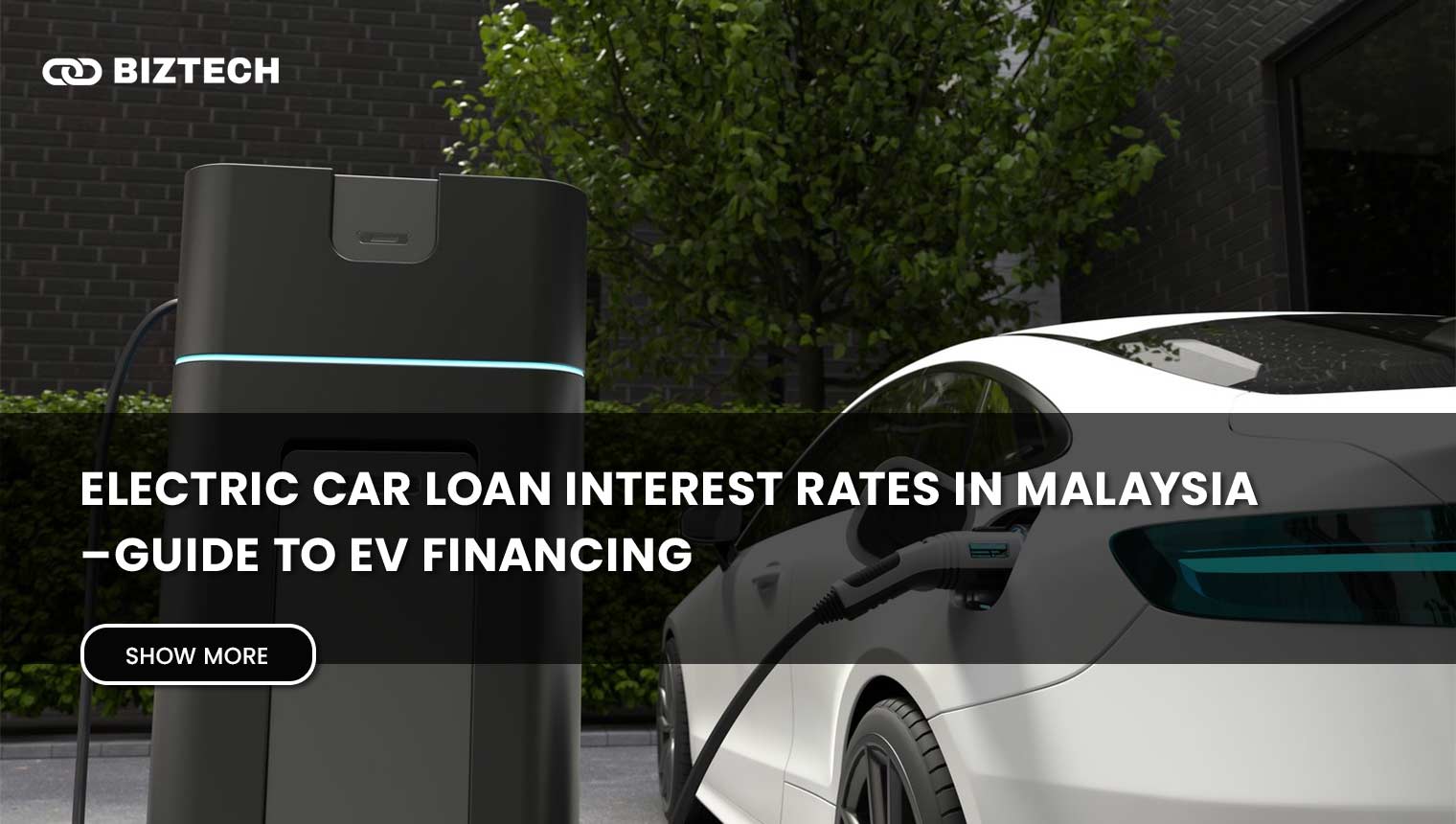
Electric vehicle (EV) loans in Malaysia work like standard hire purchase agreements, but banks often package them with preferential “green” rates and EV-specific perks. They sit slightly apart from Malaysia’s usual car loan interest rates, and 2026 brings the biggest shake-up in years.
- What Changed for EV Loans in 2026
- EV Car Loan Interest Rates – Comparison of Top Banks (2026)
- Overview of Interest Rates
- Flat Rate vs EIR – Reading the New 2026 Numbers
- Quick Answer: Best EV Loan by Need
- Why Are EV Loan Rates Lower?
- Banks’ Green Incentives
- Government Policies
- Risk Factors and Resale Value
- Key Features and Perks of EV Financing Plans
- Free/Discounted Charger Installation & Charging Credits
- Specialised Insurance Packages
- Fast Approval & High Financing Margins
- How These Perks Offset Costs
- Worked Example: RM150,000 EV Over 7 Years
- How to Choose the Best EV Car Loan for You
- 1. Weigh Interest vs Perks (and ask for the EIR)
- 2. Check Eligibility, DSR & Terms
- 3. Match Tenure to Battery Life and Total Cost
- Common Pitfalls to Avoid
- Conclusion
- Frequently Asked Questions about EV Car Loans
- References
Two things changed the maths in 2026. First, the Hire Purchase (Amendment) Act 2026 came into force on 1 June 2026, moving new car loans (EV loans included) away from the old flat-rate method toward a reducing-balance method with a published Effective Interest Rate (EIR). Second, the EV tax landscape tightened: the fully-imported (CBU) EV duty holiday was not renewed from 1 January 2026, and the long-running road tax exemption ended on 31 December 2025. Locally assembled (CKD) EVs, however, keep their tax breaks until 31 December 2027.
The headline still holds: EV financing is generally cheaper than petrol-car financing because banks subsidise green lending. But the days of “free road tax and zero duty on any EV” are over, so the total cost of ownership matters more than the loan rate alone. This guide compares 2026 EV financing, explains the new rules, and shows you how to choose.
What Changed for EV Loans in 2026
Before comparing rates, it helps to understand the three changes that reshaped EV ownership costs this year:
| Change | What it means for you (2026) |
| Hire Purchase (Amendment) Act 2026 (in force 1 Jun 2026) | New EV loans move from flat rate + Rule of 78 to reducing-balance + published EIR. Interest is charged on the balance you still owe, so early settlement saves more. Transition period runs to 31 Mar 2027. |
| CBU (fully imported) EV duty holiday ended | From 1 Jan 2026, imported CBU EVs face import + excise + sales tax (broadly 30%+10%+10%, or 5%+10%+10% for some FTA/China-made models). CBU units that landed before 28 Dec 2025 keep the old exemption. Result: many imported EVs cost more, raising the amount you finance. |
| CKD (locally assembled) EVs still exempt to 31 Dec 2027 | Locally assembled EVs (e.g. Proton, Perodua, Volvo, Mercedes-Benz, BMW and a growing list) keep excise and sales tax exemptions, keeping their on-the-road prices — and your loan size — lower. |
| EV road tax exemption ended 31 Dec 2025 | From 1 Jan 2026 EVs pay a new kW-based road tax, roughly RM20–RM4,890/year depending on motor power — still about 40–85% cheaper than an equivalent petrol car (a ~150kW EV pays around RM160/year). |
The takeaway: a CKD (locally assembled) EV is now often the cheaper financing proposition, because its on-the-road price stayed low. For imported models, check whether the unit was registered under the old exemption before stretching your loan.
EV Car Loan Interest Rates – Comparison of Top Banks (2026)
Overview of Interest Rates
Below is a comparison of EV financing offered by major Malaysian banks in 2026. Rates are advertised flat rates unless stated; under the new rules banks must also show the EIR (the reducing-balance equivalent, usually close to double the flat figure).
| Bank | Indicative rate (p.a.) | Key features (2026) |
| Maybank (Accelerated Repayment Package) | From ~1.75% flat | Among the lowest EV rates; up to 90% financing, up to 9-year tenure; Maybank Islamic InCharge charging credit with Gentari up to RM300; Etiqa EV insurance/Takaful coverage. Model-specific deals (e.g. Chery EV from ~2.08%). |
| CIMB (Green Car Financing) | From ~2.38% flat | Up to 9-year tenure; complimentary EV+ Membership via EVPower with RM300 charge credits + 10% extra wallet reload bonus; fast approval. |
| AmBank | ~2.40% flat | Competitive on Tesla and other EV models; confirm current promo with the bank. |
| BSN MyAuto-i | ~2.30% flat / floating SBR + spread | Islamic hire purchase; high financing margin, Shariah-compliant terms. |
| Public Bank | ~2.50% flat | Standard green-vehicle rates; periodic model-specific promotions. |
The lowest advertised rate remains Maybank’s (from ~1.75% flat under its Accelerated Repayment Package, often tied to specific models or tenures), while most other banks sit in the low-to-mid 2% flat range. Always ask for the EIR too — it is the figure that reflects what you actually pay.
Flat Rate vs EIR – Reading the New 2026 Numbers
Under the Hire Purchase (Amendment) Act 2026, banks must publish the reducing-balance EIR alongside the headline flat rate. As a rule of thumb, EIR is roughly 1.8–2× the flat rate. So a 2.38% flat EV loan is closer to ~4.4% EIR, and a 1.75% flat deal sits around ~3.3% EIR. Two implications:
- Compare like with like: don’t pit one bank’s flat rate against another’s EIR.
- On reducing-balance loans, early or extra payments cut interest directly — there’s no Rule of 78 front-loading on new agreements, so paying down faster genuinely saves money. See our car loan interest rates guide and the lowest car loan rates roundup for how this plays out across lenders.
Quick Answer: Best EV Loan by Need
| If you want… | Look at |
| Lowest headline rate | Maybank Accelerated Repayment Package (from ~1.75% flat, model/tenure conditions apply) |
| Best bundled charging perks | CIMB Green Car Financing (RM300 EV+ credits + reload bonus) or Maybank (Gentari InCharge credit) |
| Shariah-compliant financing | BSN MyAuto-i (or Maybank Islamic / other banks’ -i variants) |
| High financing margin (smaller down payment) | Most banks up to 90%; confirm for your specific EV model |
| Fast approval | CIMB (rapid processing for panel EV models) |
Why Are EV Loan Rates Lower?
Banks’ Green Incentives
Many Malaysian banks price EV loans below conventional car loans as part of their commitment to green technology and sustainability goals. Financing EVs at thinner margins lets banks align with global decarbonisation targets and attract a desirable customer segment.
For instance, a conventional car loan might sit around ~3.0–3.4% flat, whereas a green EV loan can be ~1.75–2.5% flat — a gap that compounds into real savings over a 7–9 year term.
Government Policies
Malaysia doesn’t subsidise EV loan rates directly, but tax policy shapes the overall cost. In 2026 the support narrowed: the CBU (fully imported) duty exemption lapsed, while CKD (locally assembled) EVs remain exempt from excise and sales tax until 31 December 2027. The Low Carbon Mobility Blueprint and schemes such as the Green Technology Financing Scheme (GTFS) continue to support the ecosystem, indirectly benefiting buyers of locally assembled EVs.
Risk Factors and Resale Value
From a lender’s view, EVs carry high upfront costs but solid resale value for popular models, and EV buyers tend to have strong credit profiles — both lower default risk. The main concern is battery depreciation, which banks manage through tenure limits or financing margins (often capping at 85–90% of value) rather than by hiking the rate.
Key Features and Perks of EV Financing Plans
EV loans bundle more than a competitive rate. These extras can meaningfully offset upfront and running costs.
Free/Discounted Charger Installation & Charging Credits
- Maybank: Maybank Islamic InCharge charging credit with Gentari (up to RM300) and EV-specific insurance/Takaful coverage via Etiqa.
- CIMB: complimentary EV+ Membership via EVPower including RM300 charge credits and a 10% extra wallet-reload bonus.
These credits cut day-to-day running costs and are especially valuable for first-time EV buyers without home charging set up.
Specialised Insurance Packages
EV loans often pair with tailored cover that addresses battery and high-voltage component risk — important given how expensive these parts are to replace. Compare the EV battery cover, not just the premium.
Fast Approval & High Financing Margins
Most banks offer up to 90% financing for EVs, similar to regular cars, with streamlined approval for panel models — letting you secure the vehicle quickly while keeping the down payment manageable.
How These Perks Offset Costs
- Charging credits directly lower operating expenses.
- Free or discounted chargers remove a costly installation.
- Specialised insurance reduces long-term battery-replacement risk.
- Lower road tax (new 2026 kW-based rates) still beats petrol equivalents by 40–85%.
A slightly higher rate can be worth it when the package includes a home charger and charging credits — particularly if you’d otherwise pay out of pocket to install charging at home.
Worked Example: RM150,000 EV Over 7 Years
Suppose you finance RM150,000 of a CKD EV at 2.0% flat over 7 years (84 months):
- Total flat interest: RM150,000 × 2.0% × 7 = RM21,000
- Total repayable: RM171,000 → monthly instalment ≈ RM2,036
- Equivalent EIR (reducing balance) ≈ ~3.8%
At 2.5% flat instead, total interest rises to RM26,250 (≈ RM2,098/month). On a new reducing-balance agreement, settling a year early would save a meaningful chunk of the remaining interest — something the old Rule of 78 used to blunt. Run your own numbers with our loan calculator before signing.
How to Choose the Best EV Car Loan for You
Use this three-step framework to land the right deal.
1. Weigh Interest vs Perks (and ask for the EIR)
- Maybank may advertise from ~1.75% flat but tie it to specific models or tenures; CIMB’s ~2.38% flat could win if its RM300 charging credits and reload bonus suit you.
- Always request the EIR so you’re comparing the true cost, not just headline flat rates.
2. Check Eligibility, DSR & Terms
- Promotional rates carry conditions (minimum down payment, set tenure). Confirm before assuming you qualify.
- Banks assess your debt service ratio (DSR). Since EVs are pricier, a clean credit file helps — check your CTOS credit report before you apply.
3. Match Tenure to Battery Life and Total Cost
- Longer tenures (up to 9 years) lower monthly payments but raise total interest.
- EV battery warranties typically last ~8 years; aligning your loan term avoids paying off an ageing battery.
- On a reducing-balance loan, a larger down payment and early settlement both cut interest directly.
Tesla buyers should check panel banks like Maybank and CIMB for exclusive promotions; for other brands, ask the dealer which bank offers the tailored EV package. Compare against conventional financing in our guide to the best loan options and the used-car loan rates guide if you’re considering a pre-owned EV.
Common Pitfalls to Avoid
- Comparing flat against EIR. They are not the same number — insist on EIR for every quote.
- Assuming all EVs are still tax-free. CBU duty and road tax now apply in 2026; budget for them.
- Ignoring CKD vs CBU pricing. A locally assembled EV may be materially cheaper to buy and finance.
- Over-stretching the tenure. Nine years means lower instalments but more total interest and a loan that can outlast the battery warranty.
- Chasing the lowest rate only. Charging credits, charger installation and battery insurance can outweigh a 0.2% rate difference.
Conclusion
EV financing in Malaysia is still cheaper than petrol-car financing, but 2026 changed the calculus: the Hire Purchase (Amendment) Act moved new loans to reducing-balance/EIR pricing, the CBU duty holiday ended, and road tax now applies on a kW-based scale. Favour locally assembled (CKD) models for the best total cost, always compare on EIR, weigh perks against rate, and align your tenure with battery life. Do that and you’ll capture the savings while enjoying sustainable driving.
Frequently Asked Questions about EV Car Loans
Disclaimer: This article is provided by KayaToday for general information only and is not financial advice. Rates, fees, tax rules and incentives are indicative and change frequently — figures verified June 2026; always confirm the latest terms with the bank or issuer before applying.