Managing big expenses can feel scary. With an Easy Payment Plan (EPP), you can spread the cost of a large purchase over months — often at 0% interest — instead of paying everything upfront or letting it sit on your card at 15–18% p.a.
- Quick Answer: Which EPP Should You Use?
- What is an Easy Payment Plan (EPP)?
- How Does a 0% EPP Work in Malaysia?
- Benefits of Using EPP for Your Purchases
- No Interest (Real Savings)
- Affordability and Cash Flow
- Convenience
- Rewards and Perks
- Where Can You Get an EPP? (2026 Bank Comparison)
- Maybank – EzyPay
- CIMB – 0% Easy Pay
- Public Bank – Zero Interest Instalment Plan (ZIIP) & Flexipay
- RHB – Smart Instalment
- HSBC – Card Instalment Plan
- Bank Islam – Instalment Payment Plan & RSVP
- OCBC – Easy Payment Plan
- UOB – Instalment Payment Plan, Easi-Payment & LuxePay
- AmBank, Standard Chartered, Hong Leong & Others
- The Real Cost of “0%” — What Banks Don’t Headline
- Worked Example: RM6,000 Laptop, Three Ways
- EPP vs BNPL – What’s the Difference in 2026?
- Which to Choose?
- How to Apply & Use an EPP (Step-by-Step)
- Step 1: Check your credit card and limit
- Step 2: Confirm the merchant participates
- Step 3: Meet the minimum purchase amount
- Step 4: Request EPP at checkout and pick your tenure
- Step 5: Confirm the instalment details
- Step 6: Pay on time, every month
- Step 7: Monitor until fully paid
- How to Choose the Right EPP: A 4-Step Framework
- Tips for Making the Most of EPP (and Avoiding Pitfalls)
- Frequently Asked Questions
- Conclusion – Shop Smart with EPP
In Malaysia, most banks call this feature EPP, while some label it a Flexi Payment Plan (FPP), Instalment Payment Plan (IPP), or a brand name like EzyPay or Easy Pay. Whatever the name, the mechanics are the same: you pay with your credit card, choose a tenure, and repay a fixed amount each month.
This guide explains how EPP works in 2026, compares every major bank’s programme, shows you the hidden costs behind “0%”, and helps you decide between EPP and Buy Now Pay Later (BNPL) — which is now formally regulated under Malaysia’s new Consumer Credit Act.
Figures verified June 2026. Bank programmes change often — always confirm current terms with the issuer before you commit.
Quick Answer: Which EPP Should You Use?
| If you want… | Best option (2026) | Why |
|---|---|---|
| Smallest minimum spend | Bank Islam IPP | From RM150 for a 3-month plan (scales with tenure) |
| Longest 0% tenure, big merchant network | Maybank EzyPay / CIMB 0% Easy Pay / HSBC Card Instalment Plan | Up to 36 months 0% at participating merchants |
| No early-settlement fee | Maybank, HSBC, RHB, Public Bank, Standard Chartered, AmBank, Bank Islam | Settle anytime without penalty |
| Convert a purchase you already made | CIMB Flexi Payment Plan / RHB Dial-An-Instalment / UOB Easi-Payment | Post-purchase conversion via app or phone (usually interest-bearing) |
| Big-ticket education/medical bills | UOB Visa Infinite (RM10,000+, 0% for 12 months) | Category-specific 0% conversion |
| Small everyday buys without a credit card | BNPL (Atome, SPayLater, GrabPayLater) | No card needed — now licensed under the Consumer Credit Act |
What is an Easy Payment Plan (EPP)?
An Easy Payment Plan (EPP) is a credit card instalment facility. When you shop at a participating store, the bank converts that one-off payment into fixed monthly instalments — usually at 0% interest, so long as you pay every instalment on time.
In Malaysia, you typically need to spend a minimum amount in a single receipt — RM500 at most banks, RM1,000 for programmes like Maybank EzyPay and CIMB 0% Easy Pay, and as little as RM150 for Bank Islam’s IPP on a short tenure. Once you qualify, you select a tenure such as 6, 12, 24 or 36 months.
The bank splits your purchase into equal chunks. Your credit limit is held for the full amount and released bit by bit as you pay.
Put simply: EPP is your credit card’s friendly mini-loan. It uses your existing credit line, so there’s no loan application and no approval wait. Just ask for EPP at checkout and you’re set.
How Does a 0% EPP Work in Malaysia?
When you shop with your credit card at a merchant that offers EPP, look for the 0% Easy Pay, EzyPay or instalment logo at checkout. Choose your tenure — commonly 3, 6, 12, 18, 24 or 36 months — and the bank splits the purchase into equal monthly instalments at 0% interest for the entire period.
Key mechanics to understand:
- Minimum spend: Usually RM500–RM1,000 in a single transaction, and some banks scale it by tenure (Maybank EzyPay Plus requires RM3,000 for 18 months and RM5,000 for 24 months; Bank Islam requires RM1,800 for a 36-month plan).
- Credit limit hold: The bank blocks your entire purchase amount against your credit limit, releasing it progressively as you pay each instalment.
- On top of, not instead of: Your monthly EPP instalment is due in addition to the usual minimum payment (5% or RM50, whichever is higher) on your other balances.
- Miss a payment and 0% disappears: The bank can revoke the 0% deal and charge its standard tiered finance rate — 15%, 17% or 18% p.a. under Bank Negara Malaysia’s framework — on the remaining balance, and the missed payment is recorded in CCRIS and CTOS.
You can start an EPP in two ways:
- At checkout: Tell the cashier (or select the option online) before you pay. This is where the true 0% deals live, because the merchant subsidises the cost.
- Convert after purchase: Use your bank’s app or call to turn a recent charge into instalments — e.g. CIMB Flexi Payment Plan (min RM500, offers via the OCTO app), RHB Dial-An-Instalment, or UOB Easi-Payment Plan (combine up to 5 unbilled transactions, tenures up to 60 months). Important: post-purchase conversions are usually not 0% — UOB’s Easi-Payment starts from about 3.99% p.a., Hong Leong’s Flexi Payment Plan from about 1.88%, and AmBank’s AmFlexi-Pay from about 7.88%. Cheaper than 18% revolving interest, but not free.
Benefits of Using EPP for Your Purchases
No Interest (Real Savings)
A genuine 0% EPP means you pay exactly the sticker price — versus 15–18% p.a. if the same amount revolved on your card. On RM6,000 carried for a year at 18%, that’s roughly RM600–RM1,000 in finance charges avoided.
Affordability and Cash Flow
Spreading RM3,000 over 12 months into RM250 instalments keeps your emergency fund intact and smooths your budget through expensive months — festive seasons, school openings, insurance renewals.
Convenience
No loan application, no paperwork, instant approval against your existing credit line. Select the instalment option in-store or online and you’re done.
Rewards and Perks
Depending on the bank, EPP spend may still earn points, miles or cashback, and banks run extra-rebate EPP campaigns at selected merchants. Check your card’s terms — some issuers exclude instalment conversions from rewards, so don’t assume.
Where Can You Get an EPP? (2026 Bank Comparison)
Almost every major bank in Malaysia offers an EPP programme. Here’s how they compare in 2026:
| Bank / Programme | Tenure (0% at merchants) | Typical min spend | Early termination fee |
|---|---|---|---|
| Maybank EzyPay | 3–36 months | RM1,000 (campaign conversions from RM500) | None |
| CIMB 0% Easy Pay | 3–36 months | RM1,000 (RM3,000 for 24/36-mo at some merchants) | RM50 |
| Public Bank ZIIP / Flexipay | Up to 24 months* | RM300–RM1,000* | None |
| RHB Smart Instalment | Up to 36 months | RM500 | None |
| HSBC Card Instalment Plan | 3–36 months | RM300–RM1,000 (varies by merchant terminal) | None |
| Bank Islam IPP | 3–36 months | RM150 (3-mo) up to RM1,800 (36-mo) | None |
| OCBC Easy Payment Plan | Varies by merchant | RM500 | None |
| UOB Instalment Payment Plan | Varies by merchant | RM500 (LuxePay RM2,000) | None (Easi-Payment conversion: 5%) |
| AmBank Easy Payment Plan | 3–36 months | RM500 | None |
| Standard Chartered 0% Easy Payment Scheme | Varies by merchant | RM1,000 | None |
| AEON Cards 0% IPP | Varies by merchant | RM500 | RM30 (Flexi plan RM50) |
| Affin 0% Easy Payment Plan | Varies by merchant | RM500 | None |
*Public Bank’s published terms vary by plan and campaign — confirm the current minimum and tenure with the bank.
Maybank – EzyPay
Maybank’s EzyPay splits purchases into equal payments over up to 36 months at 0% at partner merchants, with no processing fees and one of the largest retailer networks in the country. Maybank also runs periodic conversion campaigns — its 0%-for-6-months special (1 February–30 April 2026) accepted retail transactions from RM500 up to RM30,000. Note that EzyPay PLUS — the version that works at any merchant — is a different product and charges interest from about 9% p.a. If you’re choosing a card for EPP access, see our guide to the best Maybank credit cards.
CIMB – 0% Easy Pay
CIMB’s 0% Easy Pay covers tenures from 3 to 36 months at electronics, furniture and home-furnishing chains (IKEA, Harvey Norman and more). Minimum spend is typically RM1,000, rising to RM3,000 for 24 and 36-month tenures at some merchants. One thing to watch: CIMB charges a RM50 fee if you settle the plan early. CIMB also offers the Flexi Payment Plan for post-purchase conversions (min RM500, zero processing fee, rate per the offer shown in the OCTO app).
(If you wish to learn more, you can read about our selection of the best CIMB credit cards.)
Public Bank – Zero Interest Instalment Plan (ZIIP) & Flexipay
Public Bank’s ZIIP runs at participating merchants with tenures commonly up to 24 months, while its 0% Flexipay campaigns (such as the January–June 2026 campaign) let you convert eligible purchases from as low as RM300. Instalments are fixed, and there’s no early-termination fee. Exact minimums and tenures vary by campaign, so check the current terms.
(Check out Public Bank’s best credit cards if you want more options.)
RHB – Smart Instalment
RHB’s Smart Instalment offers 0% for up to 36 months at over 800 participating merchants, with a RM500 minimum spend, no application, no processing fee and no early-exit fee. RHB also runs instant-rebate campaigns on top of the 0% deal, and offers Dial-An-Instalment for converting purchases after the fact. See our roundup of the best RHB credit cards.
HSBC – Card Instalment Plan
HSBC’s Card Instalment Plan offers 0% on all tenures from 3 to 36 months at participating merchants, with no early-termination fee. The minimum purchase depends on the merchant’s terminal — commonly RM300, RM500 or RM1,000. Keep paying the full instalment on time: if you only pay the 5%/RM50 minimum, interest applies to the outstanding balance.
Aside from the instalment plan, check out our top picks of HSBC’s credit cards.
Bank Islam – Instalment Payment Plan & RSVP
Bank Islam’s IPP has the lowest entry point in the market — minimums scale with tenure, from RM150 (3 months) through RM300 (6 months), RM600 (12 months), RM900 (18 months) and RM1,200 (24 months) up to RM1,800 (36 months) — with no early-termination fee. As a Shariah-compliant facility, it suits smaller purchases or anyone who prefers shorter holds on their credit line. The separate RSVP programme has a RM1,000 minimum. For more Shariah-compliant options, see our guide to the best Islamic credit cards in Malaysia.
OCBC – Easy Payment Plan
OCBC’s EPP applies at participating merchants with a RM500 minimum and no early-termination fee. OCBC also offers the Cashflo Mastercard, which automatically converts eligible retail spending into instalments (3 months for RM500–RM1,000; 6 months above RM1,000). Tenures and any handling fees vary by merchant arrangement — confirm before you enrol.
UOB – Instalment Payment Plan, Easi-Payment & LuxePay
UOB’s merchant IPP starts from RM500. Two niche plans stand out: Visa Infinite holders can convert education, medical or luxury purchases of RM10,000+ to 0% for 12 months, and Lady’s Card holders get LuxePay (min RM2,000) for luxury and overseas purchases. UOB’s post-purchase Easi-Payment Plan converts up to five unbilled transactions (min RM500 combined) over tenures up to 60 months — but it charges interest from about 3.99% p.a. and a 5% early-termination fee. See our guide to the best UOB credit cards.
AmBank, Standard Chartered, Hong Leong & Others
AmBank’s EPP offers 0% over 3–36 months (min RM500, no early-exit fee); its AmFlexi-Pay conversion product charges from about 7.88% p.a. Standard Chartered’s 0% Easy Payment Scheme (min RM1,000) and Affin’s 0% EPP (min RM500) have no termination fees. Hong Leong’s Flexi Payment Plan is a conversion product from about 1.88% p.a. — one of the cheaper post-purchase options. BSN, Bank Rakyat and AEON run their own variants.
Note: If your bank isn’t listed here, check your card’s benefits page. Most Malaysian issuers include some EPP or FPP feature that works the same way.
The Real Cost of “0%” — What Banks Don’t Headline
A 0% EPP is genuinely free only when all of these hold. Check each one before you sign:
- Merchant surcharges: Some smaller retailers add 2–5% to the price when you pay by EPP. Big chains usually absorb this; independent shops often don’t. Ask before you swipe.
- Processing or handling fees: A few plans charge a one-time upfront fee, which makes the effective rate non-zero even with no monthly interest.
- Early-settlement fees: CIMB charges RM50, AEON RM30–RM50, and UOB’s Easi-Payment 5% of the outstanding balance. Most other banks charge nothing.
- The revert-rate trap: Miss one instalment and the bank can apply its standard 15–18% p.a. tiered rate to the remaining balance for the rest of the tenure — and report the miss to CCRIS/CTOS. Read our guide on how to check your CTOS report.
- Rewards exclusions: Some issuers don’t award points or cashback on instalment conversions. If rewards matter, compare with the best cashback credit cards to know what you’re giving up.
- Credit-limit lock-up: A RM5,000 EPP on a RM6,000-limit card leaves only RM1,000 of usable credit until instalments are paid down. High utilisation can also drag your credit score.
Worked Example: RM6,000 Laptop, Three Ways
| Payment method | Monthly outlay | Total cost | Catch |
|---|---|---|---|
| 0% EPP, 12 months | RM500 | RM6,000 | RM6,000 of credit limit held; one missed payment can trigger 15–18% p.a. on the balance |
| Revolving on card (paying ~10%/month) | Starts ~RM600, declining | ~RM6,500+ | 17–18% p.a. compounding on the unpaid balance |
| Post-purchase conversion at 3.99% flat, 12 months | ~RM520 | ~RM6,240 | Flat-rate interest ≈ 7–8% effective; early-exit fee may apply |
The 0% EPP wins on cost — but only with the discipline to pay all 12 instalments on time.
EPP vs BNPL – What’s the Difference in 2026?
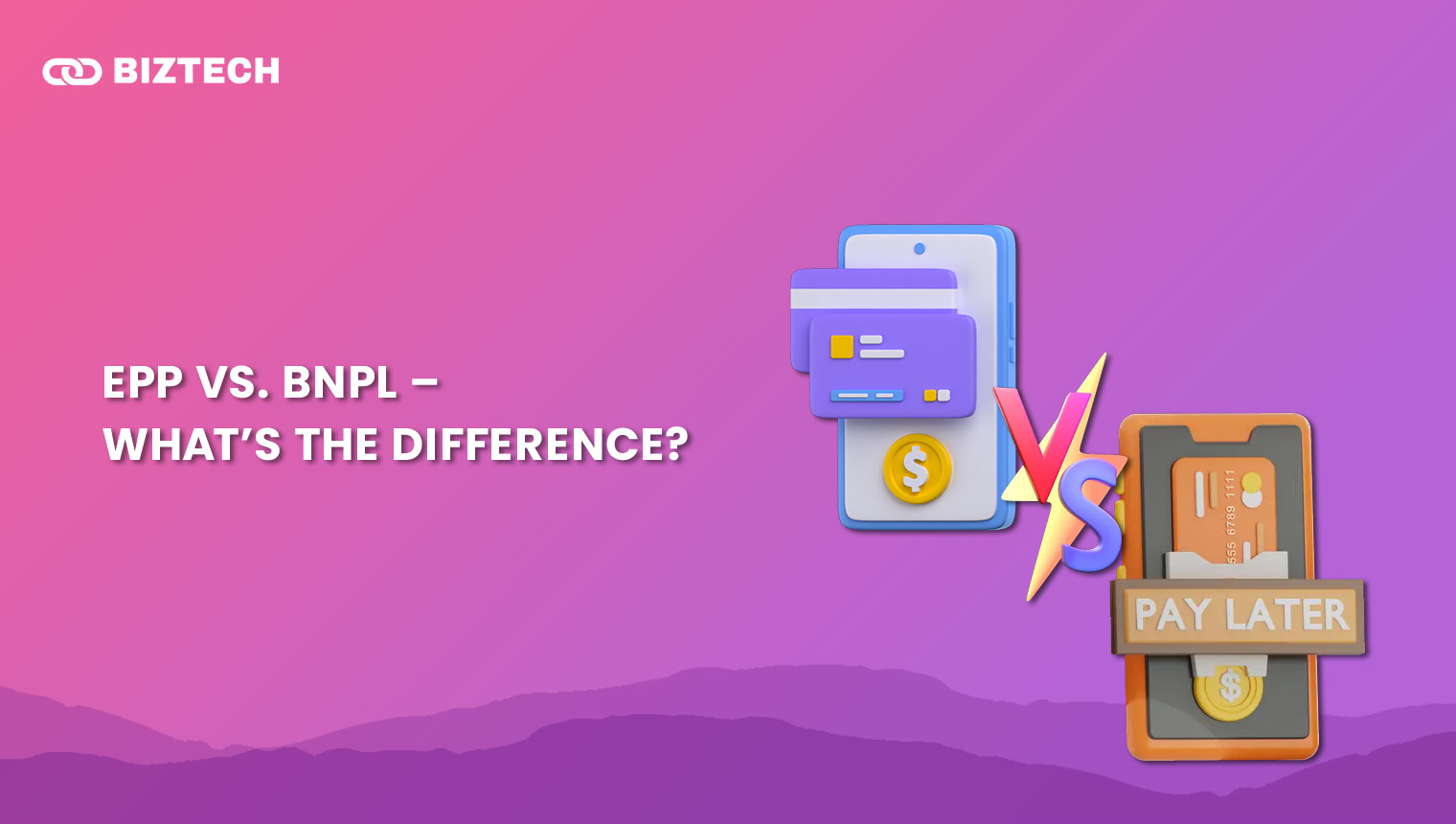
Buy Now Pay Later (BNPL) services like Atome, Grab PayLater and Shopee’s SPayLater let you split payments without a credit card — you sign up in an app and pay over weeks or months.
Regulation — the big 2026 change: BNPL is no longer lightly regulated. Malaysia’s Consumer Credit Act 2025 came into force on 1 March 2026, establishing the Consumer Credit Commission (CCC). BNPL providers must be licensed (licensing rules took effect 1 June 2026, with a six-month compliance window) and are now required to run affordability and credit checks before approving you, with clearer fee disclosure and legal safeguards against unfair practices. EPP, as a bank credit card facility, remains regulated by Bank Negara Malaysia.
Requirements: EPP needs a credit card (credit approval, income and age rules apply). BNPL only requires an account with the provider — handy for shoppers without cards, though affordability checks now apply.
Interest & fees: Both typically advertise 0%. BNPL providers earn via merchant fees and late-payment charges; EPP is a bank facility where a missed payment can trigger 15–18% p.a. on the balance.
Limits & ticket size: EPP capacity is tied to your card’s credit limit and suits big-ticket purchases over long tenures. BNPL limits start small and grow with usage, suited to everyday online buys.
Which to Choose?
If you have a credit card, EPP offers longer tenures, higher limits and (often) reward-earning. For quick, small-value instalments without a card, BNPL is a reasonable alternative now that it’s licensed and supervised. Either way, instalments are still debt — spend within your means.
How to Apply & Use an EPP (Step-by-Step)
Step 1: Check your credit card and limit
Ensure your card offers EPP (most do) and that you have enough available limit for the full purchase. If you don’t have a suitable card yet, start with our guide to the best credit cards in Malaysia.
Step 2: Confirm the merchant participates
Look for instalment stickers at the counter or payment options online (e.g. “0% instalment up to 12 months with Maybank”). The 0% rate only applies where the merchant has an agreement with your bank.
Step 3: Meet the minimum purchase amount
Usually RM500–RM1,000 in a single receipt; some banks scale it by tenure. Below the minimum, EPP won’t be offered.
Step 4: Request EPP at checkout and pick your tenure
Tell the cashier (or select online) before paying, and choose a tenure whose monthly amount fits your budget. The card is charged the full amount, labelled as an EPP transaction.
Step 5: Confirm the instalment details
Double-check the monthly amount, the number of months, and whether any surcharge or fee applies. Keep the receipt or a screenshot.
Step 6: Pay on time, every month
Your statement includes the EPP instalment in the amount due. Pay at least the full instalment (ideally the whole bill) by the due date — set up auto-debit or reminders so you never trip the revert rate.
Step 7: Monitor until fully paid
Track remaining instalments on your statement, and contact the bank if anything looks wrong. Once all instalments clear, your limit is fully restored.
How to Choose the Right EPP: A 4-Step Framework
- Start from the purchase, not the bank. Check which banks the merchant partners with for 0% — that list decides your real options.
- Match tenure to the item’s useful life. Don’t finance a phone over 36 months if you’ll replace it in 24. Shorter tenures free your credit limit sooner.
- Stress-test the instalment. The monthly amount should fit comfortably after your existing commitments — treat it like any other loan repayment within your debt service ratio.
- Compare the true cost. Factor merchant surcharges, processing fees and early-exit fees. A “0%” plan with a 3% surcharge is more expensive than paying cash with a 2% cashback card.
One more distinction: EPP is for new purchases. If you’re trying to clear existing card debt, what you need is a balance transfer plan instead — several banks offer 0% for 6–12 months on transferred balances.
Tips for Making the Most of EPP (and Avoiding Pitfalls)
- Budget accordingly: Treat EPP like a real loan, not free money. Make sure every instalment fits your monthly budget for the whole tenure.
- Pay on time, every time: One missed instalment can cancel the 0% deal, trigger 15–18% p.a. on the balance, and mark your CCRIS/CTOS record. Auto-debit is your friend.
- Skip EPP for small purchases: Splitting RM300 into instalments clutters your statement and ties up credit for little benefit.
- Don’t max out your card: Leave a cushion of available credit for emergencies — the full EPP amount stays blocked until paid off.
- Be careful with services: Avoid EPP for gym memberships, travel packages or prepaid services that could end (or the provider fold) before you finish paying — you’d still owe the instalments.
- Watch for promotions: Banks run festive EPP campaigns with extended tenures or extra cashback (e.g. Maybank’s 0%-for-6-months conversion campaigns, RHB instant-rebate offers). Time big purchases around them.
- Keep records: Verify each statement shows the EPP transaction and the correct instalment. Query errors immediately.
Frequently Asked Questions
Conclusion – Shop Smart with EPP
Easy Payment Plans remain one of the most useful free-financing tools available to Malaysian cardholders in 2026 — if you respect the conditions. Choose a tenure you can sustain, confirm the deal is genuinely 0% (no surcharges, no processing fees), pay every instalment on time, and keep an eye on your credit-limit headroom.
For new big-ticket purchases, compare EPP options across your cards before you buy. For existing debt, look at a balance transfer instead. And for small buys without a card, regulated BNPL is a fallback. The key is discipline: only commit to instalments you can comfortably repay.
For more on how BNPL regulation works, see Bank Negara Malaysia’s consumer resources on CCRIS and coverage of the Consumer Credit Act 2025 licensing timeline. Current campaign terms are published on issuer sites such as Maybank EzyPay.
Rates, fees and programme terms verified June 2026 and may change — always confirm with the issuing bank before committing. This article is for general information only and is not financial advice. Disclaimer: KayaToday is not responsible for decisions made based on this content.