Used cars look like the smart, budget-friendly choice — a smaller price tag and slower depreciation than a brand-new model. But the loan you take to buy one tells the real story, and second-hand car loans in Malaysia almost always cost a little more than new-car loans.
- What Changed in 2026: The Hire Purchase (Amendment) Act
- How Do Used Car Loan Interest Rates Work in Malaysia?
- Flat rate vs EIR — read the right number
- Used Car Loan Interest Rates by Bank (2026)
- Who Offers the Lowest Used Car Loan Rate?
- How to Choose the Right Used Car Loan (3-Step Framework)
- Worked example
- Factors That Affect Used Car Loan Interest Rates
- Financing margin by car age (2026)
- Tips to Secure the Lowest Used Car Loan Interest Rate
- 1. Improve your credit score
- 2. Put down a larger deposit
- 3. Choose a shorter tenure
- 4. Shop around and compare EIR
- 5. Time your purchase around promotions
- Used Car Loan Eligibility and Requirements
- Common Pitfalls to Avoid
- Frequently Asked Questions
- Conclusion
- References
This guide breaks down used car loan interest rates in Malaysia for 2026, including the major rule change that took effect on 1 June 2026, a bank-by-bank comparison, the factors that decide your rate, and a clear framework for choosing and saving. Figures are verified June 2026 — always confirm the exact rate with the bank before you sign.
What Changed in 2026: The Hire Purchase (Amendment) Act
The single biggest development for any car buyer in 2026 — new or used — is the Hire Purchase (Amendment) Act 2026, which came into force on 1 June 2026 (gazetted 30 January 2026).
For decades, Malaysian car loans — used cars included — ran on a flat interest rate with the Rule of 78 deciding how interest was front-loaded. The amendment abolishes both for new agreements and moves all hire-purchase financing to the reducing-balance method with a published Effective Interest Rate (EIR), where interest is calculated only on your outstanding balance.
| Element | Before (until May 2026) | From 1 June 2026 |
| Interest method | Flat rate on full principal | Reducing balance on outstanding principal |
| Rate you compare | Flat rate (e.g. 3.0% p.a.) | Published EIR (true cost) |
| Early settlement | Rule of 78 (interest front-loaded) | No penalty front-loading; you only owe interest on what’s left |
| Rate type allowed | Mostly fixed flat | Fixed or variable, both reducing balance |
| Transition | — | Banks may still use Rule of 78 until 31 March 2027 while upgrading systems |
Why this matters for used cars: the reducing-balance method rewards early settlement, which is common with second-hand vehicles that owners flip or upgrade sooner. If you settle a used-car loan early under the new rules, you stop paying interest on money you’ve already repaid — a meaningful saving versus the old Rule of 78.
There is also a goodwill gesture for existing borrowers: under the Association of Banks in Malaysia (with AIBIM and ADFIM), banks offer goodwill early-settlement discounts from 1 June 2026 to eligible customers still on Rule-of-78 fixed-rate loans, so their settlement figure is closer to what it would have been under reducing balance. Eligibility generally requires the account not be significantly overdue or under legal action. See our full breakdown in the car loan interest rates guide.
How Do Used Car Loan Interest Rates Work in Malaysia?
Used cars almost always carry higher hire-purchase rates than new cars, and the reason is straightforward: older vehicles depreciate faster and have lower resale value, which makes them riskier collateral for the bank.
According to AKPK, a hire-purchase loan involves hiring goods with the option of buying them at the end of the term. You are the hirer; the bank is the legal owner until you make the final instalment, at which point ownership transfers to you.
Banks also price by car type. A foreign make such as a BMW — pricier to maintain and quicker to lose value — typically attracts a higher rate than a national car like a Perodua Bezza. The car’s age matters even more for used loans: the older the vehicle, the higher the rate and the smaller the financing margin.
Most Malaysian used-car loans have historically been quoted as a fixed flat rate, though some banks (for example CIMB) offer a variable rate pegged to the Standardised Base Rate (SBR) plus a spread. With the OPR held at 2.75% through 2026 (cut from 3.00% in July 2025), variable-rate pricing has been relatively stable. From 1 June 2026, remember that both fixed and variable new loans use the reducing-balance method and must publish an EIR.
Flat rate vs EIR — read the right number
Because a flat rate is charged on the full original loan amount for the whole tenure, its true cost (EIR) is roughly 1.8 to 2 times the flat figure. A 3.0% flat used-car rate works out to roughly a 5.5%–6% EIR; an older car at, say, 4.0% flat can land around 7%–8% EIR. From 2026 banks must show you the EIR, so compare EIR-to-EIR and don’t be fooled by a low-looking flat number.
Used Car Loan Interest Rates by Bank (2026)
Every bank sets its own second-hand car rates, and your final offer depends on loan tenure, the car you choose, its age, and your credit profile. The figures below are indicative flat rates for 2026 with the approximate EIR for comparison — confirm the exact rate with each bank.
| Bank | Used Car Rate (flat, indicative) | Approx. EIR | Max Financing (used) |
| Bank Rakyat | 2.95% – 3.20% p.a. | ~5.5% – 6.0% | Up to 90% |
| Affin Bank | ~3.00% p.a. | ~5.6% | Up to 85% |
| Maybank | 3.20% – 4.00% p.a. | ~6.0% – 7.4% | Up to 85% |
| Public Bank | 3.30% – 4.10% p.a. | ~6.1% – 7.6% | Up to 90% |
| CIMB | 3.50% – 4.45% p.a. | ~6.5% – 8.2% | Up to 90% |
| BSN (MyAuto Used) | ~3.80% p.a. | ~7.0% | Up to 90% (vehicle up to 15 yrs) |
National-car specialists and government-linked banks such as Bank Rakyat, BSN and Bank Islam tend to be most competitive on used Perodua and Proton models, and Bank Rakyat is especially accessible for government servants thanks to salary-deduction (BPA) financing. Note the EIR figures are estimates from the flat rate; from 2026 the bank’s own published EIR is the number to trust.
Who Offers the Lowest Used Car Loan Rate?
On the indicative numbers above, Bank Rakyat and Affin Bank sit at the cheapest end for used-car financing, both around 3.0% flat. The catch is the financing margin: a lower headline rate paired with a smaller margin of finance means a bigger deposit.
For example, if a bank only finances 85% of an older used car, you need a 15% down payment; a 90%-margin loan needs just 10% upfront. So the “lowest rate” isn’t always the cheapest deal once you factor in the cash you must put down and the car’s age. Compare the lowest car loan rates in Malaysia alongside the margin before deciding.
How to Choose the Right Used Car Loan (3-Step Framework)
Instead of chasing the lowest advertised number, work through these three steps:
- 1. Match the tenure to the car’s age. A used car loses value fast — a 7 or 9-year tenure on a car that’s already 5 years old can leave you “underwater” (owing more than the car is worth). Shorter tenures cost less interest and reduce that risk.
- 2. Compare EIR, not flat rate. From June 2026 every bank shows the EIR. A 3.5% flat used-car loan and a 3.0% flat loan can be closer than they look once margin, fees and tenure are included — line up the EIRs side by side.
- 3. Weigh rate against margin and deposit. If you have cash, a larger down payment shrinks the loan and the total interest, and can unlock a better rate. If cash is tight, a 90%-margin bank (Bank Rakyat, Public Bank, CIMB, BSN) keeps your upfront outlay low.
Worked example
Say you buy a 4-year-old national car for RM50,000 and the bank finances 85% (RM42,500) over 5 years at a 3.2% flat rate. Total interest = RM42,500 × 3.2% × 5 = RM6,800, so total repayable is RM49,300, or about RM821/month. Stretch the same loan to 7 years and interest rises to RM9,520 — you pay roughly RM2,720 more for a lower monthly figure. Under the 2026 reducing-balance rules, settling that loan early would cut the interest you actually pay. Run your own numbers with our loan calculator.
Factors That Affect Used Car Loan Interest Rates
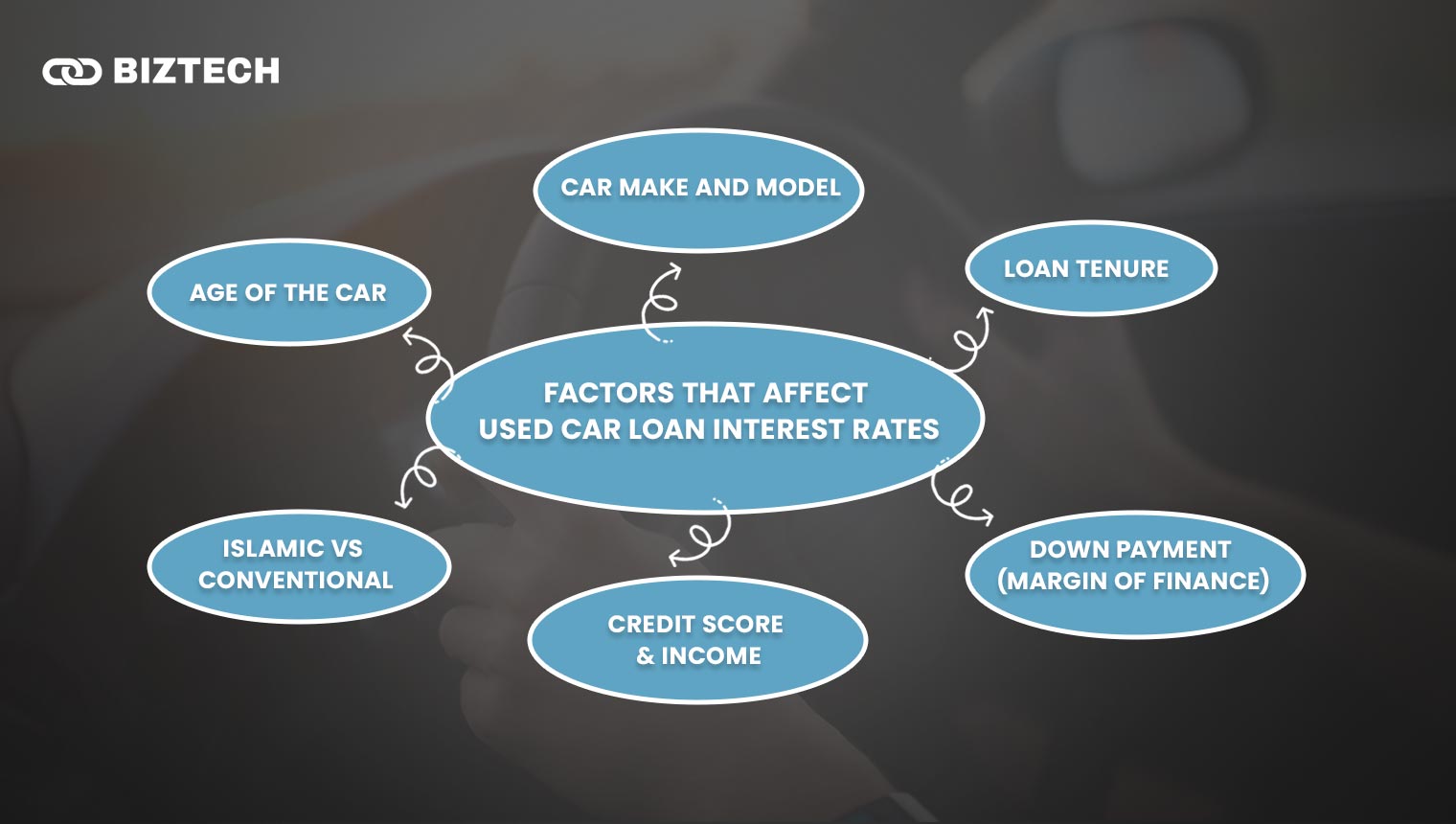
- Loan tenure: Longer tenures mean more total interest, even if the monthly instalment looks smaller.
- Car model: National cars (Proton, Perodua) generally get lower rates than foreign makes with higher maintenance costs.
- Age of the car: Vehicles over 10 years old are much harder to finance and attract higher rates and smaller margins, because of lower value and faster depreciation.
- Credit score and income: A clean CTOS/CCRIS record, stable employment and income above roughly RM4,000/month help you secure the lowest advertised rate; past late payments push you to the top of the range.
- Margin of finance: Most banks offer up to 90% for newer used cars but scale this down sharply with age (see below). A bigger down payment can sometimes win you a lower rate.
Financing margin by car age (2026)
| Car age | Typical financing margin | Down payment needed |
| 1 – 3 years | Up to 90% | ~10% |
| 4 – 5 years | 80% – 85% | 15% – 20% |
| 6 – 7 years | 70% – 80% | 20% – 30% |
| 8+ years | 70% or less | 30%+ |
Tips to Secure the Lowest Used Car Loan Interest Rate
1. Improve your credit score
Settle outstanding debts and keep a stable income before applying — a stronger profile qualifies you for the lowest advertised rate. Check where you stand first with our guide to checking your CTOS score.
2. Put down a larger deposit
Paying more than the minimum 10% shrinks your loan, lowers total interest, and can win you a better rate — especially useful for older cars where margins are tight.
3. Choose a shorter tenure
A 5-year loan has higher monthly payments than a 9-year one, but you pay far less interest overall and reduce the risk of negative equity on a depreciating used car.
4. Shop around and compare EIR
Get quotes from several banks and compare the published EIR, not just the flat rate. Watch for ongoing promotions too.
5. Time your purchase around promotions
Year-end and festive seasons often bring lower promotional rates from banks and dealerships. Timing your purchase can shave a meaningful amount off your total cost.
Used Car Loan Eligibility and Requirements
For Malaysians, the application requirements are straightforward:
- At least 18 years old with a stable, demonstrable income
- MyKad (NRIC) for Malaysians, or passport for foreigners
- Income documents: recent payslips, EPF statements or bank statements
- Proof of residence, such as a utility bill
- The car’s proforma invoice or booking receipt
For the vehicle itself, the used car must pass a PUSPAKOM inspection (request the B5 inspection report) and complete a valid JPJ ownership transfer before loan approval. It’s also wise to check the car’s blacklist status at JPJ, confirm the previous owner’s loan is fully settled, and review any accident history.
Most banks require the used car to be no older than 12–15 years at the end of the tenure. In practice, to take the longest 9-year tenure you’d usually need a car no older than about 6 years today. BSN’s MyAuto financing is more generous, financing vehicles up to 15 years old.
Common Pitfalls to Avoid
- Judging by flat rate alone: a low flat rate can hide a high EIR. From 2026, always compare the published EIR.
- Over-long tenure on an old car: stretching the tenure to lower the instalment risks negative equity as the car depreciates.
- Ignoring the margin: the “cheapest” bank may finance less of the car, demanding a bigger deposit.
- Skipping the PUSPAKOM and JPJ checks: an unsettled prior loan or a blacklisted vehicle can stall your approval.
Frequently Asked Questions
Conclusion
A used car loan isn’t as complicated as it looks once you understand how the rate is built. Compare the published EIR rather than the flat rate, match the tenure to the car’s age, and weigh the headline rate against the financing margin and deposit. The 2026 reducing-balance rules make early settlement fairer, which is good news if you tend to upgrade sooner.
Take your time, compare several banks, and time your purchase around festive promotions for the best deal. For related reading, see our guides on electric car loan rates and the best personal loans in Malaysia if you need extra financing.
Information verified June 2026. Rates, margins and promotions change frequently and vary by car, tenure and credit profile — always confirm the exact figures with the bank before signing. This guide is general information from Kayatoday and not financial advice.