Businesses in today’s digital world rely on software to manage their operations, serve customers, and remain competitive. But buying software is not enough — it needs to be set up, connected to your existing tools, and actually used by your team. This process is called software implementation.
- What is Software Implementation?
- Key Phases of the Software Implementation Process
- 1. Planning and Requirements Gathering
- 2. System Design and Customization
- 3. Installation and Deployment
- 4. Data Migration and Integration
- 5. Testing and Quality Assurance
- 6. Training and User Adoption
- 7. Go-Live and Post-Implementation Support
- How Long Does Software Implementation Take — and What Does It Cost?
- Big Bang, Phased, or Parallel? Choosing a Rollout Strategy
- Why Software Implementations Fail — The Numbers
- Best Practices for a Successful Software Implementation
- Set Realistic Timelines and Goals
- Involve Key Stakeholders and Get User Feedback Early
- Ensure Proper Change Management and Communication
- Have a Contingency Plan for Unexpected Issues
- Common Challenges in Software Implementation and How to Overcome Them
- Lack of Clear Objectives and Scope Creep
- Poor User Adoption Due to Inadequate Training
- Data Security and Compliance Issues
- Integration Difficulties with Existing Systems
- Strategies to Mitigate Risks and Ensure a Smooth Process
- Software Implementation in Malaysia and Singapore: Grants and Local Notes
- Conclusion
- Frequently Asked Questions (FAQs)
The stakes are higher than most people realise. Industry research consistently finds that the majority of large software projects miss their goals: analyses cited by McKinsey put ERP implementation failure at 55–75%, and Gartner has reported that more than 70% of ERP implementations fail to deliver their original business case. Roughly 47% of implementations run over budget, by an average of about 35%.
A well-planned implementation helps businesses work faster, reduce mistakes, and get the best return from their investment. A poor one leads to wasted money, frustrated employees, and — in the worst cases — abandoned systems. In this guide, we explain what software implementation is, the key phases, how long it takes and what it costs, why projects fail, and how Malaysian and Singaporean businesses can get government help to pay for it.
What is Software Implementation?
Software implementation refers to setting up and putting a new software system to work in a business or organization. It includes installing or configuring the software, migrating data, integrating it with existing tools, training users, and making sure it runs smoothly in daily operations.
Many people confuse software implementation with software development and software deployment. (If you’re still untangling the basics, see our guides on hardware vs software and firmware vs software.) They are related but different stages:
| Term | What it means | Who does it | Example |
|---|---|---|---|
| Software development | Creating the software — writing, testing, and building the product | The software vendor or an in-house dev team | A vendor builds an accounting app |
| Software deployment | Delivering and releasing the software so it can be installed or accessed | Vendor / IT team | The app is released to the cloud or installed on servers |
| Software implementation | Configuring, integrating, migrating data, training users, and embedding the software into daily work | The business, often with the vendor or a consultant | Your company sets up the accounting app, moves old records in, and trains the finance team |
Different industries use software implementation in unique ways:
- Healthcare: Hospitals implement systems to store patient records and schedule appointments.
- Finance: Banks implement software for online transactions and account management.
- Retail and e-commerce: Stores implement inventory, point-of-sale, and marketplace tools.
- Manufacturing: Factories implement ERP systems to link production, purchasing, and accounts.
Key Phases of the Software Implementation Process
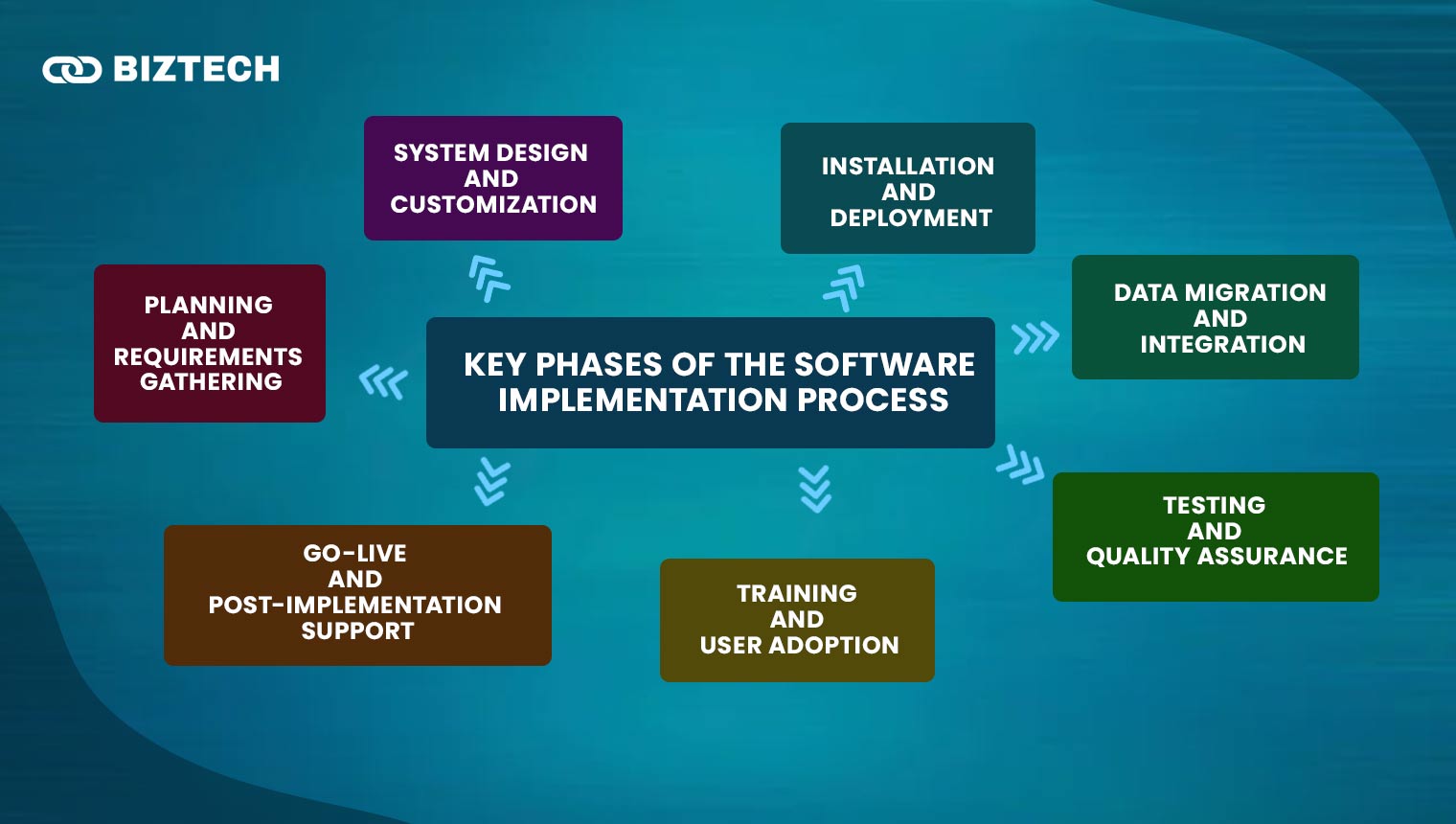
A successful software implementation follows a step-by-step process. Skipping any step can lead to problems, wasted money, and frustration. Below are the seven key phases that help businesses set up and use software the right way.
1. Planning and Requirements Gathering
Before implementing new software, businesses must first understand their requirements. Ask: What problems will this software solve? Which features are must-haves, and which are nice-to-haves? What will success look like in 12 months?
Once goals are clear, you can shortlist and choose the right software. Assign key people early — an executive sponsor who owns the outcome, a project lead, IT staff, and representatives of the employees who will actually use the system. Projects with a clearly accountable sponsor are far more likely to survive the difficult middle stretch.
2. System Design and Customization
Not all software works perfectly out of the box. Businesses may need to adjust settings, build workflows, or add features to fit their processes.
A word of caution from experienced implementers: customize as little as possible. Every customization adds cost, testing effort, and pain at every future upgrade. Where you can, adapt your process to the software’s standard way of working rather than bending the software to old habits. The software must also work seamlessly with the other tools the company already uses — map out every integration before you start building.
3. Installation and Deployment
Once the system is designed, it must be set up on computers, servers, or — most commonly today — a cloud platform. Cloud (SaaS) implementations are usually faster and cheaper to stand up, while on-premises installations give more control but need in-house infrastructure and maintenance.
After installation, basic testing confirms that everything works before the heavier phases begin.
4. Data Migration and Integration
Businesses frequently upgrade from older systems, which means moving data — customer records, sales history, stock balances — into the new software. This is consistently one of the most underestimated phases.
Clean the data before you move it: de-duplicate customer records, archive dead entries, and standardize formats. Migrating rubbish into a new system just gives you an expensive new home for old problems. Run trial migrations, reconcile record counts and totals, and confirm the new software talks correctly to the systems staying behind.
5. Testing and Quality Assurance
Businesses should thoroughly test the software before going live — functionality, speed, security, and the end-to-end business processes it supports (quote to cash, purchase to pay, and so on).
User acceptance testing (UAT) lets real employees run their real daily tasks in the new system and flag issues while they are still cheap to fix. Fixing bugs after go-live typically costs far more, both in money and in user trust.
6. Training and User Adoption
Even the best software is useless if people do not know how — or do not want — to use it. Training sessions, guides, video tutorials, and floor-walking support in the first weeks help employees get comfortable.
Treat adoption as a change-management project, not just a training checkbox: explain why the change is happening, involve influential team members as champions, and measure actual usage after launch rather than assuming attendance at training equals adoption.
7. Go-Live and Post-Implementation Support
After training and testing, the software is ready for full use — the “go-live.” Plan a hypercare period of two to six weeks with extra support on standby, monitor performance, fix issues fast, and gather feedback.
Afterwards, review the project against the goals set in phase 1: Did it deliver the promised benefits? What would you do differently? Ongoing support, updates, and periodic health checks protect the investment for years.
How Long Does Software Implementation Take — and What Does It Cost?
Timelines and budgets vary enormously with company size, software complexity, and how much data and integration work is involved. As a rough 2026 guide for business systems such as ERP, CRM, or accounting platforms:
| Business size | Typical timeline | Typical first-year cost (software + implementation) | Notes |
|---|---|---|---|
| Small business (cloud SaaS) | 8–12 weeks for simple tools; ~3–6 months for a small ERP | ~US$10,000–80,000 for a small ERP; far less for a single SaaS tool | Standard configuration, minimal customization |
| Mid-market | 4–9 months (6–12 with complex integrations) | ~US$150,000–750,000 for ERP-class projects | Services, migration, and training dominate the bill |
| Large enterprise (on-premise / multi-site) | 12–18+ months | Seven figures and up | Phased rollouts across sites are common |
Two budgeting rules of thumb: implementation services (consultants, data migration, training, change management) typically make up 50–70% of first-year spend — the licence itself is often only 20–30% — and consultant rates commonly run US$150–350 per hour. Always budget a contingency of at least 15–20%, since roughly half of projects overrun.
Big Bang, Phased, or Parallel? Choosing a Rollout Strategy
How you switch over matters as much as what you switch to. There are three classic approaches:
| Strategy | How it works | Pros | Cons | Best for |
|---|---|---|---|---|
| Big bang | Everyone moves to the new system on one date; the old one is switched off | Fastest; no double-entry; one training push | Highest risk — problems hit the whole business at once | Smaller firms, simpler systems, strong preparation |
| Phased | Roll out module by module, department by department, or site by site | Lower risk; lessons from early phases improve later ones | Longer project; temporary bridges between old and new systems | Mid-size and larger firms, multi-site businesses |
| Parallel | Run old and new systems side by side for a period, then cut over | Safest — the old system is a live fallback | Most expensive; staff enter everything twice; fatigue sets in | High-risk functions like payroll or regulatory reporting |
Many real projects mix approaches — for example, phased by department, with payroll run in parallel for two cycles before trust is established.
Why Software Implementations Fail — The Numbers
The statistics are sobering, and they have barely improved in a decade. Beyond the 55–75% ERP failure estimates above, around 70% of broader digital transformation programmes fail to reach their goals, and an estimated US$97 million of every US$1 billion spent on technology ends up tied to failed transformations.
The encouraging part: the causes are well understood and mostly human, not technical. The most common failure patterns and their fixes:
| Failure cause | What it looks like | How to prevent it |
|---|---|---|
| No clear objectives / scope creep | Requirements keep growing; the project drifts for months | Written goals and success metrics before starting; a change-control process for new requests |
| Weak executive sponsorship | Nobody senior clears roadblocks or defends the budget | Name one accountable sponsor with real authority |
| Underestimating data migration | Dirty, duplicated data delays go-live or corrupts reports | Clean data early; trial migrations; reconcile before cut-over |
| Poor user adoption | Staff quietly keep using spreadsheets and the old system | Involve users early, train properly, measure real usage after launch |
| Over-customization | Costs balloon; every upgrade becomes a mini-project | Adopt standard processes where possible; customize only for true differentiators |
| Unrealistic timeline and budget | Corners get cut on testing and training — the two things you need most | Realistic plan plus 15–20% contingency; never compress UAT |
Notably, implementations that bring in experienced consultants or implementation partners report success rates around 85% — dramatically higher than internal-only attempts — which is why the services line on the budget, painful as it looks, is usually money well spent (see Rand Group’s analysis of ERP failure rates). Increasingly, teams also lean on AI to speed up the technical work — from AI coding tools for integrations to autonomous agents like Devin AI for migration scripts — though these assist rather than replace a disciplined process.
Best Practices for a Successful Software Implementation
A well-planned software implementation helps businesses save time, avoid mistakes, and get the most from their investment. Following best practices makes the process smooth and stress-free.
Set Realistic Timelines and Goals
Rushing software implementation leads to mistakes. Set clear goals and a timeline that allows enough time for setup, testing, and training — using the benchmarks above as a sanity check. Breaking the project into manageable milestones keeps the team on track and makes progress visible.
Involve Key Stakeholders and Get User Feedback Early
Employees, managers, and IT teams should be involved from the start. Their feedback helps in choosing the right software and shaping the design. People support what they help build — users who feel heard are far more likely to embrace the new system rather than resist it.
Ensure Proper Change Management and Communication
Change is hard. Explain why the new software is needed and what’s in it for each team — not just for management. Regular updates, honest answers about what will change, visible champions in each department, and accessible support all reduce fear and speed up adoption.
Have a Contingency Plan for Unexpected Issues
Even the best plans hit problems — technical issues, data errors, or user confusion. Decide in advance what happens if go-live must be delayed, keep a rollback path for the first days, and have IT support, troubleshooting guides, and extra training ready so small issues do not become big ones.
Common Challenges in Software Implementation and How to Overcome Them
Many businesses experience issues during software implementation. If these challenges are not addressed properly, they can result in delays, additional costs, and frustration. Below are the most common ones and ways to fix them.
Lack of Clear Objectives and Scope Creep
Sometimes businesses start without a clear plan, then keep adding features, making the project longer and more costly. Set clear goals before you begin, and run every new request through a simple question: does this serve the original objective, or can it wait for phase two? A detailed roadmap keeps the project on track.
Poor User Adoption Due to Inadequate Training
Employees resist change when they are unsure how to use the new software. Offer workshops, video tutorials, and step-by-step guides — and keep help available after go-live, when the real questions surface. Watch usage data: if a team’s activity in the new system is low, intervene early.
Data Security and Compliance Issues
Moving data to a new system creates security and compliance risks. Use encryption in transit and at rest, strong access controls, and regular security checks — and vet the vendors themselves, since modern breaches increasingly arrive through the software supply chain. In Malaysia, personal data handling must comply with the PDPA 2010 (tightened by the 2024 amendments, including breach-notification duties); in Singapore, the PDPA applies similarly. Check where a cloud vendor stores your data before you sign.
Integration Difficulties with Existing Systems
The new software must work with the tools you keep. If it does not, employees end up re-keying data between systems — the very waste you bought the software to remove. Test every integration with real data volumes before go-live, and confirm the vendor’s connectors or APIs actually cover your use cases rather than trusting the brochure.
Strategies to Mitigate Risks and Ensure a Smooth Process
To avoid problems, businesses should:
- Plan ahead, set realistic goals, and add a 15–20% contingency.
- Appoint an accountable executive sponsor.
- Clean data before migrating it, and rehearse the migration.
- Train employees properly and support them after go-live.
- Use strong security measures and check PDPA compliance.
- Test thoroughly — including user acceptance testing — before full use.
- Offer ongoing support, updates, and a post-project review.
Read also: Hardware vs Software: Easy Guide to Learning The Differences
Software Implementation in Malaysia and Singapore: Grants and Local Notes
If you run an SME in Malaysia or Singapore, the government will often help pay for your software implementation:
- Malaysia — MSME Digital Grant MADANI (Geran Digital PMKS MADANI): administered through BSN with MDEC-listed technology service providers, it offers 50% matching funds of up to RM5,000 towards digital tools such as accounting software, e-commerce, POS, ERP/CRM systems, and productivity tools. Eligibility broadly requires at least 60% Malaysian ownership, SSM registration, six months of operation, and roughly RM50,000 minimum annual turnover — check the current terms with BSN before applying.
- Singapore — Productivity Solutions Grant (PSG): supports up to 50% of qualifying costs for pre-approved solutions (accounting, HR, CRM, cybersecurity, and more). Apply through the Business Grants Portal before committing to the purchase, using a quotation from a pre-approved vendor. See Enterprise Singapore for the current solution list and caps.
- Taxes and billing: Malaysian businesses pay 8% service tax on many software and digital services (including imported ones), while Singapore applies 9% GST — budget for this on top of quoted USD prices, and watch exchange-rate movements on multi-year subscriptions.
- Data protection: both countries’ PDPA regimes apply when you migrate customer data to new (often overseas-hosted) cloud systems — confirm hosting locations and sign the appropriate data-processing terms.
Conclusion
A well-planned software implementation helps businesses work more efficiently, reduce errors, and get the best results from their investment. Each phase — from planning and customization through migration, testing, training, and post-go-live support — plays a role in making the process smooth and successful.
The failure statistics are not a reason to avoid new software; they are a map of what to take seriously: clear goals, an accountable sponsor, clean data, honest timelines, real training, and proper testing. Businesses that respect those fundamentals — and, where it makes sense, bring in experienced implementation help and available grants — routinely land in the successful minority.
Before implementing new software, make a detailed plan. A strategic approach saves time, money, and effort — and your business will enjoy the benefits for years.
Details verified July 2026. Grant terms, support levels, and statistics change — confirm with the official agencies and your vendor before committing.
Frequently Asked Questions (FAQs)
Disclaimer: This article is for general information only and does not constitute professional, financial, or legal advice. Figures and grant terms were checked at the time of writing and may change. KayaToday is not affiliated with any vendor or agency mentioned. Always verify details with the official provider before making decisions.