The software supply chain is everything that goes into building and shipping software: your own source code, the open-source libraries you pull in, the build tools and CI/CD pipelines that assemble it, the container images you ship, and the cloud services and APIs it depends on. Just as a factory needs trusted raw materials, modern software is only as secure as the weakest link feeding into it.
- What Is a Software Supply Chain?
- How It Differs From a Traditional Supply Chain
- Key Components of a Software Development Supply Chain
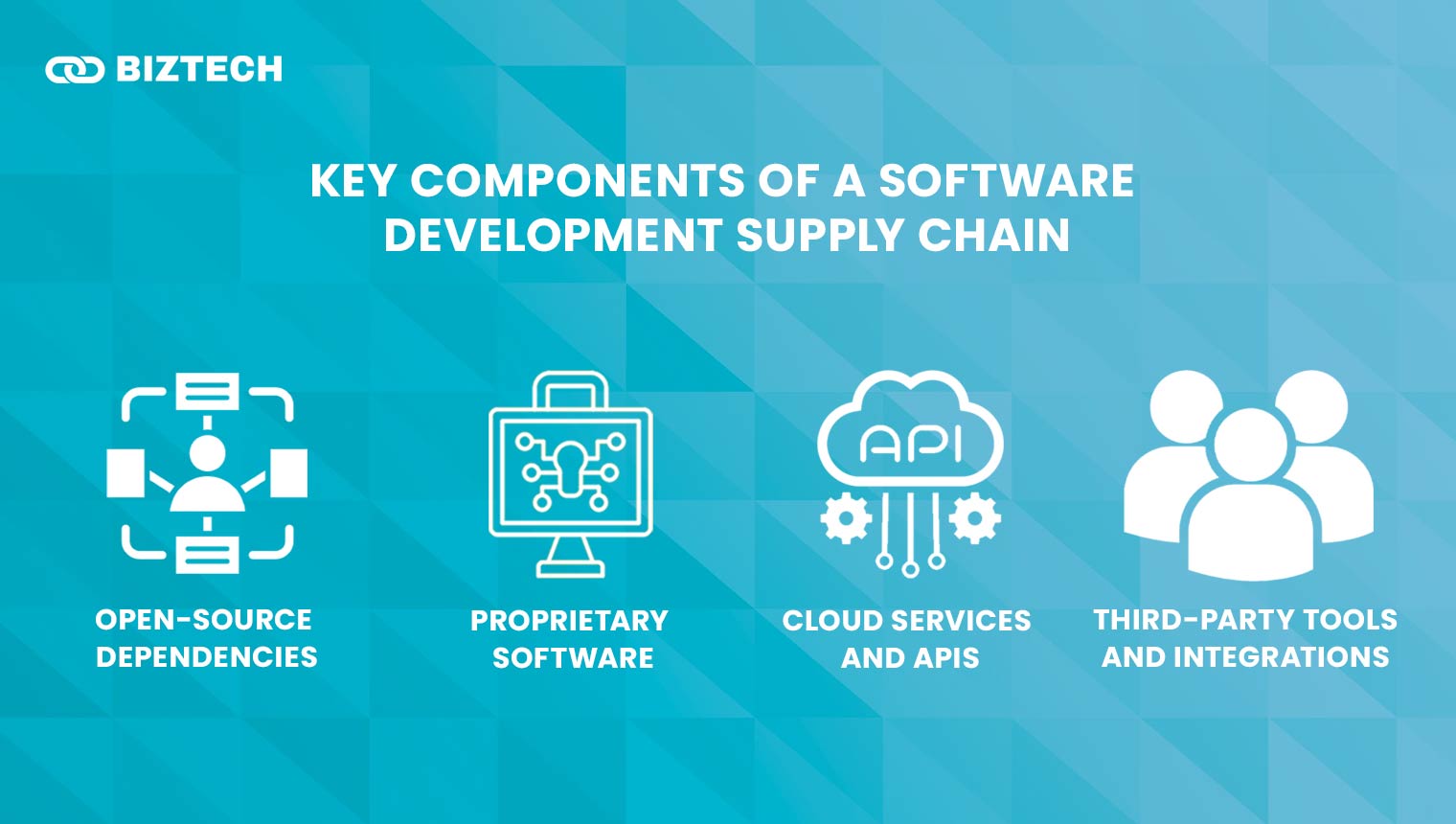
- 1. Open-Source Dependencies
- 2. Proprietary and First-Party Code
- 3. Build Systems and CI/CD Pipelines
- 4. Cloud Services and APIs
- 5. Third-Party Tools, Plugins and Integrations
- How a Software Supply Chain Attack Actually Works
- Real-World Software Supply Chain Attacks (2020–2026)
- Major Challenges in Software Supply Chain Security
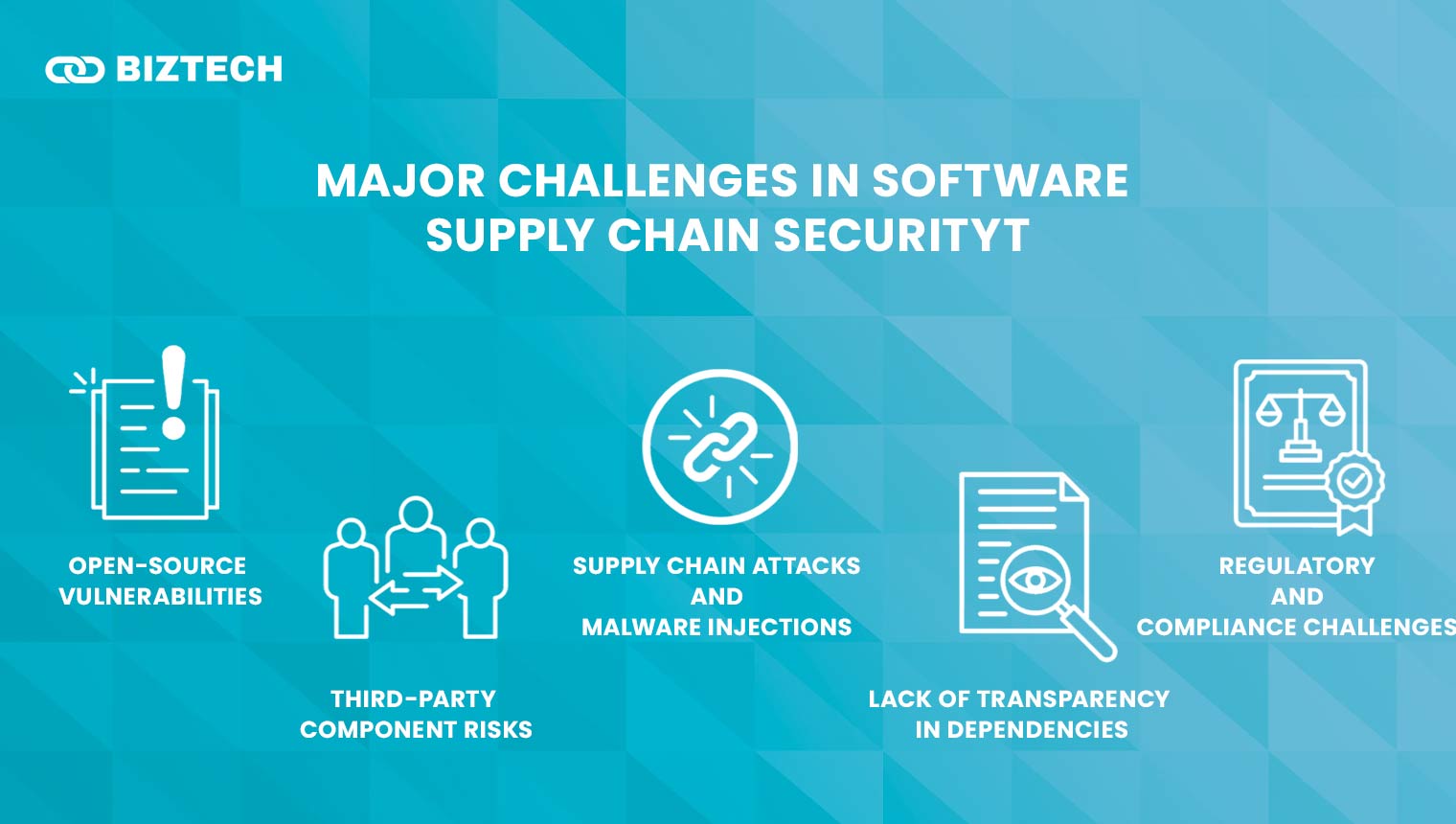
- 1. Open-Source Vulnerabilities
- 2. Third-Party Component Risks
- 3. Supply Chain Attacks and Malware Injections
- 4. Lack of Transparency in Dependencies
- 5. AI-Generated Code and “Slopsquatting”
- 6. Regulatory and Compliance Pressure
- Best Practices for Securing the Software Supply Chain
- 1. Generate and Maintain an SBOM
- 2. Verify Provenance and Sign Your Artifacts
- 3. Manage Dependencies Deliberately
- 4. Use Supply Chain Security Tools
- 5. Follow Secure Coding Practices
- 6. Run Regular Audits and Vulnerability Assessments
- 7. Integrate DevSecOps
- Key Frameworks and Standards to Know
- Regulations and Compliance in 2026
- Emerging Technologies and Trends
- AI and Automation — Both Threat and Defence
- Provenance, Attestation and Signing Go Mainstream
- Zero-Trust Architecture
- How to Choose Software Supply Chain Security Tools
- A Simple Way to Choose
- How Businesses Can Strengthen Their Software Supply Chain
- Conduct Vendor Risk Assessments
- Leverage SBOMs for Transparency
- Build a Security-First Culture
- How Top Tech Companies Do It
- Common Pitfalls to Avoid
- Software Supply Chain Security in Malaysia & Singapore
- A Worked Example: Securing a Malaysian SaaS Startup
- Conclusion
- Frequently Asked Questions
That chain has become the front line of cybersecurity. In 2025 there were roughly 9.8 trillion open-source package downloads across Maven Central, PyPI, npm and NuGet, and security firm Sonatype discovered more than 454,000 new malicious packages in a single year — open-source malware volume grew about 75% year over year. Attackers no longer just target your firewall; they target the components you trust and let you install the threat yourself.
This guide explains what the software supply chain is, walks through the real-world attacks that reshaped the field (SolarWinds, Log4j, the xz-utils backdoor and the self-spreading “Shai-Hulud” npm worm), and gives you a practical, 2026-ready playbook — SBOMs, the SLSA framework, DevSecOps, tooling and the compliance picture for Malaysia and Singapore.
What Is a Software Supply Chain?
The software supply chain is the full set of people, processes, tools and components involved in developing and delivering a piece of software. It includes everything developers touch — from open-source libraries and package registries to build servers, source-code repositories, cloud services and third-party APIs.
Think of it like a factory that needs raw materials to make a product. Software companies require safe, trusted digital resources at every stage. If just one part of the chain is weak — a compromised library, a hijacked build server, a leaked signing key — it can undermine the security of the entire product and every customer who installs it.
How It Differs From a Traditional Supply Chain
A traditional supply chain moves physical goods from one place to another. A software supply chain moves digital components — code, dependencies, container images and configuration.
The failure modes are different too. Physical chains worry about delayed shipments, damaged goods or counterfeit parts. Software chains worry about cyber threats: malicious code slipped into a trusted update, a dependency that quietly turns hostile, or credentials stolen from a build pipeline. And unlike a physical defect, a single poisoned software component can replicate across millions of systems in hours — automatically.
Key Components of a Software Development Supply Chain
1. Open-Source Dependencies
Developers use free, open-source code to build faster — and modern apps are mostly open source, with reused components often making up 80–90% of a typical codebase. That reuse is a huge productivity win, but if a library has a security flaw (or is deliberately poisoned), every project that pulls it in inherits the risk.
2. Proprietary and First-Party Code
This is the code your own team writes, plus any paid, closed-source software you license. It gives you more control, but still needs secure coding practices, code review and regular updates to stay safe.
3. Build Systems and CI/CD Pipelines
The build and continuous integration/continuous delivery (CI/CD) pipeline is where source code is compiled, tested and packaged. It is also a prime target: if an attacker controls the build, they can inject malicious code after your developers have written clean, reviewed source — exactly how the SolarWinds and xz-utils attacks worked.
4. Cloud Services and APIs
Most applications rely on cloud storage, managed databases and third-party APIs (an API is an interface that lets different software programs talk to each other). If one of those services is breached or misconfigured, the whole system can be exposed.
5. Third-Party Tools, Plugins and Integrations
Developers add analytics scripts, SDKs, browser extensions and integrations to extend functionality. Each one is code you did not write, running with your app’s trust. The 2024 polyfill.io incident — where a widely embedded JavaScript library began serving malicious code to more than 100,000 websites after a change of ownership — is a textbook example of this risk.
How a Software Supply Chain Attack Actually Works
Attackers don’t need to breach your network if they can compromise something you already trust. The open SLSA framework maps supply-chain threats to four main points in the chain — a useful mental model for defenders:
| Attack point | What the attacker does | Real-world example |
|---|---|---|
| Source | Sneaks malicious code into a repository via a compromised account, rogue contributor or poisoned pull request. | xz-utils backdoor (2024) |
| Dependencies | Publishes a malicious package, hijacks an existing one, or uses typosquatting so you install the wrong thing. | Shai-Hulud npm worm (2025) |
| Build | Compromises the CI/CD system so clean source is turned into a tampered binary during compilation. | SolarWinds Orion (2020) |
| Distribution | Tampers with the package after build — poisoning a registry, CDN or update server. | Codecov, polyfill.io |
The lesson: security has to cover every stage, not just the code your developers write. A signed, reviewed commit means little if the build server that compiles it has been hijacked.
Real-World Software Supply Chain Attacks (2020–2026)
Nothing explains supply-chain risk better than the incidents that defined it. These are the cases every developer and business leader should know:
| Incident (year) | What happened | Why it mattered |
|---|---|---|
| SolarWinds Orion (2020) | Attackers compromised the build pipeline and slipped a backdoor into signed software updates. | Around 18,000 organisations — including US government agencies — downloaded the trojanised update. The wake-up call for build security. |
| Log4Shell / Log4j (2021) | A critical flaw (CVE-2021-44228, CVSS 10) in a ubiquitous open-source logging library allowed remote code execution. | It sat inside millions of Java apps, most of which didn’t know they used it — proving why you need to know your dependencies. |
| Codecov (2021) | A widely used code-coverage tool was modified to quietly exfiltrate secrets and credentials from CI environments. | Thousands of organisations had tokens and keys stolen from their pipelines. |
| 3CX (2023) | A “cascading” attack: a compromised upstream vendor led to a trojanised 3CX desktop app. | First widely documented case of one supply-chain attack feeding directly into another. |
| MOVEit (2023) | The Cl0p group exploited a zero-day (CVE-2023-34362) in the MOVEit Transfer file-sharing tool. | Data from thousands of downstream organisations was stolen through a single vendor’s software. |
| xz-utils backdoor (2024) | A maintainer built up trust over ~3 years, then hid an SSH backdoor (CVE-2024-3094, CVSS 10) inside a core Linux compression library. | Caught almost by accident before it reached stable releases. Showed patient, likely state-sponsored infiltration of open source. |
| polyfill.io (2024) | After a change of ownership, a popular JavaScript library began serving malicious code. | Over 100,000 websites were affected at once through a single embedded script. |
| Shai-Hulud npm worm (2025) | The first self-propagating npm worm: infected packages harvested secrets with TruffleHog and auto-published to other packages the tokens could reach. | A second wave in late 2025 exposed 25,000+ GitHub repositories and hit packages from Zapier, ENS, PostHog and Postman. |
The trend is clear: attacks are moving “upstream” — into the open-source components, build tools and registries that everyone shares — because one compromise there can reach thousands of victims at once.
Major Challenges in Software Supply Chain Security
The software supply chain faces many risks that can cascade into serious business problems. Cybercriminals target the weak spots between components, so security has to be treated as an end-to-end concern.
1. Open-Source Vulnerabilities
Because open-source code is shared so widely, one flaw can affect countless systems. It’s made harder by a data gap: Sonatype found that roughly 65% of open-source CVEs still lack an official CVSS severity score from the US National Vulnerability Database, and the median time to score one in 2025 was about 41 days — so teams are often flying blind on how urgent a fix really is.
2. Third-Party Component Risks
Businesses use third-party software to save time, but each vendor’s weakness can become your own. If a supplier doesn’t follow strict security practices, attackers can ride their trusted software straight into your systems.
3. Supply Chain Attacks and Malware Injections
Attackers inject malicious code during development, build or updates — often via a compromised maintainer account or CI system. Once installed, the infected software can steal data or spread further, and worm-like malware such as Shai-Hulud can propagate automatically across a registry.
4. Lack of Transparency in Dependencies
Modern software is a stack of dependencies that themselves have dependencies (so-called transitive dependencies). Without a clear Software Bill of Materials (SBOM), businesses often can’t answer a basic question — “what is actually inside our software?” — which makes responding to the next Log4Shell painfully slow.
5. AI-Generated Code and “Slopsquatting”
This is the newest risk. When AI coding assistants suggest packages, they sometimes invent ones that don’t exist — Sonatype’s testing found a leading model hallucinated component versions about 28% of the time, and attackers now pre-register those hallucinated names with malware waiting inside (“slopsquatting”). Blindly installing what an AI recommends can pull a threat straight into your build. For more on where AI helps and where it misfires, see our explainer on generative AI vs predictive AI.
6. Regulatory and Compliance Pressure
Governments increasingly require SBOMs, vulnerability reporting and secure-development evidence. Keeping up — especially across multiple markets — is now a real operational burden, and non-compliance can mean fines, lost contracts and reputational damage.
Best Practices for Securing the Software Supply Chain
Securing the chain is about layering defences across every stage. Here are the practices that deliver the most protection for the effort:
1. Generate and Maintain an SBOM
A Software Bill of Materials is a machine-readable inventory of every component in your software. Produce one for every release in a standard format (SPDX or CycloneDX) so that when the next critical vulnerability drops, you can answer “are we affected?” in minutes, not weeks.
2. Verify Provenance and Sign Your Artifacts
Provenance is tamper-evident proof of how and where something was built. Adopting the SLSA framework’s build levels and signing artifacts (for example with keyless signing via Sigstore/cosign) lets downstream users verify that what they received is exactly what you built — closing the door on build- and distribution-stage tampering.
3. Manage Dependencies Deliberately
Pin dependencies to specific, verified versions; use lockfiles; and enable automated tools that flag or block malicious and vulnerable packages before they enter your codebase. Treat a new dependency like a hire — check its reputation, maintenance and permissions first.
4. Use Supply Chain Security Tools
Software Composition Analysis (SCA) and related tools scan for known vulnerabilities, watch third-party components for malicious behaviour, and alert teams to risky changes. Automation and AI-assisted monitoring make this practical at scale (more on specific tools below).
5. Follow Secure Coding Practices
Reduce the attack surface in your own code: write and test defensively, never hardcode passwords or API keys, use secrets managers, and encrypt sensitive data. Secure coding blocks many of the injection and credential-theft techniques attackers rely on.
6. Run Regular Audits and Vulnerability Assessments
Continuously scan for outdated or weak components, fix issues before they’re exploited, and confirm you still meet compliance requirements. “Continuous” is the key word — a once-a-year audit can’t keep pace with a threat landscape that moves weekly.
7. Integrate DevSecOps
DevSecOps (Development, Security and Operations) builds security into the pipeline instead of bolting it on at the end. It lets teams catch vulnerabilities early, automate security testing, and create a culture where security is everyone’s job — the same shift-left thinking behind sound software implementation in general.
Key Frameworks and Standards to Know
You don’t have to invent supply-chain security from scratch. A handful of open standards now define best practice — and increasingly underpin regulation:
| Standard | What it does | Who’s behind it |
|---|---|---|
| SLSA (Supply-chain Levels for Software Artifacts) | A graded checklist (Build Levels 1–3) for producing tamper-resistant build provenance. | OpenSSF |
| SBOM: SPDX | A widely used, ISO-standardised SBOM format for listing components and licences. | Linux Foundation / ISO |
| SBOM: CycloneDX | A security-focused SBOM format popular in AppSec tooling. | OWASP |
| NIST SSDF (SP 800-218) | The Secure Software Development Framework — the reference set of secure-dev practices. | NIST (US) |
| Sigstore | Free, keyless signing and verification of software artifacts. | OpenSSF |
| OpenSSF Scorecard | Automated health/security checks that rate the risk of an open-source project. | OpenSSF |
You rarely adopt just one. A common combination is: use an SBOM to know what’s in your software, SLSA to prove how it was built, and Sigstore to sign it so others can verify both.
Regulations and Compliance in 2026
Supply-chain security is now law in major markets, not just a best practice. Two frameworks matter most:
| Regulation | Key dates | What it requires |
|---|---|---|
| EU Cyber Resilience Act (CRA) | In force 10 Dec 2024; vulnerability & incident reporting from 11 Sep 2026; full obligations from 11 Dec 2027. | SBOMs in technical documentation, secure-by-design, vulnerability handling and security updates for products with digital elements. Fines up to €15M or 2.5% of global turnover. |
| US Executive Order 14028 & follow-ups | Issued 2021; still in force. 2026 memo (M-26-05) shifted federal buyers to a risk-based approach. | Kick-started SBOM adoption and secure-dev attestation. Agencies now have more discretion, but NIST’s SSDF remains the authoritative baseline and SBOM expectations persist across industry. |
The direction of travel is one-way: even where specific mandates have softened, buyers, insurers and enterprise customers increasingly expect SBOMs and provenance as a condition of doing business. (For the Malaysia and Singapore picture, see the dedicated section below.)
Emerging Technologies and Trends
The field keeps evolving as both attackers and defenders adopt new tools. Here’s where things are heading.
AI and Automation — Both Threat and Defence
AI is a double-edged sword. On defence, AI-assisted tools detect anomalies, triage vulnerabilities and spot malicious package behaviour faster than humans can. On offence, attackers use AI to generate convincing malicious packages at scale, and developers risk installing AI-hallucinated dependencies (the “slopsquatting” problem above). The takeaway: use AI to defend, but never trust AI-suggested components without verification. Autonomous coding agents like Devin AI make this discipline even more important, since they can pull in dependencies on their own.
Provenance, Attestation and Signing Go Mainstream
Cryptographic provenance — verifiable records of what a component is and how it was built — is becoming standard. Build platforms such as GitHub Actions and GitLab CI now generate SLSA provenance natively, and keyless signing via Sigstore is production-ready. Some organisations also explore blockchain-style ledgers for tamper-proof records of component origin, though signed attestations (SLSA + Sigstore) are the practical mainstream approach today.
Zero-Trust Architecture
Zero trust assumes no user, device or component is automatically trustworthy and verifies at every step. Applied to the supply chain, that means least-privilege access for build systems, continuous monitoring of pipeline activity, and multi-factor authentication on maintainer and CI accounts — the exact controls that would have blunted several attacks in the table above.
How to Choose Software Supply Chain Security Tools
No single tool covers everything. The market splits into categories — software composition analysis (SCA), malicious-package detection, secret scanning, CI/CD security, container hardening, and SBOM/provenance — and most teams end up combining four or five. Here’s how the best-known 2026 options compare:
| Tool | Best for | Notes |
|---|---|---|
| GitHub Dependabot | Getting started for free | Built into GitHub; alerts on vulnerable dependencies and opens update PRs automatically. The easiest first step. |
| Snyk | All-round AppSec | Broad platform covering open-source, container, IaC and code security. A safe default when supply chain is part of wider AppSec. |
| Sonatype Nexus | Policy & governance at scale | Veteran SCA with reachability analysis and a strong policy engine for enforcing open-source usage rules. |
| Socket | Catching malicious packages | Purpose-built to detect npm/PyPI supply-chain attacks by analysing package behaviour, not just known CVEs. |
| Chainguard | Hardened images & provenance | Minimal, near-zero-CVE container images with automatic SBOMs and SLSA attestations. |
A Simple Way to Choose
If you’re a small team on GitHub, start with Dependabot (free) and add Socket to catch malicious packages. Growing product teams usually add Snyk or Sonatype for policy and depth. If you ship containers, Chainguard-style hardened images cut your vulnerability count dramatically. Match the tool to your biggest gap first, rather than buying a platform you won’t fully use.
How Businesses Can Strengthen Their Software Supply Chain
Tools alone aren’t enough — strengthening the chain is also strategic and cultural. Here’s a practical playbook.
Conduct Vendor Risk Assessments
Evaluate a vendor’s security posture before you integrate their software, require them to meet defined security standards, and re-audit periodically. A supplier’s weakness can become yours overnight.
Leverage SBOMs for Transparency
Maintain an SBOM for every product so you can quickly identify at-risk dependencies, confirm components are patched, and satisfy compliance requests. Ask your vendors for their SBOMs too — you can’t secure what you can’t see.
Build a Security-First Culture
Make security a shared responsibility, not just the IT department’s job. Train developers on secure coding, bake security testing into every stage, and reward teams for catching vulnerabilities early rather than punishing them for finding problems.
How Top Tech Companies Do It
The leaders treat this as core infrastructure: Google runs AI-driven monitoring of the open-source ecosystem and helped create SLSA; Microsoft enforces zero-trust across its build and release process; and Apple gatekeeps third-party software through a strict review pipeline before it reaches users. The common thread is verification at every stage, not trust by default.
Common Pitfalls to Avoid
Even well-meaning teams trip over the same mistakes:
- Trusting AI-suggested packages blindly. Verify that a recommended dependency actually exists and is reputable before installing it.
- Ignoring transitive dependencies. The risky component is often a dependency-of-a-dependency you never chose directly — which is exactly what an SBOM surfaces.
- Generating an SBOM once and forgetting it. An SBOM is only useful if it’s produced for every release and actually monitored.
- Leaving CI/CD credentials over-privileged. Stolen build tokens were central to Codecov and Shai-Hulud. Apply least privilege and rotate secrets.
- Treating security as a one-off audit. Threats evolve weekly; monitoring must be continuous.
- Skipping MFA on maintainer accounts. Many attacks start with a single phished developer login.
Software Supply Chain Security in Malaysia & Singapore
For teams building or buying software in Malaysia and Singapore, supply-chain security is now firmly on the regulatory and operational agenda.
Malaysia. The Cyber Security Act 2024 (Act 854) came into force on 26 August 2024, overseen by the National Cyber Security Agency (NACSA). It sets duties for National Critical Information Infrastructure (NCII) entities — risk assessments, audits and incident reporting — and introduces licensing for cyber-security service providers. One notable gap: unlike Singapore, Act 854 does not currently extend mandatory reporting to incidents involving third-party vendors and supply chains, so NCII owners should manage vendor and supply-chain risk proactively rather than assume it’s covered by the letter of the law.
Singapore. The Cybersecurity Act 2018, administered by the Cyber Security Agency of Singapore (CSA), sets comparable obligations for Critical Information Infrastructure. CSA is also active on live threats — it issued a public advisory during the 2025 Shai-Hulud npm supply-chain attack, urging developers to audit dependencies and rotate exposed secrets. Singapore government tech teams have also published guidance referencing SLSA for build integrity.
What it means locally. Most tools and standards here (Snyk, Sonatype, Sigstore, SLSA) are global and priced in USD, so budget for foreign-exchange and the 8% SST in Malaysia or 9% GST in Singapore on top of list prices. And whatever your sector, personal-data handling still falls under Malaysia’s PDPA and Singapore’s PDPA — a breach that flows in through a compromised component is still your reporting obligation. Supply-chain hygiene sits alongside broader defences like IoT cybersecurity and understanding the difference between firmware and software updates.
A Worked Example: Securing a Malaysian SaaS Startup
Imagine a small KL-based fintech shipping a web app on npm and Python, deployed via GitHub Actions. A pragmatic, low-cost hardening path might be:
- Week 1 — Visibility. Turn on GitHub Dependabot (free) and generate a CycloneDX SBOM in the build so the team finally knows every dependency.
- Week 2 — Malicious-package defence. Add Socket to flag risky npm/PyPI packages before merge, and enable MFA on all GitHub and package-registry accounts.
- Week 3 — Build integrity. Use GitHub Actions’ native provenance and sign release artifacts with Sigstore/cosign, targeting SLSA Build Level 2.
- Ongoing. Pin dependencies, rotate CI secrets quarterly, and keep the SBOM updated each release so a future Log4Shell-style scramble takes minutes, not days.
None of these steps require an enterprise budget — the biggest wins come from visibility, MFA and signing, not expensive platforms.
Conclusion
The software supply chain has become one of the most important — and most attacked — parts of modern technology. From SolarWinds to the self-spreading Shai-Hulud worm, the pattern is consistent: attackers compromise something you trust so you deploy the threat yourself.
The good news is that the defensive playbook is now mature and largely open source. Know what’s in your software with an SBOM, prove how it was built with SLSA and Sigstore, manage dependencies deliberately, integrate DevSecOps, and apply zero-trust thinking to your build pipeline. Layer in the right tools for your biggest gaps, keep an eye on evolving rules like the EU CRA and Malaysia’s Cyber Security Act 2024, and you turn the supply chain from a liability into a genuine competitive strength. Start with visibility today — you can’t protect what you can’t see.
Figures and regulatory dates verified July 2026. Tool pricing, framework versions and compliance deadlines change frequently — always confirm against the official source before you rely on them.
Frequently Asked Questions
Disclaimer: This guide is published by KayaToday for general educational purposes only and is not security, legal or compliance advice. Tools, prices, framework versions and regulations change and vary by organisation — verify details with the official provider or a qualified professional before making decisions for your business.