If you were anywhere near the internet in early 2025, you could not have avoided the name ‘DeepSeek’. The Chinese AI lab’s R1 reasoning model briefly wiped hundreds of billions of dollars off US tech stocks, topped app store charts worldwide, and forced every big AI company to answer one uncomfortable question: why does frontier AI cost so much?
- What is DeepSeek?
- DeepSeek’s major releases at a glance
- How Does It Work?
- What is DeepSeek R1, and where does it fit now?
- Is DeepSeek Free?
- Features of DeepSeek and Our Experience Using DeepSeek
- Important Key Features
- Solid Industry-Specific Insights
- DeepSeek vs ChatGPT in 2026
- Is DeepSeek Safe? Privacy Concerns and Government Bans
- DeepSeek for Malaysia and Singapore Users
- Should You Use DeepSeek? A Quick Decision Framework
- Common Pitfalls to Avoid
- What’s in Store for DeepSeek’s Future?
- Impacts of DeepSeek on the AI Industry
- Opinions in the Industry on DeepSeek
- Frequently Asked Questions
- Conclusion
A year and a half later, DeepSeek is no longer just a viral moment. Its latest release, DeepSeek-V4 (April 2026), is an open-weights model that benchmarks alongside the best closed models from OpenAI, Google, and Anthropic — and the chatbot is still completely free to use.
In this guide, we cover everything you need to know about DeepSeek in 2026: what it is, how it works, whether it is safe, how it compares with ChatGPT, and what Malaysian and Singaporean users should keep in mind before typing anything sensitive into it.
What is DeepSeek?
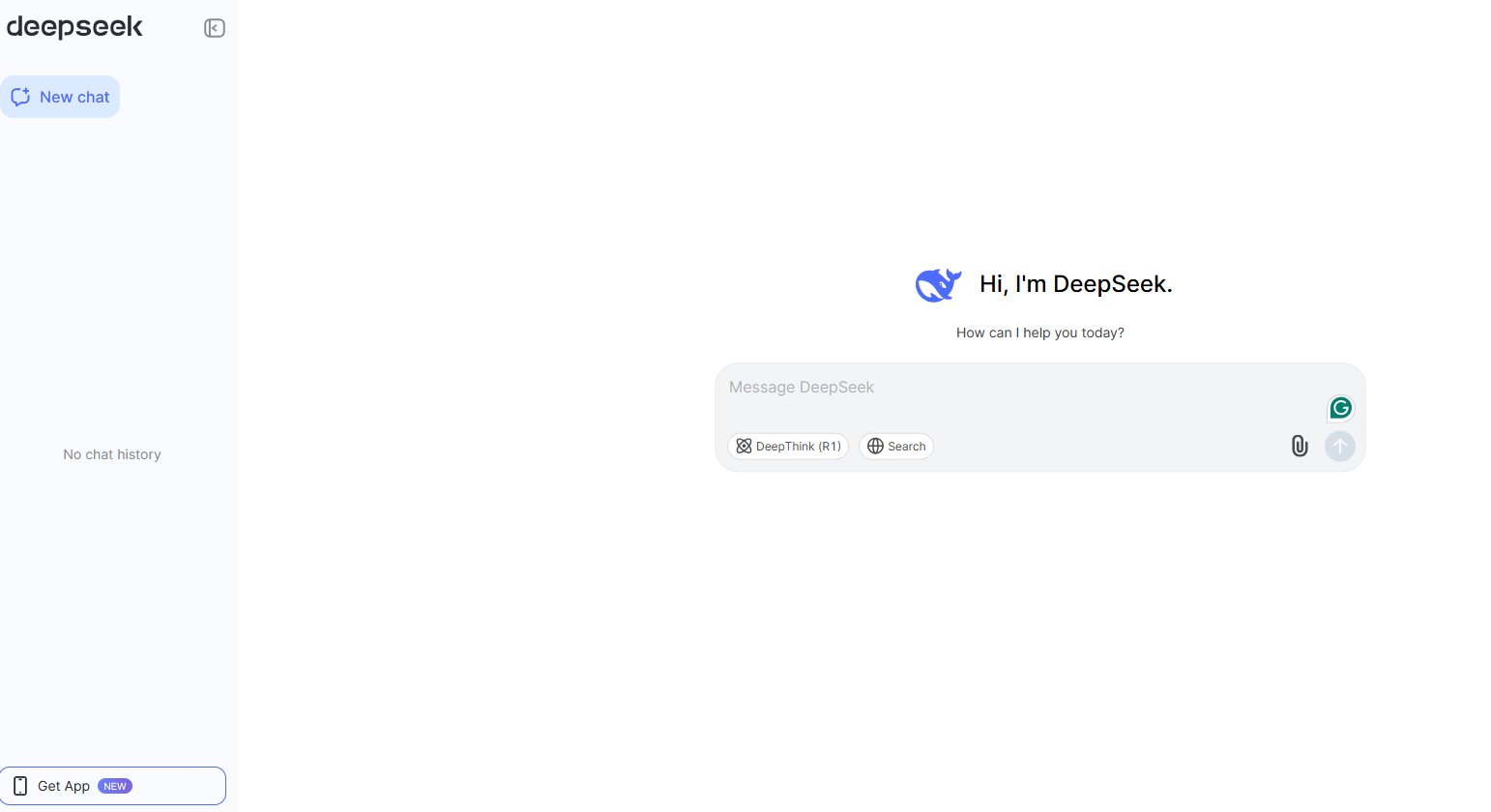
DeepSeek is a family of large language models (LLMs) built by DeepSeek (深度求索), an AI research lab based in Hangzhou, China. The company was founded in 2023 by Liang Wenfeng and is backed by High-Flyer, the quantitative hedge fund he co-founded. Like ChatGPT, Google Gemini, or Claude, DeepSeek can answer questions, write and debug code, summarise documents, and reason through complex multi-step problems.
Two things made DeepSeek a global story rather than just another chatbot:
- It is open weights. DeepSeek publishes its model weights on Hugging Face, so researchers and companies can download, inspect, fine-tune, and self-host the models rather than renting access to a black box.
- It is radically cheap. DeepSeek claims to train and serve frontier-class models at a fraction of what US labs spend, and its API prices undercut most competitors by an order of magnitude.
DeepSeek’s major releases at a glance
DeepSeek ships fast. Here is the release timeline that matters, based on DeepSeek’s official changelog:
| Release | Date | Why it mattered |
| DeepSeek-V3 | December 2024 | First frontier-class general model; reportedly trained for a fraction of typical frontier costs |
| DeepSeek-R1 | January 2025 | The reasoning model that shook global markets; open weights with near-o1 performance |
| R1-0528 | May 2025 | Major R1 upgrade: better reasoning benchmarks, fewer hallucinations, function calling |
| DeepSeek-V3.1 | August 2025 | Hybrid architecture: one model with both ‘thinking’ and ‘non-thinking’ modes |
| DeepSeek-V3.2 | December 2025 | Stronger reasoning; the Speciale variant reached gold-medal level on olympiad-style maths |
| DeepSeek-V4 (Flash & Pro) | April 2026 | Current flagship: 1M-token context, open weights, benchmarks alongside top closed models |
How Does It Work?
Under the hood, DeepSeek’s models use a Mixture-of-Experts (MoE) design. Instead of firing up the entire neural network for every word, the model routes each token to a small subset of specialised ‘experts’. DeepSeek-V4-Pro, for example, has about 1.6 trillion total parameters but activates only around 49 billion per token — which is a big part of why it is so cheap to run.
In practice, three capabilities define the experience:
- Language understanding: DeepSeek parses the context, structure, and tone of your prompt, and V4’s one-million-token context window means it can ingest entire codebases or long reports in a single conversation.
- Coding and debugging: DeepSeek has always punched above its weight on programming tasks — it can write, explain, and debug code across the most-used languages, which is why it shows up in so many AI coding tool stacks.
- Reasoning (‘thinking mode’): Since V3.1, DeepSeek models can switch between fast answers and a slower ‘thinking’ mode that works through problems step by step — pattern recognition, logical deduction, and breaking big tasks into smaller chunks.
What is DeepSeek R1, and where does it fit now?
A common misconception (one the earlier version of this article shared) is that R1 meant ‘Release 1’. It doesn’t. R1 was DeepSeek’s dedicated reasoning model — the ‘R’ is for reasoning — released in January 2025 as an open-weights answer to OpenAI’s o1. It showed its chain of thought, excelled at maths and code, and its weights were published under a permissive licence.
As of 2026, R1 is effectively a legacy line. Its reasoning abilities have been folded into the hybrid V3.1/V3.2/V4 models, which offer both a quick mode and a thinking mode in a single model. If you use the DeepSeek app or website today, you are talking to DeepSeek-V4. For a deeper look at how reasoning-style AI differs from other approaches, see our guide to generative AI vs predictive AI.
Is DeepSeek Free?
For everyday users — yes, still. The web chat (chat.deepseek.com) and the official iOS/Android apps remain completely free in 2026, with no premium consumer tier. That remains one of DeepSeek’s sharpest advantages over ChatGPT Plus (US$20/month) and Google’s paid Gemini plans.
Developers pay for the API, but the prices are famously low. Official rates as of July 2026:
| Model | Input (per 1M tokens) | Input, cache hit | Output (per 1M tokens) |
| DeepSeek-V4-Flash | US$0.14 | US$0.0028 | US$0.28 |
| DeepSeek-V4-Pro | US$0.435 | US$0.003625 | US$0.87 |
For comparison, flagship closed models from US labs typically cost several dollars per million output tokens. Note for developers: the legacy API model names deepseek-chat and deepseek-reasoner are deprecated as of 24 July 2026 — switch to deepseek-v4-flash or deepseek-v4-pro.
Features of DeepSeek and Our Experience Using DeepSeek
We first put DeepSeek to a hands-on test in early 2025, when R1 was making headlines, and we have re-checked the experience on DeepSeek-V4 in July 2026. The core impressions below still hold — V4 is simply faster and noticeably stronger at long, structured tasks.
We designed our test prompt to answer some major questions about DeepSeek’s capabilities:
- Can DeepSeek generate organised answers that include industry-specific insights?
- Is DeepSeek able to analyse, research, and reason through its outputs?
- Does it break output down into logical, bite-sized information?
- Can it provide technical data and balance that information with real applications?
So, the prompt that we tested DeepSeek with was:
‘As the new business development manager, I am developing a market entry strategy for an electric vehicle (EV) startup in Southeast Asia. Provide a structured analysis covering the below topics that will be presented to the company:
1. Market demand and trends
2. Key competitors and their strengths/weaknesses
3. Regulatory challenges and incentives
4. Consumer pain points and how to address them
5. A recommended business model and pricing strategy based on local conditions’
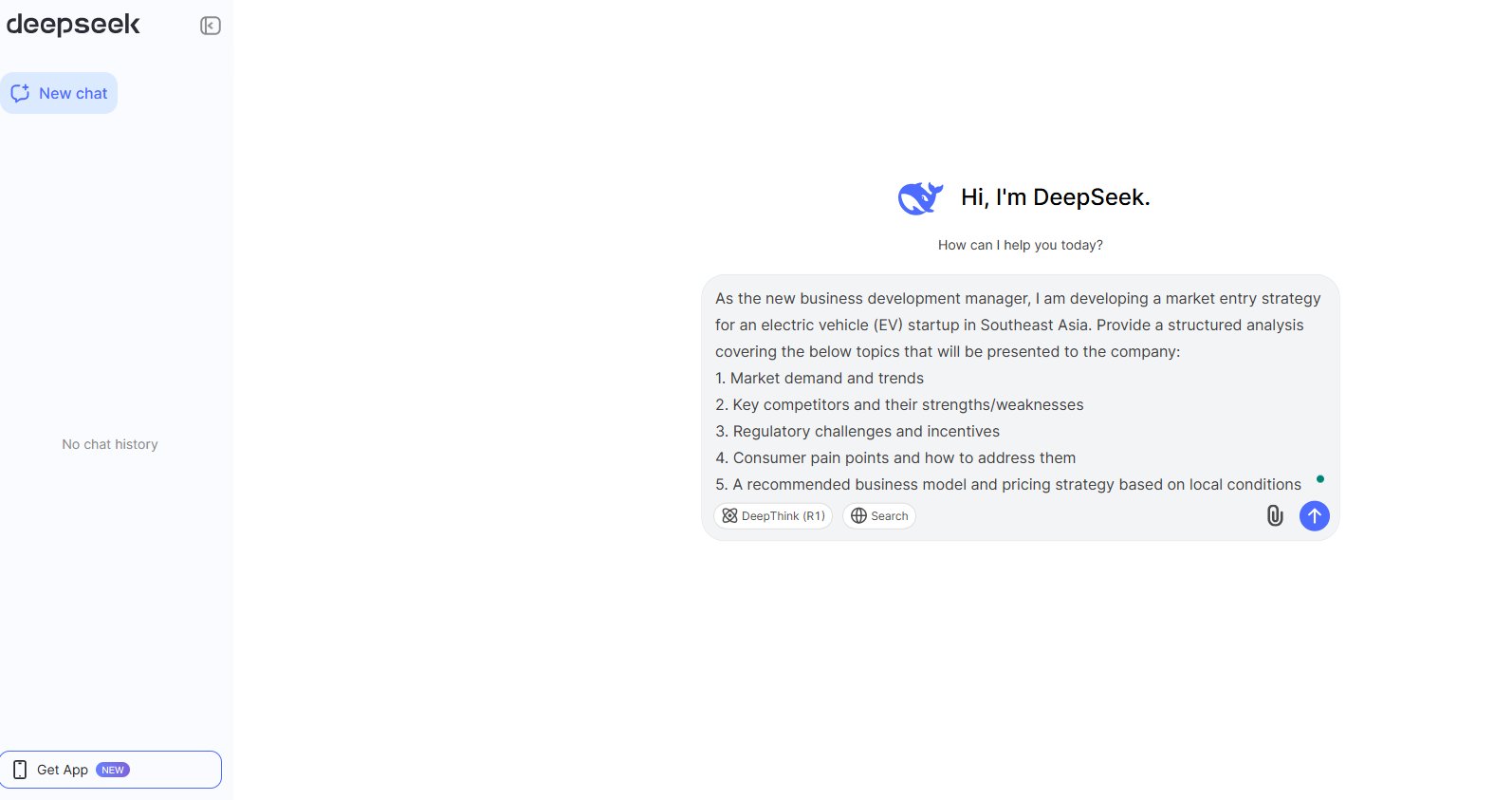
Here’s our take on DeepSeek’s features and user experience after running the prompt above:
First Impression
DeepSeek’s UX and UI are very simple. Like ChatGPT, you can create an account via Google to save your conversations.
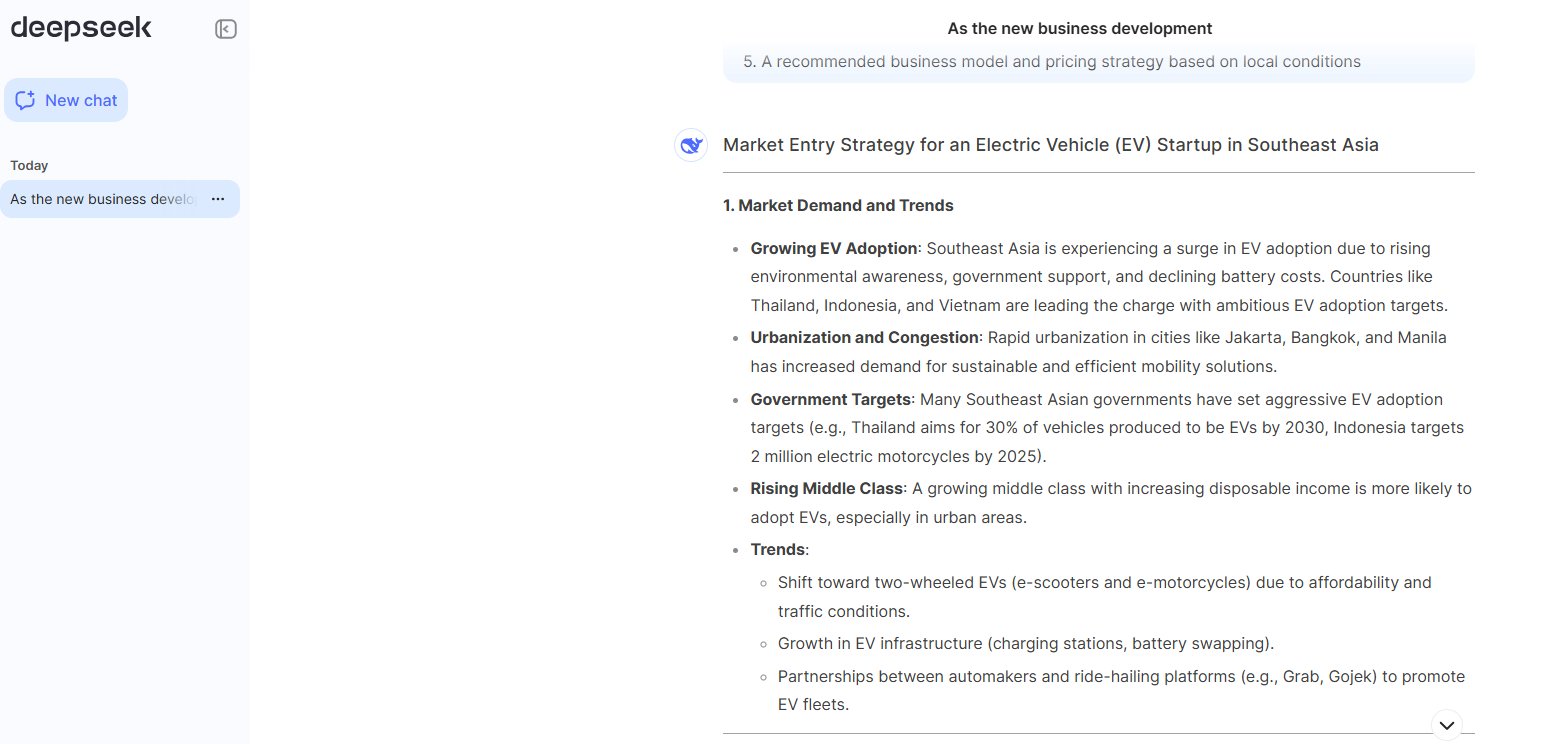
Response time was quick — roughly 15 seconds for a full multi-part answer in our original test, and faster still on V4 in 2026 unless you enable the deeper ‘thinking’ mode, which trades speed for more careful reasoning.
The response was structured and logical. It categorised the answer with numbers, bullets, and bolded sub-topics, which made reading very easy.
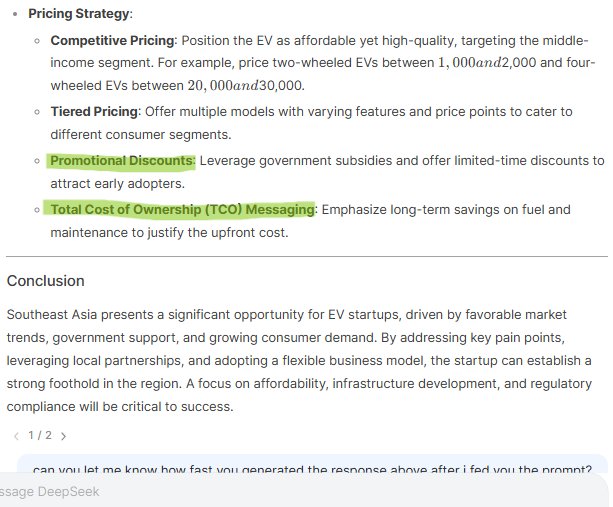
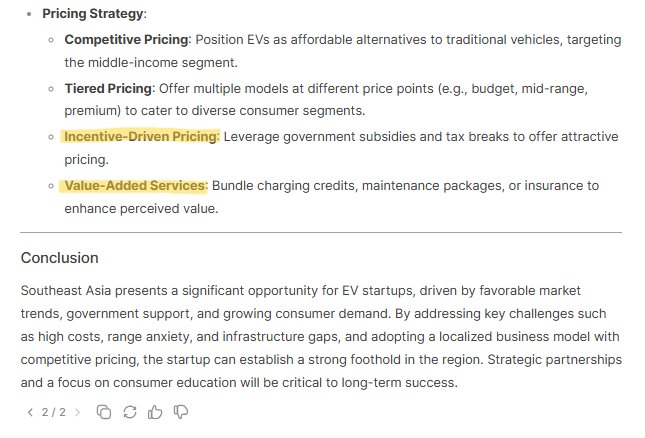
Much like ChatGPT, DeepSeek also lets you regenerate a response if you are unhappy with the output.
However, upon clicking ‘regenerate response’, we found the answers were not significantly different. There were some additional pointers, but most content was reworded.
(Different answers are highlighted in green in the first response and yellow in the second response. The rest of the answers remain the same.)
Important Key Features
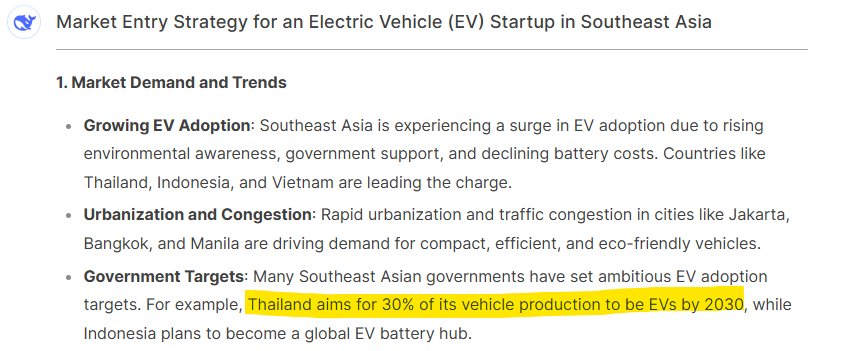
In its responses, it was surprising to note that DeepSeek provided answers that were well thought out instead of just stating obvious factors.
For example, when answering the market demands and trends for EVs, it provided data supporting its claims.
Solid Industry-Specific Insights
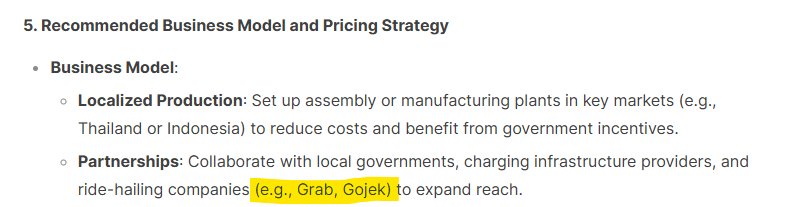
Another feature that impressed us was its ability to include specific industry examples when recommending business and pricing strategies.
For example, it specifically named the two giant ride-hailing companies based in Southeast Asia.
DeepSeek vs ChatGPT in 2026
Many of us are familiar with ChatGPT. But how does it actually compare with DeepSeek today?
We fed both models the same EV market-entry prompt in our original test, and re-ran the comparison against the current free tiers in July 2026. Here is where things stand:
| Aspect | DeepSeek (V4) | ChatGPT |
| Price | Completely free (web + app); very cheap API | Free tier available; Plus US$20/month for the best models and fewer limits |
| Depth of information | Deep, detail-oriented answers with relevant industry examples | Strong, but free tier tends toward broader, more general answers |
| Structure of answers | Well structured, good readability | Well structured, good readability |
| Creativity | Solid but sometimes ‘safe’, formulaic recommendations | More creative and varied phrasing |
| Openness | Open weights — downloadable, self-hostable | Closed — API and app access only |
| Ecosystem | Chat, API, open models; fewer integrations | Huge ecosystem: voice, image generation, custom GPTs, plugins |
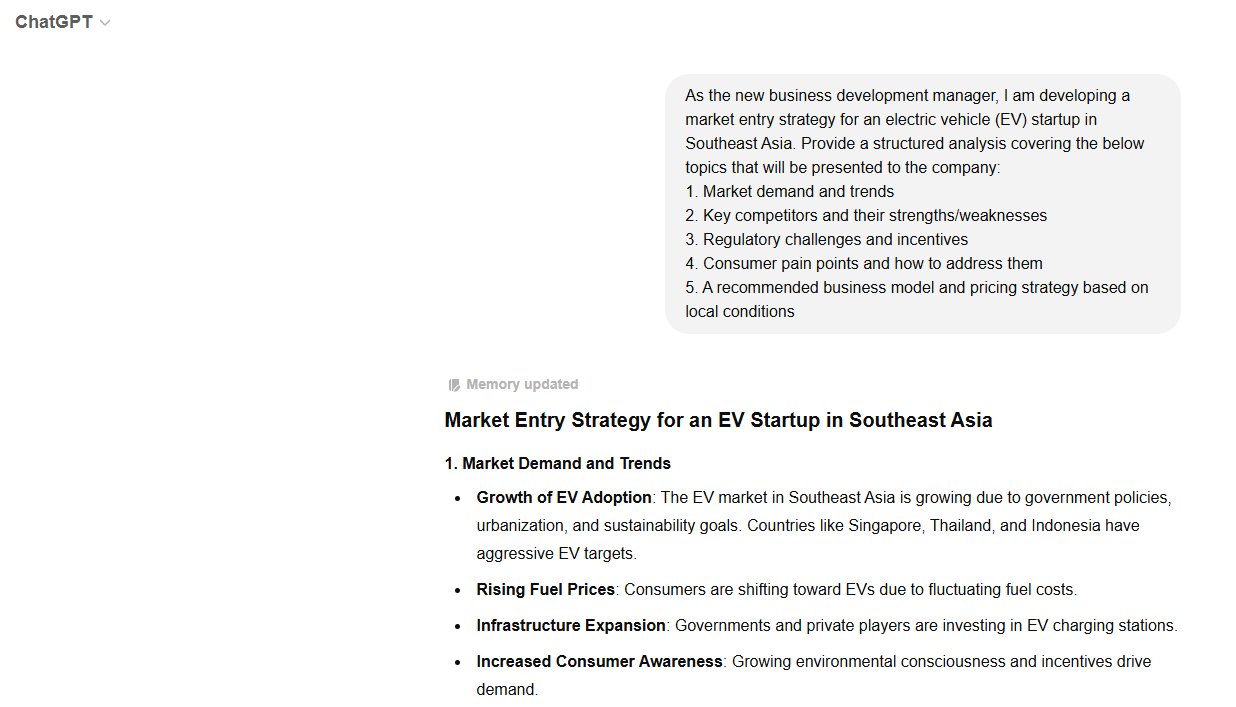
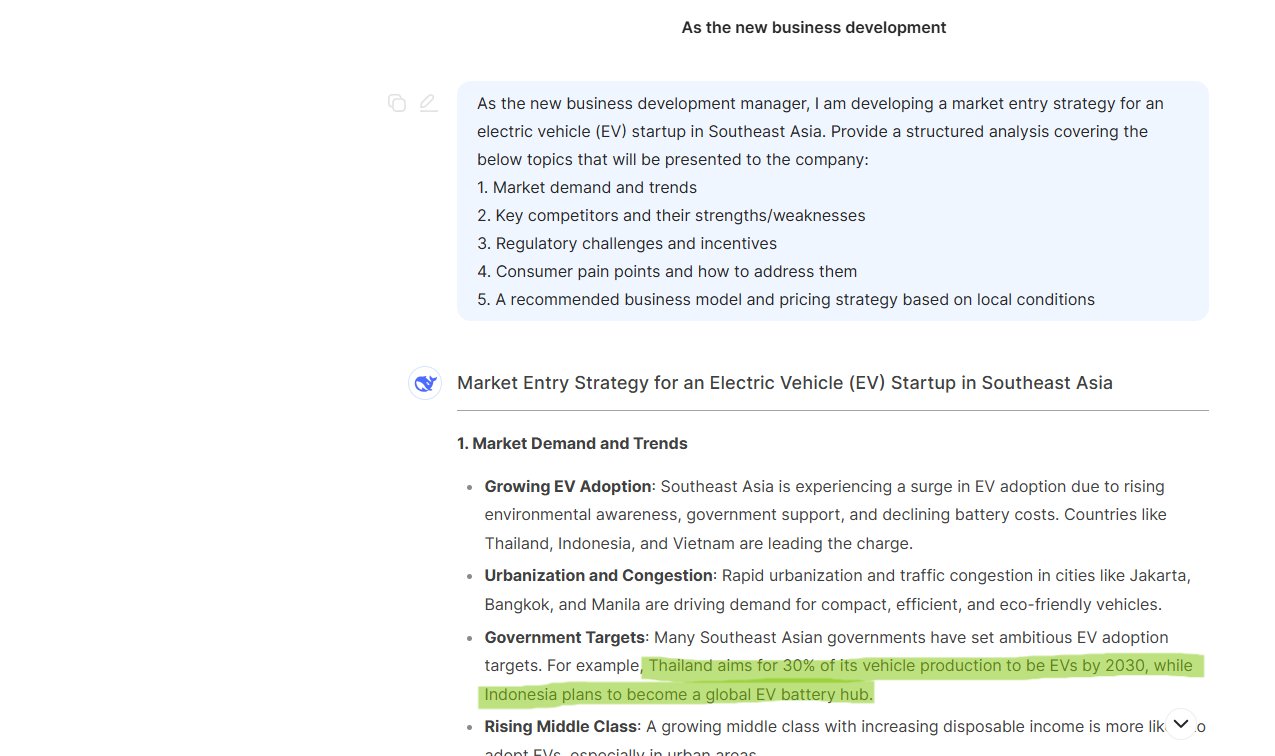
In our structured-analysis test, DeepSeek’s output was more detail-oriented, included relevant examples, and stayed focused. ChatGPT was not far behind, but was noticeably more general, with shorter sentences and a broader approach. For creative writing and multimodal work (images, voice), ChatGPT’s ecosystem is still ahead — see our round-up of the best AI text generators for how the wider field compares.
ChatGPT’s answers:
DeepSeek’s answer: The highlighted section in green shows the depth of output provided vs ChatGPT’s general overview
Is DeepSeek Safe? Privacy Concerns and Government Bans
This is the section that has changed the most since DeepSeek launched, and it deserves an honest treatment.
DeepSeek’s consumer app stores user data — including your prompts — on servers in China. Under Chinese law, companies can be required to cooperate with national intelligence requests. That combination has triggered real regulatory action:
- Italy blocked the DeepSeek app in January 2025 after the company failed to satisfy GDPR regulators about its data practices.
- South Korea’s privacy watchdog found DeepSeek had transmitted user data to third parties without proper consent; the app was pulled from Korean app stores in February 2025 pending fixes.
- Australia, Taiwan, and several US federal and state bodies have banned DeepSeek on government devices.
- Security researchers at Wiz also discovered an exposed DeepSeek database in early 2025 containing over a million records, including chat histories and API keys, with no authentication.
Singapore, notably, has not banned DeepSeek for public officers — the government says it evaluates all technologies against its own security frameworks — and Malaysia has issued no consumer ban either.
Our practical advice: treat DeepSeek like any overseas cloud chatbot, but with an extra layer of caution. It is excellent for general questions, coding, drafting, and analysis of non-sensitive material. Do not paste in personal data, customer records, company confidential documents, passwords, or financial details. And here is the twist unique to DeepSeek: because the models are open weights, businesses with real confidentiality needs can self-host DeepSeek on their own hardware (or via a local provider), keeping data entirely in-house — something that is impossible with ChatGPT or Gemini.
DeepSeek for Malaysia and Singapore Users
A few local notes worth knowing:
- Access and cost: DeepSeek is freely available in Malaysia and Singapore on iOS, Android, and the web. Since there is no paid consumer tier, there are no USD-billing, SST, or GST considerations — a genuine advantage when ChatGPT Plus costs around RM95+/S$27+ per month after currency conversion.
- Language: DeepSeek handles English and Chinese exceptionally well, and copes decently with Bahasa Malaysia, though English prompts still get the strongest results for technical work.
- Compliance: If you run a business, remember Malaysia’s amended PDPA (with stricter cross-border transfer and breach-notification rules phased in through 2025) and Singapore’s PDPA both apply to personal data you feed into any overseas AI service — DeepSeek included. When in doubt, anonymise before you prompt.
- Government stance: Neither country has banned DeepSeek; Singapore’s Ministry of Digital Development and Information has said public-sector use is governed by its existing security and evaluation frameworks.
Should You Use DeepSeek? A Quick Decision Framework
| Your situation | Our recommendation |
| You want a powerful, genuinely free AI assistant | DeepSeek is arguably the best free option in 2026 — no message caps that force an upgrade |
| You do heavy coding, maths, or structured analysis | DeepSeek’s reasoning mode is excellent; compare with paid tools in our AI coding tools guide |
| You need images, voice, or a large plugin ecosystem | ChatGPT or Gemini remain stronger all-round platforms |
| You handle confidential or personal data | Avoid the hosted app; consider self-hosting the open-weights models, or use an enterprise AI plan with data controls |
| You are a developer watching costs | DeepSeek’s API is among the cheapest frontier-class options available |
Common Pitfalls to Avoid
- Oversharing: the biggest real risk is what users paste in, not the model itself. Keep IC numbers, bank details, and client data out of any cloud chatbot.
- Fake apps: DeepSeek’s virality spawned copycat apps with subscription traps. The real app is free — anything charging a ‘DeepSeek Pro’ weekly fee is not official.
- Treating output as fact: like every LLM, DeepSeek can hallucinate. Verify figures, citations, and legal or financial claims before acting on them.
- Sensitive-topic gaps: the hosted version declines or filters some politically sensitive topics, which matters if you need a general-purpose research tool.
What’s in Store for DeepSeek’s Future?
Predictions from early 2025 — more features, more integrations, possible paid tiers — have mostly played out, except that the consumer product has stayed free. Looking ahead from mid-2026:
- Faster release cadence: DeepSeek shipped V3.1, V3.2, and V4 within roughly twelve months. Community speculation about an R2 or V5 is constant, though DeepSeek has announced nothing official — treat any ‘confirmed R2’ headlines with scepticism.
- Deeper integrations: V4’s API supports both OpenAI-style and Anthropic-style interfaces, making it a drop-in replacement inside many developer tools and agent frameworks, including autonomous coding agents like Devin.
- Regulatory pressure: expect continued scrutiny in Europe, South Korea, and the US — the open-weights strategy is partly DeepSeek’s answer, since anyone can run the models outside DeepSeek’s own infrastructure.
Impacts of DeepSeek on the AI Industry
DeepSeek’s introduction genuinely reshaped the AI landscape, and the effects are still visible in 2026:
- It crashed the cost of AI. When R1 launched in January 2025, Nvidia lost roughly US$589 billion in market value in a single day — at the time the largest one-day loss in US stock market history — as investors panicked over whether frontier AI really required so much expensive hardware. Prices across the industry have fallen sharply since, and DeepSeek’s aggressive pricing is a big reason why.
- It legitimised open-weights AI. DeepSeek proved open models could sit at the frontier, pressuring competitors: Meta, Alibaba (Qwen), and even OpenAI have since leaned further into open releases.
- It sharpened the privacy debate. DeepSeek made millions of people think, for the first time, about where their chatbot conversations are stored and under which country’s laws — a healthy question to ask of every AI tool, not just this one.
Opinions in the Industry on DeepSeek
Industry reaction has evolved from shock to respect. When R1 launched, Apple CEO Tim Cook called it evidence that ‘innovation drives efficiency’, as reported by TechCrunch. The release of V4 in April 2026 — landing a day after OpenAI shipped its own flagship — was widely read as proof that the open-vs-closed race is now permanent, with independent benchmarks placing V4-Pro alongside the top proprietary models on coding and agentic tasks.
Critics’ concerns have shifted from ‘is it real?’ to data governance and geopolitical questions, which remain unresolved. Our own view is unchanged in spirit: DeepSeek’s open-weights, free-for-all approach lets smaller companies, students, and hobbyists in Malaysia and Singapore access frontier AI without a subscription — and that accessibility is worth celebrating, provided you are thoughtful about what data you share.
Frequently Asked Questions
Conclusion
DeepSeek’s launch was one of the biggest tech stories of 2025, and unlike many viral moments, it stuck. Eighteen months on, DeepSeek-V4 sits at or near the frontier, the chatbot is still free, and the company’s open-weights strategy has permanently changed how the AI industry prices and publishes its models.
The questions that remain are less about capability and more about trust: where your data lives, and how regulators respond. If you are comfortable with those trade-offs — or you sidestep them by self-hosting — DeepSeek is one of the most capable free AI tools available to Malaysian and Singaporean users today. Curious how it stacks up inside a wider toolkit? See our guides to the best AI apps for iPhone and the best ChatGPT-style apps to build your own AI stack.
Facts, pricing, and availability verified in July 2026 against official sources including DeepSeek’s official API documentation, DeepSeek’s Hugging Face releases, and the Singapore MDDI statement on DeepSeek. AI products change quickly — confirm current details with the provider before making decisions.
Disclaimer: This article is for general information only and does not constitute professional, legal, or financial advice. KayaToday is not affiliated with DeepSeek or any provider mentioned. Always do your own due diligence before sharing data with any AI service.