
Robotic arms are transforming industries like manufacturing and healthcare, making them more efficient and innovative. Because robotics is developing so quickly, these machines are always changing. And the pace is real: the International Federation of Robotics counted about 4.66 million industrial robots operating in factories worldwide in 2024 (up 9% year-on-year), with a record 542,000 new units installed – more than double the figure from a decade earlier. With so many types of robotic arms to choose from, how do you pick the best one for your needs?
- What is a Robotic Arm?
- What’s Changed in 2026
- The 6 Main Types of Robotic Arms
- 1. Articulated Robotic Arms
- 2. Cartesian Robotic Arms
- 3. SCARA Robots (Selective Compliance Assembly Robot Arm)
- 4. Cylindrical Robotic Arms
- 5. Delta Robots (Parallel Robots)
- 6. Collaborative Robotic Arms (Cobots)
- Quick Comparison: Which Arm for Which Job?
- How to Choose the Right Robotic Arm
- 1. Task Requirements (Precision, Speed, Load Capacity)
- 2. Industry-Specific Needs
- 3. Budget and ROI
- 4. Ease of Integration and Programming
- Worked Example: A Malaysian SME Packing Line
- Common Pitfalls to Avoid
- Emerging Trends in Robotic Arms for 2026
- AI and Machine Learning Integration
- Increased Use of Soft Robotic Arms
- IoT-Enabled Robotic Arms
- Sustainability in Robotic Arm Design
- Applications of Robotic Arms Across Industries
- Agriculture and Food Processing
- Space Exploration and Defense
- Education and Research
- Conclusion
- Frequently Asked Questions (FAQs)
Knowing these machines is essential to staying ahead, whether you are an engineer, business owner, student, or simply a tech enthusiast. In this guide we break down the six main types of robotic arms, compare them side by side, walk through how to choose one, and share the pitfalls to avoid in 2026. Let’s get started!
What is a Robotic Arm?
A robotic arm is a programmable machine that can grab and move things, much like a human arm but with greater precision, repeatability, and strength. These arms are the backbone of automation, making repetitive or complex tasks faster and more accurate.
Over the years, robotic arms have evolved from simple mechanical machines into advanced tools powered by AI, vision systems, and force sensors. You’ll find them playing a key role in everything from building cars to performing surgery and exploring other planets. Understanding the different types of robotic arms helps you see how they solve real-world problems – and which one actually fits your task.
What’s Changed in 2026
The core arm families below haven’t changed – but the market around them has. A few developments worth knowing before you choose:
- Adoption keeps climbing. The IFR expects worldwide installations to reach roughly 575,000 units in 2025 and surpass 700,000 by 2028. Asia drove about 74% of new deployments in 2024.
- Southeast Asia is a hotspot. Singapore has the world’s second-highest robot density (about 818 robots per 10,000 manufacturing workers, behind only South Korea), and Malaysian manufacturers are steadily automating electronics and food-processing lines.
- Cobots are the fastest-growing segment. The collaborative-robot market is estimated at roughly US$2.8–3.7 billion in 2026 and is forecast to grow at a ~20–23% annual rate through the early 2030s – far faster than the industrial-robot market overall.
- AI is now standard, not a luxury. Vision-guided picking, adaptive grip, and predictive maintenance are increasingly built into mainstream arms rather than reserved for research labs.
The 6 Main Types of Robotic Arms
You’ll find robotic arms everywhere these days – in factories, hospitals, warehouses, and labs. Here are the six families you’ll actually encounter, and what each one is best at.
1. Articulated Robotic Arms
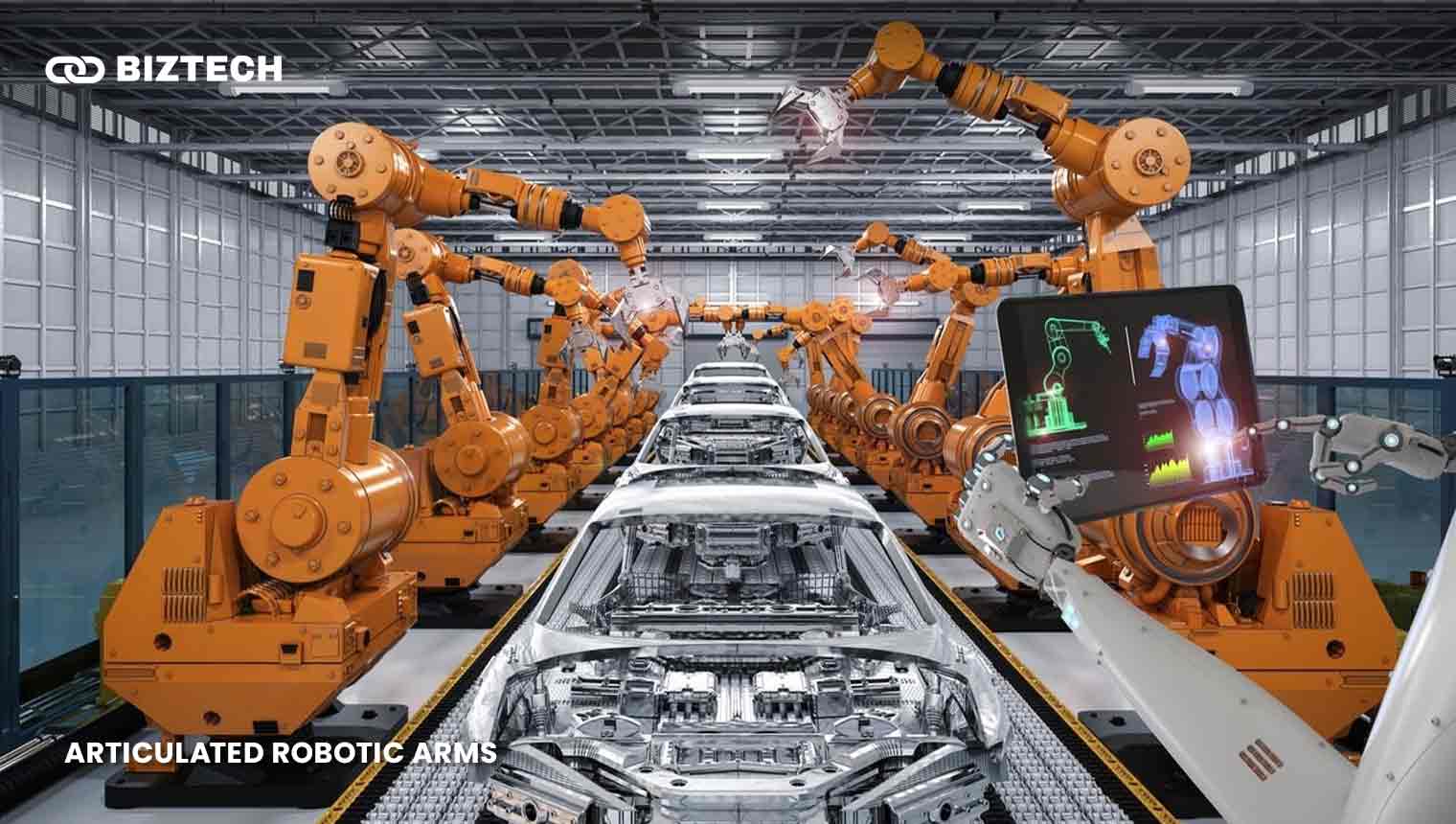
These arms have several rotary joints (usually 4 to 6, sometimes 7), just like a human shoulder-elbow-wrist. That flexibility lets a single arm reach almost any position and orientation in 3D space, which is why they dominate welding, painting, assembly, and material handling. They are the most common industrial arm by far.
- Advantages: Highest range of motion and versatility; handles complex, multi-angle tasks.
- Trade-off: More joints mean more programming and a larger footprint.
- Examples: FANUC M-2000iA (heavy payload), ABB IRB series, KUKA KR series.
2. Cartesian Robotic Arms
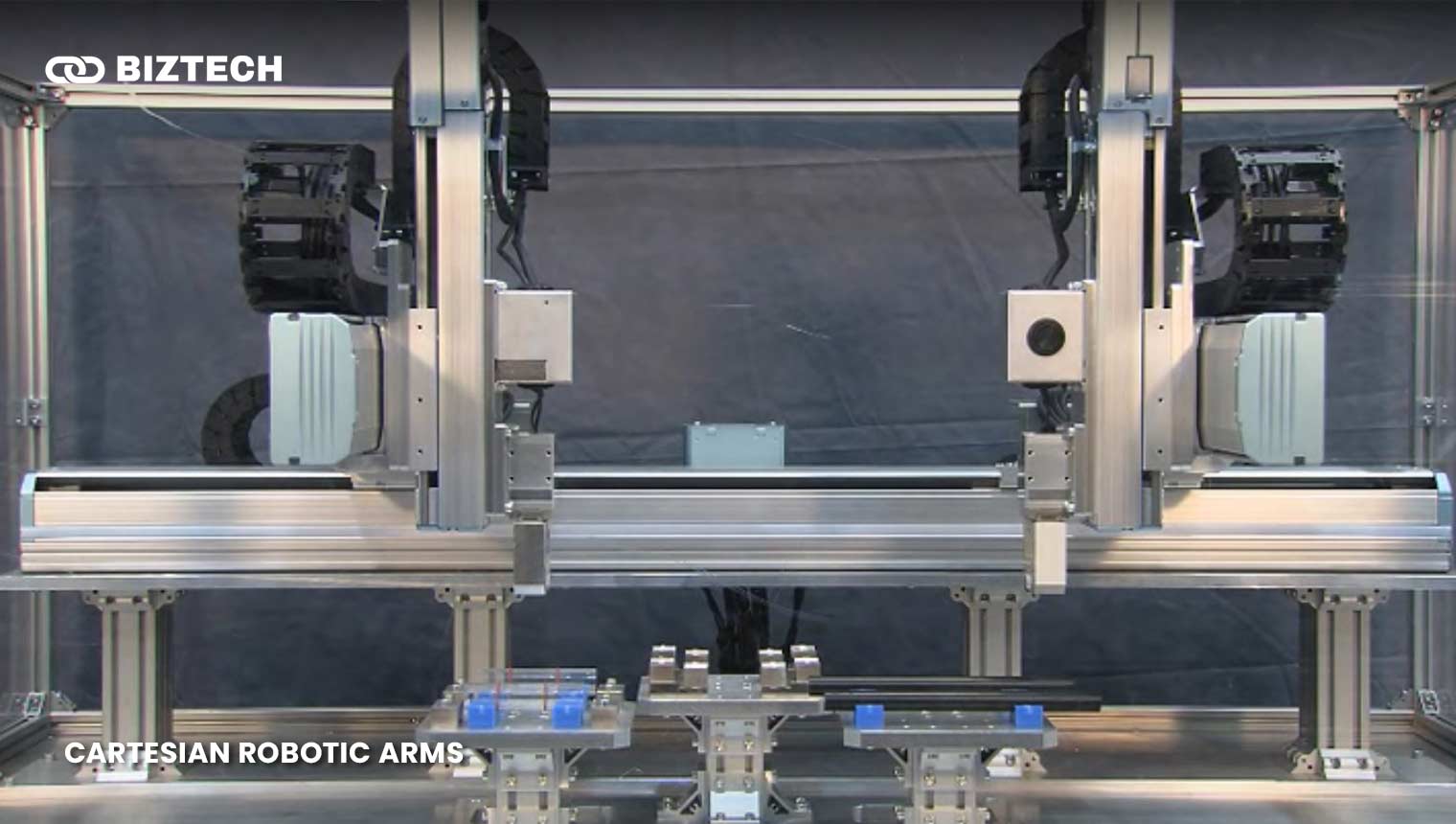
Also called gantry robots, these move linearly along three axes – X, Y, and Z – like a crane over a grid. Their simple, rigid structure makes them very precise and easy to program, which suits 3D printing, CNC machines, and pick-and-place over large areas.
- Advantages: Simple design, high precision, easily scaled to large work areas.
- Trade-off: Limited to rectangular motion; bulky frame.
- Examples: Gantry robots on packaging and palletising lines.
3. SCARA Robots (Selective Compliance Assembly Robot Arm)
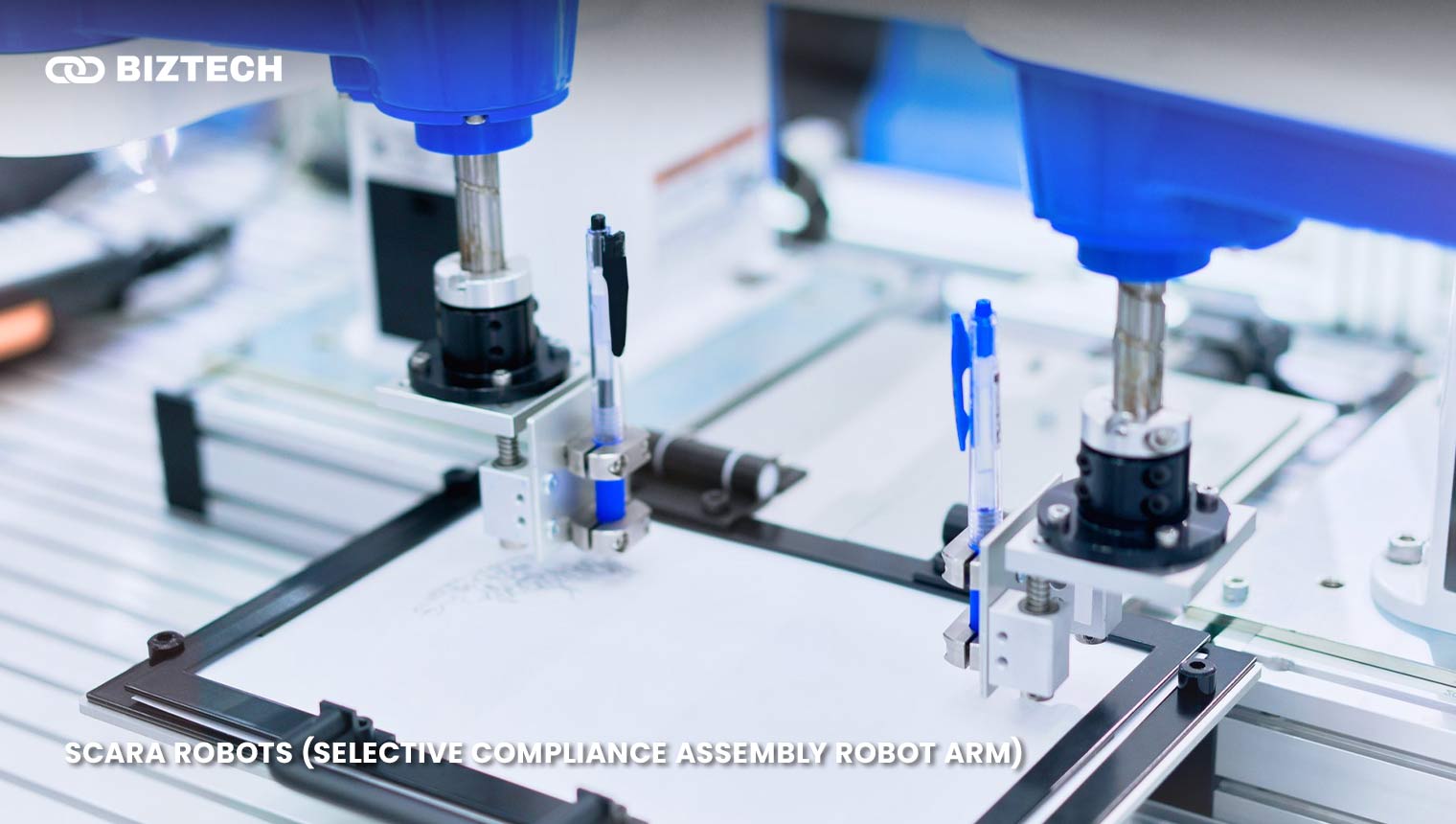
A SCARA arm has two parallel rotary joints on a horizontal plane plus a vertical linear axis. That design is rigid up-and-down but compliant side-to-side, making it exceptionally fast and accurate for horizontal pick-and-place, assembly, packaging, and stacking.
- Advantages: Speed and repeatability in horizontal work; small footprint.
- Trade-off: Limited vertical reach and orientation flexibility.
- Examples: EPSON and Omron SCARA lines.
4. Cylindrical Robotic Arms
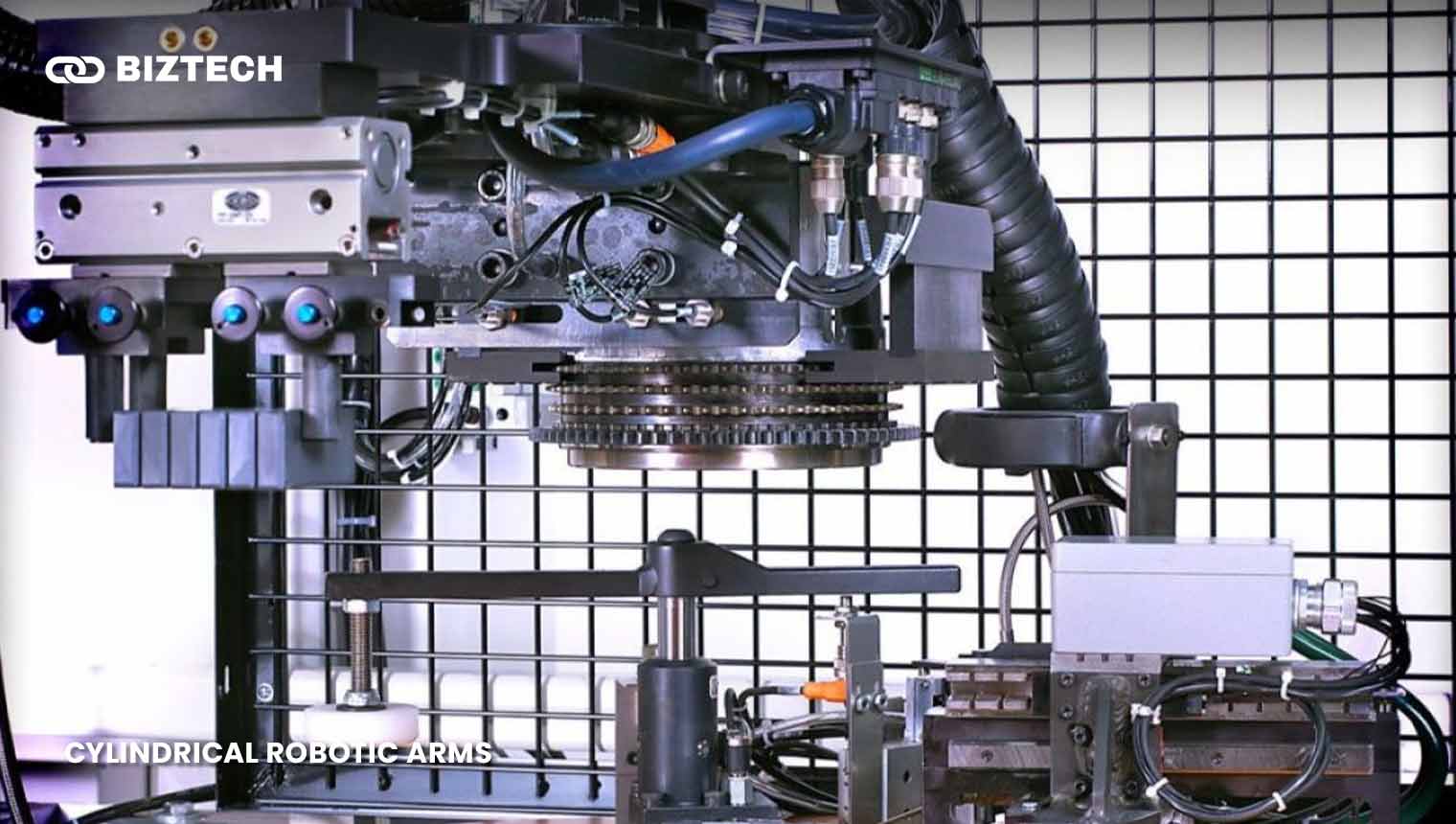
These rotate at the base and extend up-and-down and in-and-out, sweeping a cylindrical work envelope. They’re handy for machine loading, coating, and assembly in tight or vertical spaces. They’re less common in new installations today, having been largely displaced by SCARA and articulated arms, but you’ll still meet them in legacy lines.
- Advantages: Compact design and strong lifting power in a small area.
- Trade-off: Limited reach and dexterity compared with articulated arms.
- Examples: Classic machine-tending robots such as the IBM 7565.
5. Delta Robots (Parallel Robots)
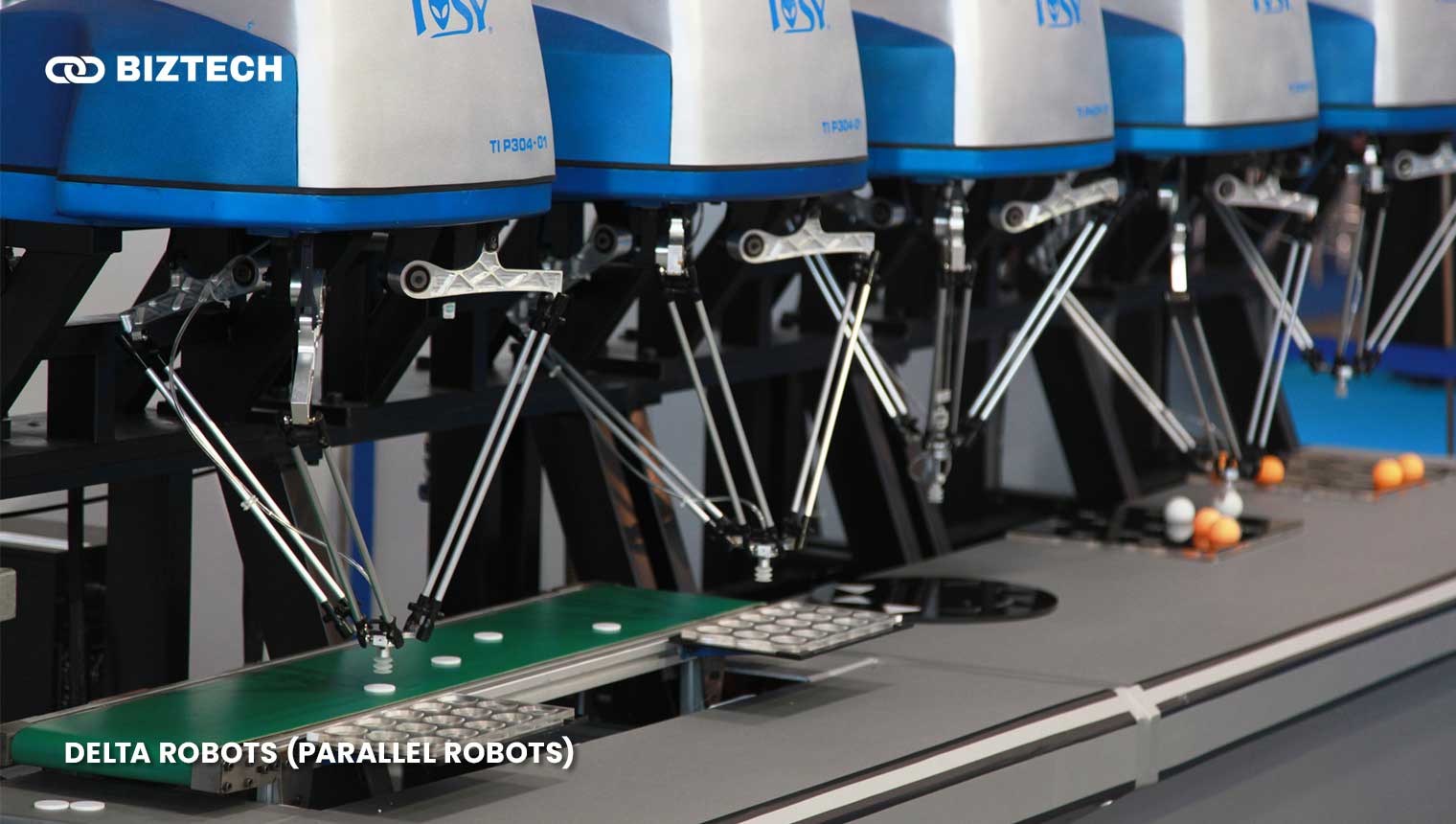
Delta robots hang from an overhead frame with three lightweight arms sharing one moving platform. Because the motors stay fixed and only thin arms move, they are blisteringly fast – high-speed lines can run well over 100 pick-and-place cycles a minute, a rate articulated or SCARA arms can’t match. Ideal for food packaging, pharmaceuticals, and electronics sorting.
- Advantages: Incredible speed and precision for light parts.
- Trade-off: Low payload and limited vertical reach.
- Examples: ABB FlexPicker.
6. Collaborative Robotic Arms (Cobots)
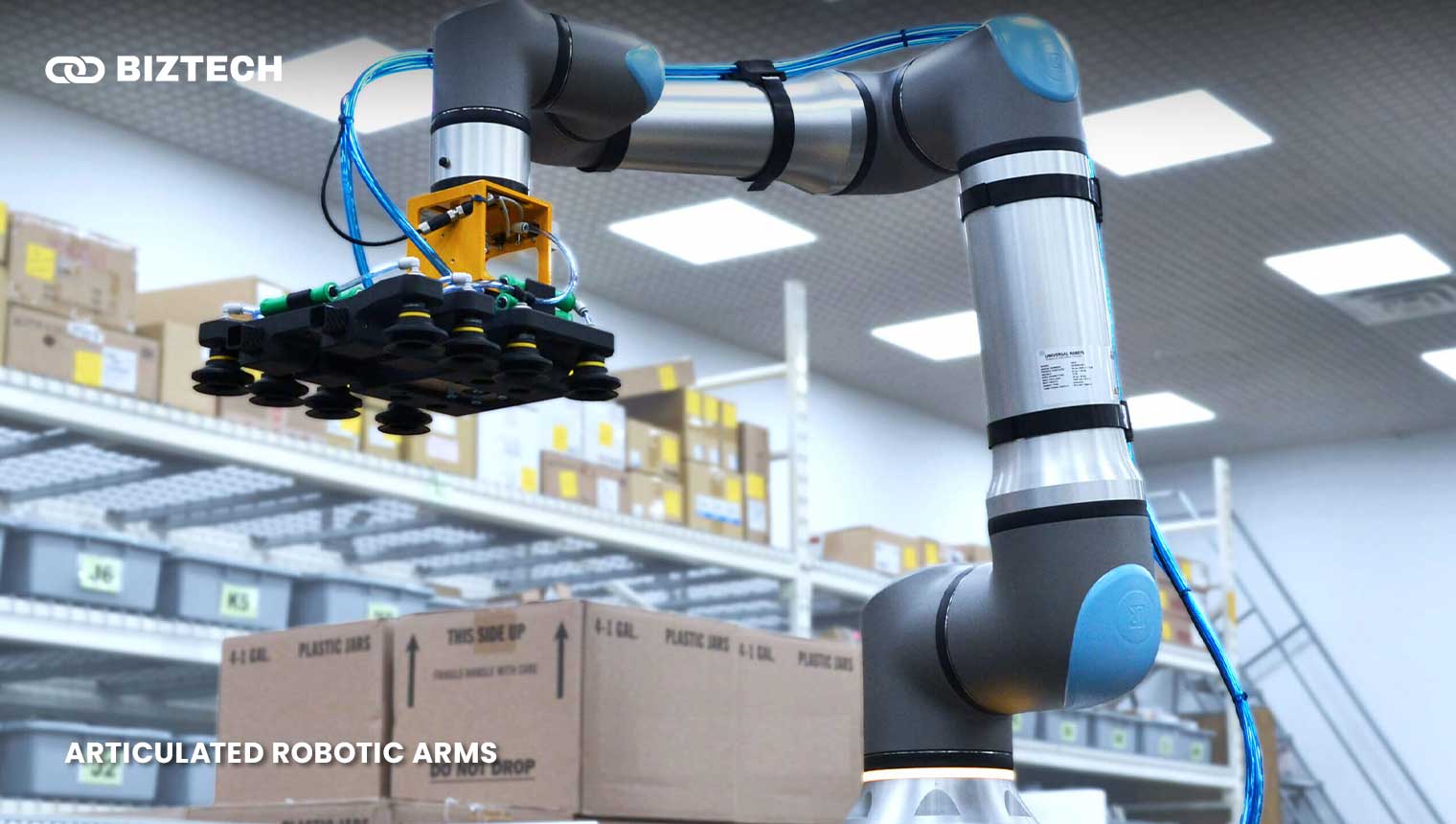
Cobots are built with force-limiting joints and sensors so they can work safely alongside people without a safety cage. They’re easy to teach by hand-guiding, which makes them popular with small factories, healthcare, labs, and even schools. As noted above, this is the fastest-growing arm category in 2026 – and often the best entry point for a small business.
- Advantages: Safe around humans, user-friendly, flexible, and relatively affordable.
- Trade-off: Slower and lower-payload than caged industrial arms.
- Examples: Universal Robots UR series, FANUC CRX, Techman.
Quick Comparison: Which Arm for Which Job?
| Type | Motion | Best For | Speed | Typical Payload | Ease of Setup |
|---|---|---|---|---|---|
| Articulated | 4–6 rotary joints | Welding, painting, complex assembly | Medium–High | Light to very heavy | Harder |
| Cartesian | Linear X/Y/Z | 3D printing, CNC, large-area pick-and-place | Medium | Light to heavy | Easy |
| SCARA | 2 rotary + 1 vertical | Fast horizontal assembly & packaging | High | Light–Medium | Medium |
| Cylindrical | Rotate + extend | Machine loading, tight-space assembly | Medium | Medium | Medium |
| Delta | Parallel (overhead) | Ultra-fast sorting, food & pharma | Very High | Very light | Medium |
| Cobot | Articulated, force-limited | Human-side tasks, small batches, SMEs | Low–Medium | Light–Medium | Easiest |
How to Choose the Right Robotic Arm
Selecting the right arm depends on what you want to accomplish and the constraints you face. Work through these four questions in order – each one narrows the field.
1. Task Requirements (Precision, Speed, Load Capacity)
Start with the job itself. High-precision work like assembling small electronics points to a SCARA or articulated arm. Heavy lifting calls for a cylindrical or high-payload articulated arm. If the task is fast, repetitive sorting of light parts, a delta robot wins on speed. Write down the payload in kilograms, the required reach, and the target cycle time before you shortlist anything.
2. Industry-Specific Needs
Different industries have different demands. In healthcare and any workspace shared with people, cobots are the safe, cage-free choice. For high-volume manufacturing, articulated or Cartesian arms handle assembly lines. Food and pharma favour delta robots for hygienic, high-speed handling. Match the arm to the environment, not just the motion.
3. Budget and ROI
Robotic arms span a wide price range, from entry cobots to six-figure heavy industrial cells once you add grippers, vision, safety, and integration. Advanced AI-equipped models cost more up front but can pay for themselves through higher throughput and fewer errors. Estimate the payback period: annual labour or scrap savings versus the fully-installed cost. A two-to-three-year payback is a common benchmark for SMEs.
4. Ease of Integration and Programming
Finally, weigh how hard it is to deploy. Cobots are hand-guided and need no specialist programmer, so they suit teams without a robotics engineer. Traditional industrial arms are more capable but demand more setup, safety fencing, and integration with your existing machines. Also confirm the arm speaks the same protocols as your PLCs and conveyors.
Worked Example: A Malaysian SME Packing Line
Say a small Selangor food company wants to automate boxing of snack pouches. The parts are light (under 1 kg), the line is shared with human packers, batches change often, and there’s no in-house engineer. Speed matters but not delta-level extremes. Here a cobot is the natural fit: safe beside staff, quick to re-teach when the product changes, and deployable without fencing. If volumes later explode into millions of identical packs per month, a delta robot becomes worth the extra integration cost. This is the typical upgrade path – start collaborative and flexible, scale to dedicated high-speed only when volume justifies it.
Common Pitfalls to Avoid
- Buying on payload alone. A 10 kg-rated arm loses effective payload once you add a heavy gripper – always budget capacity for end-of-arm tooling.
- Ignoring reach and work envelope. An arm that can’t physically reach every point of your workstation is useless no matter how fast it is.
- Forgetting the “hidden” costs. Grippers, vision, safety scanners, cabling, and integration often cost as much as the arm itself.
- Over-buying for the task. A six-axis industrial arm for a simple horizontal pick-and-place is overkill – a SCARA or cobot is cheaper and easier.
- Skipping the safety assessment. Even “collaborative” arms need a risk assessment; a sharp tool or heavy part can make any cobot application unsafe.
Emerging Trends in Robotic Arms for 2026
The world of robotic arms is evolving fast. Here are the biggest trends shaping their future.
AI and Machine Learning Integration
AI makes arms smarter and more autonomous. Vision-guided models now recognise and adapt to parts that aren’t perfectly positioned, while predictive maintenance flags wear before a breakdown. Adaptive learning lets an arm improve at tricky tasks over time – see our overview of robotic arm technology for a deeper look.
Increased Use of Soft Robotic Arms
Soft, flexible arms are gentle by design, making them ideal for delicate work – handling sensitive tissue in surgery, or picking fragile items like fruit and glassware without damage.
IoT-Enabled Robotic Arms
Connecting arms to the internet turns them into part of a larger smart factory, sharing real-time data to optimise production and cut errors. That connectivity also widens the attack surface – worth reading up on IoT cybersecurity before you network a production cell.
Sustainability in Robotic Arm Design
Manufacturers increasingly use lightweight materials and energy-recovery systems to cut power draw, which is good for the environment and lowers running costs.
Applications of Robotic Arms Across Industries
Robotic arms are making waves in countless fields. Here’s how they show up beyond the factory floor.
Agriculture and Food Processing
In farming, arms harvest crops and sort produce; on food lines they pack quickly and hygienically – a major driver of delta-robot demand.
Space Exploration and Defense
Arms repair satellites and collect samples in space, and handle bomb disposal and hazardous materials safely in defence.
Education and Research
Students learn automation on real arms in schools and labs, and researchers use them to run precise, repeatable experiments – increasingly as testbeds for the AI and data pipelines that train the next generation of robots. Consumer robotics is following the same curve, from the Tesla Bot to home robot butlers.
Conclusion
Understanding the different types of robotic arm matters for anyone in engineering, manufacturing, healthcare, or research. Each family – articulated, Cartesian, SCARA, cylindrical, delta, and collaborative – has distinct strengths, so the “best” arm is simply the one that matches your task, industry, budget, and team.
Through 2026 and beyond, AI integration, soft robotics, and sustainable design will keep making these machines smarter, faster, and more efficient – and with adoption still climbing across Asia, more accessible to smaller businesses than ever. Map your requirements first, then let the arm type follow.
Figures verified August 2026 against the International Federation of Robotics and industry market reports; robot pricing and market sizes change frequently, so confirm current specifications and quotes with the manufacturer or a local integrator before buying. This guide is provided by KayaToday for general information only and is not professional engineering or purchasing advice.