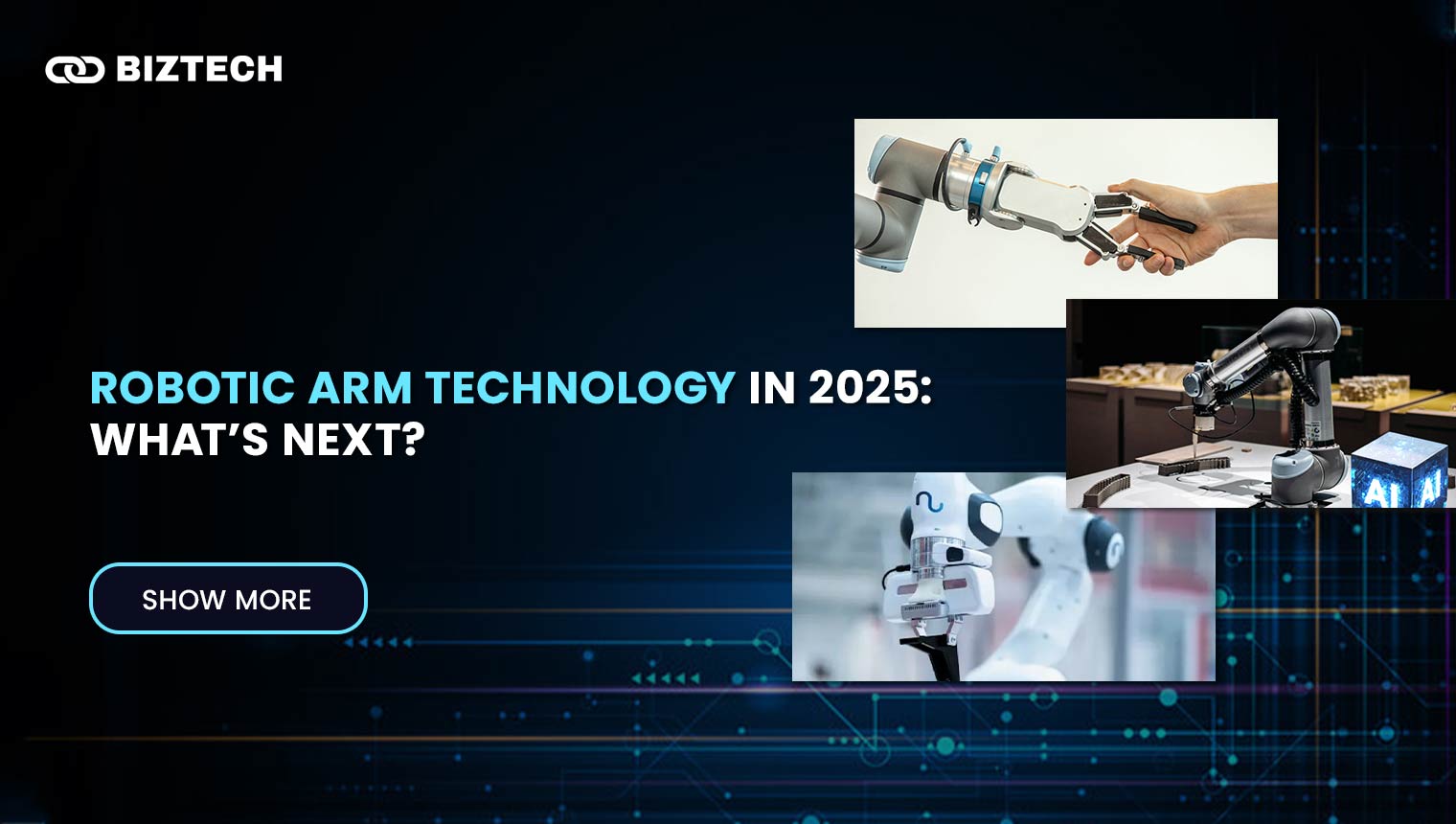
Robotic arm technology has come a long way, transforming how we work across the manufacturing, healthcare, logistics, and research industries.
- What’s Changed in 2026: The State of Play
- What is a Robotic Arm?
- How Does a Robotic Arm Work?
- The Basic Structure
- Power and Control
- Programming and Automation
- Advanced Features
- How Much Does a Robotic Arm Cost?
- Robotic Arm Parts
- Joints and Links
- Actuators
- End-Effector
- Sensors
- Controller
- The Current State of Robotic Arm Technology
- Applications of Robotic Arms in 2026
- Challenges Facing Robotic Arm Adoption
- Key Innovations in Robotic Arm Technology for 2026
- AI and Machine Learning Integration
- Advanced Materials and Lightweight Designs
- Human-Robot Collaboration (Cobots)
- Enhanced Precision and Sensory Capabilities
- 5G, IoT, and Connected Automation
- How to Choose a Robotic Arm: A Simple Framework
- Worked Example: A Malaysian SME Packing Line
- Common Pitfalls to Avoid
- The Future Impact of Robotic Arm Technology
- Economic and Workforce Implications
- Sustainability and Environmental Benefits
- Ethical Considerations and Safety Standards
- Conclusion
- Frequently Asked Questions (FAQs)
But as demands grow, so do the challenges of precision, speed, and adaptability. What if these robotic arms could do even more in 2026 and beyond?
This guide explains what a robotic arm is, how it works, what it costs, and the advancements shaping the technology’s future. From smarter AI to lighter materials and safer human-robot collaboration, you’ll learn how to make sense of the trends — and how to decide whether a robotic arm is right for your operation.
Want to know where robotic arms stand today and where they’re heading? Let’s start.
What’s Changed in 2026: The State of Play
Robotic arms are no longer a factory-only technology. According to the International Federation of Robotics (IFR) World Robotics 2025 report, the global operational stock of industrial robots reached a record 4.66 million units in 2024 — up 9% year on year — with 542,000 new robots installed that year, the fourth straight year above 500,000 units.
The centre of gravity is firmly in Asia, which accounted for 74% of new installations in 2024 (Europe 16%, the Americas 9%). China alone made up 54% of global deployments, while Japan remained the second-largest market. For Southeast Asian readers, this matters: the supply chains, integrators, and after-sales support you’ll rely on are increasingly regional.
Two other shifts define 2026. First, collaborative robots (cobots) have moved from novelty to mainstream — the cobot market is estimated at roughly US$2.3–3.6 billion in 2026 and is growing at around 18–21% a year, far faster than traditional industrial arms. Second, payloads are climbing: cobots such as the Universal Robots UR20 and UR30 now handle up to 25 kg and 35 kg respectively, closing the gap with caged industrial arms while staying safe to work beside people.
| Metric (2026 view) | Figure | Source / note |
|---|---|---|
| Global operational stock (industrial robots) | ~4.66 million units (2024, +9% YoY) | IFR World Robotics 2025 |
| New installations (latest year) | ~542,000 units (2024) | IFR World Robotics 2025 |
| Share of installs in Asia | ~74% | IFR World Robotics 2025 |
| Cobot market size | ~US$2.3–3.6 billion (2026) | Range across research firms |
| Cobot market growth | ~18–21% CAGR | Range across research firms |
| Top cobot payloads | Up to 35 kg (e.g. UR30) | Universal Robots |
Market-size estimates vary widely between research firms because they define “the market” differently; treat them as directional. The IFR unit figures are the most reliable anchor.
What is a Robotic Arm?
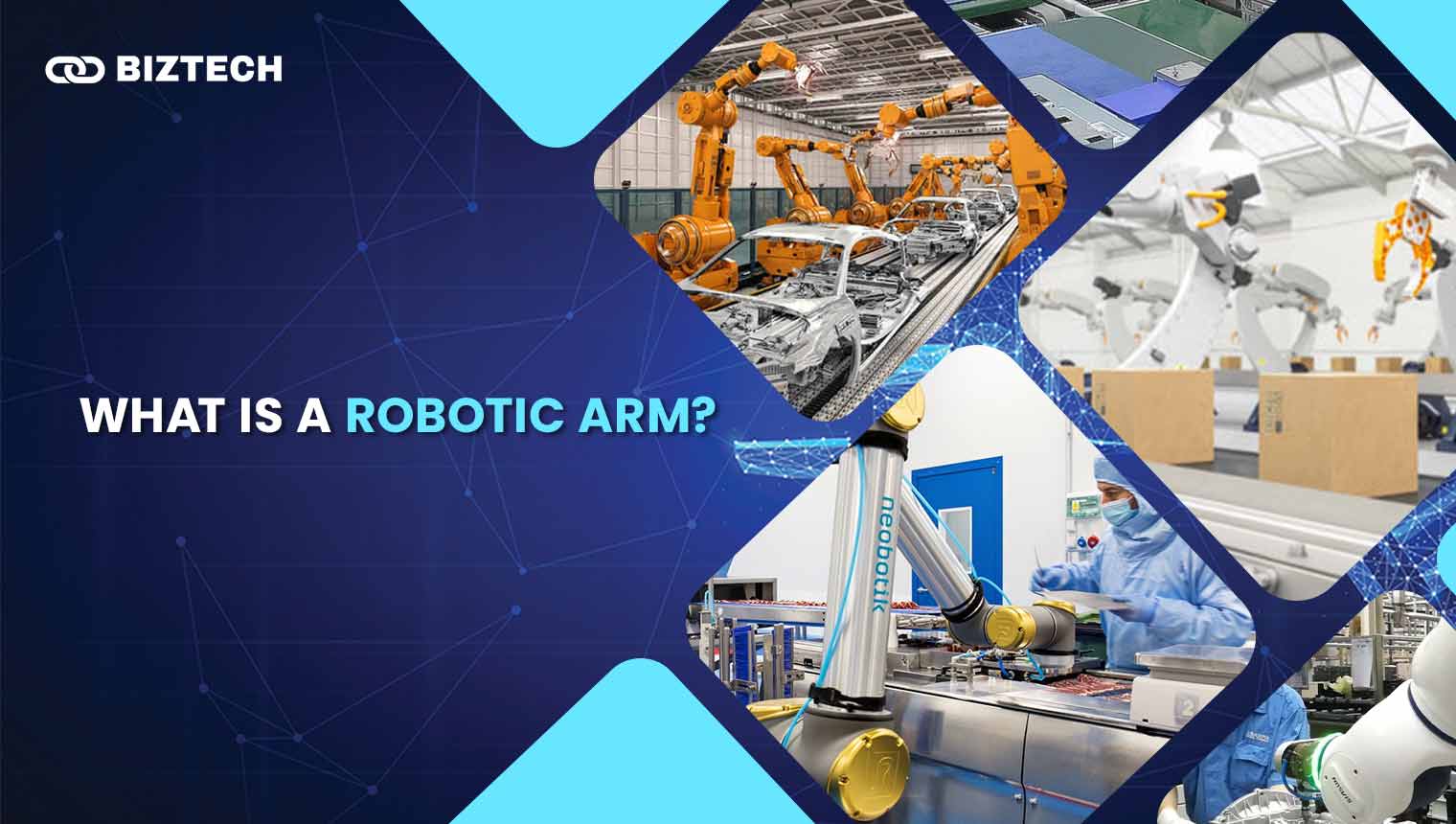
A robotic arm is a programmable mechanical arm that performs tasks like lifting, moving, welding, and assembling objects. It works like a human arm but with greater precision, repeatability, and strength.
These arms are powered by motors (or, in heavy applications, hydraulics) and controlled by computers or remote operators. They can be programmed to repeat tasks accurately to fractions of a millimetre, making them ideal for factories, warehouses, hospitals, laboratories, and even space exploration.
Robotic arms are versatile tools used for everything from building cars to assisting in surgery. They help people work faster, safer, and more efficiently across many industries. If you want a breakdown of the different configurations, see our companion guide on the types of robotic arm.
How Does a Robotic Arm Work?
Robotic arms mimic human arm movements but with more precision and strength. Here’s how they actually work — and why they’re so good at what they do.
The Basic Structure
A robotic arm typically has joints, links, a wrist, and an end effector — the “hand” that performs the task. The number of joints determines its degrees of freedom; six-axis arms are the workhorses of industry because they can reach almost any position and orientation within their working envelope.
Power and Control
Motors and sensors power and monitor the arm, while a controller tells it what to do. Sensors let the arm “feel” force and position, so it can adjust its movements for accuracy and stop safely if something unexpected gets in the way.
Programming and Automation
Robotic arms follow programmed instructions to perform tasks like welding, painting, palletising, or lifting. Modern cobots can be “taught” by hand-guiding — an operator physically moves the arm through the motion once and the software records it — dramatically lowering the skills barrier compared with older text-based programming.
Advanced Features
Many robotic arms now use AI and machine vision to learn and adapt over time. Cameras and 3D sensors let them “see” and adjust to variable parts and surroundings, while force-torque sensing enables delicate handling of fragile items.
How Much Does a Robotic Arm Cost?
The price of a robotic arm depends on payload, reach, precision, and whether it’s a collaborative or a caged industrial unit. Just as important is the total cost of ownership — integration, tooling (grippers, vision), safety guarding, programming, and maintenance often cost as much as, or more than, the arm itself.
| Tier | Typical arm price (USD) | Best for | Watch out for |
|---|---|---|---|
| Hobby / desktop / educational | ~US$500 – 3,000 | Learning, light pick-and-place, prototyping | Limited payload & repeatability |
| Entry cobot | ~US$20,000 – 40,000 | SME machine tending, packing, light assembly | Add ~30–100% for tooling & integration |
| Industrial six-axis (caged) | ~US$30,000 – 80,000+ | Welding, palletising, high-speed lines | Safety guarding & floor space required |
| High-end / specialised (surgical, precision, high payload) | US$100,000 – 1M+ | Medical, aerospace, heavy industry | Long lead times, regulatory approval |
Figures are indicative 2026 ranges to help you budget; always request a quote for your exact payload, reach, and application.
Robotic Arm Parts
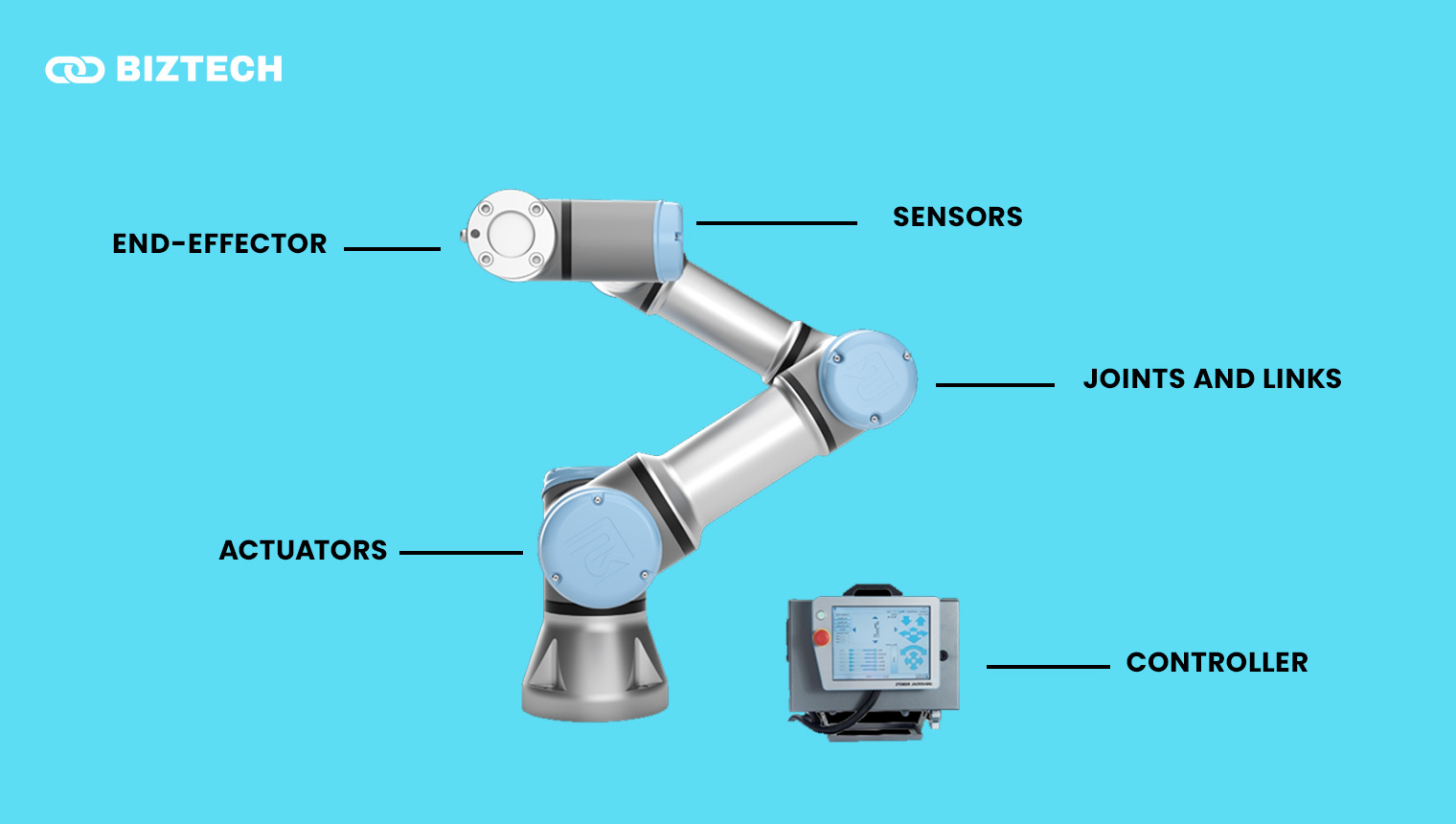
A robotic arm is like a puzzle where each part — from the joints to the motors — plays a crucial role. Each component has a specific job, making the arm flexible, strong, and precise.
Joints and Links
Joints act like the elbow or shoulder of a human arm, allowing movement. Links are the rigid parts connecting the joints, giving the arm its structure and reach.
Actuators
Actuators are the key components that create motion. They use electric motors (or, in heavy-duty arms, hydraulics) to power the arm’s movements, letting it lift, twist, or bend.
End-Effector
The end-effector is the “hand” of the robotic arm. It can be a gripper, welder, suction cup, or camera, depending on the task. Choosing the right end-effector is often the single biggest factor in whether an automation project succeeds.
Sensors
Sensors help the arm “see” and “feel” its surroundings. They provide feedback so the arm moves accurately, applies the right force, and avoids collisions.
Controller
The controller is the central command centre. It processes instructions and coordinates the motors, sensors, and end-effector so tasks are completed correctly and safely.
The Current State of Robotic Arm Technology
Robotic arm technology has made huge strides, becoming a key tool in many industries. Here’s where it stands today and what challenges remain.
Applications of Robotic Arms in 2026
In manufacturing, robotic arms assemble products, weld parts, and paint surfaces with unmatched precision. They work faster than humans and reduce errors, boosting productivity and consistency.
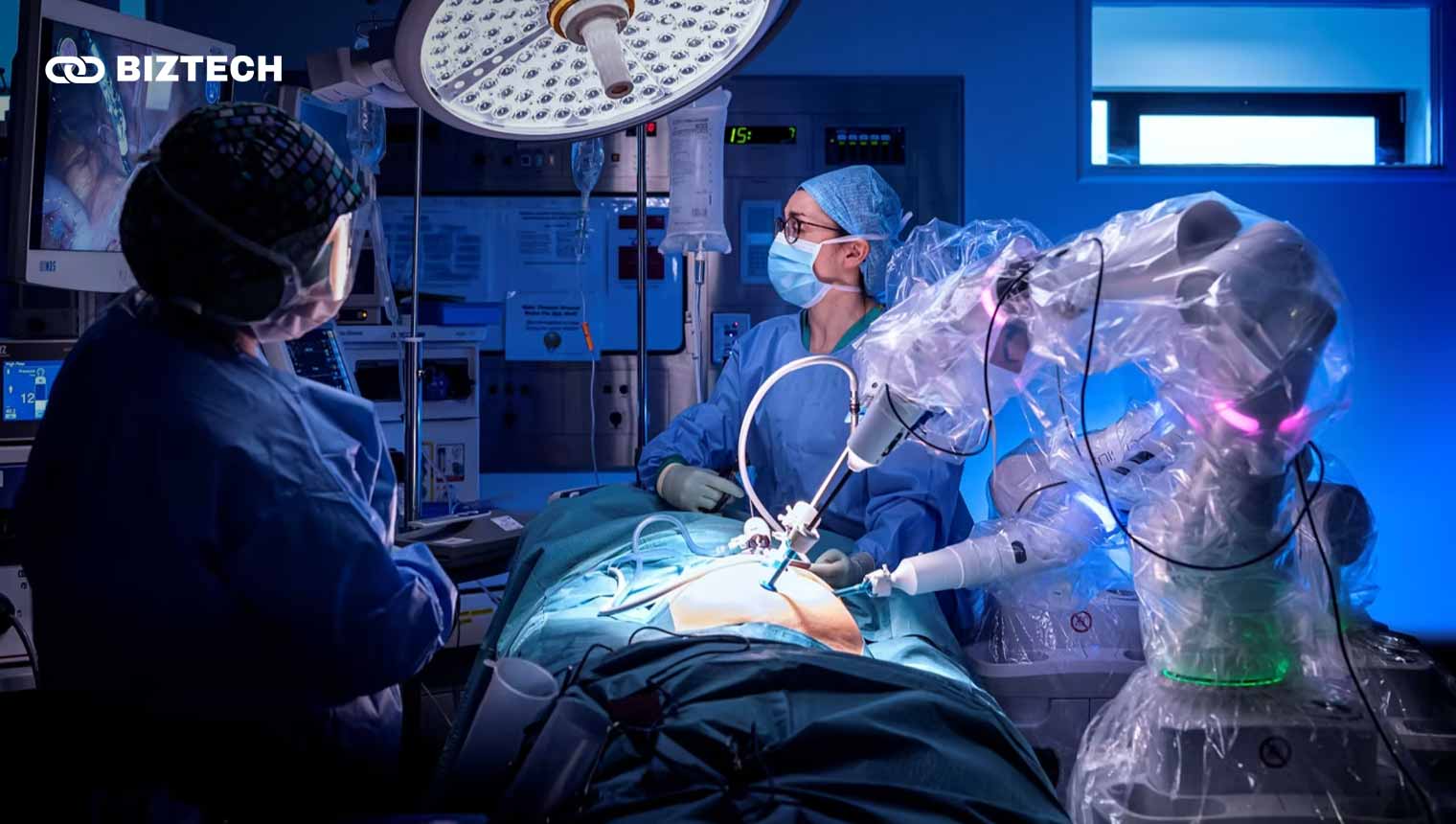
In healthcare, robotic arms give surgeons a steady, high-precision helping hand during minimally invasive procedures, and support patient care by lifting and moving individuals safely.
Warehouses and logistics companies use robotic arms to sort, pack, and palletise goods quickly and consistently, keeping supply chains running smoothly even during demand spikes.
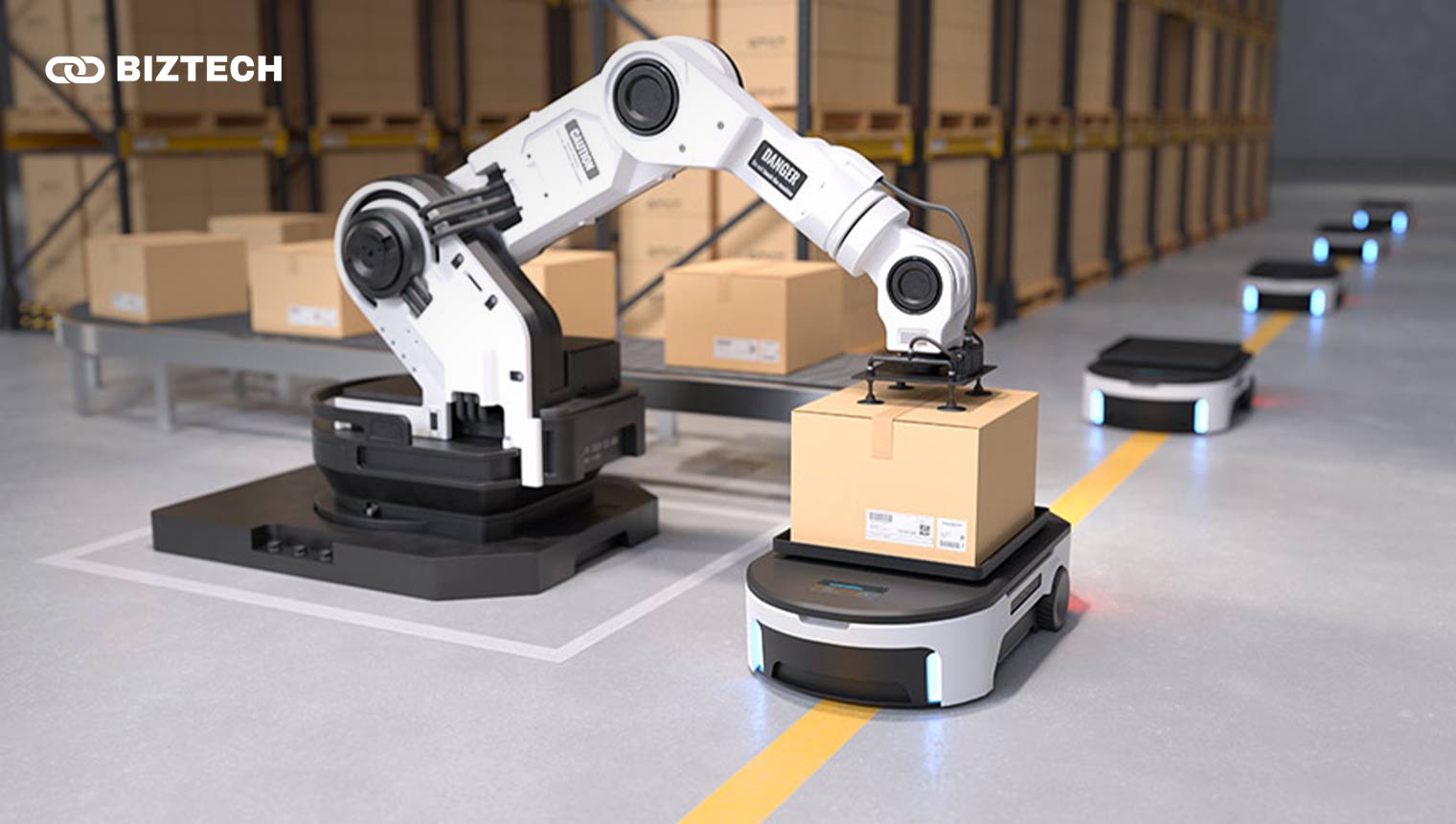
Artificial intelligence is making robotic arms smarter — allowing them to learn new tasks and adapt to changing situations — while improved vision systems make them more precise and reliable than ever. This is the same AI-and-robotics convergence driving humanoid projects like the Tesla Bot.
Challenges Facing Robotic Arm Adoption
Despite their benefits, robotic arms can be expensive to buy, integrate, and maintain. Smaller businesses often struggle with the upfront cost — although cobots and leasing/”robots-as-a-service” models are narrowing that gap.
Setting up and programming arms can be complex, requiring skilled technicians. This limits adoption in industries with fewer resources — a real constraint in many Malaysian and Singaporean SMEs where automation talent is scarce.
Finally, some tasks still require human flexibility and judgement that robotic arms can’t fully replicate. Adapting them to new or unpredictable environments remains a genuine challenge.
Key Innovations in Robotic Arm Technology for 2026
The next wave of robotic arm technology is making these machines smarter, safer, and more versatile.
AI and Machine Learning Integration
AI helps robotic arms make better decisions on their own. They learn from experience, adapt to new tasks, and increasingly handle variability — like picking randomly oriented parts from a bin — that used to require rigid, custom programming.
Advanced Materials and Lightweight Designs
New composites and lightweight alloys make arms lighter and stronger, improving energy efficiency and letting them handle challenging conditions without sacrificing precision.
Human-Robot Collaboration (Cobots)
Collaborative robots work safely alongside people. Built-in force sensing lets them slow or stop on contact, so they can help with strength- and precision-intensive tasks without safety cages — the fastest-growing segment of the market in 2026.
Enhanced Precision and Sensory Capabilities
Better vision and force-torque sensing let robotic arms “see” and “feel” with remarkable accuracy. Haptic feedback allows them to handle delicate objects — from electronics to food — without damage.
5G, IoT, and Connected Automation
With 5G and IoT connectivity, robotic arms communicate and operate in near real time, can be monitored remotely, and feed data into predictive-maintenance systems. Connectivity also raises the stakes on security — see our guide on IoT cybersecurity before putting arms on your network.
How to Choose a Robotic Arm: A Simple Framework
Rather than starting with a brand, start with your task. Work through these questions in order:
| Step | Question to answer | Why it matters |
|---|---|---|
| 1. Payload | How heavy is the part plus the gripper? | Under-specifying payload is the most common mistake — always include tooling weight. |
| 2. Reach & workspace | How far must the arm move, and around what obstacles? | Determines model size and cell layout. |
| 3. Cycle time / precision | How fast and how accurate must it be? | High speed favours caged industrial arms; delicate work favours cobots with force sensing. |
| 4. Cobot or caged? | Will people work nearby? | Cobots avoid guarding costs but run slower; caged arms are faster but need safety fencing. |
| 5. End-effector | Gripper, suction, welder, or vision? | The tool often decides whether the project succeeds. |
| 6. Total cost & support | What’s the all-in cost, and who supports it locally? | Integration and local service can outweigh the arm’s sticker price. |
Worked Example: A Malaysian SME Packing Line
Say a Selangor food packager wants to automate placing 3 kg boxes onto a pallet, with staff working nearby. Working the framework: payload ~3 kg + a 2 kg gripper = ~5 kg needed (choose a 10 kg-class arm for headroom); reach ~1,300 mm to cover the pallet; moderate speed; a cobot is the right call because people are close, avoiding cage costs. Budget roughly RM90,000–160,000 all-in (arm ~RM110,000 + gripper, vision, and integration), then confirm a local integrator can service it. The lesson: the arm is often less than half the project cost.
Common Pitfalls to Avoid
Automation projects fail for predictable reasons. Watch for these:
1. Forgetting the gripper weight. Payload specs must include the end-effector, not just the part. 2. Ignoring integration cost. The arm can be 40–60% of the total; tooling, vision, safety, and programming make up the rest. 3. Buying speed you don’t need. A cobot is often “fast enough” and far cheaper to deploy safely than a caged high-speed arm. 4. No local support. Downtime is expensive — confirm parts and service are available in your region. 5. Automating a bad process. Fix and standardise the manual workflow first; a robot will only repeat a flawed process faster.
The Future Impact of Robotic Arm Technology
Robotic arm technology will shape the future in ways that go beyond efficiency, changing how we work, live, and care for the planet.
Economic and Workforce Implications
While robotic arms may replace some manual tasks, they also create new roles in programming, integration, maintenance, and design. In regions facing labour shortages, they help firms stay competitive rather than simply cutting jobs.
Sustainability and Environmental Benefits
Fewer mistakes mean less material waste, and modern arms use energy more efficiently — contributing to greener manufacturing and logistics.
Ethical Considerations and Safety Standards
As robotic arms become more common, safety and governance are top priorities. Standards such as ISO 10218 and ISO/TS 15066 (for collaborative operation) help ensure arms work alongside humans without risk.
Read also: Types of Robotic Arm: Expert Insights for 2026 | Do You Need a Robot Butler?
Conclusion
Robotic arm technology is moving fast, and 2026 brings smarter AI, higher-payload cobots, and broader adoption across Asia. With a record 4.66 million industrial robots now in operation worldwide, automation is no longer just for large factories — it’s increasingly within reach of SMEs too.
The key is to start with your task, not a brand: define your payload, reach, speed, and support needs, and budget for the full project rather than just the arm. Whether you’re an engineer, a business owner, or a student, understanding these trends gives you a real advantage.
Be part of the innovation, not just a spectator — explore how robotic arm technology could fit your field and take the first steps today.
Figures verified August 2026 against the IFR World Robotics 2025 report and current manufacturer specifications; market-size ranges vary by research firm, so confirm the latest data and request quotes for your specific application before making decisions. This article is provided by KayaToday for general information only and is not professional or purchasing advice.